Rigveda 5.25: To Agni
Introduction
Rigveda 5.25 is a hymn of 9 verses addressed to Agni. It stands in book (maṇḍala) 5, the family book of the Atri clan. The Rigveda is the oldest collection of Sanskrit hymns, composed in the second half of the second millennium BCE and handed down orally for many centuries before it was written down.
The manuscript shown is Penn Ms. Coll. 390 Item 41 (University of Pennsylvania), an undated paper manuscript of the padapāṭha (the word-by-word recitation text, in which every word is written separately and compounds are split) of the whole Ṛgveda in Devanāgarī, 884 leaves in fascicles, 7-9 lines to the page, accents in red; this hymn stands on fol. 336v-337r. Each section below gives the verses that end on one page; the page boundaries were read on the images (the opening words of every page), not counted out. Where the manuscript is a padapāṭha (the word-by-word recitation text), the section shows Aufrecht's continuous (saṃhitā) text first and, as the edition text, the padapāṭha of the same verses, which is the form written on the page.
How was this verified? (Provenance)
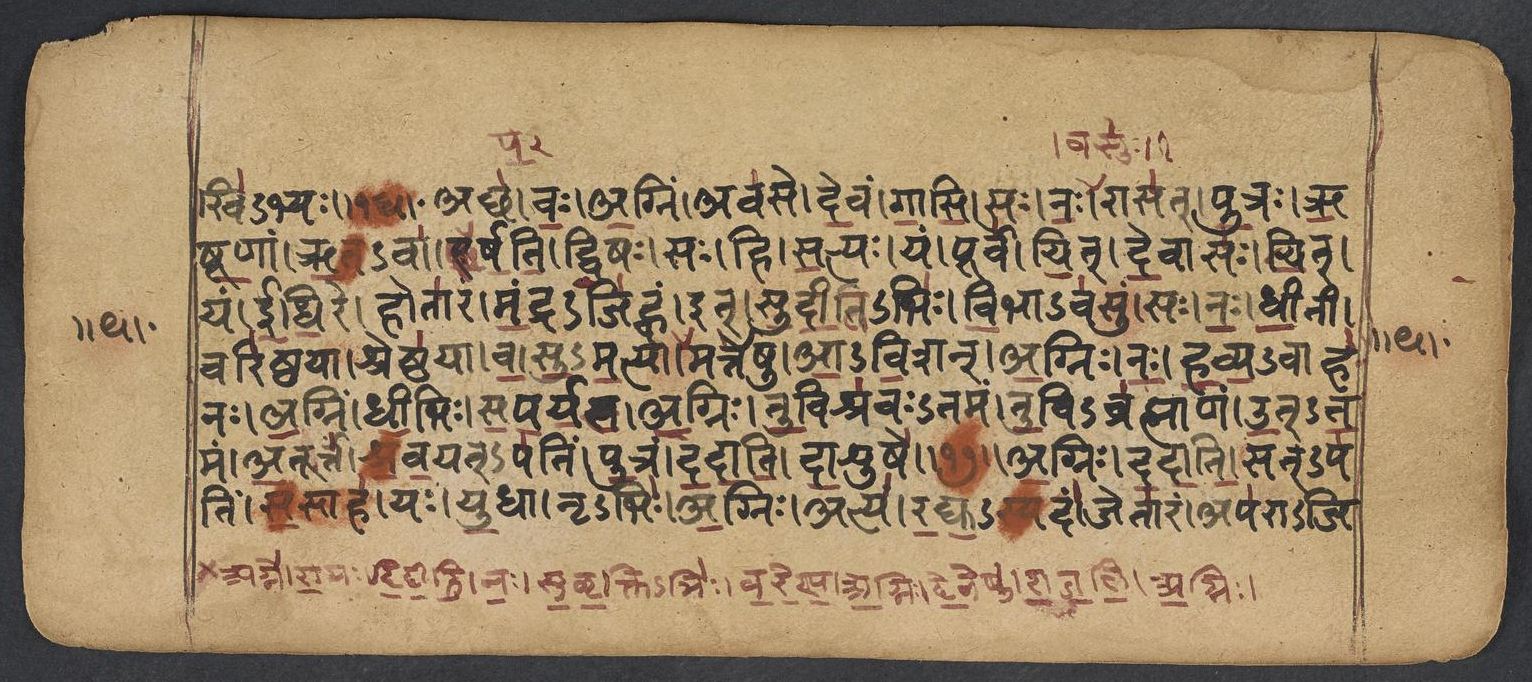
Where on the image
Penn Ms. Coll. 390 Item 41, fol. 336v (numbered 9v by the scribe) (OPenn image 337, upper leaf). Checked on the image: the Rigveda text on this page begins in RV 5.24.4 ‹-sakhi-bhyaḥ›. The next page with Rigveda text, fol. 337r (numbered 10r by the scribe), begins in RV 5.25.6 ‹-aparājitam›. Verses 5.25.1-5 end on this page.
1acchā̍ vo a̱gnim ava̍se de̱vaṁ gā̍si̱ sa no̱ vasu̍ḥ | rāsa̍t pu̱tra ṛ̍ṣū̱ṇām ṛ̱tāvā̍ parṣati dvi̱ṣaḥ ||
2sa hi sa̱tyo yam pūrve̍ cid de̱vāsa̍ś ci̱d yam ī̍dhi̱re | hotā̍ram ma̱ndraji̍hva̱m it su̍dī̱tibhi̍r vi̱bhāva̍sum ||
3sa no̍ dhī̱tī vari̍ṣṭhayā̱ śreṣṭha̍yā ca suma̱tyā | agne̍ rā̱yo di̍dīhi naḥ suvṛ̱ktibhi̍r vareṇya ||
4a̱gnir de̱veṣu̍ rājaty a̱gnir marte̍ṣv āvi̱śan | a̱gnir no̍ havya̱vāha̍no̱ 'gniṁ dhī̱bhiḥ sa̍paryata ||
5a̱gnis tu̱viśra̍vastamaṁ tu̱vibra̍hmāṇam utta̱mam | a̱tūrta̍ṁ śrāva̱yatpa̍tim pu̱traṁ da̍dāti dā̱śuṣe̍ ||
Compare: Padapāṭha (word-by-word text written in the manuscript; Sansknet e-text via GRETIL)
1accha | vaḥ | agnim | avase | devam | gāsi | saḥ | naḥ | vasuḥ | rāsat | putraḥ | ṛṣūṇām | ṛta-vā | parṣati | dviṣaḥ
2saḥ | hi | satyaḥ | yam | pūrve | cit | devāsaḥ | cit | yam | īdhire | hotāram | mandra-jihvam | it | sudīti-bhiḥ | vibhāvasum
3saḥ | naḥ | dhītī | variṣthayā | śreṣṭhayā | ca | su-matyā | agne | rāyaḥ | didīhi | naḥ | suvṛkti-bhiḥ | vareṇya
4agniḥ | deveṣu | rājati | agniḥ | marteṣu | āviśan | agniḥ | naḥ | havya-vāhanaḥ | agnim | dhībhiḥ | saparyata
5agniḥ | tuviśravaḥ-tamam | tuvi-brahmāṇam | ut-tamam | atūrtam | śravayat-patim | putran | dadāti | dāśuṣe
1I WILL sing near, for grace, your God Agni, for he is good to us. Son of the Brands, may he give gifts, and, righteous, save us from the foe.
2For be is true, whom men of old enkindled, and the Gods themselves, The Priest with the delicious tongue, rich with the light of glorious beams.
3With wisdom that surpasseth all, with gracious will most excellent, O Agni, worthy of our choice, shine wealth on us through hymns of praise.
4Agni is King, for he extends to mortals and to Gods alike. Agni is bearer of our gifts. Worship ye Agni with your thoughts.
5Agni gives to the worshipper a son, the best, of mightiest fame, Of deep devotion, ne'er subdued, bringer of glory to his sire.
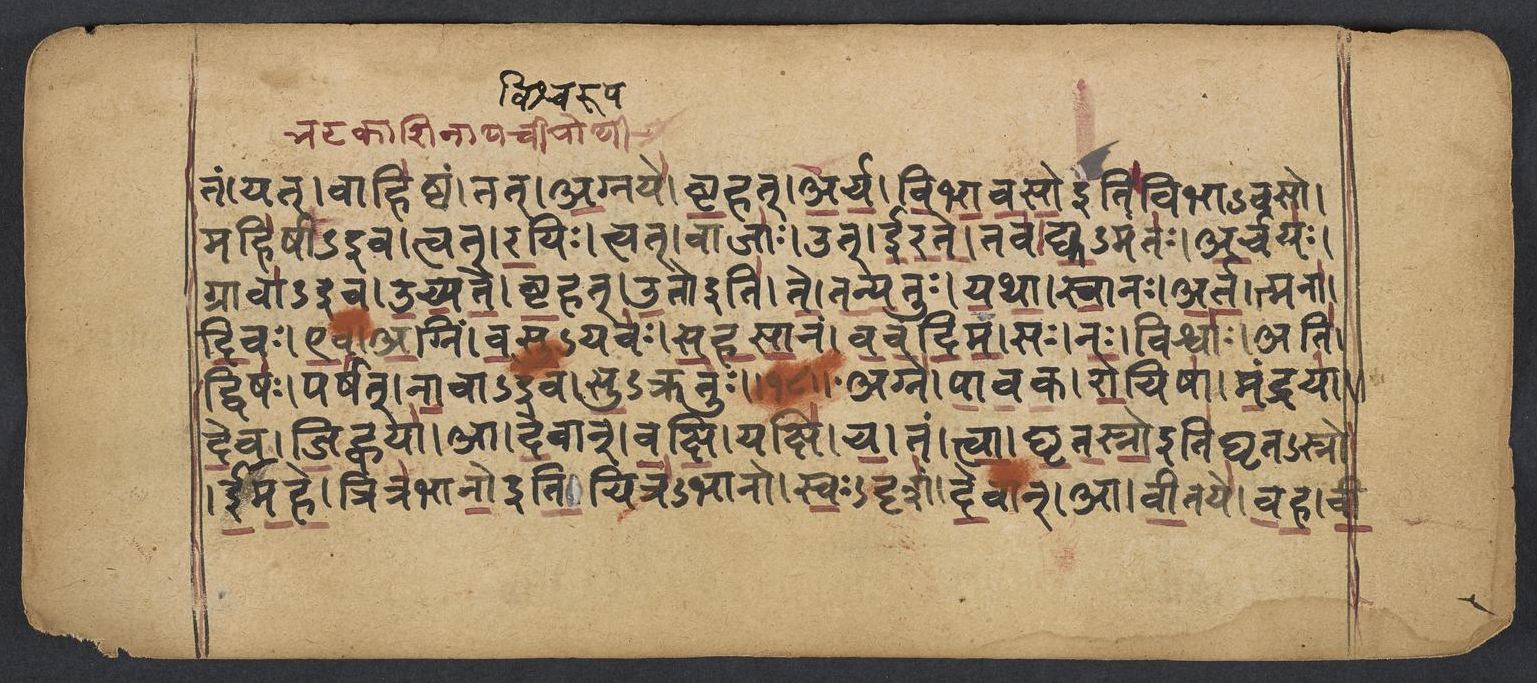
Where on the image
Penn Ms. Coll. 390 Item 41, fol. 337r (numbered 10r by the scribe) (OPenn image 337, lower leaf). Checked on the image: the Rigveda text on this page begins in RV 5.25.6 ‹-aparājitam›. The next page with Rigveda text, fol. 337v (numbered 10v by the scribe), begins in RV 5.26.3 ‹vīti-hotram tvā kave dyu-mantam›. Verses 5.25.6-9 end on this page; 5.25.6 begins on fol. 336v (numbered 9v by the scribe).
6a̱gnir da̍dāti̱ satpa̍tiṁ sā̱sāha̱ yo yu̱dhā nṛbhi̍ḥ | a̱gnir atya̍ṁ raghu̱ṣyada̱ṁ jetā̍ra̱m apa̍rājitam ||
7yad vāhi̍ṣṭha̱ṁ tad a̱gnaye̍ bṛ̱had a̍rca vibhāvaso | mahi̍ṣīva̱ tvad ra̱yis tvad vājā̱ ud ī̍rate ||
8tava̍ dyu̱manto̍ a̱rcayo̱ grāve̍vocyate bṛ̱hat | u̱to te̍ tanya̱tur ya̍thā svā̱no a̍rta̱ tmanā̍ di̱vaḥ ||
9e̱vām̐ a̱gniṁ va̍sū̱yava̍ḥ sahasā̱naṁ va̍vandima | sa no̱ viśvā̱ ati̱ dviṣa̱ḥ parṣa̍n nā̱veva̍ su̱kratu̍ḥ ||
Compare: Padapāṭha (word-by-word text written in the manuscript; Sansknet e-text via GRETIL)
6agniḥ | dadāti | sat-patim | sasāha | yaḥ | yudhā | nṛ-bhiḥ | agniḥ | atyam | raghu-syadam | jetāram | aparājitam
7yat | vāhiṣṭham | tat | agnaye | bṛhat | arca | vibhāvaso itivibhāvaso | mahiṣī-iva | tvat | rayiḥ | tvat | vājāḥ | ut | īrate
8tava | dyu-mantaḥ | arcayaḥ | grāvāiva | ucyate | bṛhat | uto iti | te | tanyatuḥ | yathā | svānaḥ | arta | tmanā | divaḥ
9eva | agnim | vasu-yavaḥ | sahasānam | vavandima | saḥ | naḥ | viśvā | at i | dviṣaḥ | parṣat | nāvāiva | su-kratuḥ
6Agni bestows the hero-lord who conquers with the men in fight. Agni bestows the fleet-foot steed, the victor never overcome.
7The mightiest song is Agni's: shine on high, thou who art rich in light. Like the Chief Consort of a King, riches and strength proceed -from thee.
8Resplendent are thy rays of light: loud is thy voice like pressing-stones. Yea, of itself thy thunder goes forth like the roaring of the heaven.
9Thus, seeking riches, have we paid homage to Agni Conqueror. May he, most wise, as with a ship, carry us over all our foes.
Notes
- Sanskrit: Aufrecht's edition (1877) with the Vedic accents, as entered by van Nooten and Holland (GRETIL).
- English: Ralph T. H. Griffith, The Hymns of the Rigveda (1889-1892; 2nd ed. 1896-1897), from the VedaWeb digital text; OCR slips in that text were corrected against the printed 2nd edition (data/sources/rigveda/griffith_errata.json).
- Padapāṭha (edition text): Sansknet e-text via GRETIL (CC BY-NC-SA 4.0).
Cite
Sources
- Source: Penn Ms. Coll. 390 Item 41 (undated (catalogued with Penn's 18th-19th c. Vedic manuscripts)), OPenn, Public Domain Mark + Aufrecht's accented text (GRETIL) + Griffith's English (VedaWeb) (holding institution)
- Critical edition: Aufrecht (1877), accented e-text via GRETIL
← previous · → next · v cycle view · l back to library