Rigveda 5.27: To Agni
Introduction
Rigveda 5.27 is a hymn of 6 verses addressed to Agni. It stands in book (maṇḍala) 5, the family book of the Atri clan. The Rigveda is the oldest collection of Sanskrit hymns, composed in the second half of the second millennium BCE and handed down orally for many centuries before it was written down.
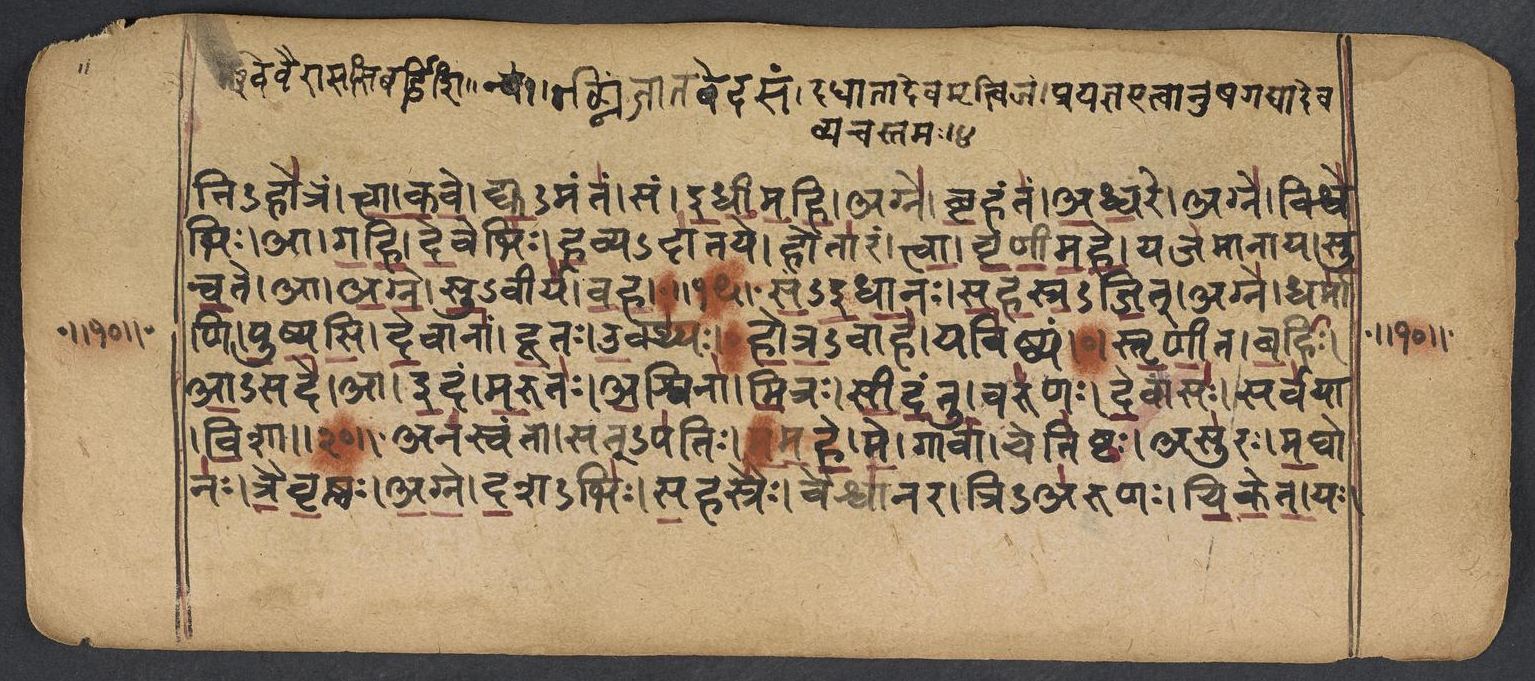
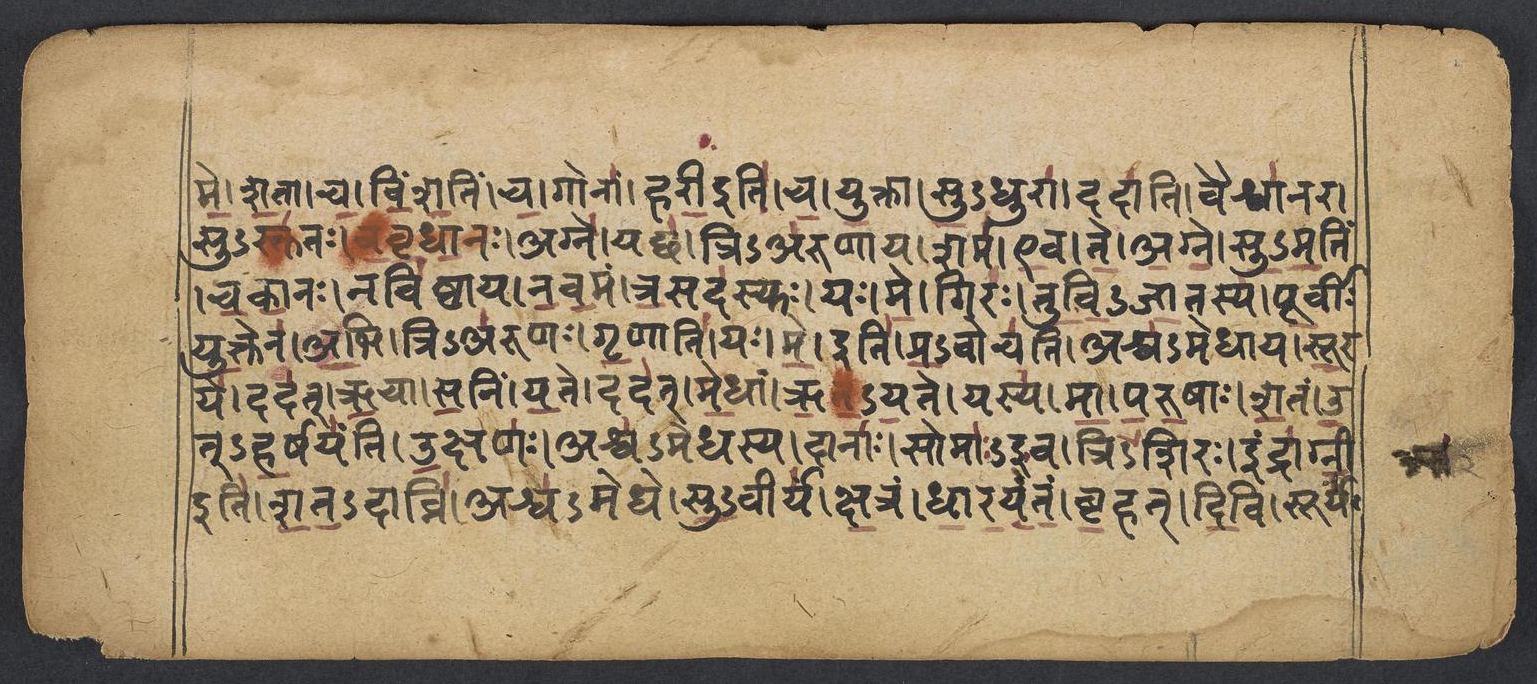
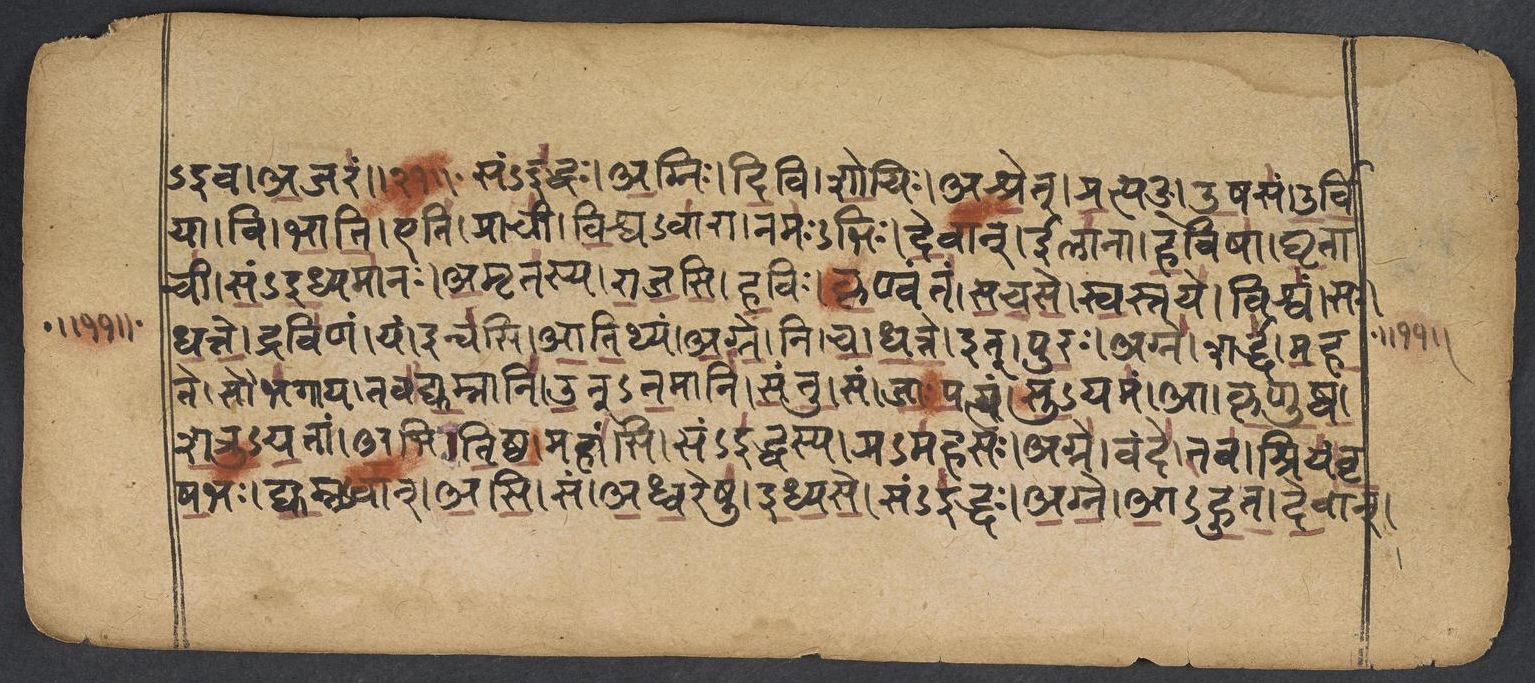
The manuscript shown is Penn Ms. Coll. 390 Item 41 (University of Pennsylvania), an undated paper manuscript of the padapāṭha (the word-by-word recitation text, in which every word is written separately and compounds are split) of the whole Ṛgveda in Devanāgarī, 884 leaves in fascicles, 7-9 lines to the page, accents in red; this hymn stands on fol. 337v-338v. Each section below gives the verses that end on one page; the page boundaries were read on the images (the opening words of every page), not counted out. Where the manuscript is a padapāṭha (the word-by-word recitation text), the section shows Aufrecht's continuous (saṃhitā) text first and, as the edition text, the padapāṭha of the same verses, which is the form written on the page.
How was this verified? (Provenance)
Where on the image
Penn Ms. Coll. 390 Item 41, fol. 337v (numbered 10v by the scribe) (OPenn image 338, upper leaf). Checked on the image: the Rigveda text on this page begins in RV 5.26.3 ‹vīti-hotram tvā kave dyu-mantam›. The next page with Rigveda text, fol. 338r (numbered 11r by the scribe), begins in RV 5.27.2 ‹me śatā ca viṃśatim›. Verse 5.27.1 ends on this page.
1ana̍svantā̱ satpa̍tir māmahe me̱ gāvā̱ ceti̍ṣṭho̱ asu̍ro ma̱ghona̍ḥ | trai̱vṛ̱ṣṇo a̍gne da̱śabhi̍ḥ sa̱hasrai̱r vaiśvā̍nara̱ trya̍ruṇaś ciketa ||
Compare: Padapāṭha (word-by-word text written in the manuscript; Sansknet e-text via GRETIL)
1anasvantā | sat-patiḥ | mamahe | me | gāvā | cetiṣṭhaḥ | asuraḥ | maghonaḥ | traivṛṣṇaḥ | agne | daśa-bhiḥ | sahasraiḥ | vaiśvānara | tri-aruṇaḥ | ciketa
1THE Godlike hero, famousest of nobles, hath granted me two oxen with a wagon. Trivr̥ishan's son Tryaruṇa hath distinguished himself, Vaiṣvânara Agni! with ten thousands.
Where on the image
Penn Ms. Coll. 390 Item 41, fol. 338r (numbered 11r by the scribe) (OPenn image 338, lower leaf). Checked on the image: the Rigveda text on this page begins in RV 5.27.2 ‹me śatā ca viṃśatim›. The next page with Rigveda text, fol. 338v (numbered 11v by the scribe), begins in RV 5.27.6 ‹-sūryam-iva ajaram›. Verses 5.27.2-5 end on this page; 5.27.2 begins on fol. 337v (numbered 10v by the scribe).
2yo me̍ śa̱tā ca̍ viṁśa̱tiṁ ca̱ gonā̱ṁ harī̍ ca yu̱ktā su̱dhurā̱ dadā̍ti | vaiśvā̍nara̱ suṣṭu̍to vāvṛdhā̱no 'gne̱ yaccha̱ trya̍ruṇāya̱ śarma̍ ||
3e̱vā te̍ agne suma̱tiṁ ca̍kā̱no navi̍ṣṭhāya nava̱maṁ tra̱sada̍syuḥ | yo me̱ gira̍s tuvijā̱tasya̍ pū̱rvīr yu̱ktenā̱bhi trya̍ruṇo gṛ̱ṇāti̍ ||
4yo ma̱ iti̍ pra̱voca̱ty aśva̍medhāya sū̱raye̍ | dada̍d ṛ̱cā sa̱niṁ ya̱te dada̍n me̱dhām ṛ̍tāya̱te ||
5yasya̍ mā paru̱ṣāḥ śa̱tam u̍ddha̱rṣaya̍nty u̱kṣaṇa̍ḥ | aśva̍medhasya̱ dānā̱ḥ somā̍ iva̱ tryā̍śiraḥ ||
Compare: Padapāṭha (word-by-word text written in the manuscript; Sansknet e-text via GRETIL)
2yaḥ | me | śatā | ca | viṃśatim | ca | gonām | harī iti | ca | yuktā | su-dhurā | dadāti | vaiśvānara | su-stutaḥ | vavṛdhānaḥ | agne | yaccha | tri-aruṇāya | śarma
3eva | te | agne | su-matim | cakānaḥ | naviṣṭhāya | navamam | trasadasyuḥ | yaḥ | me | giraḥ | tuvijātasya | pūrvīḥ | yuktena | abhi | tri-aruṇaḥ | gṛṇāti
4yaḥ | me | iti | pra-vocati | aśva-medhāya | sūraye | dadat | ṛcā | sanim | yate | dadat | medhām | ṛta-yate
5yasya | mā | paruṣāḥ | śatam | ut-harṣayanti | ukṣaṇaḥ | aśva-medhasya | dānāḥ | somāḥ-iva | tri-āśiraḥ
2Protect Tryaruṇa, as thou art waxing strong and art highly praised, Vaiṣvânara Agni! Who granteth me a hundred kine and twenty, and two bay horses, good at draught, and harnessed.
3So Trasadasyu served thee, God Most Youthful, craving thy favour for the ninth time, Agni; Tryaruṇa who with attentive spirit accepteth many a song from me the mighty.
4He who declares his wish to me, to Aṣvamedha, to the Prince, Pays him who with his verse seeks gain, gives power to him who keeps the Law.
5From whom a hundred oxen, all of speckled hue, delight my heart, The gifts of Aṣvamedha, like thrice-mingled draughts of Soma juice.
Where on the image
Penn Ms. Coll. 390 Item 41, fol. 338v (numbered 11v by the scribe) (OPenn image 339, upper leaf). Checked on the image: the Rigveda text on this page begins in RV 5.27.6 ‹-sūryam-iva ajaram›. The next page with Rigveda text, fol. 339r (numbered 12r by the scribe), begins in RV 5.28.5 ‹yakṣi su-adhvara tvam hi›. Verse 5.27.6 ends on this page; 5.27.6 begins on fol. 338r (numbered 11r by the scribe).
6indrā̍gnī śata̱dāvny aśva̍medhe su̱vīrya̍m | kṣa̱traṁ dhā̍rayatam bṛ̱had di̱vi sūrya̍m ivā̱jara̍m ||
Compare: Padapāṭha (word-by-word text written in the manuscript; Sansknet e-text via GRETIL)
6indrāgnī iti | śata-dāvni | aśva-medhe | su-vīryam | kṣatram | dhārayatam | bṛhat | divi | sūryam-iva | ajaram
6To Aṣvamedha who bestows a hundred gifts grant hero power, O Indra-Agni! lofty rule like the unwasting Sun in heaven.
Notes
- Sanskrit: Aufrecht's edition (1877) with the Vedic accents, as entered by van Nooten and Holland (GRETIL).
- English: Ralph T. H. Griffith, The Hymns of the Rigveda (1889-1892; 2nd ed. 1896-1897), from the VedaWeb digital text; OCR slips in that text were corrected against the printed 2nd edition (data/sources/rigveda/griffith_errata.json).
- Padapāṭha (edition text): Sansknet e-text via GRETIL (CC BY-NC-SA 4.0).
Cite
Sources
- Source: Penn Ms. Coll. 390 Item 41 (undated (catalogued with Penn's 18th-19th c. Vedic manuscripts)), OPenn, Public Domain Mark + Aufrecht's accented text (GRETIL) + Griffith's English (VedaWeb) (holding institution)
- Critical edition: Aufrecht (1877), accented e-text via GRETIL
← previous · → next · v cycle view · l back to library