Rigveda 5.28: To Agni
Introduction
Rigveda 5.28 is a hymn of 6 verses addressed to Agni. It stands in book (maṇḍala) 5, the family book of the Atri clan. The Rigveda is the oldest collection of Sanskrit hymns, composed in the second half of the second millennium BCE and handed down orally for many centuries before it was written down.
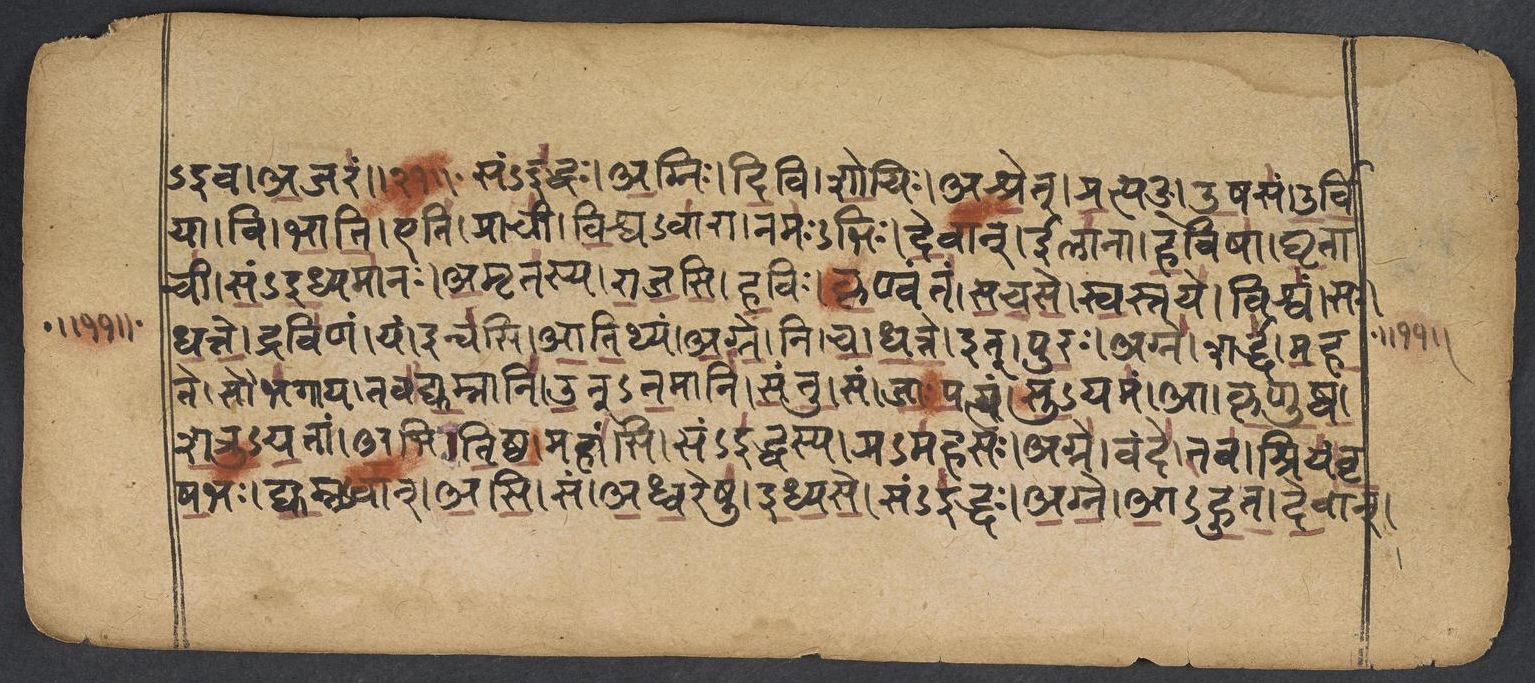
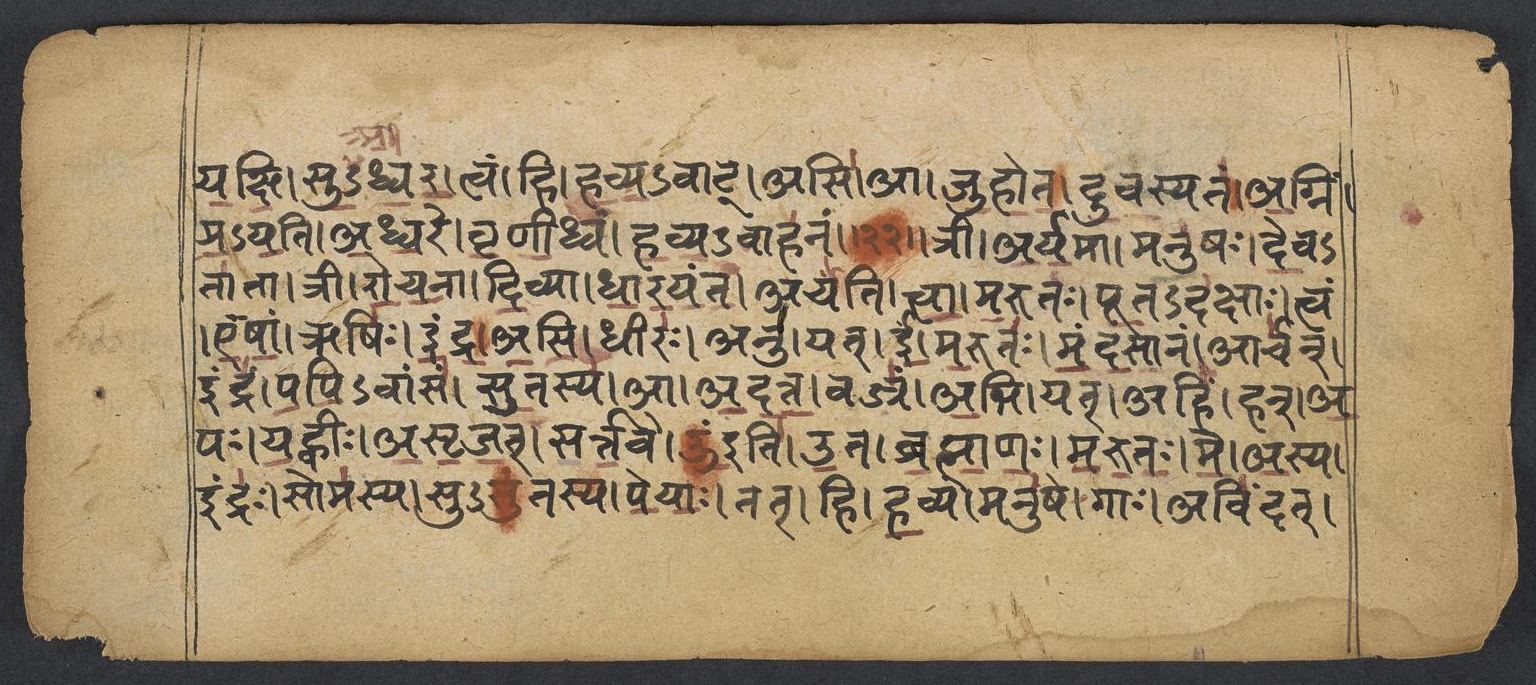
The manuscript shown is Penn Ms. Coll. 390 Item 41 (University of Pennsylvania), an undated paper manuscript of the padapāṭha (the word-by-word recitation text, in which every word is written separately and compounds are split) of the whole Ṛgveda in Devanāgarī, 884 leaves in fascicles, 7-9 lines to the page, accents in red; this hymn stands on fol. 338v-339r. Each section below gives the verses that end on one page; the page boundaries were read on the images (the opening words of every page), not counted out. Where the manuscript is a padapāṭha (the word-by-word recitation text), the section shows Aufrecht's continuous (saṃhitā) text first and, as the edition text, the padapāṭha of the same verses, which is the form written on the page.
How was this verified? (Provenance)
Where on the image
Penn Ms. Coll. 390 Item 41, fol. 338v (numbered 11v by the scribe) (OPenn image 339, upper leaf). Checked on the image: the Rigveda text on this page begins in RV 5.27.6 ‹-sūryam-iva ajaram›. The next page with Rigveda text, fol. 339r (numbered 12r by the scribe), begins in RV 5.28.5 ‹yakṣi su-adhvara tvam hi›. Verses 5.28.1-4 end on this page.
1sami̍ddho a̱gnir di̱vi śo̱cir a̍śret pra̱tyaṅṅ u̱ṣasa̍m urvi̱yā vi bhā̍ti | eti̱ prācī̍ vi̱śvavā̍rā̱ namo̍bhir de̱vām̐ īḻā̍nā ha̱viṣā̍ ghṛ̱tācī̍ ||
2sa̱mi̱dhyamā̍no a̱mṛta̍sya rājasi ha̱viṣ kṛ̱ṇvanta̍ṁ sacase sva̱staye̍ | viśva̱ṁ sa dha̍tte̱ dravi̍ṇa̱ṁ yam inva̍sy āti̱thyam a̍gne̱ ni ca̍ dhatta̱ it pu̱raḥ ||
3agne̱ śardha̍ maha̱te saubha̍gāya̱ tava̍ dyu̱mnāny u̍tta̱māni̍ santu | saṁ jā̍spa̱tyaṁ su̱yama̱m ā kṛ̍ṇuṣva śatrūya̱tām a̱bhi ti̍ṣṭhā̱ mahā̍ṁsi ||
4sami̍ddhasya̱ prama̍ha̱so 'gne̱ vande̱ tava̱ śriya̍m | vṛ̱ṣa̱bho dyu̱mnavā̍m̐ asi̱ sam a̍dhva̱reṣv i̍dhyase ||
Compare: Padapāṭha (word-by-word text written in the manuscript; Sansknet e-text via GRETIL)
1sam-iddhaḥ | agniḥ | divi | śociḥ | aśret | pratyaṅ | uṣasam | urviyā | vi | bhāti | eti | prācī | viśva-vārā | namaḥ-bhiḥ | devān | īḷānā | haviṣā | ghṛtācī
2sam-idhyamānaḥ | amṛtasya | rājasi | haviḥ | kṛṇvantam | sacase | svastaye | viśvam | saḥ | dhatte | draviṇam | yam | invasi | ātithyam | agne | ni | ca | dhatte | it | puraḥ
3agne | śardha | mahate | saubhagāya | tava | dyumnāni | ut-tamāni | santu | sam | jaḥ-patyam | su-yamam | ā | kṛṇuṣva | śatru-yatām | abhi | tiṣṭha | mahāṃsi
4sam-iddhasya | pra-mahasaḥ | agne | vande | tava | śriyam | vṛṣabhaḥ | dyumna-vān | asi | sam | adhvareṣu | idhyase
1AGNI inflamed hath sent to heaven his lustre: he shines forth widely turning unto Morning. Eastward the ladle goes that brings all blessing, praising the Godswith homage and oblation.
2Enkindled, thou art King of the immortal world: him who brings offerings thou attendest for his weal. He whom thou urgest on makes all possessions his: he sets before thee, Agni, gifts that guests may claim.
3Show thyself strong for mighty bliss, O Agni, most excellent be thine effulgent splendours. Make easy to maintain our household lordship, and overcome the might of those who hate us.
4Thy glory, Agni, I adore, kindled, exalted in thy strength. A Steer of brilliant splendour, thou art lighted well at sacred rites.
Where on the image
Penn Ms. Coll. 390 Item 41, fol. 339r (numbered 12r by the scribe) (OPenn image 339, lower leaf). Checked on the image: the Rigveda text on this page begins in RV 5.28.5 ‹yakṣi su-adhvara tvam hi›. The next page with Rigveda text, fol. 339v (numbered 12v by the scribe), begins in RV 5.29.3 ‹ahan ahim papi-vān indraḥ›. Verses 5.28.5-6 end on this page; 5.28.5 begins on fol. 338v (numbered 11v by the scribe).
5sami̍ddho agna āhuta de̱vān ya̍kṣi svadhvara | tvaṁ hi ha̍vya̱vāḻ asi̍ ||
6ā ju̍hotā duva̱syatā̱gnim pra̍ya̱ty a̍dhva̱re | vṛ̱ṇī̱dhvaṁ ha̍vya̱vāha̍nam ||
Compare: Padapāṭha (word-by-word text written in the manuscript; Sansknet e-text via GRETIL)
5sam-iddhaḥ | agne | āhuta | devān | yakṣi | su-adhvara | tvam | hi | havya-vāṭ | asi
6ā | juhota | duvasyata | agnim | pra-yati | adhvare | vṛṇīdhvam | havya-vāhanam
5Agni, invoked and kindled, serve the Gods, thou skilled in sacrifice: For thou art bearer of our gifts.
6Invoke and worship Agni while the sacrificial rite proceeds: For offering-bearer choose ye him.
Notes
- Sanskrit: Aufrecht's edition (1877) with the Vedic accents, as entered by van Nooten and Holland (GRETIL).
- English: Ralph T. H. Griffith, The Hymns of the Rigveda (1889-1892; 2nd ed. 1896-1897), from the VedaWeb digital text; OCR slips in that text were corrected against the printed 2nd edition (data/sources/rigveda/griffith_errata.json).
- Padapāṭha (edition text): Sansknet e-text via GRETIL (CC BY-NC-SA 4.0).
Cite
Sources
- Source: Penn Ms. Coll. 390 Item 41 (undated (catalogued with Penn's 18th-19th c. Vedic manuscripts)), OPenn, Public Domain Mark + Aufrecht's accented text (GRETIL) + Griffith's English (VedaWeb) (holding institution)
- Critical edition: Aufrecht (1877), accented e-text via GRETIL
← previous · → next · v cycle view · l back to library