Rigveda 5.48: To all the gods
Introduction
Rigveda 5.48 is a hymn of 5 verses addressed to all the gods. It stands in book (maṇḍala) 5, the family book of the Atri clan. The Rigveda is the oldest collection of Sanskrit hymns, composed in the second half of the second millennium BCE and handed down orally for many centuries before it was written down.
The manuscript shown is Penn Ms. Coll. 390 Item 41 (University of Pennsylvania), an undated paper manuscript of the padapāṭha (the word-by-word recitation text, in which every word is written separately and compounds are split) of the whole Ṛgveda in Devanāgarī, 884 leaves in fascicles, 7-9 lines to the page, accents in red; this hymn stands on fol. 366r-366v. Each section below gives the verses that end on one page; the page boundaries were read on the images (the opening words of every page), not counted out. Where the manuscript is a padapāṭha (the word-by-word recitation text), the section shows Aufrecht's continuous (saṃhitā) text first and, as the edition text, the padapāṭha of the same verses, which is the form written on the page.
How was this verified? (Provenance)
Where on the image
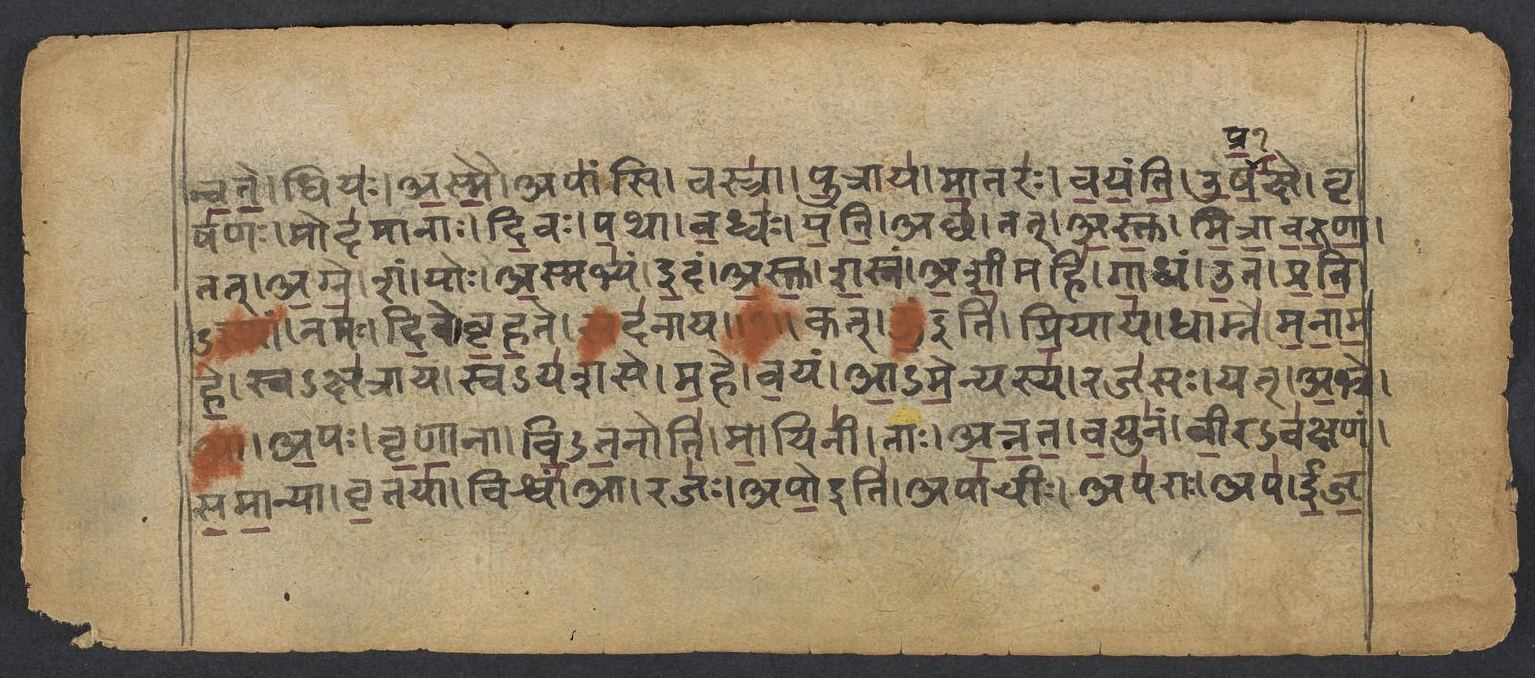
Penn Ms. Coll. 390 Item 41, fol. 366r (numbered 39r by the scribe) (OPenn image 366, lower leaf). Checked on the image: the Rigveda text on this page begins in RV 5.47.6 ‹-tanvate dhiyaḥ asmai apāṃsi›. The next page with Rigveda text, fol. 366v (numbered 39v by the scribe), begins in RV 5.48.2 ‹-ījate pra pūrvābhiḥ tirate›. Verse 5.48.1 ends on this page.
1kad u̍ pri̱yāya̱ dhāmne̍ manāmahe̱ svakṣa̍trāya̱ svaya̍śase ma̱he va̱yam | ā̱me̱nyasya̱ raja̍so̱ yad a̱bhra ām̐ a̱po vṛ̍ṇā̱nā vi̍ta̱noti̍ mā̱yinī̍ ||
Compare: Padapāṭha (word-by-word text written in the manuscript; Sansknet e-text via GRETIL)
1kat | oṃ iti | priyāya | dhāmne | manāmahe | sva-kṣatrāya | sva-yaśase | mahe | vayam | āmenyasya | rajasaḥ | yat | abhre | ā | apaḥ | vṛṇānā | vi-tanoti | māyinī
1WHAT may we meditate for the beloved Power, mighty in native strength and glorious in itself, Which as a magic energy seeking waters spreads even to theimmeasurable middle region's cloud?
Where on the image
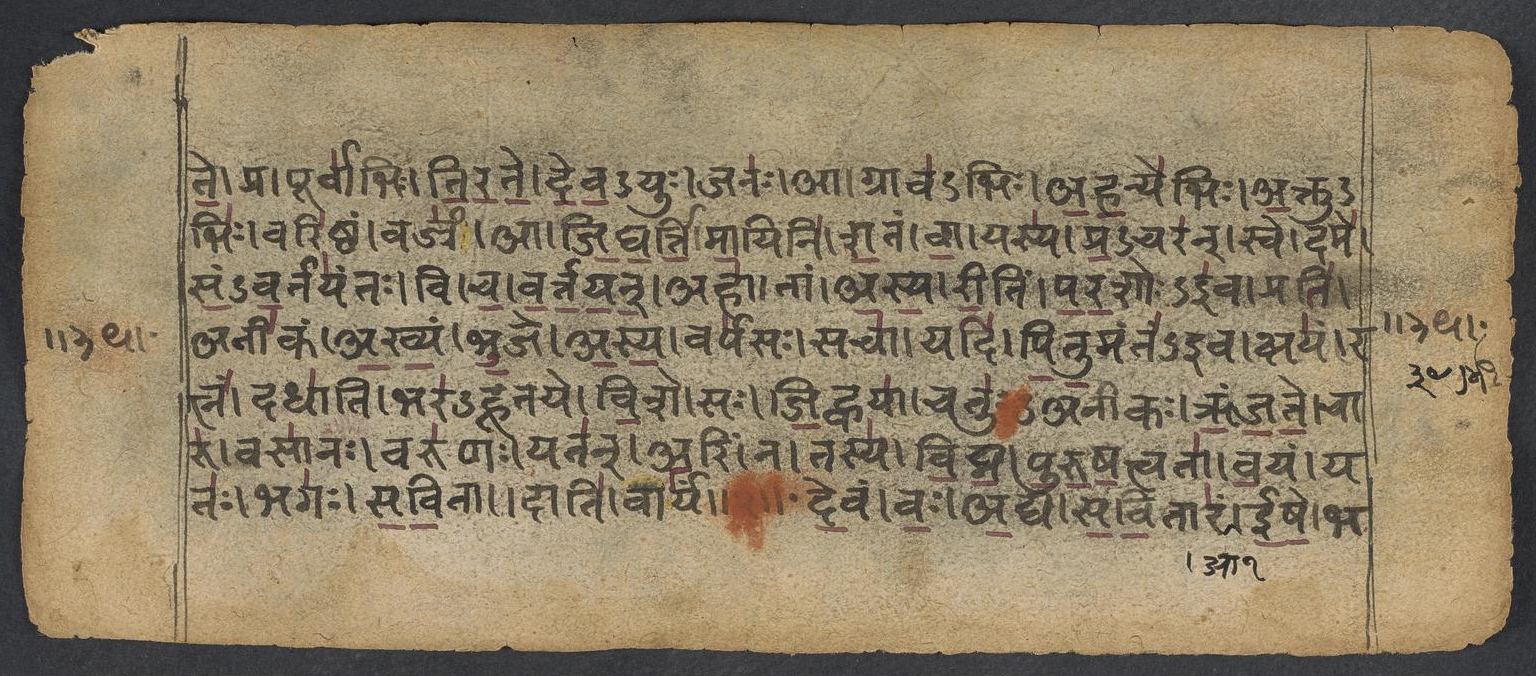
Penn Ms. Coll. 390 Item 41, fol. 366v (numbered 39v by the scribe) (OPenn image 367, upper leaf). Checked on the image: the Rigveda text on this page begins in RV 5.48.2 ‹-ījate pra pūrvābhiḥ tirate›. The next page with Rigveda text, fol. 367r (numbered 40r by the scribe), begins in RV 5.49.1 ‹-bhagam ca ratnam vi-bhajantam›. Verses 5.48.2-5 end on this page; 5.48.2 begins on fol. 366r (numbered 39r by the scribe).
2tā a̍tnata va̱yuna̍ṁ vī̱rava̍kṣaṇaṁ samā̱nyā vṛ̱tayā̱ viśva̱m ā raja̍ḥ | apo̱ apā̍cī̱r apa̍rā̱ ape̍jate̱ pra pūrvā̍bhis tirate deva̱yur jana̍ḥ ||
3ā grāva̍bhir aha̱nye̍bhir a̱ktubhi̱r vari̍ṣṭha̱ṁ vajra̱m ā ji̍gharti mā̱yini̍ | śa̱taṁ vā̱ yasya̍ pra̱cara̱n sve dame̍ saṁva̱rtaya̍nto̱ vi ca̍ vartaya̱nn ahā̍ ||
4tām a̍sya rī̱tim pa̍ra̱śor i̍va̱ praty anī̍kam akhyam bhu̱je a̍sya̱ varpa̍saḥ | sacā̱ yadi̍ pitu̱manta̍m iva̱ kṣaya̱ṁ ratna̱ṁ dadhā̍ti̱ bhara̍hūtaye vi̱śe ||
5sa ji̱hvayā̱ catu̍ranīka ṛñjate̱ cāru̱ vasā̍no̱ varu̍ṇo̱ yata̍nn a̱rim | na tasya̍ vidma puruṣa̱tvatā̍ va̱yaṁ yato̱ bhaga̍ḥ savi̱tā dāti̱ vārya̍m ||
Compare: Padapāṭha (word-by-word text written in the manuscript; Sansknet e-text via GRETIL)
2tāḥ | atnata | vayunam | vīra-vakṣaṇam | samānyā | vṛtayā | viśvam | ā | rajaḥ | apo iti | apācīḥ | aparāḥ | apa | ījate | pra | pūrvābhiḥ | tirate | deva-yuḥ | janaḥ
3ā | grāva-bhiḥ | ahanyebhiḥ | aktu-bhiḥ | variṣṭham | vajram | ā | jigharti | māyini | śatam | vā | yasya | pra-caran | sve | dame | sam-vartayantaḥ | vi | ca | vataryan | ahā
4tām | asya | rītim | paraśoḥ-iva | prati | anīkam | akhyam | bhuje | asya | varpasaḥ | sacā | yadi | pitumantam-iva | kṣayam | ratnam | dadhāti | bhara-hūtaye | vi śe
5saḥ | jihvayā | catuḥ-anīkaḥ | ṛñjate | cāru | vasānaḥ | varuṇaḥ | yatan | arim | na | tasya | vidma | puruṣa-tvatā | vayam | yataḥ | bhagaḥ | savitā | dāti | vāryam
2O'er all the region with their uniform advance these have spread out the lore that giveth heroes strength. Back, with their course reversed, the others pass away: the pious lengthens life with those that are before.
3With pressing-stones and with the bright beams of the day he hurls his broadest bolt against the Guileful One. Even he whose hundred wander in his own abode, driving the days afar and bringing them again.
4I, to enjoy the beauty of his form, behold that rapid rush of his as 'twere an axe's edge, What time he gives the man who calls on him in fight wealth like a dwelling-house filled full with store of food.
5Four-faced and nobly clad, Varuṇa, urging on the pious to his task, stirs himself with the tongue. Naught by our human nature do we know of him, him from whom Bhaga Savitar bestows the boon.
Notes
- Sanskrit: Aufrecht's edition (1877) with the Vedic accents, as entered by van Nooten and Holland (GRETIL).
- English: Ralph T. H. Griffith, The Hymns of the Rigveda (1889-1892; 2nd ed. 1896-1897), from the VedaWeb digital text; OCR slips in that text were corrected against the printed 2nd edition (data/sources/rigveda/griffith_errata.json).
- Padapāṭha (edition text): Sansknet e-text via GRETIL (CC BY-NC-SA 4.0).
Cite
Sources
- Source: Penn Ms. Coll. 390 Item 41 (undated (catalogued with Penn's 18th-19th c. Vedic manuscripts)), OPenn, Public Domain Mark + Aufrecht's accented text (GRETIL) + Griffith's English (VedaWeb) (holding institution)
- Critical edition: Aufrecht (1877), accented e-text via GRETIL
← previous · → next · v cycle view · l back to library