Rigveda 5.7: To Agni
Introduction
Rigveda 5.7 is a hymn of 10 verses addressed to Agni. It stands in book (maṇḍala) 5, the family book of the Atri clan. The Rigveda is the oldest collection of Sanskrit hymns, composed in the second half of the second millennium BCE and handed down orally for many centuries before it was written down.
The manuscript shown is Penn Ms. Coll. 390 Item 41 (University of Pennsylvania), an undated paper manuscript of the padapāṭha (the word-by-word recitation text, in which every word is written separately and compounds are split) of the whole Ṛgveda in Devanāgarī, 884 leaves in fascicles, 7-9 lines to the page, accents in red; this hymn stands on fol. 325v-326v. Each section below gives the verses that end on one page; the page boundaries were read on the images (the opening words of every page), not counted out. Where the manuscript is a padapāṭha (the word-by-word recitation text), the section shows Aufrecht's continuous (saṃhitā) text first and, as the edition text, the padapāṭha of the same verses, which is the form written on the page.
How was this verified? (Provenance)
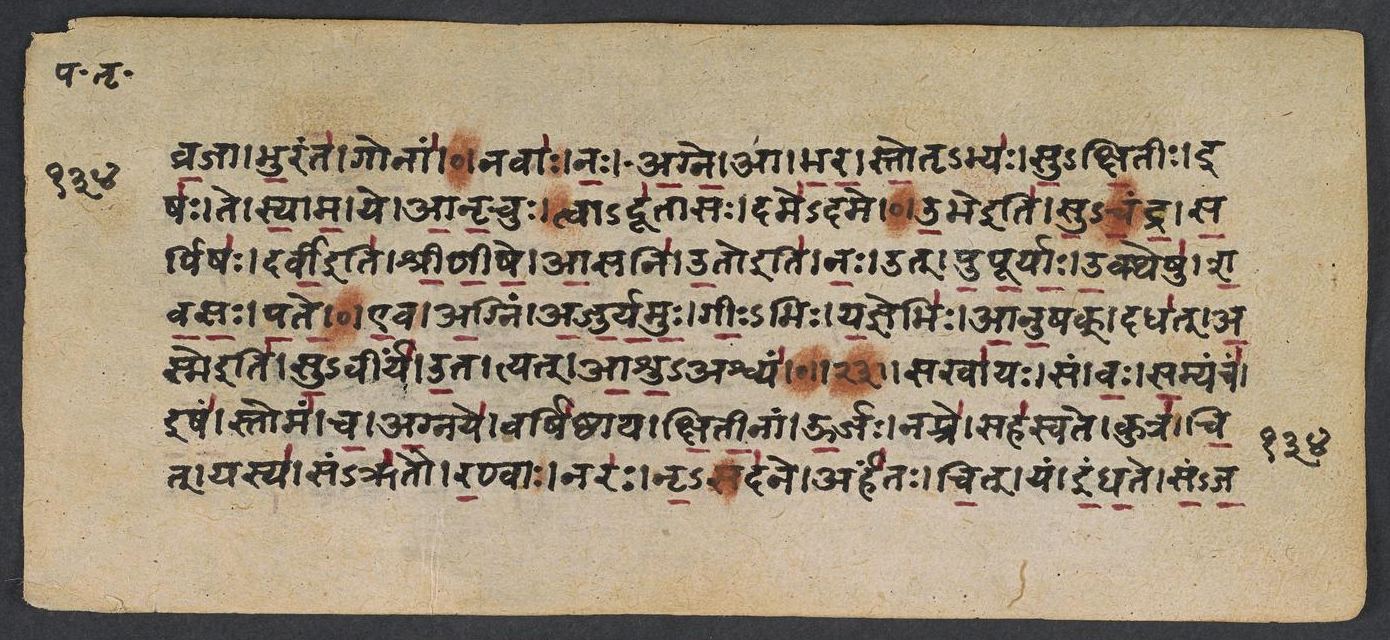
Where on the image
Penn Ms. Coll. 390 Item 41, fol. 325v (numbered 134v by the scribe) (OPenn image 326, upper leaf). Checked on the image: the Rigveda text on this page begins in RV 5.6.7 ‹vrajā bhuranta gonām iṣam›. The next page with Rigveda text, fol. 326r (numbered 135r by the scribe), begins in RV 5.7.2 ‹-sam-janayanti jantavaḥ›. Verse 5.7.1 ends on this page.
1sakhā̍ya̱ḥ saṁ va̍ḥ sa̱myañca̱m iṣa̱ṁ stoma̍ṁ cā̱gnaye̍ | varṣi̍ṣṭhāya kṣitī̱nām ū̱rjo naptre̱ saha̍svate ||
Compare: Padapāṭha (word-by-word text written in the manuscript; Sansknet e-text via GRETIL)
1sakhāyaḥ | sam | vaḥ | samyañcam | iṣam | stomam | ca | agnaye | varṣiṣṭhāya | kṣi tīnām | ūrjaḥ | naptre | sahasvate
1OFFER to Agni, O my friends, your seemly food, your seemly praise; To him supremest o'er the folk, the Son of Strength, the mighty Lord:
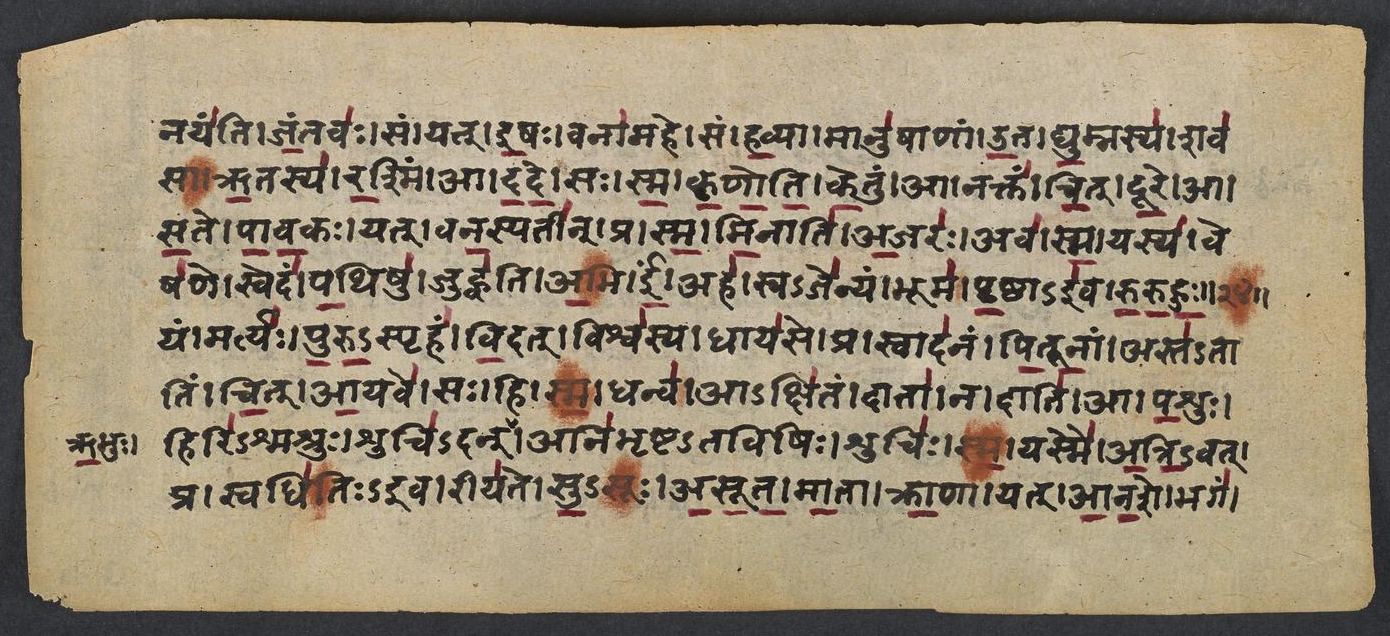
Where on the image
Penn Ms. Coll. 390 Item 41, fol. 326r (numbered 135r by the scribe) (OPenn image 326, lower leaf). Checked on the image: the Rigveda text on this page begins in RV 5.7.2 ‹-sam-janayanti jantavaḥ›. The next page with Rigveda text, fol. 326v (numbered 135v by the scribe), begins in RV 5.7.9 ‹ā yaḥ te sarpiḥ-āsute›. Verses 5.7.2-8 end on this page; 5.7.2 begins on fol. 325v (numbered 134v by the scribe).
2kutrā̍ ci̱d yasya̱ samṛ̍tau ra̱ṇvā naro̍ nṛ̱ṣada̍ne | arha̍ntaś ci̱d yam i̍ndha̱te sa̍ṁja̱naya̍nti ja̱ntava̍ḥ ||
3saṁ yad i̱ṣo vanā̍mahe̱ saṁ ha̱vyā mānu̍ṣāṇām | u̱ta dyu̱mnasya̱ śava̍sa ṛ̱tasya̍ ra̱śmim ā da̍de ||
4sa smā̍ kṛṇoti ke̱tum ā nakta̍ṁ cid dū̱ra ā sa̱te | pā̱va̱ko yad vana̱spatī̱n pra smā̍ mi̱nāty a̱jara̍ḥ ||
5ava̍ sma̱ yasya̱ veṣa̍ṇe̱ sveda̍m pa̱thiṣu̱ juhva̍ti | a̱bhīm aha̱ svaje̍nya̱m bhūmā̍ pṛ̱ṣṭheva̍ ruruhuḥ ||
6yam martya̍ḥ puru̱spṛha̍ṁ vi̱dad viśva̍sya̱ dhāya̍se | pra svāda̍nam pitū̱nām asta̍tātiṁ cid ā̱yave̍ ||
7sa hi ṣmā̱ dhanvākṣi̍ta̱ṁ dātā̱ na dāty ā pa̱śuḥ | hiri̍śmaśru̱ḥ śuci̍dann ṛ̱bhur ani̍bhṛṣṭataviṣiḥ ||
8śuci̍ḥ ṣma̱ yasmā̍ atri̱vat pra svadhi̍tīva̱ rīya̍te | su̱ṣūr a̍sūta mā̱tā krā̱ṇā yad ā̍na̱śe bhaga̍m ||
Compare: Padapāṭha (word-by-word text written in the manuscript; Sansknet e-text via GRETIL)
2kutra | cit | yasya | sam-ṛtau | raṇvāḥ | naraḥ | nṛ-sadane | arhantaḥ | cit | yam | indhate | sam-janayanti | jantavaḥ
3sam | yat | iṣaḥ | vanāmahe | sam | havyā | mānuṣāṇām | uta | dyumnasya | śavasā | ṛtasya | raśmim | ā | dade
4saḥ | sma | kṛṇoti | ketum | ā | naktam | cit | dūre | ā | sate | pāvakaḥ | yat | vanaspatīn | pra | sma | mināti | ajaraḥ
5ava | sma | yasya | veṣaṇe | svedam | pathiṣu | juhvati | abhi | īm | aha | sva-jenyam | bhūma | pṛṣṭāiva | ruruhuḥ
6yam | martyaḥ | puru-spṛham | vidat | viśvasya | dhāyase | pra | svādanam | pitūnām | asta-tātim | cit | āyave
7saḥ | hi | ṣma | dhanva | ākṣitam | dātā | na | dāti | ā | paśuḥ | hiri-śmaśruḥ | śuci--dan | ṛbhuḥ | anibhṛṣṭa-taviṣiḥ
8śuciḥ | sma | yasmai | atri-vat | pra | svadhitiḥ-iva | rīyate | su-sūḥ | asūta | mātā | krāṇā | yat | ānaśe | bhagam
2Him in whose presence, when they meet in full assembly, men rejoice; Even him whom worthy ones inflame, and living creatures bring to life.
3When we present to him the food and sacrificial gifts of men, He by the might of splendour grasps the holy Ordinance's rein.
4He gives a signal in the night even to him who is afar, When he, the Bright, unchanged by eld, consumes the sovrans of the wood.
5He in whose service on the ways they offer up their drops of sweat, On him is their high kin have they mounted, as ridges on the earth.
6Whom, sought of many, mortal man hath found to be the Stay of all; He who gives flavour to our food, the home of every man that lives.
7Even as a herd that crops the grass he shears the field and wilderness, With flashing teeth and beard of gold, deft with his unabated might.
8For him, to whom, bright as an axe he, as to Atri, hath flashed forth, Hath the well-bearing Mother borne, producing when her time is come.
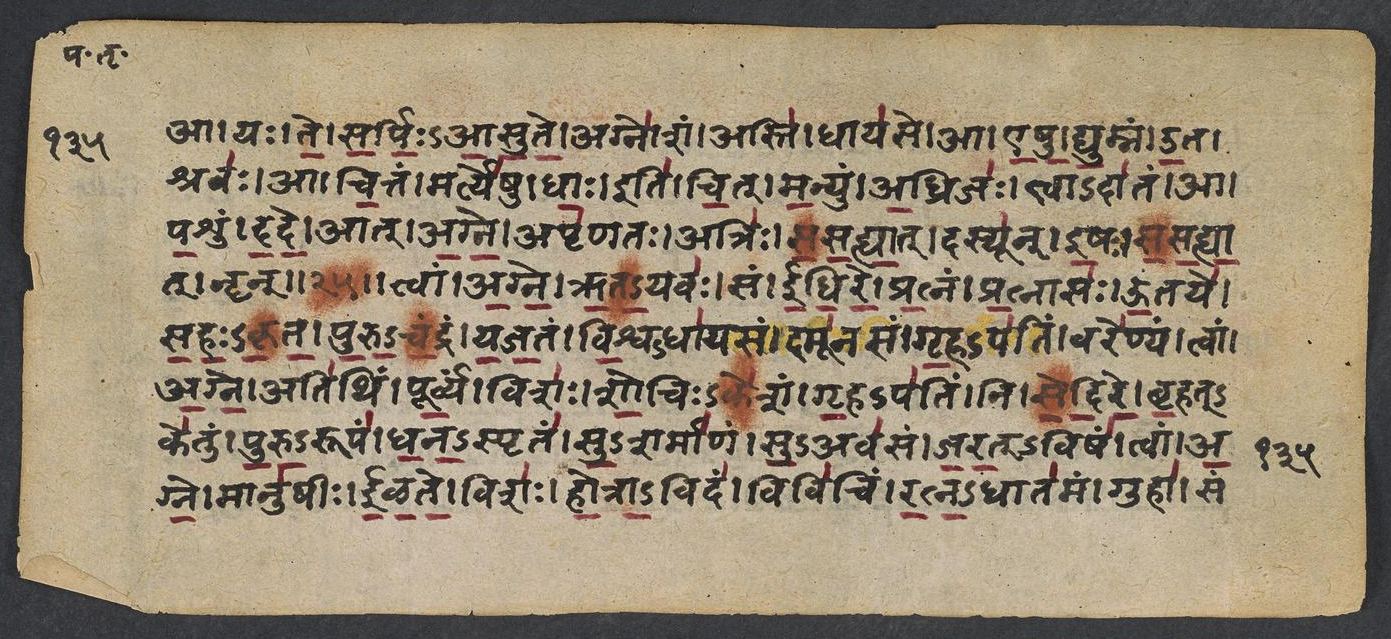
Where on the image
Penn Ms. Coll. 390 Item 41, fol. 326v (numbered 135v by the scribe) (OPenn image 327, upper leaf). Checked on the image: the Rigveda text on this page begins in RV 5.7.9 ‹ā yaḥ te sarpiḥ-āsute›. The next page with Rigveda text, fol. 327r (numbered 136r by the scribe), begins in RV 5.8.3 ‹-santam su-bhaga viśva-darśatam tuvi-svaṇasam›. Verses 5.7.9-10 end on this page.
9ā yas te̍ sarpirāsu̱te 'gne̱ śam asti̱ dhāya̍se | aiṣu̍ dyu̱mnam u̱ta śrava̱ ā ci̱ttam martye̍ṣu dhāḥ ||
10iti̍ cin ma̱nyum a̱dhrija̱s tvādā̍ta̱m ā pa̱śuṁ da̍de | ād a̍gne̱ apṛ̍ṇa̱to 'tri̍ḥ sāsahyā̱d dasyū̍n i̱ṣaḥ sā̍sahyā̱n nṝn ||
Compare: Padapāṭha (word-by-word text written in the manuscript; Sansknet e-text via GRETIL)
9ā | yaḥ | te | sarpiḥ-āsute | agne | śam | asti | dhāyase | ā | eṣu | dyumnam | uta | śravaḥ | ā | cittam | martyeṣu | dhāḥ
10iti | cit | manyum | adhrijaḥ | tvādātam | ā | paśum | dade | āt | agne | apṛṇataḥ | atriḥ | sasahyāt | dasyūn | iṣaḥ | sasahyāt | nṝn
9Agni to whom the oil is shed by him thou lovest to support, Bestow upon these mortals fame and splendour and intelligence.
10Such zeal hath he, resistless one: he gained the cattle given by thee. Agni, may Atri overcome the Dasyus who bestow no gifts, subdue the men who give no food.
Notes
- Sanskrit: Aufrecht's edition (1877) with the Vedic accents, as entered by van Nooten and Holland (GRETIL).
- English: Ralph T. H. Griffith, The Hymns of the Rigveda (1889-1892; 2nd ed. 1896-1897), from the VedaWeb digital text; OCR slips in that text were corrected against the printed 2nd edition (data/sources/rigveda/griffith_errata.json).
- Padapāṭha (edition text): Sansknet e-text via GRETIL (CC BY-NC-SA 4.0).
Cite
Sources
- Source: Penn Ms. Coll. 390 Item 41 (undated (catalogued with Penn's 18th-19th c. Vedic manuscripts)), OPenn, Public Domain Mark + Aufrecht's accented text (GRETIL) + Griffith's English (VedaWeb) (holding institution)
- Critical edition: Aufrecht (1877), accented e-text via GRETIL
← previous · → next · v cycle view · l back to library