Rigveda 5.6: To Agni
Introduction
Rigveda 5.6 is a hymn of 10 verses addressed to Agni. It stands in book (maṇḍala) 5, the family book of the Atri clan. The Rigveda is the oldest collection of Sanskrit hymns, composed in the second half of the second millennium BCE and handed down orally for many centuries before it was written down.
The manuscript shown is Penn Ms. Coll. 390 Item 41 (University of Pennsylvania), an undated paper manuscript of the padapāṭha (the word-by-word recitation text, in which every word is written separately and compounds are split) of the whole Ṛgveda in Devanāgarī, 884 leaves in fascicles, 7-9 lines to the page, accents in red; this hymn stands on fol. 324v-325v. Each section below gives the verses that end on one page; the page boundaries were read on the images (the opening words of every page), not counted out. Where the manuscript is a padapāṭha (the word-by-word recitation text), the section shows Aufrecht's continuous (saṃhitā) text first and, as the edition text, the padapāṭha of the same verses, which is the form written on the page.
How was this verified? (Provenance)
Where on the image
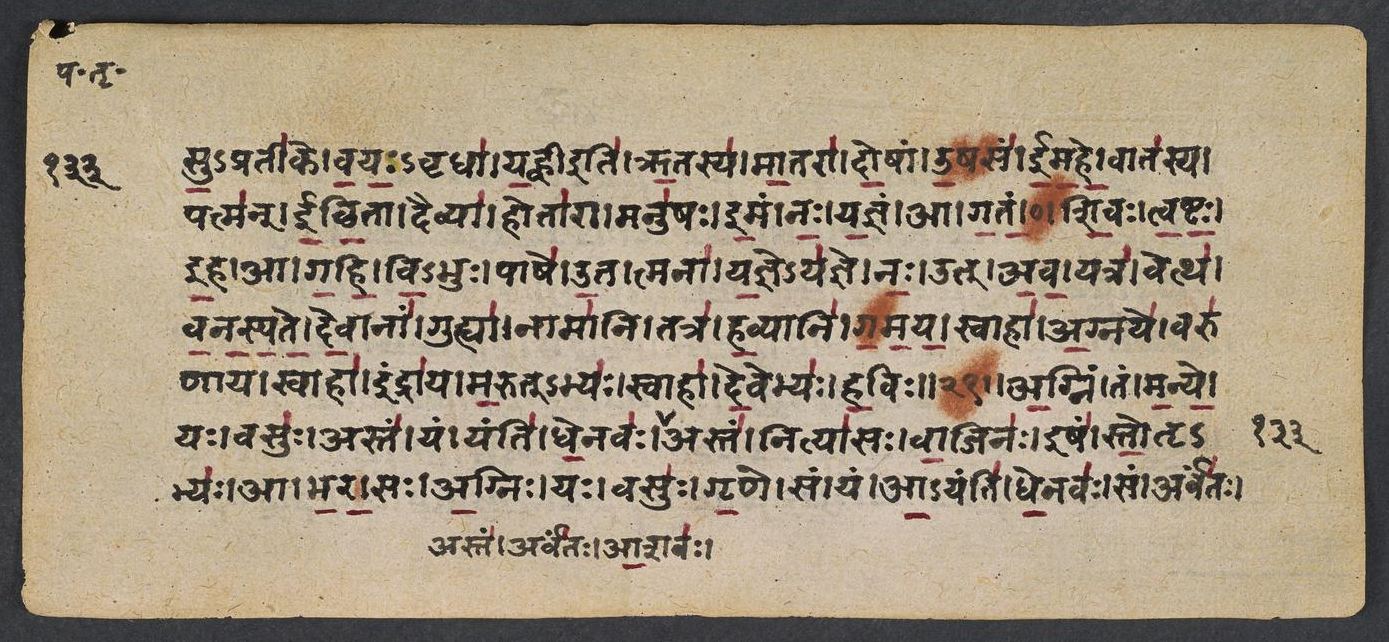
Penn Ms. Coll. 390 Item 41, fol. 324v (numbered 133v by the scribe) (OPenn image 325, upper leaf). Checked on the image: the Rigveda text on this page begins in RV 5.5.6 ‹-itisu-pratīke vayaḥ-vṛdhā yahvī ṛtasya›. The next page with Rigveda text, fol. 325r (numbered 134r by the scribe), begins in RV 5.6.2 ‹raghu-druvaḥ sam su-jātāsaḥ sūraya›. Verse 5.6.1 ends on this page.
1a̱gniṁ tam ma̍nye̱ yo vasu̱r asta̱ṁ yaṁ yanti̍ dhe̱nava̍ḥ | asta̱m arva̍nta ā̱śavo 'sta̱ṁ nityā̍so vā̱jina̱ iṣa̍ṁ sto̱tṛbhya̱ ā bha̍ra ||
Compare: Padapāṭha (word-by-word text written in the manuscript; Sansknet e-text via GRETIL)
1agnim | tam | manye | yaḥ | vasuḥ | astam | yam | yanti | dhenavaḥ | astam | avarntaḥ | āśavaḥ | astam | nityāsaḥ | vājinaḥ | iṣam | stotṛ-bhyaḥ | ā | bhara
1I VALUE Agni that good Lord, the home to which the kine return: Whom fleet-foot coursers seek as home, and strong enduring steeds as home. Bring food to those who sing thy praise.
Where on the image
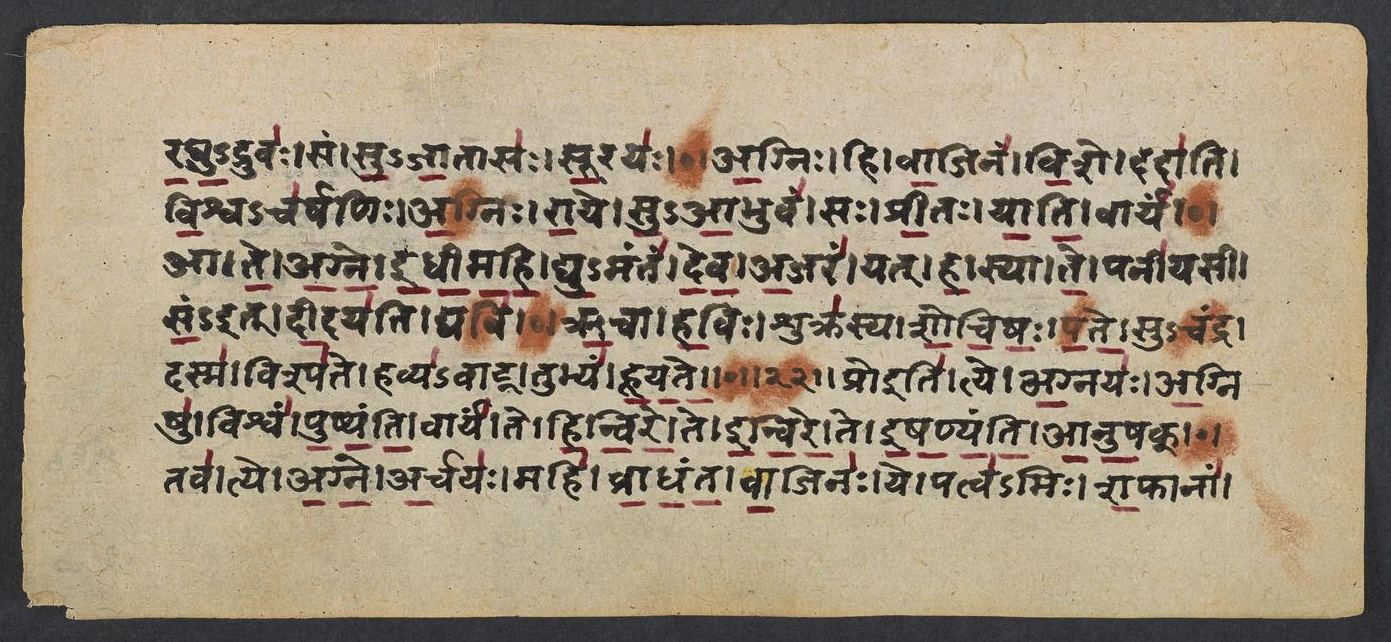
Penn Ms. Coll. 390 Item 41, fol. 325r (numbered 134r by the scribe) (OPenn image 325, lower leaf). Checked on the image: the Rigveda text on this page begins in RV 5.6.2 ‹raghu-druvaḥ sam su-jātāsaḥ sūraya›. The next page with Rigveda text, fol. 325v (numbered 134v by the scribe), begins in RV 5.6.7 ‹vrajā bhuranta gonām iṣam›. Verses 5.6.2-6 end on this page; 5.6.2 begins on fol. 324v (numbered 133v by the scribe).
2so a̱gnir yo vasu̍r gṛ̱ṇe saṁ yam ā̱yanti̍ dhe̱nava̍ḥ | sam arva̍nto raghu̱druva̱ḥ saṁ su̍jā̱tāsa̍ḥ sū̱raya̱ iṣa̍ṁ sto̱tṛbhya̱ ā bha̍ra ||
3a̱gnir hi vā̱jina̍ṁ vi̱śe dadā̍ti vi̱śvaca̍rṣaṇiḥ | a̱gnī rā̱ye svā̱bhuva̱ṁ sa prī̱to yā̍ti̱ vārya̱m iṣa̍ṁ sto̱tṛbhya̱ ā bha̍ra ||
4ā te̍ agna idhīmahi dyu̱manta̍ṁ devā̱jara̍m | yad dha̱ syā te̱ panī̍yasī sa̱mid dī̱daya̍ti̱ dyavīṣa̍ṁ sto̱tṛbhya̱ ā bha̍ra ||
5ā te̍ agna ṛ̱cā ha̱viḥ śukra̍sya śociṣas pate | suśca̍ndra̱ dasma̱ viśpa̍te̱ havya̍vā̱ṭ tubhya̍ṁ hūyata̱ iṣa̍ṁ sto̱tṛbhya̱ ā bha̍ra ||
6pro tye a̱gnayo̱ 'gniṣu̱ viśva̍m puṣyanti̱ vārya̍m | te hi̍nvire̱ ta i̍nvire̱ ta i̍ṣaṇyanty ānu̱ṣag iṣa̍ṁ sto̱tṛbhya̱ ā bha̍ra ||
Compare: Padapāṭha (word-by-word text written in the manuscript; Sansknet e-text via GRETIL)
2saḥ | agniḥ | yaḥ | vasuḥ | gṛṇe | sam | yam | āyanti | dhenavaḥ | sam | arvantaḥ | raghu-druvaḥ | sam | su-jātāsaḥ | sūraya | iṣam | stotṛ-bhyaḥ | ā | bhara
3agniḥ | hi | vājinam | viśe | dadāti | viśva-carṣaṇiḥ | agniḥ | rāye | su-ābhuvam | saḥ | prītaḥ | yāti | vāryam | iṣam | stotṛ-bhyaḥ | ā | bhara
4ā | te | agne | idhīmahi | dyu-mantam | deva | ajaram | yat | ha | syā | te | panīyasī | sam-it | dīdayati | dyavi | iṣam | stotṛ-bhyaḥ | ā | bhara
5ā | te | agne | ṛcā | haviḥ | śukrasya | śociṣaḥ | pate | su-candra | dasma | viśpate | havya-vāṭ | tubhyam | hūyate | iṣam | stotṛ-bhyaḥ | ā | bhara
6pro iti | tye | agnayaḥ | agniṣu | viśvam | puṣyanti | vāryam | te | hinvire | te | invire | te | iṣaṇyanti | ānuṣak | iṣam | stotṛ-bhyaḥ | ā | bhara
2'Tis Agni whom we laud as good, to whom the milch-kine come in herds, To whom the chargers swift of foot, to whom our well-born princes come. Bring food to those who sing thy praise.
3Agni the God of all mankind, gives, verily, a steed to man. Agni gives precious gear for wealth, treasure he gives when he is pleased. Bring food to those who sing thy praise.
4God, Agni, we will kindle thee, rich in thy splendour, fading not, So that this glorious fuel may send forth by day its light for thee. Bring food to those who sing thy praise.
5To thee the splendid, Lord of flame, bright, wondrous, Prince of men, is brought. Oblation with the holy verse, O Agni, bearer of our gifts. Bring food to those who sing thy praise.
6These Agnis in the seats of the fire nourish each thing most excellent. They give delight, they spread abroad, they move themselves continually. Bring food to those who sing thy praise.
Where on the image
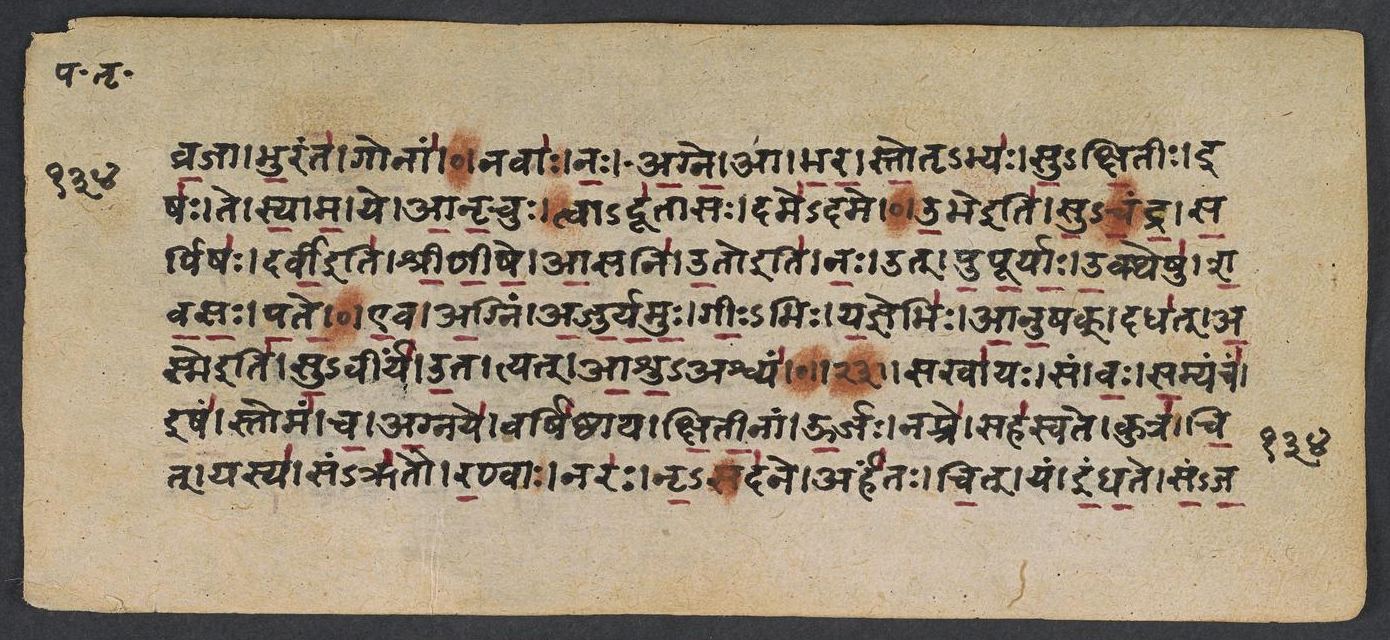
Penn Ms. Coll. 390 Item 41, fol. 325v (numbered 134v by the scribe) (OPenn image 326, upper leaf). Checked on the image: the Rigveda text on this page begins in RV 5.6.7 ‹vrajā bhuranta gonām iṣam›. The next page with Rigveda text, fol. 326r (numbered 135r by the scribe), begins in RV 5.7.2 ‹-sam-janayanti jantavaḥ›. Verses 5.6.7-10 end on this page; 5.6.7 begins on fol. 325r (numbered 134r by the scribe).
7tava̱ tye a̍gne a̱rcayo̱ mahi̍ vrādhanta vā̱jina̍ḥ | ye patva̍bhiḥ śa̱phānā̍ṁ vra̱jā bhu̱ranta̱ gonā̱m iṣa̍ṁ sto̱tṛbhya̱ ā bha̍ra ||
8navā̍ no agna̱ ā bha̍ra sto̱tṛbhya̍ḥ sukṣi̱tīr iṣa̍ḥ | te syā̍ma̱ ya ā̍nṛ̱cus tvādū̍tāso̱ dame̍-dama̱ iṣa̍ṁ sto̱tṛbhya̱ ā bha̍ra ||
9u̱bhe su̍ścandra sa̱rpiṣo̱ darvī̍ śrīṇīṣa ā̱sani̍ | u̱to na̱ ut pu̍pūryā u̱ktheṣu̍ śavasas pata̱ iṣa̍ṁ sto̱tṛbhya̱ ā bha̍ra ||
10e̱vām̐ a̱gnim a̍juryamur gī̱rbhir ya̱jñebhi̍r ānu̱ṣak | dadha̍d a̱sme su̱vīrya̍m u̱ta tyad ā̱śvaśvya̱m iṣa̍ṁ sto̱tṛbhya̱ ā bha̍ra ||
Compare: Padapāṭha (word-by-word text written in the manuscript; Sansknet e-text via GRETIL)
7tava | tye | agne | arcayaḥ | mahi | vrādhanta | vājinaḥ | ye | patva-bhiḥ | śaphānām | vrajā | bhuranta | gonām | iṣam | stotṛ-bhyaḥ | ā | bhara
8navāḥ | naḥ | agne | ā | bhara | stotṛ-bhyaḥ | su-kṣitīḥ | iṣaḥ | te | syāma | ye | ānṛcuḥ | tvādūtāsaḥ | dame--dame | iṣam | stotṛ-bhyaḥ | ā | bhara
9ubhe | su-candra | sarpiṣaḥ | darvī iti | śrīṇīṣe | āsani | uto iti | naḥ | ut | pupūryāḥ | ukthyeṣu | śavasaḥ | pate | iṣam | stotṛ-bhyaḥ | ā | bhara
10eva | agnim | ajuryamuḥ | gīḥ-bhiḥ | yajñebhiḥ | ānuṣak | dadhat | asme iti | su-vīryam | uta | tyat | āśu-aśvyam | iṣam | stotṛ-bhyaḥ | ā | bhara
7Agni, these brilliant flames of thine wax like strong chargers mightily, Who with the treadings of their hoofs go swiftly to the stalls of kine. Bring food to those who sing thy praise.
8To us who laud thee, Agni, bring fresh food and safe and happy homes. May we who have sung hymns to thee have thee for envoy in each house. Bring food to those who sing thy praise.
9Thou, brilliant God, within thy mouth warmest both ladles of the oil. So fill us also, in our hymns, abundantly, O Lord of Strength,Bring food to those who sing thy praise.
10Thus Agni have we duly served with sacrifices and with hymns. So may he give us what we crave, store of brave sons and fleet-foot steeds. Bring food to those who sing thy praise.
Notes
- Sanskrit: Aufrecht's edition (1877) with the Vedic accents, as entered by van Nooten and Holland (GRETIL).
- English: Ralph T. H. Griffith, The Hymns of the Rigveda (1889-1892; 2nd ed. 1896-1897), from the VedaWeb digital text; OCR slips in that text were corrected against the printed 2nd edition (data/sources/rigveda/griffith_errata.json).
- Padapāṭha (edition text): Sansknet e-text via GRETIL (CC BY-NC-SA 4.0).
Cite
Sources
- Source: Penn Ms. Coll. 390 Item 41 (undated (catalogued with Penn's 18th-19th c. Vedic manuscripts)), OPenn, Public Domain Mark + Aufrecht's accented text (GRETIL) + Griffith's English (VedaWeb) (holding institution)
- Critical edition: Aufrecht (1877), accented e-text via GRETIL
← previous · → next · v cycle view · l back to library