Rigveda 5.81: To Savitri
Introduction
Rigveda 5.81 is a hymn of 5 verses addressed to Savitri. It stands in book (maṇḍala) 5, the family book of the Atri clan. The Rigveda is the oldest collection of Sanskrit hymns, composed in the second half of the second millennium BCE and handed down orally for many centuries before it was written down.
The manuscript shown is Penn Ms. Coll. 390 Item 41 (University of Pennsylvania), an undated paper manuscript of the padapāṭha (the word-by-word recitation text, in which every word is written separately and compounds are split) of the whole Ṛgveda in Devanāgarī, 884 leaves in fascicles, 7-9 lines to the page, accents in red; this hymn stands on fol. 395r-396r. Each section below gives the verses that end on one page; the page boundaries were read on the images (the opening words of every page), not counted out. Where the manuscript is a padapāṭha (the word-by-word recitation text), the section shows Aufrecht's continuous (saṃhitā) text first and, as the edition text, the padapāṭha of the same verses, which is the form written on the page.
How was this verified? (Provenance)
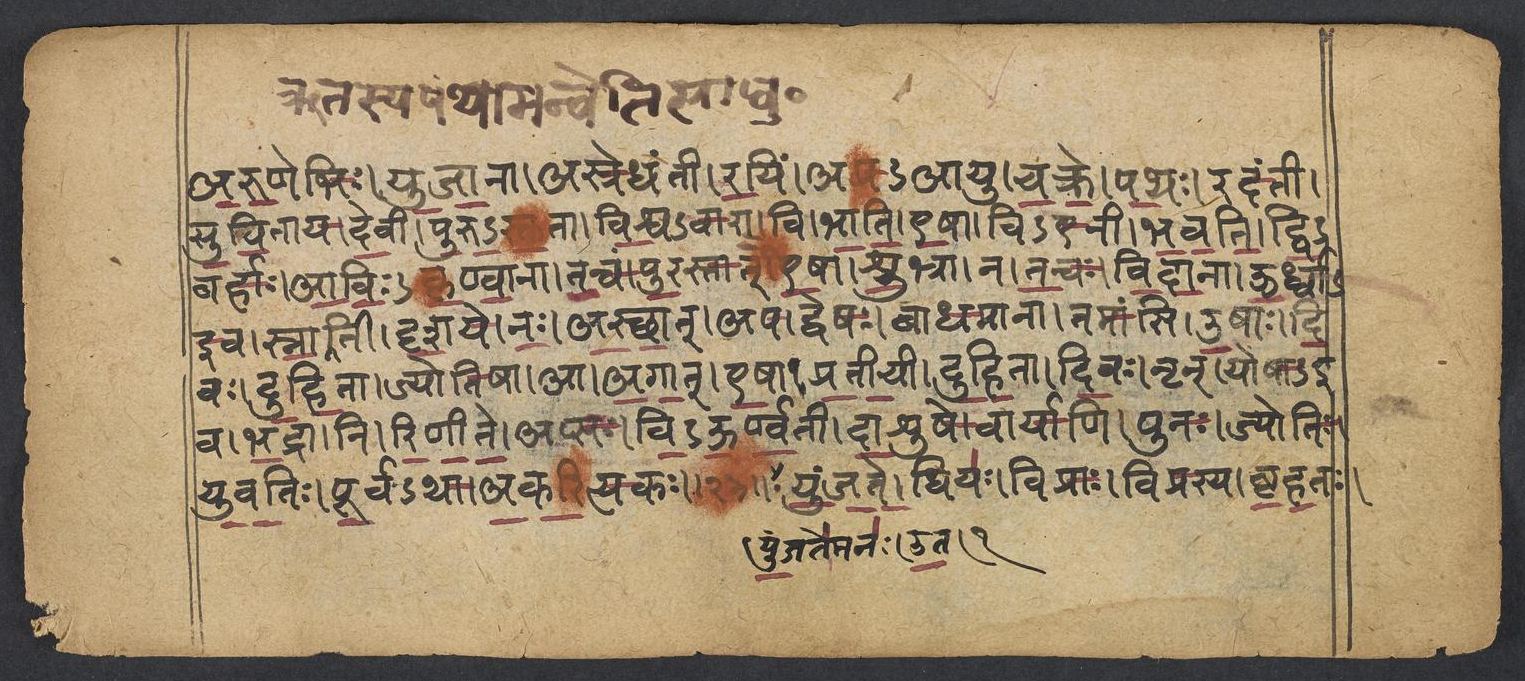
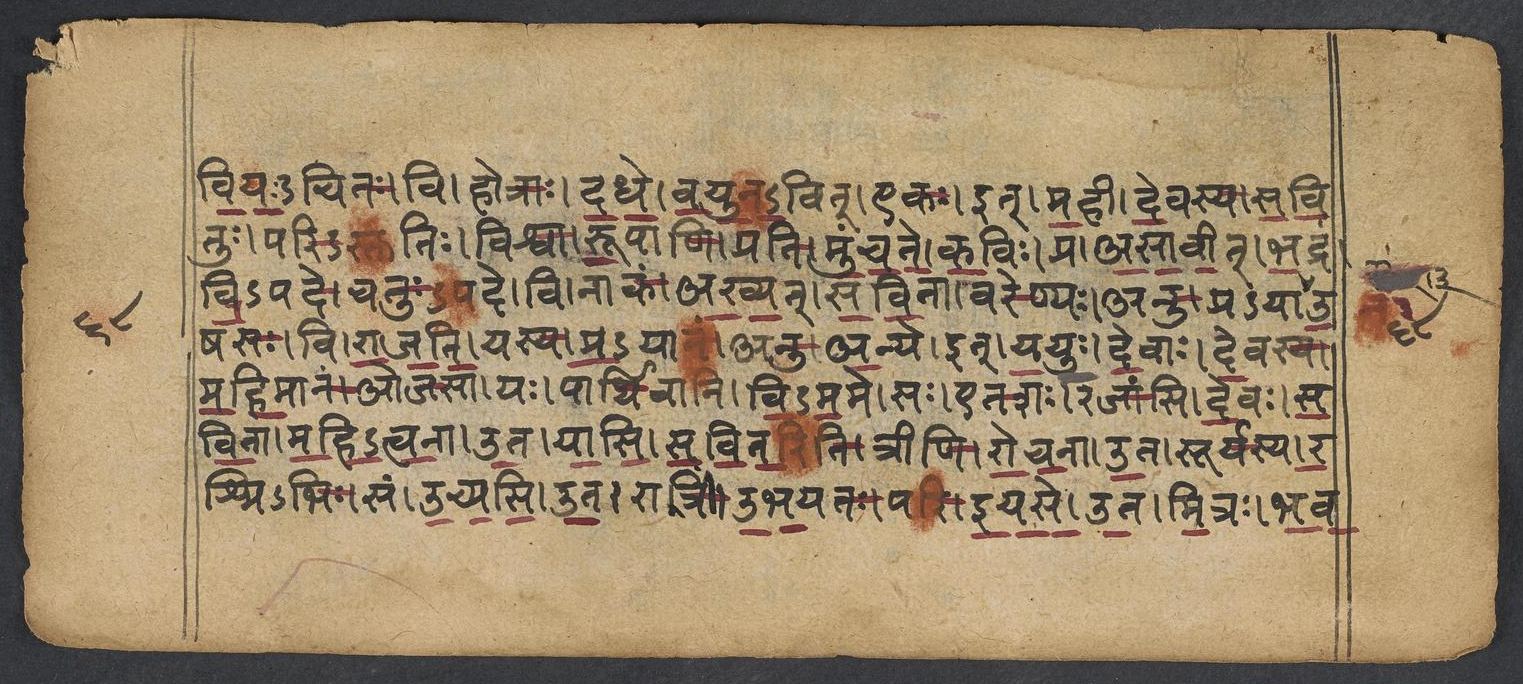
Where on the image
Penn Ms. Coll. 390 Item 41, fol. 395v (numbered 68v by the scribe) (OPenn image 396, upper leaf). Checked on the image: the Rigveda text on this page begins in RV 5.81.1 ‹vipaḥ-citaḥ vi hotrāḥ dadhe›. The next page with Rigveda text, fol. 396r (numbered 69r by the scribe), begins in RV 5.81.4 ‹-bhavasi deva dharma-bhiḥ›. Verses 5.81.1-3 end on this page; 5.81.1 begins on fol. 395r (numbered 68r by the scribe).
1yu̱ñjate̱ mana̍ u̱ta yu̍ñjate̱ dhiyo̱ viprā̱ vipra̍sya bṛha̱to vi̍pa̱ścita̍ḥ | vi hotrā̍ dadhe vayunā̱vid eka̱ in ma̱hī de̱vasya̍ savi̱tuḥ pari̍ṣṭutiḥ ||
2viśvā̍ rū̱pāṇi̱ prati̍ muñcate ka̱viḥ prāsā̍vīd bha̱draṁ dvi̱pade̱ catu̍ṣpade | vi nāka̍m akhyat savi̱tā vare̱ṇyo 'nu̍ pra̱yāṇa̍m u̱ṣaso̱ vi rā̍jati ||
3yasya̍ pra̱yāṇa̱m anv a̱nya id ya̱yur de̱vā de̱vasya̍ mahi̱māna̱m oja̍sā | yaḥ pārthi̍vāni vima̱me sa eta̍śo̱ rajā̍ṁsi de̱vaḥ sa̍vi̱tā ma̍hitva̱nā ||
Compare: Padapāṭha (word-by-word text written in the manuscript; Sansknet e-text via GRETIL)
1yuñjate | manaḥ | uta | yuñjate | dhiyaḥ | viprāḥ | viprasya | bṛhataḥ | vipaḥ-citaḥ | vi | hotrāḥ | dadhe | vayuna-vit | ekaḥ | it | mahī | devasya | savituḥ | pari-stutiḥ
2viśvā | rūpāṇi | prati | muñcate | kaviḥ | pra | asāvīt | bhadram | dvi-pade | catuḥ-pade | vi | nākam | akhyat | savitā | vareṇyaḥ | anu | pra-yānam | uṣasaḥ | vi | rājati
3yasya | pra-yāmam | anu | anye | it | yayuḥ | devāḥ | devasya | mahimānam | ojasā | yaḥ | pārthivāni | vi-mame | saḥ | etaśaḥ | rajāṃsi | devaḥ | savitā | mahi-tvanā
1THE priests of him the lofty Priest well-skilled in hymns harness their spirit, yea, harness their holy thoughts. He only knowing works assigns their priestly tasks. Yea, lofty is the praise of Savitar the God.
2The Sapient One arrays himself in every form: for quadruped and biped he hath brought forth good. Excellent Savitar hath looked on heaven's high vault, and shineth after the outgoing of the Dawn.
3Even he, the God whose going-forth and majesty the other Deities have followed with their might, He who hath measured the terrestrial regions out by his great power, he is the Courser Savitar.
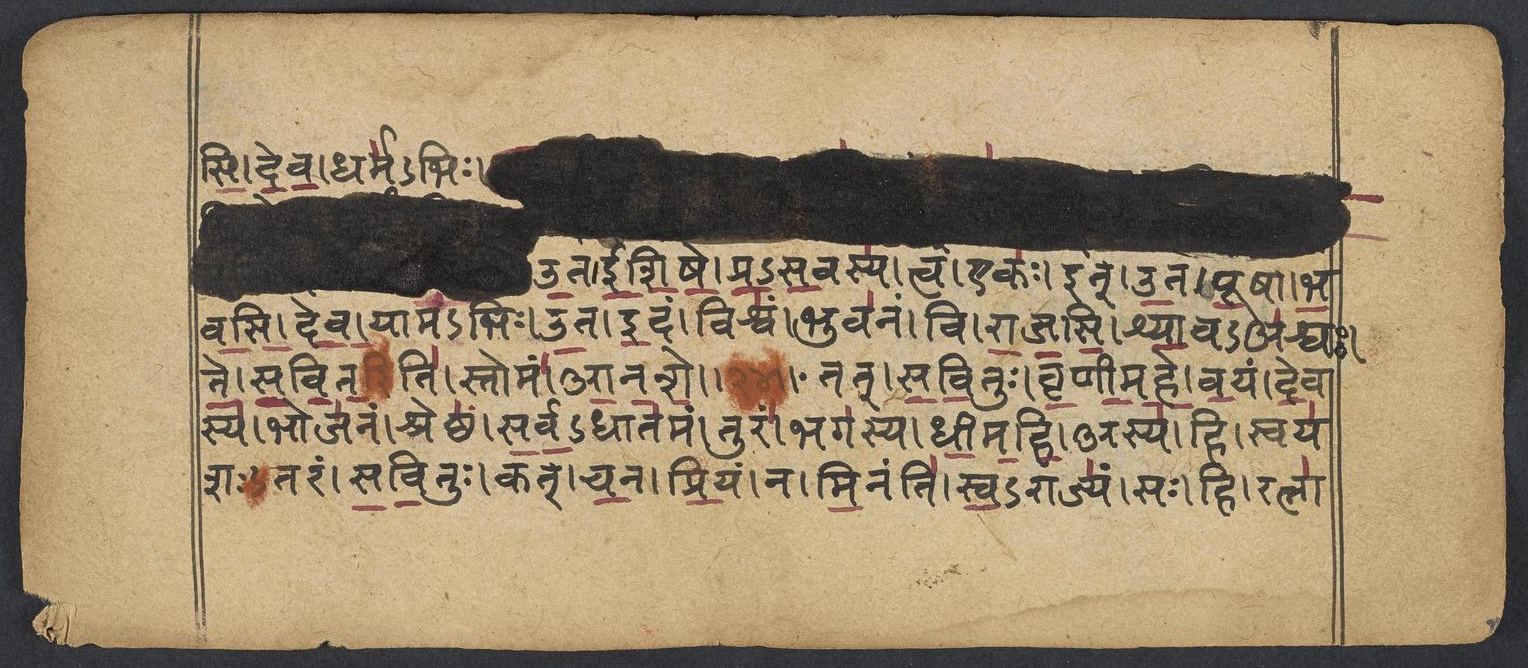
Where on the image
Penn Ms. Coll. 390 Item 41, fol. 396r (numbered 69r by the scribe) (OPenn image 396, lower leaf). Checked on the image: the Rigveda text on this page begins in RV 5.81.4 ‹-bhavasi deva dharma-bhiḥ›. The next page with Rigveda text, fol. 396v (numbered 69v by the scribe), begins in RV 5.82.3 ‹-ratnāni dāśuṣe suvāti savitā›. Verses 5.81.4-5 end on this page; 5.81.4 begins on fol. 395v (numbered 68v by the scribe).
4u̱ta yā̍si savita̱s trīṇi̍ roca̱nota sūrya̍sya ra̱śmibhi̱ḥ sam u̍cyasi | u̱ta rātrī̍m ubha̱yata̱ḥ parī̍yasa u̱ta mi̱tro bha̍vasi deva̱ dharma̍bhiḥ ||
5u̱teśi̍ṣe prasa̱vasya̱ tvam eka̱ id u̱ta pū̱ṣā bha̍vasi deva̱ yāma̍bhiḥ | u̱tedaṁ viśva̱m bhuva̍na̱ṁ vi rā̍jasi śyā̱vāśva̍s te savita̱ḥ stoma̍m ānaśe ||
Compare: Padapāṭha (word-by-word text written in the manuscript; Sansknet e-text via GRETIL)
4uta | yāsi | savitariti | trīṇi | rocanā | uta | sūryasya | raśmi-bhiḥ | sam | ucyas i | uta | rātrīm | ubhayataḥ | pari | īyase | uta | mitraḥ | bhavasi | deva | dharma-bhiḥ
5uta | īśiṣe | pra-savasya | tvam | ekaḥ | it | uta | pūṣā | bhavasi | deva | yāma-bhiḥ | uta | idam | viśvam | bhuvanam | vi | rājasi | śyāva-aśvaḥ | te | savitariti | stomam | ānaśe
4To the three spheres of light thou goest, Savitar, and with the rays of Sûrya thou combinest thee. Around, on both sides thou encompassest the night: yea, thou, O God, art Mitra through thy righteous laws.
5Over all generation thou art Lord alone: Pûshan art thou, O God, in all thy goings-forth. Yea, thou hast domination over all this world. Ṣyâvâṣva hath brought praise to thee, O Savitar,
Notes
- Sanskrit: Aufrecht's edition (1877) with the Vedic accents, as entered by van Nooten and Holland (GRETIL).
- English: Ralph T. H. Griffith, The Hymns of the Rigveda (1889-1892; 2nd ed. 1896-1897), from the VedaWeb digital text; OCR slips in that text were corrected against the printed 2nd edition (data/sources/rigveda/griffith_errata.json).
- Padapāṭha (edition text): Sansknet e-text via GRETIL (CC BY-NC-SA 4.0).
Cite
Sources
- Source: Penn Ms. Coll. 390 Item 41 (undated (catalogued with Penn's 18th-19th c. Vedic manuscripts)), OPenn, Public Domain Mark + Aufrecht's accented text (GRETIL) + Griffith's English (VedaWeb) (holding institution)
- Critical edition: Aufrecht (1877), accented e-text via GRETIL
← previous · → next · v cycle view · l back to library