Rigveda 6.13: To Agni
Introduction
Rigveda 6.13 is a hymn of 6 verses addressed to Agni. It stands in book (maṇḍala) 6, the family book of Bharadvāja. The Rigveda is the oldest collection of Sanskrit hymns, composed in the second half of the second millennium BCE and handed down orally for many centuries before it was written down.
The manuscript shown is Penn Ms. Coll. 390 Item 41 (University of Pennsylvania), an undated paper manuscript of the padapāṭha (the word-by-word recitation text, in which every word is written separately and compounds are split) of the whole Ṛgveda in Devanāgarī, 884 leaves in fascicles, 7-9 lines to the page, accents in red; this hymn stands on fol. 414v-415r. Each section below gives the verses that end on one page; the page boundaries were read on the images (the opening words of every page), not counted out. Where the manuscript is a padapāṭha (the word-by-word recitation text), the section shows Aufrecht's continuous (saṃhitā) text first and, as the edition text, the padapāṭha of the same verses, which is the form written on the page.
How was this verified? (Provenance)
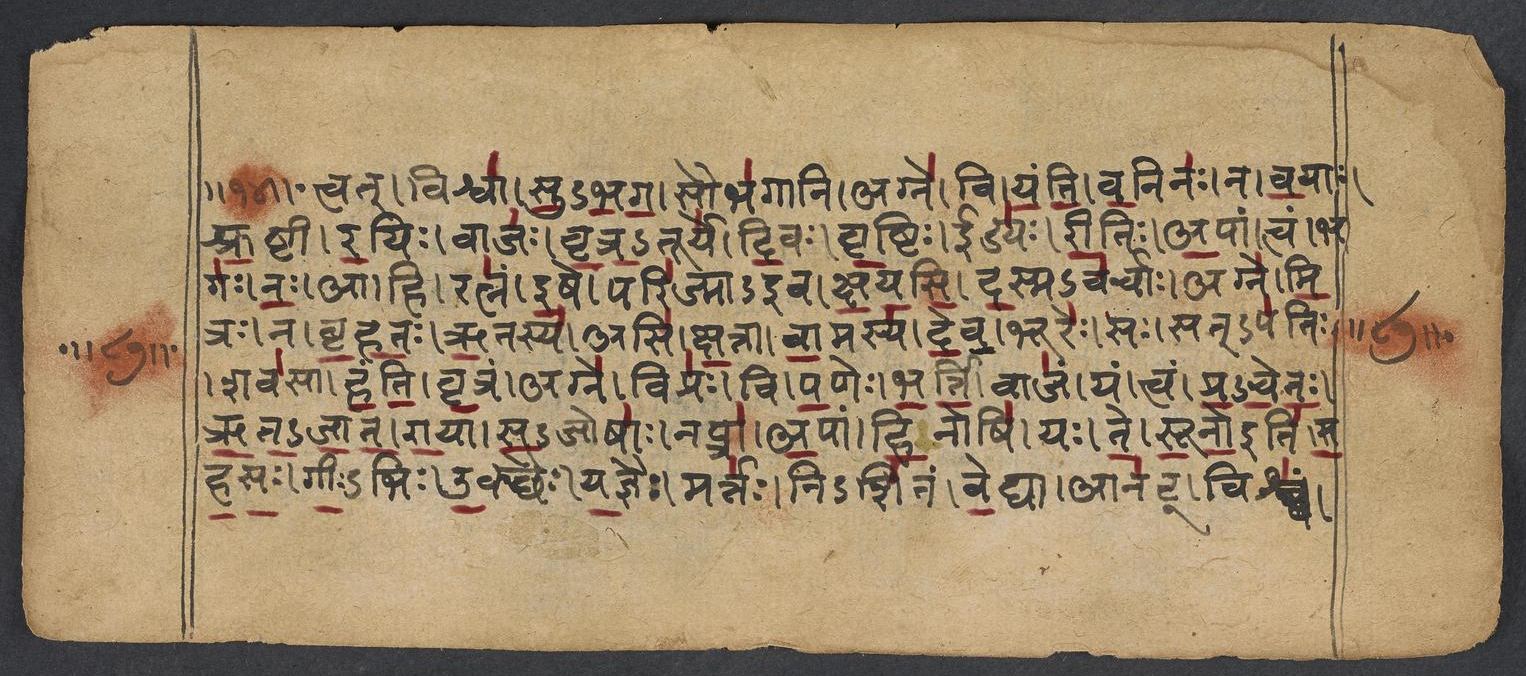
Where on the image
Penn Ms. Coll. 390 Item 41, fol. 414v (numbered 87v by the scribe) (OPenn image 415, upper leaf). Checked on the image: the Rigveda text on this page begins in RV 6.13.1 ‹tvat viśvā su-bhaga saubhagāni›. The next page with Rigveda text, fol. 415r (numbered 88r by the scribe), begins in RV 6.13.4 ‹saḥ deva prati vāram›. Verses 6.13.1-3 end on this page.
1tvad viśvā̍ subhaga̱ saubha̍gā̱ny agne̱ vi ya̍nti va̱nino̱ na va̱yāḥ | śru̱ṣṭī ra̱yir vājo̍ vṛtra̱tūrye̍ di̱vo vṛ̱ṣṭir īḍyo̍ rī̱tir a̱pām ||
2tvam bhago̍ na̱ ā hi ratna̍m i̱ṣe pari̍jmeva kṣayasi da̱smava̍rcāḥ | agne̍ mi̱tro na bṛ̍ha̱ta ṛ̱tasyāsi̍ kṣa̱ttā vā̱masya̍ deva̱ bhūre̍ḥ ||
3sa satpa̍ti̱ḥ śava̍sā hanti vṛ̱tram agne̱ vipro̱ vi pa̱ṇer bha̍rti̱ vāja̍m | yaṁ tvam pra̍ceta ṛtajāta rā̱yā sa̱joṣā̱ naptrā̱pāṁ hi̱noṣi̍ ||
Compare: Padapāṭha (word-by-word text written in the manuscript; Sansknet e-text via GRETIL)
1tvat | viśvā | su-bhaga | saubhagāni | agne | vi | yānti | vaninaḥ | na | vayāḥ | śruṣṭī | rayiḥ | vājaḥ | vṛtra-tūrye | divaḥ | vṛṣṭiḥ | īḍyaḥ | rītiḥ | apām
2tvam | bhagaḥ | naḥ | ā | hi | ratnam | iṣe | parijmāiva | kṣayasi | dasma-varcāḥ | agne | mitraḥ | na | bṛhataḥ | ṛtasya | asi | kṣattā | vāmasya | deva | bhūreḥ
3saḥ | sat-patiḥ | śavasā | hanti | vṛtram | agne | vipraḥ | vi | paṇeḥ | bharti | vājam | yam | tvam | pra-cetaḥ | ṛta-jāta | rāyā | sa-joṣāḥ | naptrā | apām | hinoṣi
1FROM thee, as branches from a tree, O Agni, from thee, Auspicious God! spring all our blessings- Wealth swiftly, strength in battle with our foemen, the rain besought of heaven, the flow of waters.
2Thou art our Bhaga to send wealth thou dwellest, like circumambient air, with wondrous splendour. Friend art thou of the lofty Law, like Mitra, Controller, Agni! God! of many a blessing.
3Agni! the hero slays with might his foeman; the singer bears away the Paṇi's booty- Even he whom thou, Sage, born in Law, incitest by wealth, accordant with the Child of Waters.
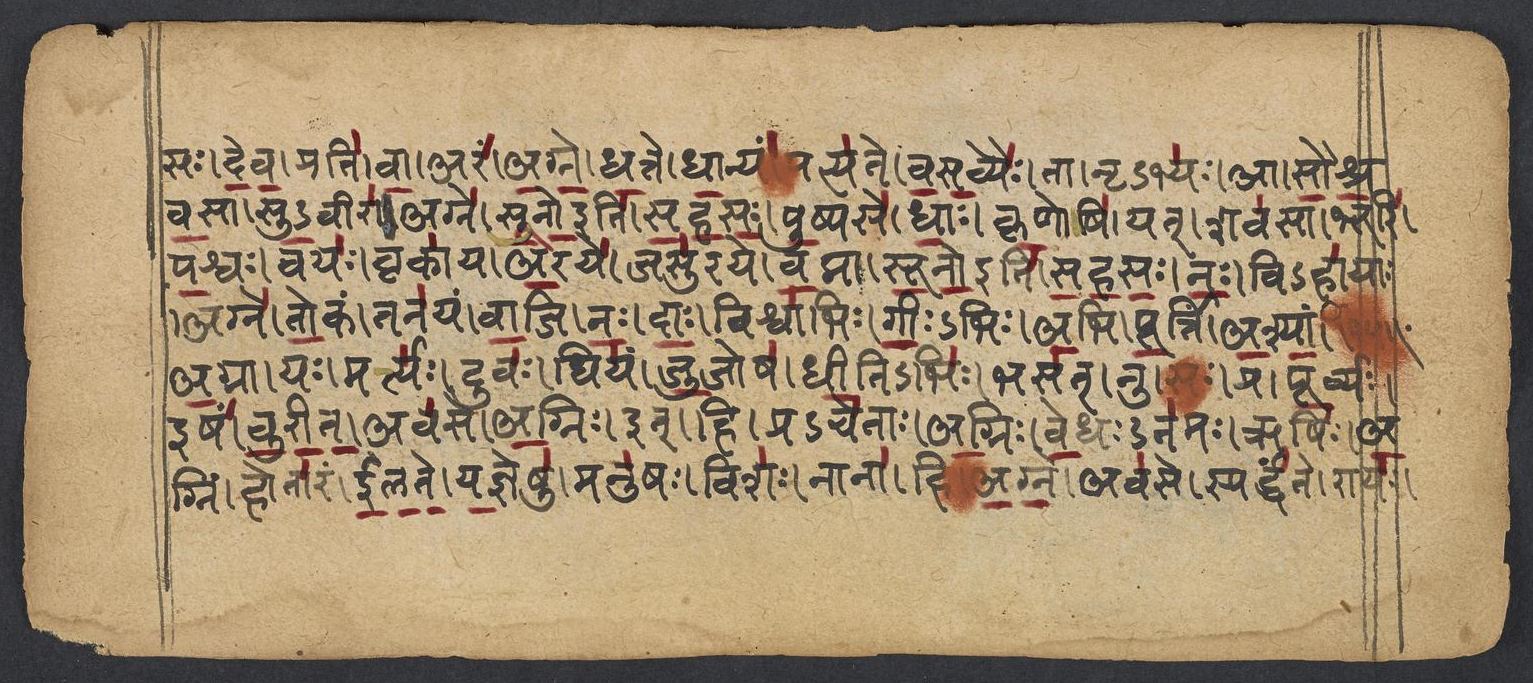
Where on the image
Penn Ms. Coll. 390 Item 41, fol. 415r (numbered 88r by the scribe) (OPenn image 415, lower leaf). Checked on the image: the Rigveda text on this page begins in RV 6.13.4 ‹saḥ deva prati vāram›. The next page with Rigveda text, fol. 415v (numbered 88v by the scribe), begins in RV 6.14.3 ‹aryaḥ tūrvantaḥ dasyum āyavaḥ›. Verses 6.13.4-6 end on this page; 6.13.4 begins on fol. 414v (numbered 87v by the scribe).
4yas te̍ sūno sahaso gī̱rbhir u̱kthair ya̱jñair marto̱ niśi̍tiṁ ve̱dyāna̍ṭ | viśva̱ṁ sa de̍va̱ prati̱ vāra̍m agne dha̱tte dhā̱nya1̱̍m patya̍te vasa̱vyai̍ḥ ||
5tā nṛbhya̱ ā sau̍śrava̱sā su̱vīrāgne̍ sūno sahasaḥ pu̱ṣyase̍ dhāḥ | kṛ̱ṇoṣi̱ yac chava̍sā̱ bhūri̍ pa̱śvo vayo̱ vṛkā̍yā̱raye̱ jasu̍raye ||
6va̱dmā sū̍no sahaso no̱ vihā̍yā̱ agne̍ to̱kaṁ tana̍yaṁ vā̱ji no̍ dāḥ | viśvā̍bhir gī̱rbhir a̱bhi pū̱rtim a̍śyā̱m made̍ma śa̱tahi̍māḥ su̱vīrā̍ḥ ||
Compare: Padapāṭha (word-by-word text written in the manuscript; Sansknet e-text via GRETIL)
4yaḥ | te | sūno iti | sahasaḥ | gīḥ-bhiḥ | ukthaiḥ | yajñaiḥ | martaḥ | ni-śitam | vedyā | ānaṭ | viśvam | saḥ | deva | prati | vāram | agne | dhatte | dhānyam | patyate | vasavyaiḥ
5tā | nṛ-bhyaḥ | ā | sauśravasā | su-vīrā | agne | sūno iti | sahasaḥ | puṣyase | dhāḥ | kṛṇoṣi | yat | śavasā | bhūri | paśvaḥ | vayaḥ | vṛkāya | araye | jasuraye
6vadmā | sūno iti | sahasaḥ | naḥ | vi-hāyāḥ | agne | tokam | tanayam | vāji | naḥ | dāḥ | viśvābhiḥ | gīḥ-bhiḥ | abhi | pūrtim | aśyām | madema | śata-himāḥ | su-vīrāḥ
4The man who, Son of Strength! with sacrifices, hymns, lauds, attracts thy fervour to the altar, Enjoys each precious thing, O God, O Agni, gains wealth of corn and is the lord of treasures.
5Grant, Son of Strength, to men for their subsistence such things as bring high fame and hero children. For thou with might givest much food in cattle even to the wicked wolf when he is hungry.
6Eloquent, Son of Strength, Most Mighty, Agni, vouchsafe us seed and offspring, full of vigour. May I by all my songs obtain abundance. May brave sons gladden us through a hundred winters.
Notes
- Sanskrit: Aufrecht's edition (1877) with the Vedic accents, as entered by van Nooten and Holland (GRETIL).
- English: Ralph T. H. Griffith, The Hymns of the Rigveda (1889-1892; 2nd ed. 1896-1897), from the VedaWeb digital text; OCR slips in that text were corrected against the printed 2nd edition (data/sources/rigveda/griffith_errata.json).
- Padapāṭha (edition text): Sansknet e-text via GRETIL (CC BY-NC-SA 4.0).
Cite
Sources
- Source: Penn Ms. Coll. 390 Item 41 (undated (catalogued with Penn's 18th-19th c. Vedic manuscripts)), OPenn, Public Domain Mark + Aufrecht's accented text (GRETIL) + Griffith's English (VedaWeb) (holding institution)
- Critical edition: Aufrecht (1877), accented e-text via GRETIL
← previous · → next · v cycle view · l back to library