Rigveda 6.12: To Agni
Introduction
Rigveda 6.12 is a hymn of 6 verses addressed to Agni. It stands in book (maṇḍala) 6, the family book of Bharadvāja. The Rigveda is the oldest collection of Sanskrit hymns, composed in the second half of the second millennium BCE and handed down orally for many centuries before it was written down.
The manuscript shown is Penn Ms. Coll. 390 Item 41 (University of Pennsylvania), an undated paper manuscript of the padapāṭha (the word-by-word recitation text, in which every word is written separately and compounds are split) of the whole Ṛgveda in Devanāgarī, 884 leaves in fascicles, 7-9 lines to the page, accents in red; this hymn stands on fol. 413v-414r. Each section below gives the verses that end on one page; the page boundaries were read on the images (the opening words of every page), not counted out. Where the manuscript is a padapāṭha (the word-by-word recitation text), the section shows Aufrecht's continuous (saṃhitā) text first and, as the edition text, the padapāṭha of the same verses, which is the form written on the page.
How was this verified? (Provenance)
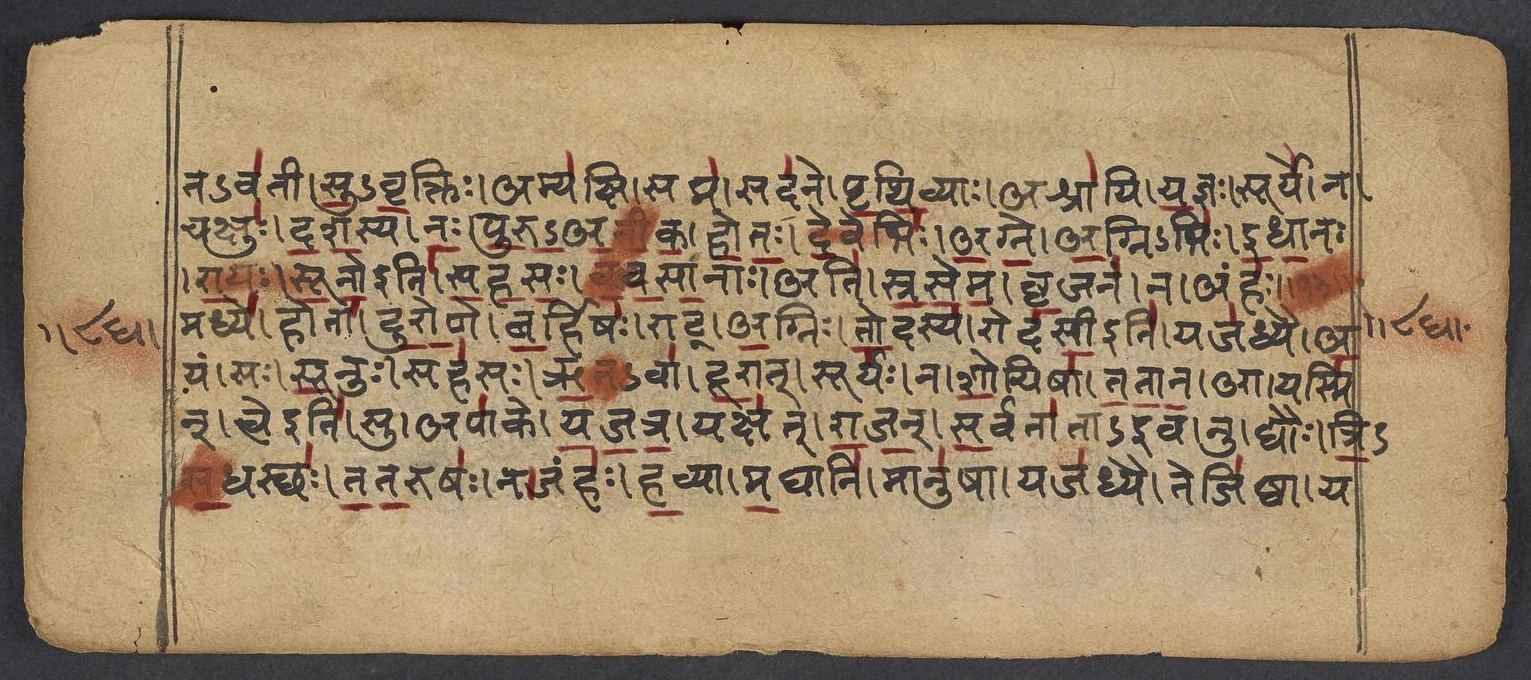
Where on the image
Penn Ms. Coll. 390 Item 41, fol. 413v (numbered 86v by the scribe) (OPenn image 414, upper leaf). Checked on the image: the Rigveda text on this page begins in RV 6.11.5 ‹-ghṛta-vatī su-vṛktiḥ amyakṣi sadma›. The next page with Rigveda text, fol. 414r (numbered 87r by the scribe), begins in RV 6.12.3 ‹-yasya aratiḥ vane--rāṭ todaḥ›. Verses 6.12.1-2 end on this page.
1madhye̱ hotā̍ duro̱ṇe ba̱rhiṣo̱ rāḻ a̱gnis to̱dasya̱ roda̍sī̱ yaja̍dhyai | a̱yaṁ sa sū̱nuḥ saha̍sa ṛ̱tāvā̍ dū̱rāt sūryo̱ na śo̱ciṣā̍ tatāna ||
2ā yasmi̱n tve sv apā̍ke yajatra̱ yakṣa̍d rājan sa̱rvatā̍teva̱ nu dyauḥ | tri̱ṣa̱dhastha̍s tata̱ruṣo̱ na jaṁho̍ ha̱vyā ma̱ghāni̱ mānu̍ṣā̱ yaja̍dhyai ||
Compare: Padapāṭha (word-by-word text written in the manuscript; Sansknet e-text via GRETIL)
1madhye | hotā | duroṇe | barhiṣaḥ | rāṭ | agniḥ | todasya | rodasī iti | yajadhyai | ayam | saḥ | sūnuḥ | sahasaḥ | ṛta-vā | dūrāt | sūryaḥ | na | śociṣā | tatāna
2ā | yasmin | tve iti | su | apāke | yajatra | yakṣat | rājan | sarvatātāiva | nu | dyauḥ | tri-sadhasthaḥ | tataruṣaḥ | na | jaṃhaḥ | havyā | maghāni | mānuṣā | yajadhyai
1KING of trimmed grass, Herald within the dwelling, may Agni worship the Impeller's World-halves. He, Son of Strength, the Holy, from a distance hath spread himself abroad with light like Sûrya.
2In thee, most wise, shall Dyaus, for full perfection, King! Holy One! pronounce the call to worship. Found in three places, like the Speeder's footstep, come to present men's riches as oblations!
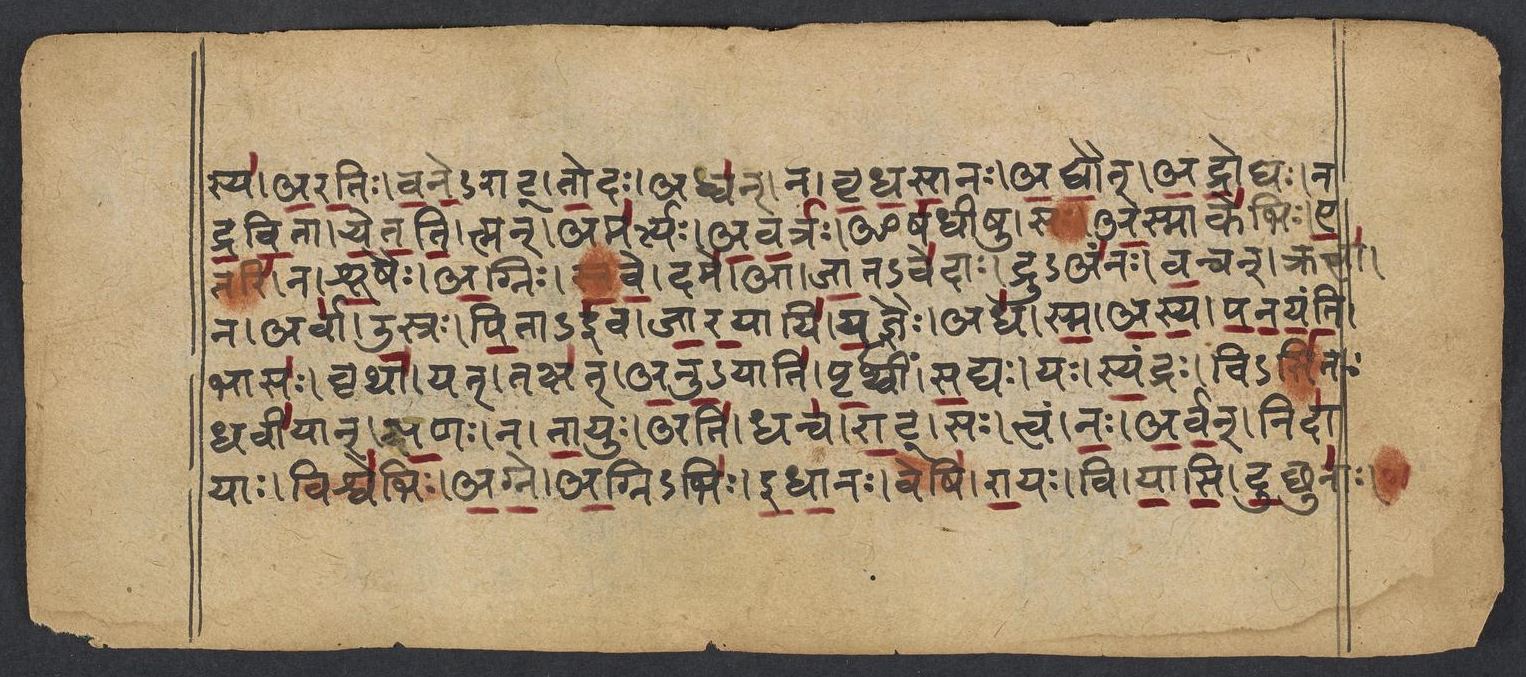
Where on the image
Penn Ms. Coll. 390 Item 41, fol. 414r (numbered 87r by the scribe) (OPenn image 414, lower leaf). Checked on the image: the Rigveda text on this page begins in RV 6.12.3 ‹-yasya aratiḥ vane--rāṭ todaḥ›. The next page with Rigveda text, fol. 414v (numbered 87v by the scribe), begins in RV 6.13.1 ‹tvat viśvā su-bhaga saubhagāni›. Verses 6.12.3-6 end on this page; 6.12.3 begins on fol. 413v (numbered 86v by the scribe).
3teji̍ṣṭhā̱ yasyā̍ra̱tir va̍ne̱rāṭ to̱do adhva̱n na vṛ̍dhasā̱no a̍dyaut | a̱dro̱gho na dra̍vi̱tā ce̍tati̱ tmann ama̍rtyo 'va̱rtra oṣa̍dhīṣu ||
4sāsmāke̍bhir e̱tarī̱ na śū̱ṣair a̱gniḥ ṣṭa̍ve̱ dama̱ ā jā̱tave̍dāḥ | drva̍nno va̱nvan kratvā̱ nārvo̱sraḥ pi̱teva̍ jāra̱yāyi̍ ya̱jñaiḥ ||
5adha̍ smāsya panayanti̱ bhāso̱ vṛthā̱ yat takṣa̍d anu̱yāti̍ pṛ̱thvīm | sa̱dyo yaḥ sya̱ndro viṣi̍to̱ dhavī̍yān ṛ̱ṇo na tā̱yur ati̱ dhanvā̍ rāṭ ||
6sa tvaṁ no̍ arva̱n nidā̍yā̱ viśve̍bhir agne a̱gnibhi̍r idhā̱naḥ | veṣi̍ rā̱yo vi yā̍si du̱cchunā̱ made̍ma śa̱tahi̍māḥ su̱vīrā̍ḥ ||
Compare: Padapāṭha (word-by-word text written in the manuscript; Sansknet e-text via GRETIL)
3tejiṣṭhā | yasya | aratiḥ | vane--rāṭ | todaḥ | adhvan | na | vṛdhasānaḥ | adyaut | adroghaḥ | na | dravitā | cetati | tman | amartyaḥ | avartraḥ | oṣadhīṣu
4saḥ | asmākebhiḥ | etari | na | śūṣaiḥ | agniḥ | stave | dame | ā | jāta-vedāḥ | dru-annaḥ | vanvan | kratvā | na | arvā | usraḥ | pitāiva | jārayāyi | yajñaiḥ
5adha | sma | asya | panayanti | bhāsaḥ | vṛthā | yat | takṣat | anu-yāti | pṛthvīm | sadyaḥ | yaḥ | spandraḥ | vi-sitaḥ | dhavīyān | ṛṇaḥ | na | tāyuḥ | ati | dhanva | rāṭ
6saḥ | tvam | naḥ | arvan | nidāyāḥ | viśvebhiḥ | agne | agnibhiḥ | idhānaḥ | madema | śata-himāḥ | su-vīrāḥ
3Whose blaze most splendid, sovran in the forest, shines waxing on his way like the – Impeller. He knows himself, like as a guileless smelter, not to be stayed among the plants, Immortal.
4Our friends extol him like a steed for vigour even Agni in the dwelling, Jâtave~as. Trce-fed, he fights with power as doth a champion, like Dawn's Sire to be praised with sacrifices.
5Men wonder at his shining glows when, paring the woods with ease, o'er the broad earth he goeth, And, like a rushing flood, loosed quickly, burneth, swift as a guilty thief, o'er desert places.
6So mighty thou protectest us from slander, O Champion, Agni! with all fires enkindled. Bring opulence and drive away affliction. May brave sons gladden us through a hundred winters.
Notes
- Sanskrit: Aufrecht's edition (1877) with the Vedic accents, as entered by van Nooten and Holland (GRETIL).
- English: Ralph T. H. Griffith, The Hymns of the Rigveda (1889-1892; 2nd ed. 1896-1897), from the VedaWeb digital text; OCR slips in that text were corrected against the printed 2nd edition (data/sources/rigveda/griffith_errata.json).
- Padapāṭha (edition text): Sansknet e-text via GRETIL (CC BY-NC-SA 4.0).
Cite
Sources
- Source: Penn Ms. Coll. 390 Item 41 (undated (catalogued with Penn's 18th-19th c. Vedic manuscripts)), OPenn, Public Domain Mark + Aufrecht's accented text (GRETIL) + Griffith's English (VedaWeb) (holding institution)
- Critical edition: Aufrecht (1877), accented e-text via GRETIL
← previous · → next · v cycle view · l back to library