Rigveda 6.42: To Indra
Introduction
Rigveda 6.42 is a hymn of 4 verses addressed to Indra. It stands in book (maṇḍala) 6, the family book of Bharadvāja. The Rigveda is the oldest collection of Sanskrit hymns, composed in the second half of the second millennium BCE and handed down orally for many centuries before it was written down.
The manuscript shown is Penn Ms. Coll. 390 Item 41 (University of Pennsylvania), an undated paper manuscript of the padapāṭha (the word-by-word recitation text, in which every word is written separately and compounds are split) of the whole Ṛgveda in Devanāgarī, 884 leaves in fascicles, 7-9 lines to the page, accents in red; this hymn stands on fol. 449r-449v. Each section below gives the verses that end on one page; the page boundaries were read on the images (the opening words of every page), not counted out. Where the manuscript is a padapāṭha (the word-by-word recitation text), the section shows Aufrecht's continuous (saṃhitā) text first and, as the edition text, the padapāṭha of the same verses, which is the form written on the page.
How was this verified? (Provenance)
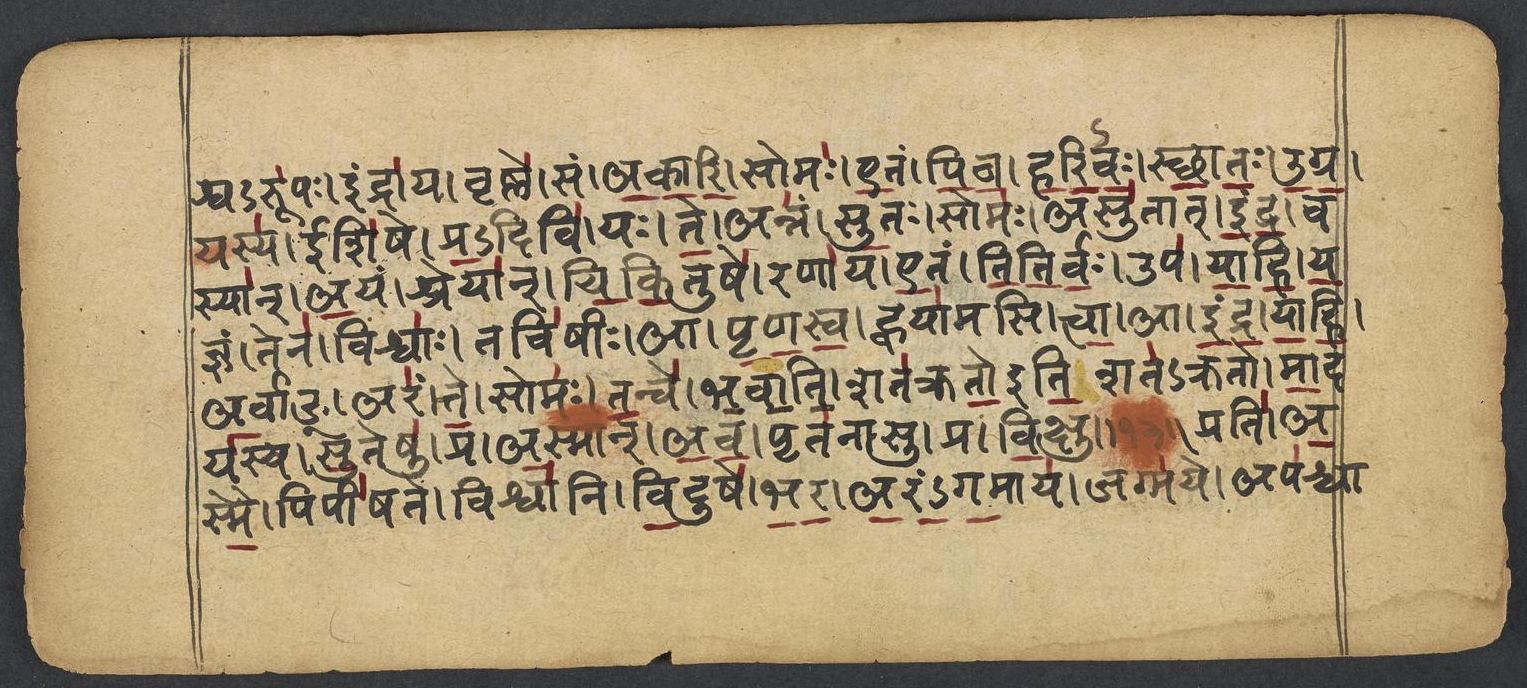
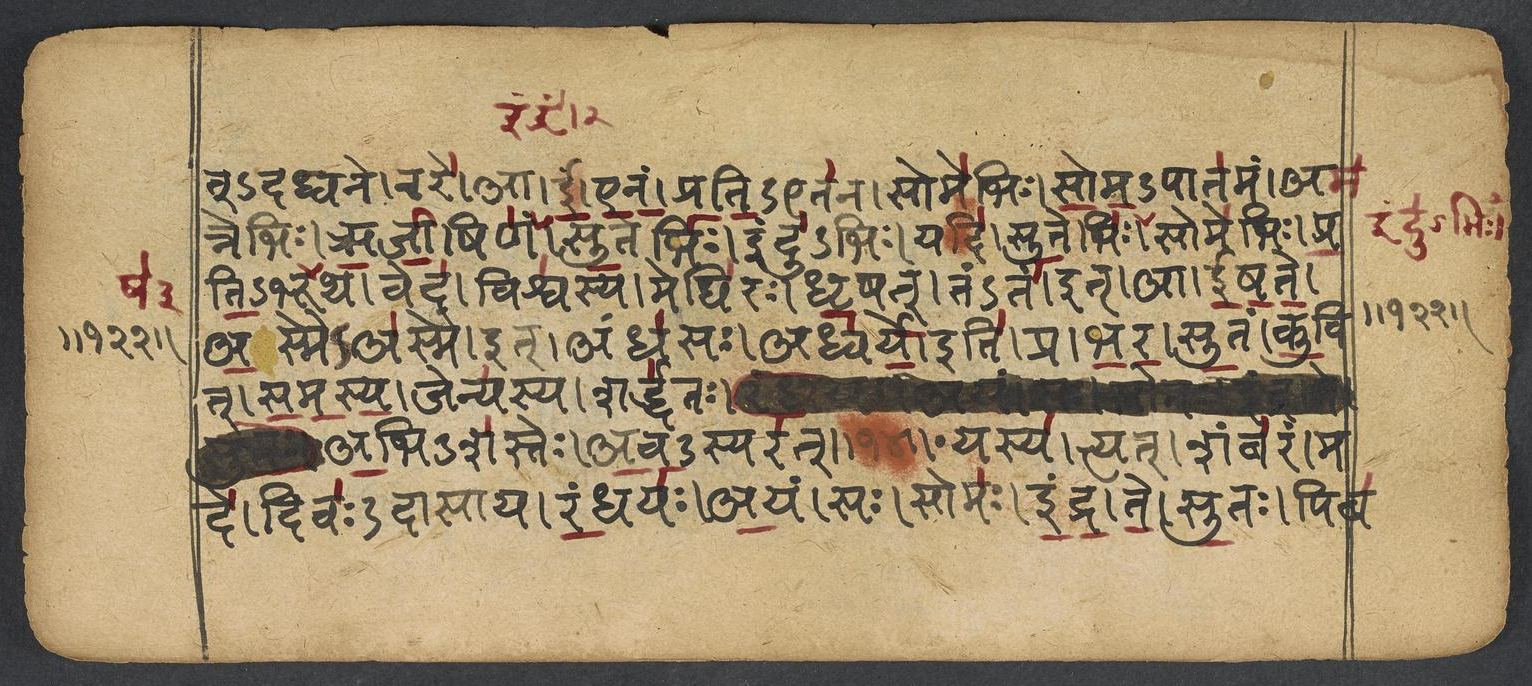
Where on the image
Penn Ms. Coll. 390 Item 41, fol. 449v (numbered 122v by the scribe) (OPenn image 450, upper leaf). Checked on the image: the Rigveda text on this page begins in RV 6.42.1 ‹-apaścāt-daghvane nare›. The next page with Rigveda text, fol. 450r (numbered 123r by the scribe), begins in RV 6.43.2 ‹yasya tīvra-sutam madam madhyam›. Verses 6.42.1-4 end on this page; 6.42.1 begins on fol. 449r (numbered 122r by the scribe).
1praty a̍smai̱ pipī̍ṣate̱ viśvā̍ni vi̱duṣe̍ bhara | a̱ra̱ṁga̱māya̱ jagma̱ye 'pa̍ścāddaghvane̱ nare̍ ||
2em e̍nam pra̱tyeta̍na̱ some̍bhiḥ soma̱pāta̍mam | ama̍trebhir ṛjī̱ṣiṇa̱m indra̍ṁ su̱tebhi̱r indu̍bhiḥ ||
3yadī̍ su̱tebhi̱r indu̍bhi̱ḥ some̍bhiḥ prati̱bhūṣa̍tha | vedā̱ viśva̍sya̱ medhi̍ro dhṛ̱ṣat taṁ-ta̱m id eṣa̍te ||
4a̱smā-a̍smā̱ id andha̱so 'dhva̍ryo̱ pra bha̍rā su̱tam | ku̱vit sa̍masya̱ jenya̍sya̱ śardha̍to̱ 'bhiśa̍ster ava̱spara̍t ||
Compare: Padapāṭha (word-by-word text written in the manuscript; Sansknet e-text via GRETIL)
1prati | asmai | pipīṣate | viśvāni | viduṣe | bhara | aram-gamāya | jagmaye | apaścāt-daghvane | nare
2ā | īm | enam | prati-etana | somebhiḥ | soma-pātanam | amatrebhiḥ | ṛjīṣiṇam | indram | sutebhiḥ | indu-bhiḥ
3yadi | sutebhiḥ | indu-bhiḥ | somebhiḥ | prati-bhūṣatha | veda | viśvasya | medhiraḥ | dhṛṣat | tam-tam | it | ā | īṣate
4asmai-asmai | it | andhasaḥ | adhvaryo iti | pra | bhara | sutam | kuvit | samasya | jenyasya | śardhataḥ | abhi-śasteḥ | ava-sparat
1BRING sacrificial gifts to him, Omniscient, for he longs to drink, The Wanderer who comes with speed, the Hero ever in the van.
2With Soma go ye nigh to him chief drinker of the Soma's juice: With beakers to the Impetuous God, to Indra with the drops effused.
3What time, with Soma, with the juice effused, ye come before the God, Full wise he knows the hope of each, and, Bold One, strikes this foe and that.
4To him, Adhvaryu! yea, to him give offerings of the juice expressed. Will he not keep us safely from the spiteful curse of each presumptuous high-born foe?
Notes
- Sanskrit: Aufrecht's edition (1877) with the Vedic accents, as entered by van Nooten and Holland (GRETIL).
- English: Ralph T. H. Griffith, The Hymns of the Rigveda (1889-1892; 2nd ed. 1896-1897), from the VedaWeb digital text; OCR slips in that text were corrected against the printed 2nd edition (data/sources/rigveda/griffith_errata.json).
- Padapāṭha (edition text): Sansknet e-text via GRETIL (CC BY-NC-SA 4.0).
Cite
Sources
- Source: Penn Ms. Coll. 390 Item 41 (undated (catalogued with Penn's 18th-19th c. Vedic manuscripts)), OPenn, Public Domain Mark + Aufrecht's accented text (GRETIL) + Griffith's English (VedaWeb) (holding institution)
- Critical edition: Aufrecht (1877), accented e-text via GRETIL
← previous · → next · v cycle view · l back to library