Rigveda 6.41: To Indra
Introduction
Rigveda 6.41 is a hymn of 5 verses addressed to Indra. It stands in book (maṇḍala) 6, the family book of Bharadvāja. The Rigveda is the oldest collection of Sanskrit hymns, composed in the second half of the second millennium BCE and handed down orally for many centuries before it was written down.
The manuscript shown is Penn Ms. Coll. 390 Item 41 (University of Pennsylvania), an undated paper manuscript of the padapāṭha (the word-by-word recitation text, in which every word is written separately and compounds are split) of the whole Ṛgveda in Devanāgarī, 884 leaves in fascicles, 7-9 lines to the page, accents in red; this hymn stands on fol. 448v-449r. Each section below gives the verses that end on one page; the page boundaries were read on the images (the opening words of every page), not counted out. Where the manuscript is a padapāṭha (the word-by-word recitation text), the section shows Aufrecht's continuous (saṃhitā) text first and, as the edition text, the padapāṭha of the same verses, which is the form written on the page.
How was this verified? (Provenance)
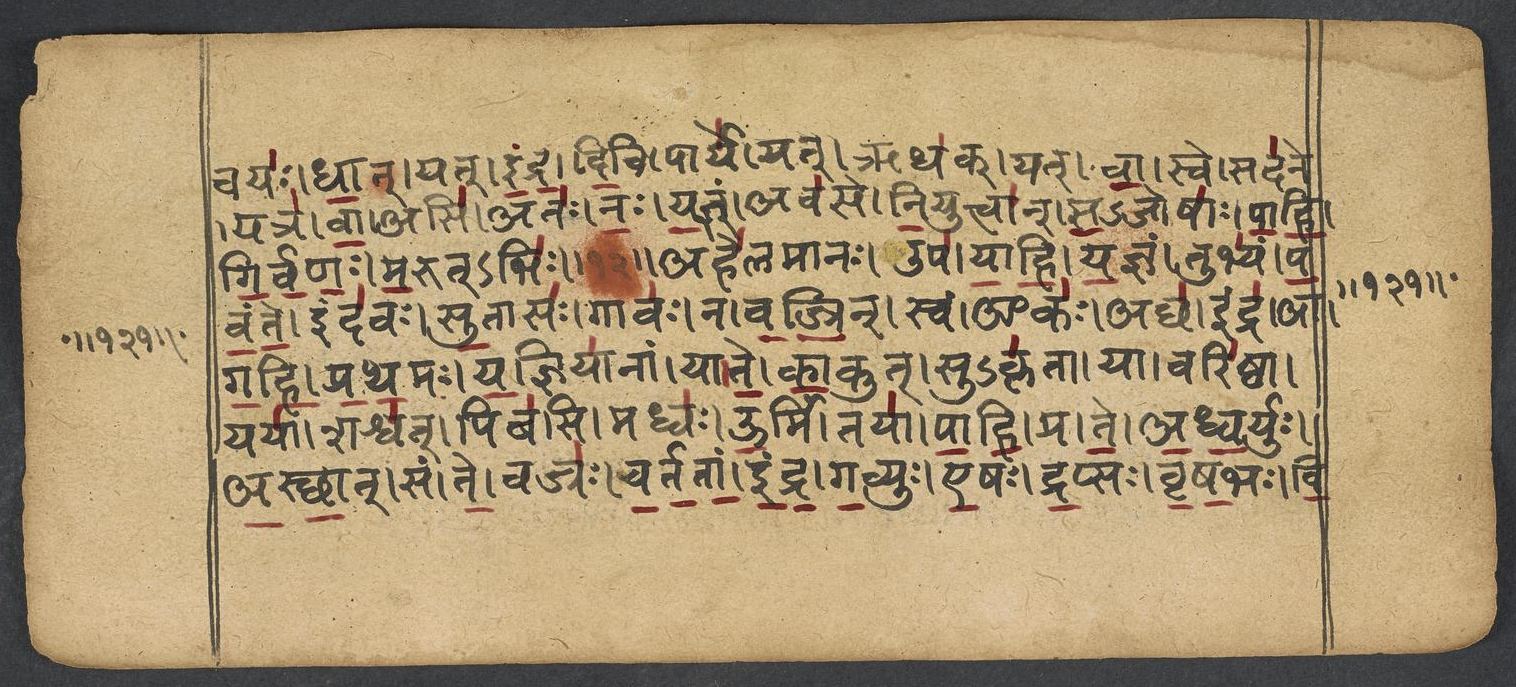
Where on the image
Penn Ms. Coll. 390 Item 41, fol. 448v (numbered 121v by the scribe) (OPenn image 449, upper leaf). Checked on the image: the Rigveda text on this page begins in RV 6.40.4 ‹vayaḥ dhāt›. The next page with Rigveda text, fol. 449r (numbered 122r by the scribe), begins in RV 6.41.3 ‹-viśva-rūpaḥ indrāya vṛṣṇe sam›. Verses 6.41.1-2 end on this page.
1ahe̍ḻamāna̱ upa̍ yāhi ya̱jñaṁ tubhya̍m pavanta̱ inda̍vaḥ su̱tāsa̍ḥ | gāvo̱ na va̍jri̱n svam oko̱ acchendrā ga̍hi pratha̱mo ya̱jñiyā̍nām ||
2yā te̍ kā̱kut sukṛ̍tā̱ yā vari̍ṣṭhā̱ yayā̱ śaśva̱t piba̍si̱ madhva̍ ū̱rmim | tayā̍ pāhi̱ pra te̍ adhva̱ryur a̍sthā̱t saṁ te̱ vajro̍ vartatām indra ga̱vyuḥ ||
Compare: Padapāṭha (word-by-word text written in the manuscript; Sansknet e-text via GRETIL)
1aheḷamānaḥ | upa | yāhi | yajñam | tubhyam | pavante | indavaḥ | sutāsaḥ | gāvaḥ | na | vājrin | svam | okaḥ | accha | indra | ā | gahi | prathamaḥ | yajñiyānām
2yā | te | kākut | su-kṛtā | yā | variṣṭhā | yayā | śaśvat | pibasi | madhvaḥ | ūrmim | tayā | pāhi | pra | te | adhvaryuḥ | asthāt | sam | te | vajraḥ | vartatām | indra | gavyuḥ
1COME gracious to our sacrifice, O Indra: pressed Soma-drops are purified to please thee. As cattle seek their home, so Thunderwielder, come, Indra, first of those who claim our worship.
2With that well-formed most wide-extending palate, wherewith thou ever drinkest streams of sweetness, Drink thou; the Adhvaryu standeth up before thee: let thy spoil-winning thunderbolt attend thee.
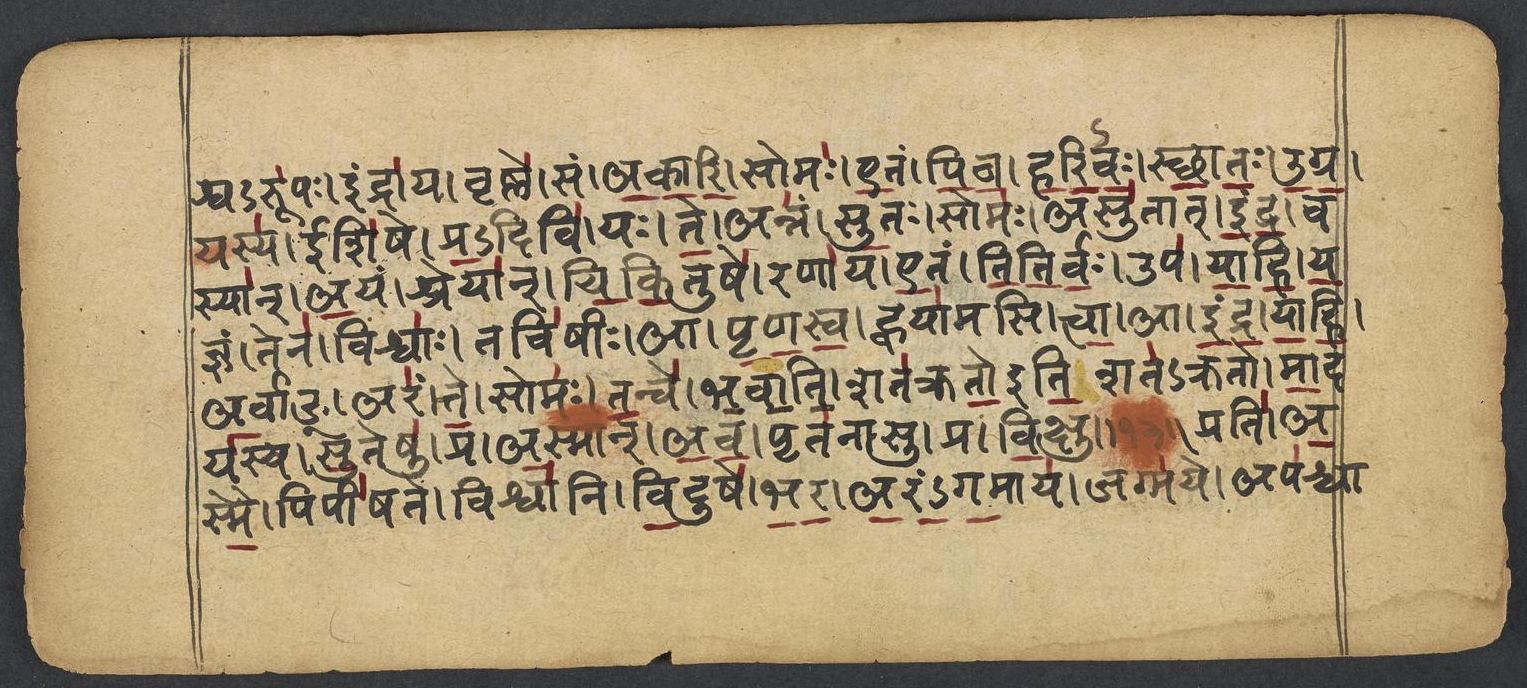
Where on the image
Penn Ms. Coll. 390 Item 41, fol. 449r (numbered 122r by the scribe) (OPenn image 449, lower leaf). Checked on the image: the Rigveda text on this page begins in RV 6.41.3 ‹-viśva-rūpaḥ indrāya vṛṣṇe sam›. The next page with Rigveda text, fol. 449v (numbered 122v by the scribe), begins in RV 6.42.1 ‹-apaścāt-daghvane nare›. Verses 6.41.3-5 end on this page; 6.41.3 begins on fol. 448v (numbered 121v by the scribe).
3e̱ṣa dra̱pso vṛ̍ṣa̱bho vi̱śvarū̍pa̱ indrā̍ya̱ vṛṣṇe̱ sam a̍kāri̱ soma̍ḥ | e̱tam pi̍ba harivaḥ sthātar ugra̱ yasyeśi̍ṣe pra̱divi̱ yas te̱ anna̍m ||
4su̱taḥ somo̱ asu̍tād indra̱ vasyā̍n a̱yaṁ śreyā̍ñ ciki̱tuṣe̱ raṇā̍ya | e̱taṁ ti̍tirva̱ upa̍ yāhi ya̱jñaṁ tena̱ viśvā̱s tavi̍ṣī̱r ā pṛ̍ṇasva ||
5hvayā̍masi̱ tvendra̍ yāhy a̱rvāṅ ara̍ṁ te̱ soma̍s ta̱nve̍ bhavāti | śata̍krato mā̱daya̍svā su̱teṣu̱ prāsmām̐ a̍va̱ pṛta̍nāsu̱ pra vi̱kṣu ||
Compare: Padapāṭha (word-by-word text written in the manuscript; Sansknet e-text via GRETIL)
3eṣaḥ | drapsaḥ | vṛṣabhaḥ | viśva-rūpaḥ | indrāya | vṛṣṇe | sam | akāri | somaḥ | etam | piba | hari-vaḥ | sthātaḥ | ugra | yasya | īśiṣe | pra-divi | yaḥ | te | annam
4sutaḥ | somaḥ | asutāt | indra | vasyān | ayam | śreyān | cikituṣe | raṇāya | etam | titirvaḥ | upa | yāhi | yajñam | tena | viśvāḥ | taviṣīḥ | ā | pṛṇasva
5hvayāmasi | tvā | ā | indra | yāhi | arvāṅ | aram | te | somaḥ | tanve | bhavāti | śatakrato itiśata-krato | mādayasva | suteṣu | pra | asmān | ava | pṛtanāsu | pra | vikṣu
3This drop, steer-strong and omniform, the Soma, hath been made ready for the Bull, for Indra. Drink this, Lord of the Bays, thou Strong Supporter, this that is thine of old, thy food for ever.
4Soma when pressed excels the unpressed Soma, better, for one who knows, to give him pleasure. Come to this sacrifice of ours, O Victor replenish all thy powers with this libation.
5We call on thee, O Indra: come thou hither: sufficient be the Soma for thy body. Rejoice thee, Ṣatakratu! in the juices guard us in wars, guard us among our people.
Notes
- Sanskrit: Aufrecht's edition (1877) with the Vedic accents, as entered by van Nooten and Holland (GRETIL).
- English: Ralph T. H. Griffith, The Hymns of the Rigveda (1889-1892; 2nd ed. 1896-1897), from the VedaWeb digital text; OCR slips in that text were corrected against the printed 2nd edition (data/sources/rigveda/griffith_errata.json).
- Padapāṭha (edition text): Sansknet e-text via GRETIL (CC BY-NC-SA 4.0).
Cite
Sources
- Source: Penn Ms. Coll. 390 Item 41 (undated (catalogued with Penn's 18th-19th c. Vedic manuscripts)), OPenn, Public Domain Mark + Aufrecht's accented text (GRETIL) + Griffith's English (VedaWeb) (holding institution)
- Critical edition: Aufrecht (1877), accented e-text via GRETIL
← previous · → next · v cycle view · l back to library