Rigveda 7.13: To Agni Vaisvanara
Introduction
Rigveda 7.13 is a hymn of 3 verses addressed to Agni Vaisvanara. It stands in book (maṇḍala) 7, the family book of Vasiṣṭha. The Rigveda is the oldest collection of Sanskrit hymns, composed in the second half of the second millennium BCE and handed down orally for many centuries before it was written down.
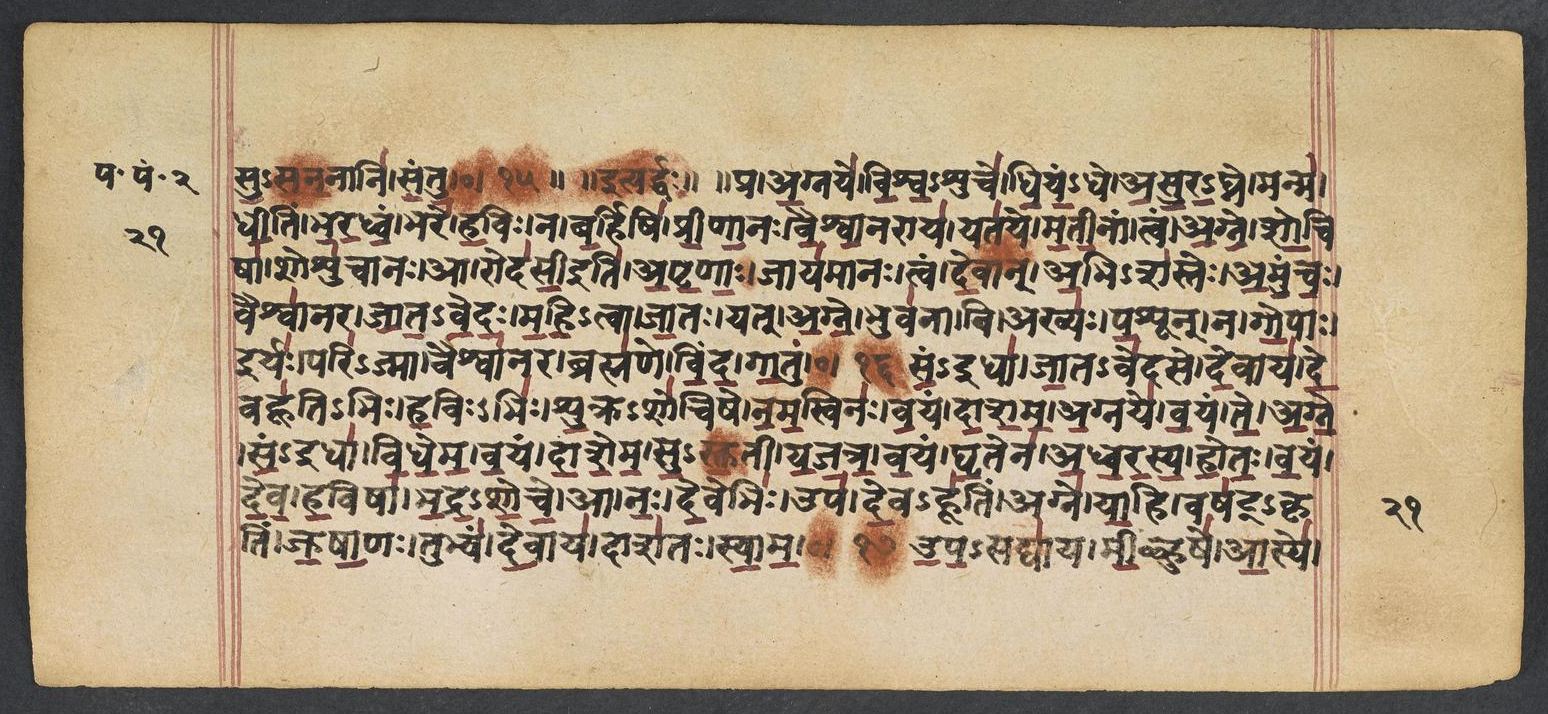
The manuscript shown is Penn Ms. Coll. 390 Item 41 (University of Pennsylvania), an undated paper manuscript of the padapāṭha (the word-by-word recitation text, in which every word is written separately and compounds are split) of the whole Ṛgveda in Devanāgarī, 884 leaves in fascicles, 7-9 lines to the page, accents in red; this hymn stands on fol. 500v. Each section below gives the verses that end on one page; the page boundaries were read on the images (the opening words of every page), not counted out. Where the manuscript is a padapāṭha (the word-by-word recitation text), the section shows Aufrecht's continuous (saṃhitā) text first and, as the edition text, the padapāṭha of the same verses, which is the form written on the page.
How was this verified? (Provenance)
Where on the image
Penn Ms. Coll. 390 Item 41, fol. 500v (numbered 21v by the scribe) (OPenn image 501, upper leaf). Checked on the image: the Rigveda text on this page begins in RV 7.12.3 ‹su-saṇanāni santu yūyam pāta›. The next page with Rigveda text, fol. 501r (numbered 22r by the scribe), begins in RV 7.15.1 ‹juhuta haviḥ yaḥ naḥ›. Verses 7.13.1-3 end on this page.
1prāgnaye̍ viśva̱śuce̍ dhiya̱ṁdhe̍ 'sura̱ghne manma̍ dhī̱tim bha̍radhvam | bhare̍ ha̱vir na ba̱rhiṣi̍ prīṇā̱no vai̍śvāna̱rāya̱ yata̍ye matī̱nām ||
2tvam a̍gne śo̱ciṣā̱ śośu̍cāna̱ ā roda̍sī apṛṇā̱ jāya̍mānaḥ | tvaṁ de̱vām̐ a̱bhiśa̍ster amuñco̱ vaiśvā̍nara jātavedo mahi̱tvā ||
3jā̱to yad a̍gne̱ bhuva̍nā̱ vy akhya̍ḥ pa̱śūn na go̱pā irya̱ḥ pari̍jmā | vaiśvā̍nara̱ brahma̍ṇe vinda gā̱tuṁ yū̱yam pā̍ta sva̱stibhi̱ḥ sadā̍ naḥ ||
Compare: Padapāṭha (word-by-word text written in the manuscript; Sansknet e-text via GRETIL)
1pra | agnaye | viśva-śuce | dhiyam-dhe | asura-ghne | manma | dhītim | bharadhvam | bhare | haviḥ | na | barhiṣi | prīṇānaḥ | vaiśvānarāya | yataye | matīnām
2tvam | agne | śociṣā | śośucānaḥ | ā | rodasī iti | apṛṇāḥ | jāyamānaḥ | tvam | devān | abhi-śasteḥ | amuñcaḥ | vaiśvānara | jāta-vedaḥ | mahi-tvā
3jātaḥ | yat | agne | bhuvanā | vi | akhyaḥ | paśūn | na | gopāḥ | iryaḥ | pari-jmā | vaiśvānara | brahmaṇe | vinda | gātum | yūyam | pāta | svasti-bhiḥ | sadā | naḥ
1BRING song and hymn to Agni, Asura-slayer, enlightener of all and thought-bestower. Like an oblation on the grass, to please him, I bring this to Vaiṣvânara, hymn-inspirer.
2Thou with thy flame, O Agni, brightly glowing, hast at thy birth filled full the earth and heaven. Thou with thy might, Vaiṣvânara Jâtavedas, settest the Gods free from the curse that bound them.
3Agni, when, born thou lookedst on all creatures, like a brisk herdsman moving round his cattle. The path to prayer, Vaiṣvânara, thou foundest. Ye Gods, preserve us evermore with blessings.
Notes
- Sanskrit: Aufrecht's edition (1877) with the Vedic accents, as entered by van Nooten and Holland (GRETIL).
- English: Ralph T. H. Griffith, The Hymns of the Rigveda (1889-1892; 2nd ed. 1896-1897), from the VedaWeb digital text; OCR slips in that text were corrected against the printed 2nd edition (data/sources/rigveda/griffith_errata.json).
- Padapāṭha (edition text): Sansknet e-text via GRETIL (CC BY-NC-SA 4.0).
Cite
Sources
- Source: Penn Ms. Coll. 390 Item 41 (undated (catalogued with Penn's 18th-19th c. Vedic manuscripts)), OPenn, Public Domain Mark + Aufrecht's accented text (GRETIL) + Griffith's English (VedaWeb) (holding institution)
- Critical edition: Aufrecht (1877), accented e-text via GRETIL
← previous · → next · v cycle view · l back to library