Rigveda 7.14: To Agni
Introduction
Rigveda 7.14 is a hymn of 3 verses addressed to Agni. It stands in book (maṇḍala) 7, the family book of Vasiṣṭha. The Rigveda is the oldest collection of Sanskrit hymns, composed in the second half of the second millennium BCE and handed down orally for many centuries before it was written down.
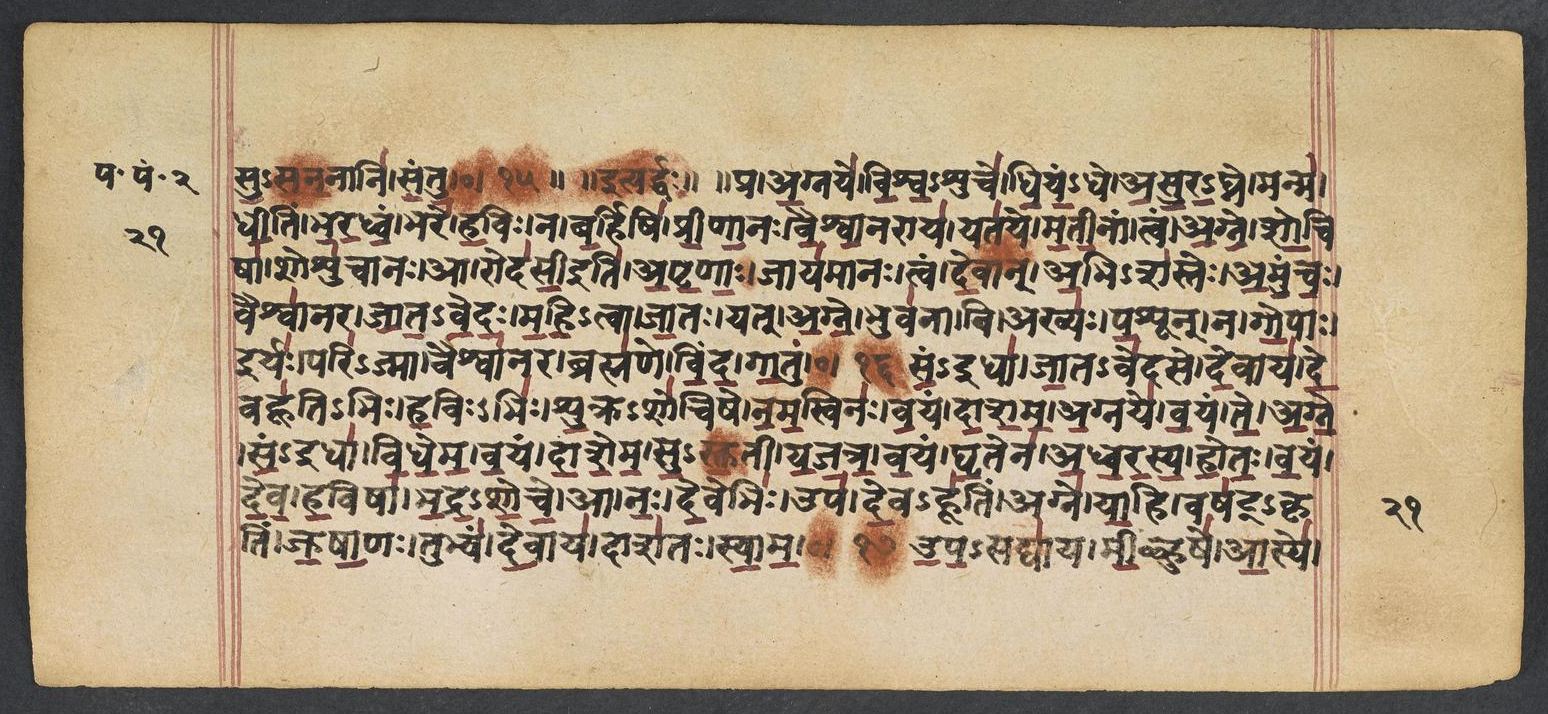
The manuscript shown is Penn Ms. Coll. 390 Item 41 (University of Pennsylvania), an undated paper manuscript of the padapāṭha (the word-by-word recitation text, in which every word is written separately and compounds are split) of the whole Ṛgveda in Devanāgarī, 884 leaves in fascicles, 7-9 lines to the page, accents in red; this hymn stands on fol. 500v. Each section below gives the verses that end on one page; the page boundaries were read on the images (the opening words of every page), not counted out. Where the manuscript is a padapāṭha (the word-by-word recitation text), the section shows Aufrecht's continuous (saṃhitā) text first and, as the edition text, the padapāṭha of the same verses, which is the form written on the page.
How was this verified? (Provenance)
Where on the image
Penn Ms. Coll. 390 Item 41, fol. 500v (numbered 21v by the scribe) (OPenn image 501, upper leaf). Checked on the image: the Rigveda text on this page begins in RV 7.12.3 ‹su-saṇanāni santu yūyam pāta›. The next page with Rigveda text, fol. 501r (numbered 22r by the scribe), begins in RV 7.15.1 ‹juhuta haviḥ yaḥ naḥ›. Verses 7.14.1-3 end on this page.
1sa̱midhā̍ jā̱tave̍dase de̱vāya̍ de̱vahū̍tibhiḥ | ha̱virbhi̍ḥ śu̱kraśo̍ciṣe nama̱svino̍ va̱yaṁ dā̍śemā̱gnaye̍ ||
2va̱yaṁ te̍ agne sa̱midhā̍ vidhema va̱yaṁ dā̍śema suṣṭu̱tī ya̍jatra | va̱yaṁ ghṛ̱tenā̍dhvarasya hotar va̱yaṁ de̍va ha̱viṣā̍ bhadraśoce ||
3ā no̍ de̱vebhi̱r upa̍ de̱vahū̍ti̱m agne̍ yā̱hi vaṣa̍ṭkṛtiṁ juṣā̱ṇaḥ | tubhya̍ṁ de̱vāya̱ dāśa̍taḥ syāma yū̱yam pā̍ta sva̱stibhi̱ḥ sadā̍ naḥ ||
Compare: Padapāṭha (word-by-word text written in the manuscript; Sansknet e-text via GRETIL)
1sam-idhā | jāta-vedase | devāya | deva-hūtibhiḥ | haviḥ-bhiḥ | śukra-śociṣe | namasvinaḥ | vayam | dāśema | agnaye
2vayam | te | agne | sam-idhā | vidhema | vayam | dāśema | su-stutī | yajatra | vayam | ghṛtena | adhvarasya | hotaḥ | vayam | deva | haviṣā | bhadra-śoce
3ā | naḥ | devebhiḥ | upa | deva-hūtim | agne | yāhi | vaṣaṭ-kṛtim | juṣāṇaḥ | tubhyam | devāya | dāśataḥ | syāma | yūyam | pāta | svasti-bhiḥ | sadā | naḥ
1WITH reverence and with offered gifts serve we the God whose flame is bright: Let us bring Jâtavedas fuel, and adore Agni when we invoke the Gods.
2Agni, may we perform thy rites with fuel, and honour thee, O Holy one, with praises: Honour thee, Priest of sacrifice! with butter, thee, God of blessed light! with our oblation.
3Come, Agni, with the Gods to our invoking, come, pleased, to offerings sanctified with Vashaṭ. May we be his who pays thee, God, due honour. Ye Gods, preserve us evermore with blessings.
Notes
- Sanskrit: Aufrecht's edition (1877) with the Vedic accents, as entered by van Nooten and Holland (GRETIL).
- English: Ralph T. H. Griffith, The Hymns of the Rigveda (1889-1892; 2nd ed. 1896-1897), from the VedaWeb digital text; OCR slips in that text were corrected against the printed 2nd edition (data/sources/rigveda/griffith_errata.json).
- Padapāṭha (edition text): Sansknet e-text via GRETIL (CC BY-NC-SA 4.0).
Cite
Sources
- Source: Penn Ms. Coll. 390 Item 41 (undated (catalogued with Penn's 18th-19th c. Vedic manuscripts)), OPenn, Public Domain Mark + Aufrecht's accented text (GRETIL) + Griffith's English (VedaWeb) (holding institution)
- Critical edition: Aufrecht (1877), accented e-text via GRETIL
← previous · → next · v cycle view · l back to library