Rigveda 7.46: To Rudra
Introduction
Rigveda 7.46 is a hymn of 4 verses addressed to Rudra. It stands in book (maṇḍala) 7, the family book of Vasiṣṭha. The Rigveda is the oldest collection of Sanskrit hymns, composed in the second half of the second millennium BCE and handed down orally for many centuries before it was written down.
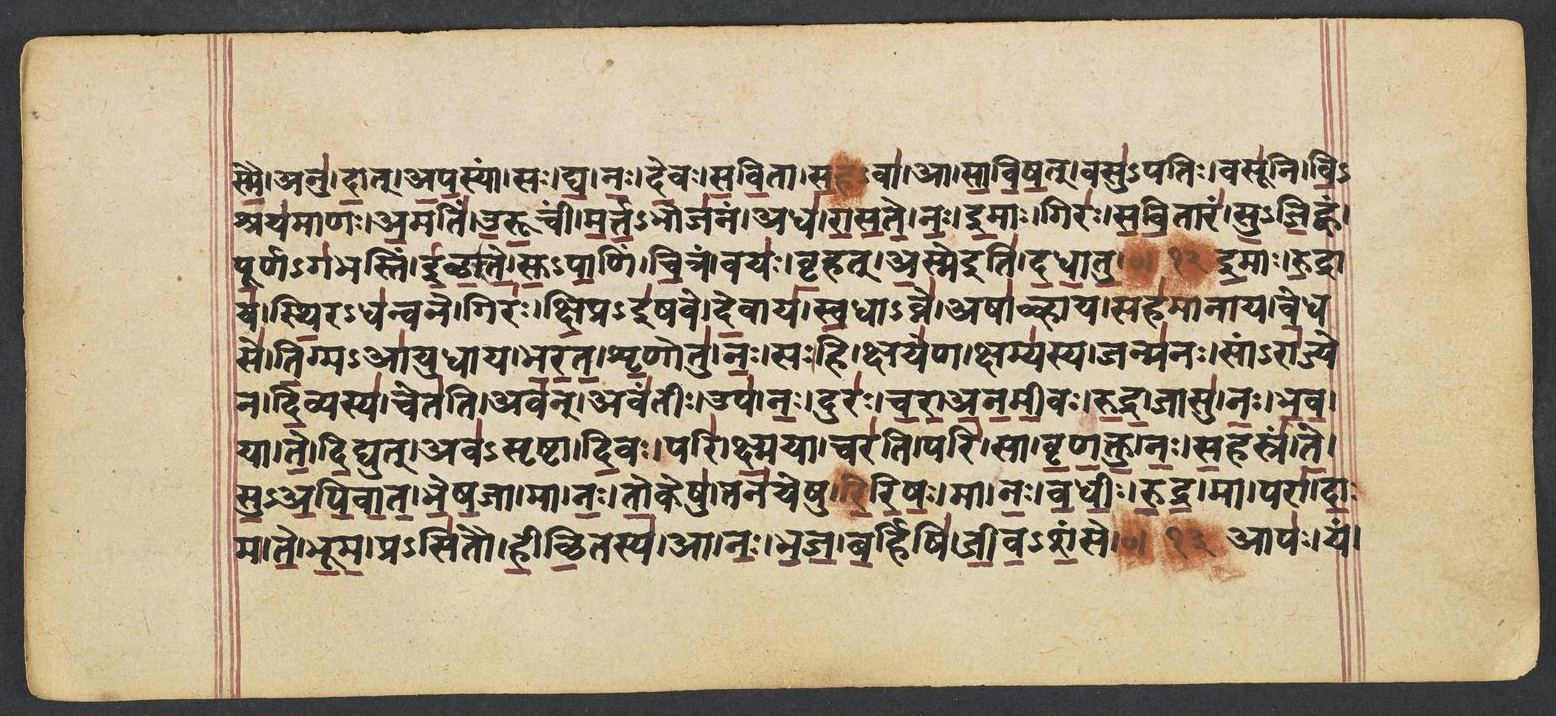
The manuscript shown is Penn Ms. Coll. 390 Item 41 (University of Pennsylvania), an undated paper manuscript of the padapāṭha (the word-by-word recitation text, in which every word is written separately and compounds are split) of the whole Ṛgveda in Devanāgarī, 884 leaves in fascicles, 7-9 lines to the page, accents in red; this hymn stands on fol. 524r. Each section below gives the verses that end on one page; the page boundaries were read on the images (the opening words of every page), not counted out. Where the manuscript is a padapāṭha (the word-by-word recitation text), the section shows Aufrecht's continuous (saṃhitā) text first and, as the edition text, the padapāṭha of the same verses, which is the form written on the page.
How was this verified? (Provenance)
Where on the image
Penn Ms. Coll. 390 Item 41, fol. 524r (numbered 45r by the scribe) (OPenn image 524, lower leaf). Checked on the image: the Rigveda text on this page begins in RV 7.45.2 ‹-asmai anu dāt apasyām›. The next page with Rigveda text, fol. 524v (numbered 45v by the scribe), begins in RV 7.47.1 ‹-yam vaḥ prathamam dava-yantaḥ›. Verses 7.46.1-4 end on this page.
1i̱mā ru̱drāya̍ sthi̱radha̍nvane̱ gira̍ḥ kṣi̱preṣa̍ve de̱vāya̍ sva̱dhāvne̍ | aṣā̍ḻhāya̱ saha̍mānāya ve̱dhase̍ ti̱gmāyu̍dhāya bharatā śṛ̱ṇotu̍ naḥ ||
2sa hi kṣaye̍ṇa̱ kṣamya̍sya̱ janma̍na̱ḥ sāmrā̍jyena di̱vyasya̱ ceta̍ti | ava̱nn ava̍ntī̱r upa̍ no̱ dura̍ś carānamī̱vo ru̍dra̱ jāsu̍ no bhava ||
3yā te̍ di̱dyud ava̍sṛṣṭā di̱vas pari̍ kṣma̱yā cara̍ti̱ pari̱ sā vṛ̍ṇaktu naḥ | sa̱hasra̍ṁ te svapivāta bheṣa̱jā mā na̍s to̱keṣu̱ tana̍yeṣu rīriṣaḥ ||
4mā no̍ vadhī rudra̱ mā parā̍ dā̱ mā te̍ bhūma̱ prasi̍tau hīḻi̱tasya̍ | ā no̍ bhaja ba̱rhiṣi̍ jīvaśa̱ṁse yū̱yam pā̍ta sva̱stibhi̱ḥ sadā̍ naḥ ||
Compare: Padapāṭha (word-by-word text written in the manuscript; Sansknet e-text via GRETIL)
1imāḥ | rudrāya | sthira-dhanvane | giraḥ | kṣipra-save | devāya | svadhāvne | aṣāḷhāya | sahamānāya | vedhase | tigma-āyudhāya | bharata | śṛṇotu | naḥ
2saḥ | hi | kṣayeṇa | kṣamyasya | janmanaḥ | sām-rājyena | divyasya | cetati | avan | avantīḥ | upa | naḥ | duraḥ | cara | anamīvaḥ | rudra | jāsu | naḥ | bhava
3yā | te | didyut | ava-sṛṣṭā | divaḥ | pari | kṣmayā | carati | pari | sā | vṛṇaktu | naḥ | sahasram | te | su-apivāta | bheṣajā | mā | naḥ | tokeṣu | tanayeṣu | ririṣaḥ
4mā | naḥ | vadhīḥ | rudra | mā | parā | dāḥ | mā | te | bhūma | pra-sitau | hīḷitasya | ā | naḥ | bhaja | barhiṣi | jīva-śaṃse | yūyam | pāta | svasti-bhiḥ | sadā | naḥ
1To Rudra bring these songs, whose bow is firm and strong, the self-dependent God with swiftlyflying shafts, The Wise, the Conqueror whom none may overcome, armed with sharp-pointed weapons: may he hear our call.
2He through his lordship thinks on beings of the earth, on heavenly beings through his high imperial sway. Come willingly to our doors that gladly welcome thee, and heal all sickness, Rudra., in our families.
3May thy bright arrow which, shot down by thee from heaven, flieth upon the earth, pass us uninjured by. Thou, very gracious God, hast thousand medicines: inflict no evil on our sons or progeny.
4Slay us not, nor abandon us, O Rudra let not thy noose, when thou art angry, seize us. Give us trimmed grass and fame among the living. Preserve us evermore, ye Gods, with blessings.
Notes
- Sanskrit: Aufrecht's edition (1877) with the Vedic accents, as entered by van Nooten and Holland (GRETIL).
- English: Ralph T. H. Griffith, The Hymns of the Rigveda (1889-1892; 2nd ed. 1896-1897), from the VedaWeb digital text; OCR slips in that text were corrected against the printed 2nd edition (data/sources/rigveda/griffith_errata.json).
- Padapāṭha (edition text): Sansknet e-text via GRETIL (CC BY-NC-SA 4.0).
Cite
Sources
- Source: Penn Ms. Coll. 390 Item 41 (undated (catalogued with Penn's 18th-19th c. Vedic manuscripts)), OPenn, Public Domain Mark + Aufrecht's accented text (GRETIL) + Griffith's English (VedaWeb) (holding institution)
- Critical edition: Aufrecht (1877), accented e-text via GRETIL
← previous · → next · v cycle view · l back to library