Rigveda 7.45: To Savitri
Introduction
Rigveda 7.45 is a hymn of 4 verses addressed to Savitri. It stands in book (maṇḍala) 7, the family book of Vasiṣṭha. The Rigveda is the oldest collection of Sanskrit hymns, composed in the second half of the second millennium BCE and handed down orally for many centuries before it was written down.
The manuscript shown is Penn Ms. Coll. 390 Item 41 (University of Pennsylvania), an undated paper manuscript of the padapāṭha (the word-by-word recitation text, in which every word is written separately and compounds are split) of the whole Ṛgveda in Devanāgarī, 884 leaves in fascicles, 7-9 lines to the page, accents in red; this hymn stands on fol. 523v-524r. Each section below gives the verses that end on one page; the page boundaries were read on the images (the opening words of every page), not counted out. Where the manuscript is a padapāṭha (the word-by-word recitation text), the section shows Aufrecht's continuous (saṃhitā) text first and, as the edition text, the padapāṭha of the same verses, which is the form written on the page.
How was this verified? (Provenance)
Where on the image
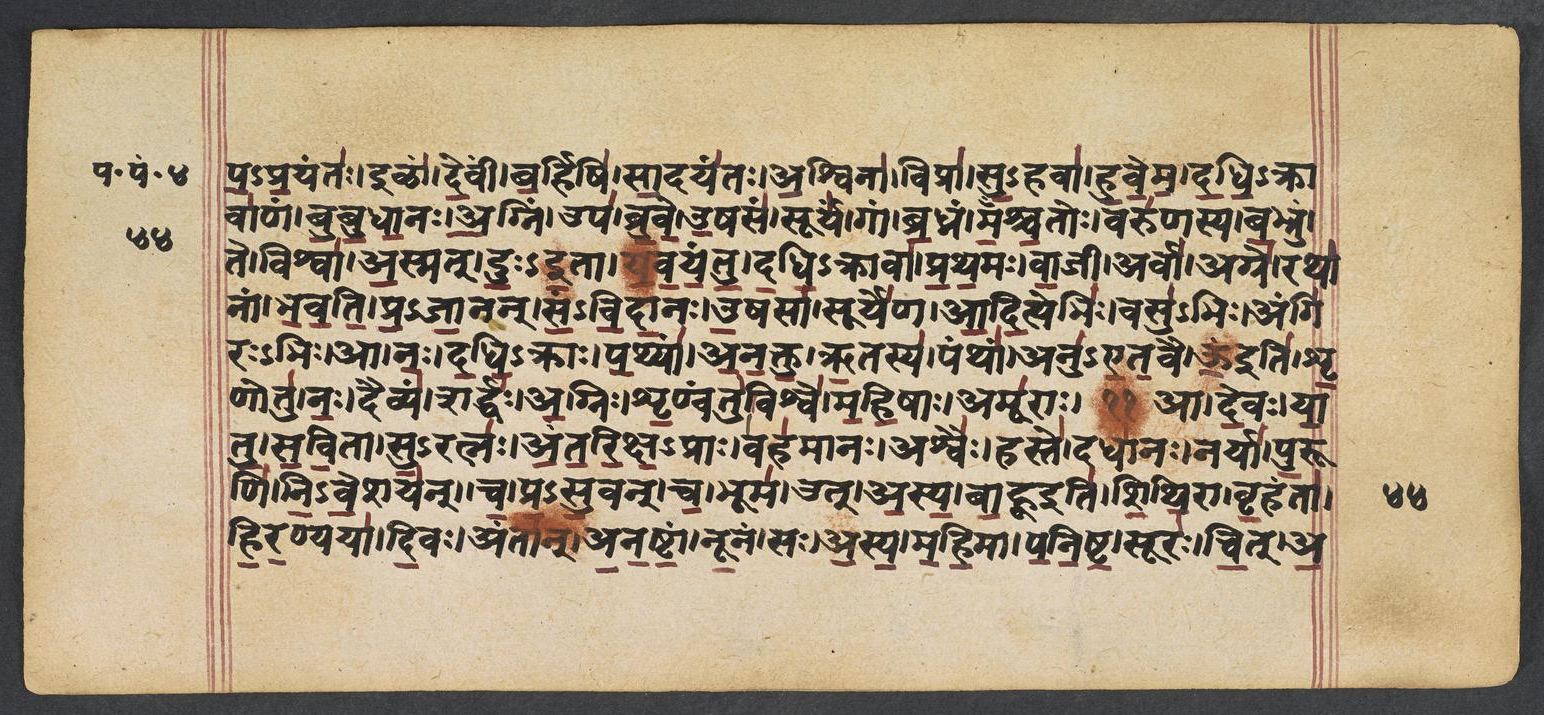
Penn Ms. Coll. 390 Item 41, fol. 523v (numbered 44v by the scribe) (OPenn image 524, upper leaf). Checked on the image: the Rigveda text on this page begins in RV 7.44.2 ‹-upa-prayantaḥ iḷām devīm barhiṣi›. The next page with Rigveda text, fol. 524r (numbered 45r by the scribe), begins in RV 7.45.2 ‹-asmai anu dāt apasyām›. Verse 7.45.1 ends on this page.
1ā de̱vo yā̍tu savi̱tā su̱ratno̍ 'ntarikṣa̱prā vaha̍māno̱ aśvai̍ḥ | haste̱ dadhā̍no̱ naryā̍ pu̱rūṇi̍ nive̱śaya̍ñ ca prasu̱vañ ca̱ bhūma̍ ||
Compare: Padapāṭha (word-by-word text written in the manuscript; Sansknet e-text via GRETIL)
1ā | devaḥ | yātu | savitā | su-ratnaḥ | antarikṣa-prāḥ | vahamānaḥ | aśvaiḥ | haste | dadhānaḥ | naryā | purūṇi | ni-veśayan | ca | pra-suvan | ca | bhūma
1MAY the God Savitar, rich in goodly treasures, filling the region, borne by steeds, come hither, In his hand holding much that makes men happy, lulling to slumber and arousing creatures.
Where on the image
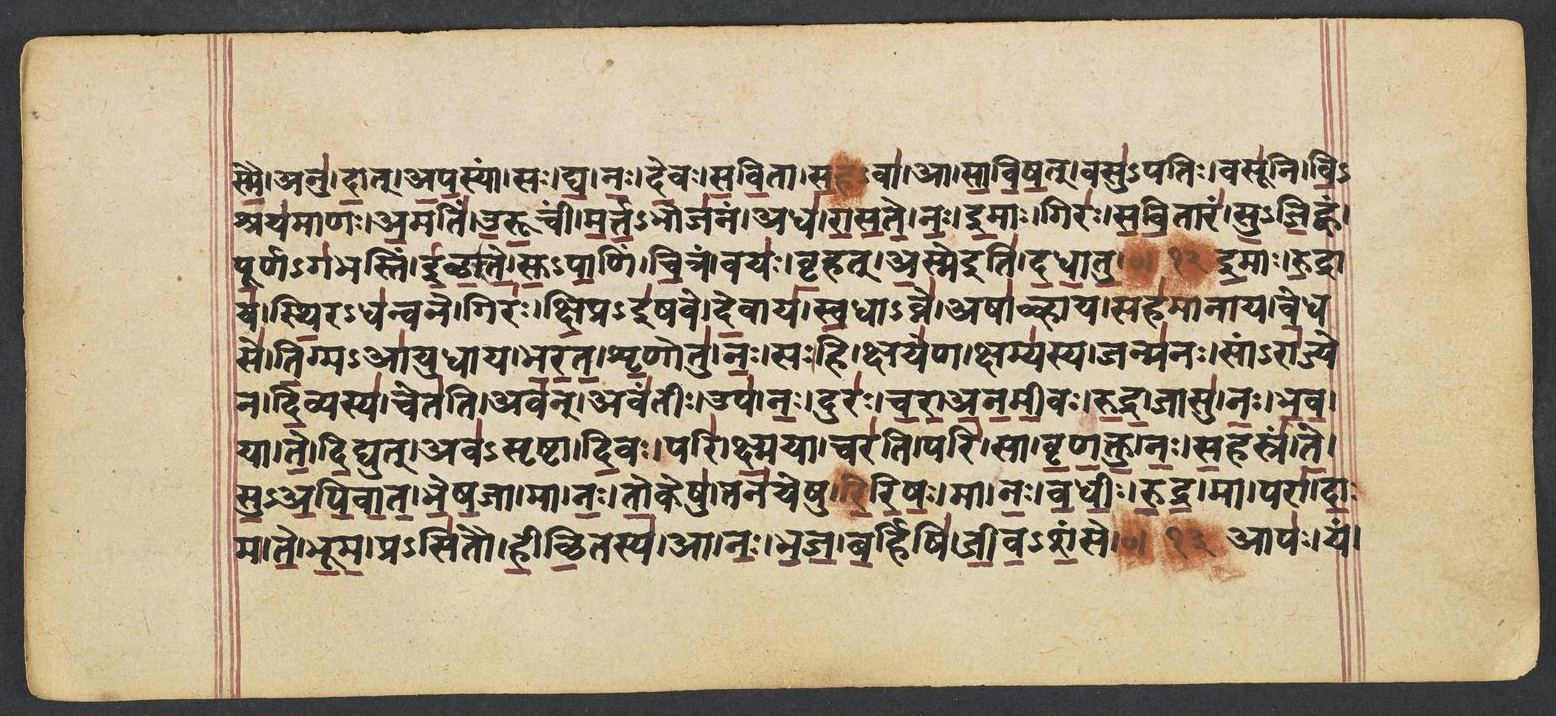
Penn Ms. Coll. 390 Item 41, fol. 524r (numbered 45r by the scribe) (OPenn image 524, lower leaf). Checked on the image: the Rigveda text on this page begins in RV 7.45.2 ‹-asmai anu dāt apasyām›. The next page with Rigveda text, fol. 524v (numbered 45v by the scribe), begins in RV 7.47.1 ‹-yam vaḥ prathamam dava-yantaḥ›. Verses 7.45.2-4 end on this page; 7.45.2 begins on fol. 523v (numbered 44v by the scribe).
2ud a̍sya bā̱hū śi̍thi̱rā bṛ̱hantā̍ hira̱ṇyayā̍ di̱vo antā̍m̐ anaṣṭām | nū̱naṁ so a̍sya mahi̱mā pa̍niṣṭa̱ sūra̍ś cid asmā̱ anu̍ dād apa̱syām ||
3sa ghā̍ no de̱vaḥ sa̍vi̱tā sa̱hāvā sā̍viṣa̱d vasu̍pati̱r vasū̍ni | vi̱śraya̍māṇo a̱mati̍m urū̱cīm ma̍rta̱bhoja̍na̱m adha̍ rāsate naḥ ||
4i̱mā gira̍ḥ savi̱tāra̍ṁ suji̱hvam pū̱rṇaga̍bhastim īḻate supā̱ṇim | ci̱traṁ vayo̍ bṛ̱had a̱sme da̍dhātu yū̱yam pā̍ta sva̱stibhi̱ḥ sadā̍ naḥ ||
Compare: Padapāṭha (word-by-word text written in the manuscript; Sansknet e-text via GRETIL)
2ut | asya | bāhū iti | śithirā | bṛhantā | hiraṇyayā | divaḥ | antān | anaṣṭām | nūnam | saḥ | asya | mahimā | paniṣṭa | sūraḥ | cit | asmai | anu | dāt | apasyām
3saḥ | gha | naḥ | devaḥ | savitā | saha-vā | ā | sāviṣat | vasu-patiḥ | vasūni | vi-śrayamāṇaḥ | amatim | urūcīm | marta-bhojanam | adha | rāsate | naḥ
4imāḥ | giraḥ | savitāram | su-jihvam | pūrṇa-gabhastim | īḷate | su-pāṇim | citram | vayaḥ | bṛhat | asme iti | dadhātu | yūyam | pāta | svasti-bhiḥ | sadā | naḥ
2Golden, sublime, and easy in their motion, his arms extend unto the bounds of heaven. Now shall that mightiness of his he lauded: even Sûrya yields to him in active vigour.
3May this God Savitar, the Strong and Mighty, the Lord of precious wealth, vouchsafe us treasures. May he, advancing his far-spreading lustre, bestow on us the food that feedeth mortals.
4These songs praise Savitar whose tongue is pleasant, praise him whose arms are full, whose hands are lovely. High vital strength, and manifold, may he grant us. Preserve us evermore, ye Gods, with blessings.
Notes
- Sanskrit: Aufrecht's edition (1877) with the Vedic accents, as entered by van Nooten and Holland (GRETIL).
- English: Ralph T. H. Griffith, The Hymns of the Rigveda (1889-1892; 2nd ed. 1896-1897), from the VedaWeb digital text; OCR slips in that text were corrected against the printed 2nd edition (data/sources/rigveda/griffith_errata.json).
- Padapāṭha (edition text): Sansknet e-text via GRETIL (CC BY-NC-SA 4.0).
Cite
Sources
- Source: Penn Ms. Coll. 390 Item 41 (undated (catalogued with Penn's 18th-19th c. Vedic manuscripts)), OPenn, Public Domain Mark + Aufrecht's accented text (GRETIL) + Griffith's English (VedaWeb) (holding institution)
- Critical edition: Aufrecht (1877), accented e-text via GRETIL
← previous · → next · v cycle view · l back to library