Rigveda 7.54: To Vastospati
Introduction
Rigveda 7.54 is a hymn of 3 verses addressed to Vastospati. It stands in book (maṇḍala) 7, the family book of Vasiṣṭha. The Rigveda is the oldest collection of Sanskrit hymns, composed in the second half of the second millennium BCE and handed down orally for many centuries before it was written down.
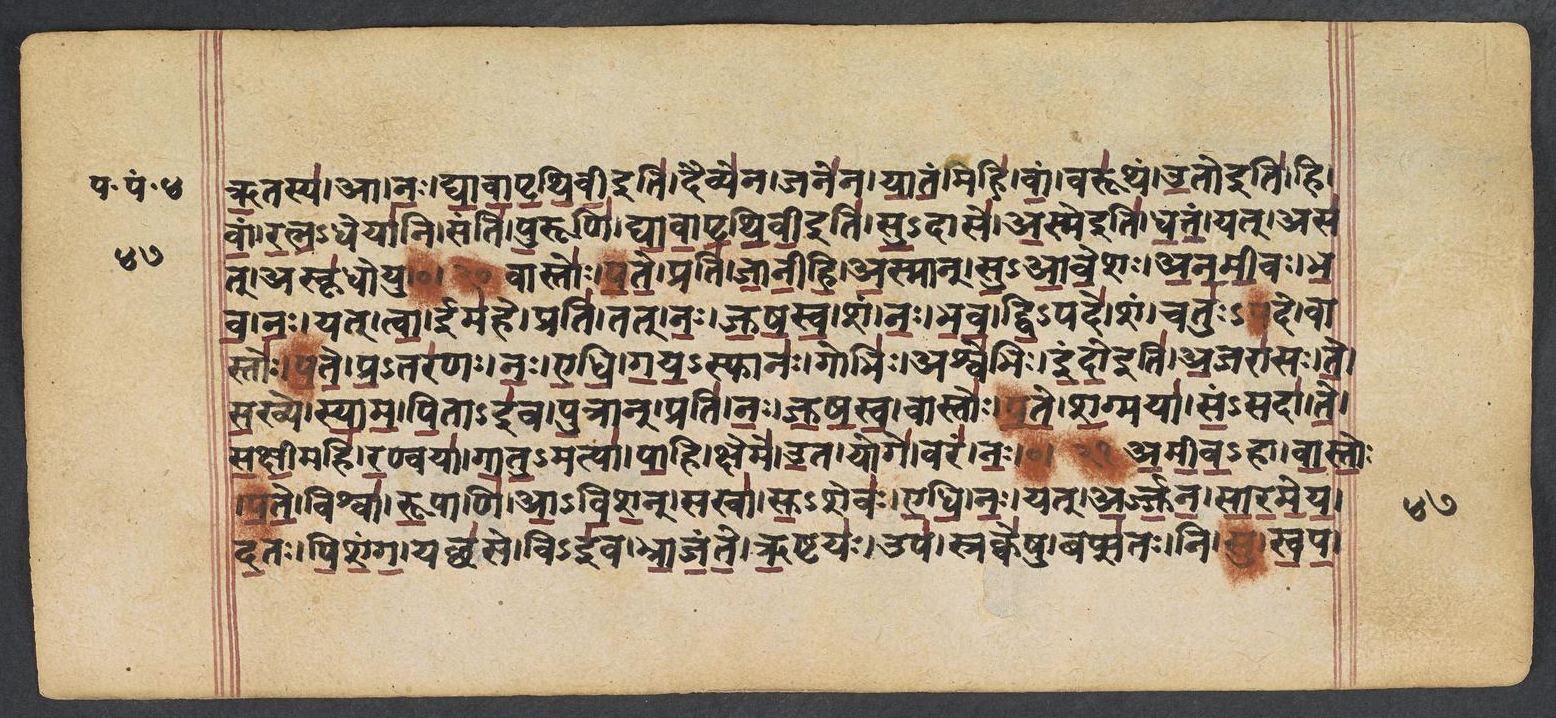
The manuscript shown is Penn Ms. Coll. 390 Item 41 (University of Pennsylvania), an undated paper manuscript of the padapāṭha (the word-by-word recitation text, in which every word is written separately and compounds are split) of the whole Ṛgveda in Devanāgarī, 884 leaves in fascicles, 7-9 lines to the page, accents in red; this hymn stands on fol. 526v. Each section below gives the verses that end on one page; the page boundaries were read on the images (the opening words of every page), not counted out. Where the manuscript is a padapāṭha (the word-by-word recitation text), the section shows Aufrecht's continuous (saṃhitā) text first and, as the edition text, the padapāṭha of the same verses, which is the form written on the page.
How was this verified? (Provenance)
Where on the image
Penn Ms. Coll. 390 Item 41, fol. 526v (numbered 47v by the scribe) (OPenn image 527, upper leaf). Checked on the image: the Rigveda text on this page begins in RV 7.53.2 ‹ṛtasya ā naḥ dyāvāpṛthivī›. The next page with Rigveda text, fol. 527r (numbered 48r by the scribe), begins in RV 7.55.3 ‹stenam rāya sārameya taskaram›. Verses 7.54.1-3 end on this page.
1vāsto̍ṣ pate̱ prati̍ jānīhy a̱smān svā̍ve̱śo a̍namī̱vo bha̍vā naḥ | yat tvema̍he̱ prati̱ tan no̍ juṣasva̱ śaṁ no̍ bhava dvi̱pade̱ śaṁ catu̍ṣpade ||
2vāsto̍ṣ pate pra̱tara̍ṇo na edhi gaya̱sphāno̱ gobhi̱r aśve̍bhir indo | a̱jarā̍sas te sa̱khye syā̍ma pi̱teva̍ pu̱trān prati̍ no juṣasva ||
3vāsto̍ṣ pate śa̱gmayā̍ sa̱ṁsadā̍ te sakṣī̱mahi̍ ra̱ṇvayā̍ gātu̱matyā̍ | pā̱hi kṣema̍ u̱ta yoge̱ vara̍ṁ no yū̱yam pā̍ta sva̱stibhi̱ḥ sadā̍ naḥ ||
Compare: Padapāṭha (word-by-word text written in the manuscript; Sansknet e-text via GRETIL)
1vāstoḥ | pate | prati | jānīhi | asmān | su-āveśaḥ | anamīvaḥ | bhava | naḥ | yat | tvā | īmahe | prati | tat | naḥ | juṣasva | śam | naḥ | bhava | dvi-pade | śam | catuḥ-pade
2vāstoḥ | pate | pra-taraṇaḥ | naḥ | edhi | gaya-sphānaḥ | gobhiḥ | aśvebhiḥ | indo iti | ajarāsaḥ | te | sakhye | syāma | pitāiva | putrān | prati | naḥ | juṣasva
3vāstoḥ | pate | śagmayā | sam-sadā | te | sakṣīmahi | raṇvayā | gātu-matyā | pāhi | kṣeme | uta | yoge | varam | naḥ | yūyam | pāta | svasti-bhiḥ | sadā | naḥ
1ACKNOWLEDGE us, O Guardian of the Homestead: bring no disease, and give us happy entrance. Whate'er we ask of thee, be pleased to grant it, and prosper thou quadrupeds and bipeds.
2Protector of the Home, be our promoter: increase our wealth in kine and steeds, O Indu. May we be ever-youthful in thy friendship: be pleased in us as in his sons a father.
3Through thy dear fellowship that bringeth welfare, may we be victors, Guardian of the Dwelling! Protect our happiness in rest and labour. Preserve us evermore, ye Gods, with blessings.
Notes
- Sanskrit: Aufrecht's edition (1877) with the Vedic accents, as entered by van Nooten and Holland (GRETIL).
- English: Ralph T. H. Griffith, The Hymns of the Rigveda (1889-1892; 2nd ed. 1896-1897), from the VedaWeb digital text; OCR slips in that text were corrected against the printed 2nd edition (data/sources/rigveda/griffith_errata.json).
- Padapāṭha (edition text): Sansknet e-text via GRETIL (CC BY-NC-SA 4.0).
Cite
Sources
- Source: Penn Ms. Coll. 390 Item 41 (undated (catalogued with Penn's 18th-19th c. Vedic manuscripts)), OPenn, Public Domain Mark + Aufrecht's accented text (GRETIL) + Griffith's English (VedaWeb) (holding institution)
- Critical edition: Aufrecht (1877), accented e-text via GRETIL
← previous · → next · v cycle view · l back to library