Rigveda 7.55: Lullaby
Introduction
Rigveda 7.55 is a hymn of 8 verses addressed to lullaby. It stands in book (maṇḍala) 7, the family book of Vasiṣṭha. The Rigveda is the oldest collection of Sanskrit hymns, composed in the second half of the second millennium BCE and handed down orally for many centuries before it was written down.
The manuscript shown is Penn Ms. Coll. 390 Item 41 (University of Pennsylvania), an undated paper manuscript of the padapāṭha (the word-by-word recitation text, in which every word is written separately and compounds are split) of the whole Ṛgveda in Devanāgarī, 884 leaves in fascicles, 7-9 lines to the page, accents in red; this hymn stands on fol. 526v-527r. Each section below gives the verses that end on one page; the page boundaries were read on the images (the opening words of every page), not counted out. Where the manuscript is a padapāṭha (the word-by-word recitation text), the section shows Aufrecht's continuous (saṃhitā) text first and, as the edition text, the padapāṭha of the same verses, which is the form written on the page.
How was this verified? (Provenance)
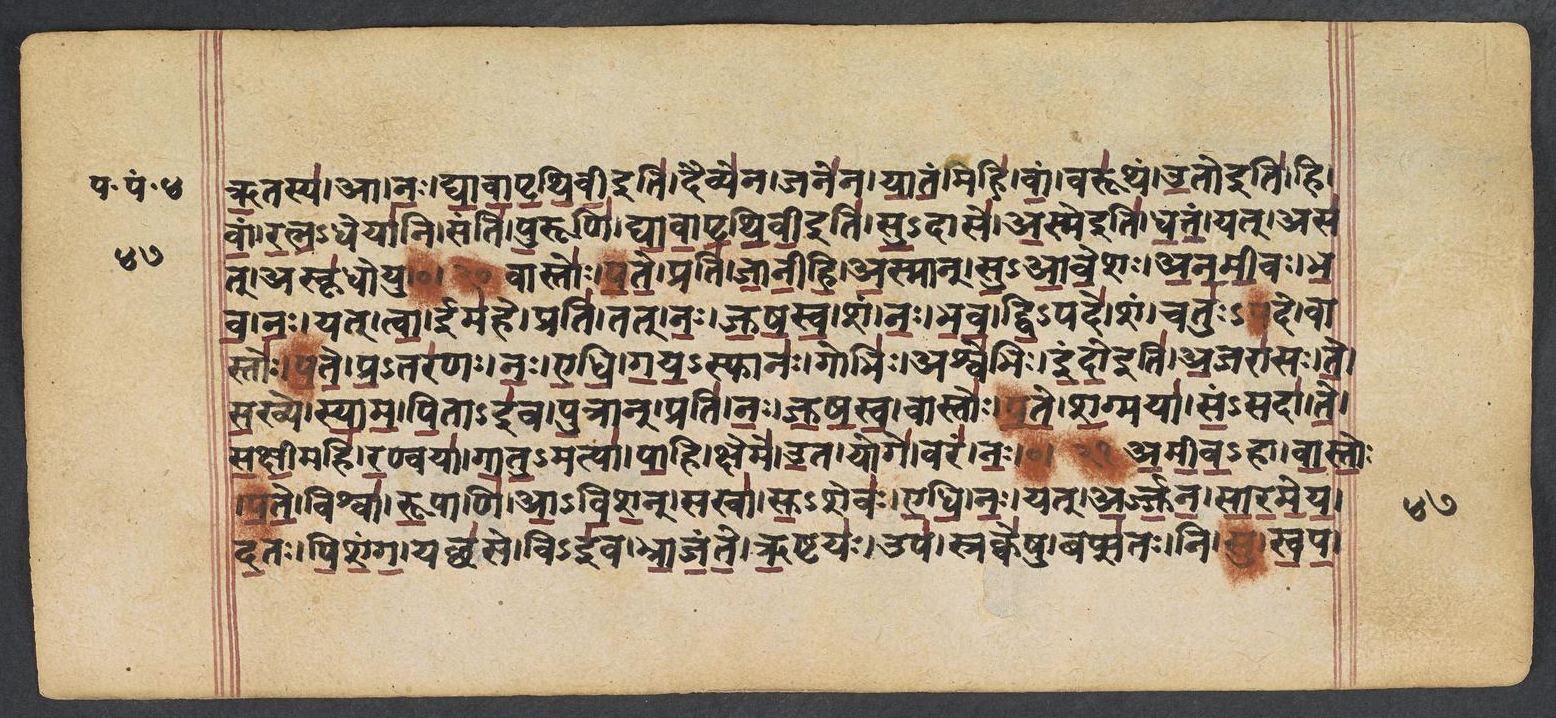
Where on the image
Penn Ms. Coll. 390 Item 41, fol. 526v (numbered 47v by the scribe) (OPenn image 527, upper leaf). Checked on the image: the Rigveda text on this page begins in RV 7.53.2 ‹ṛtasya ā naḥ dyāvāpṛthivī›. The next page with Rigveda text, fol. 527r (numbered 48r by the scribe), begins in RV 7.55.3 ‹stenam rāya sārameya taskaram›. Verses 7.55.1-2 end on this page.
1a̱mī̱va̱hā vā̍stoṣ pate̱ viśvā̍ rū̱pāṇy ā̍vi̱śan | sakhā̍ su̱śeva̍ edhi naḥ ||
2yad a̍rjuna sārameya da̱taḥ pi̍śaṅga̱ yaccha̍se | vī̍va bhrājanta ṛ̱ṣṭaya̱ upa̱ srakve̍ṣu̱ bapsa̍to̱ ni ṣu sva̍pa ||
Compare: Padapāṭha (word-by-word text written in the manuscript; Sansknet e-text via GRETIL)
1amīva-hā | vāstoḥ | pate | viśvā | rūpāṇi | āviśan | sakhā | su-śevaḥ | edhi | naḥ
2yat | arjuna | sārameya | dataḥ | piśaṅga | yacchase | vi-iva | bhrājante | ṛṣṭayaḥ | upa | srakveṣu | ni | su | svapa
1VÂSTOSHPATI, who killest all disease and wearest every form, Be an auspicious Friend to us.
2When, O bright Son of Saramâ, thou showest, tawny-hued! thy teeth, They gleam like lances' points within thy mouth when thou wouldst bite; go thou to steep.
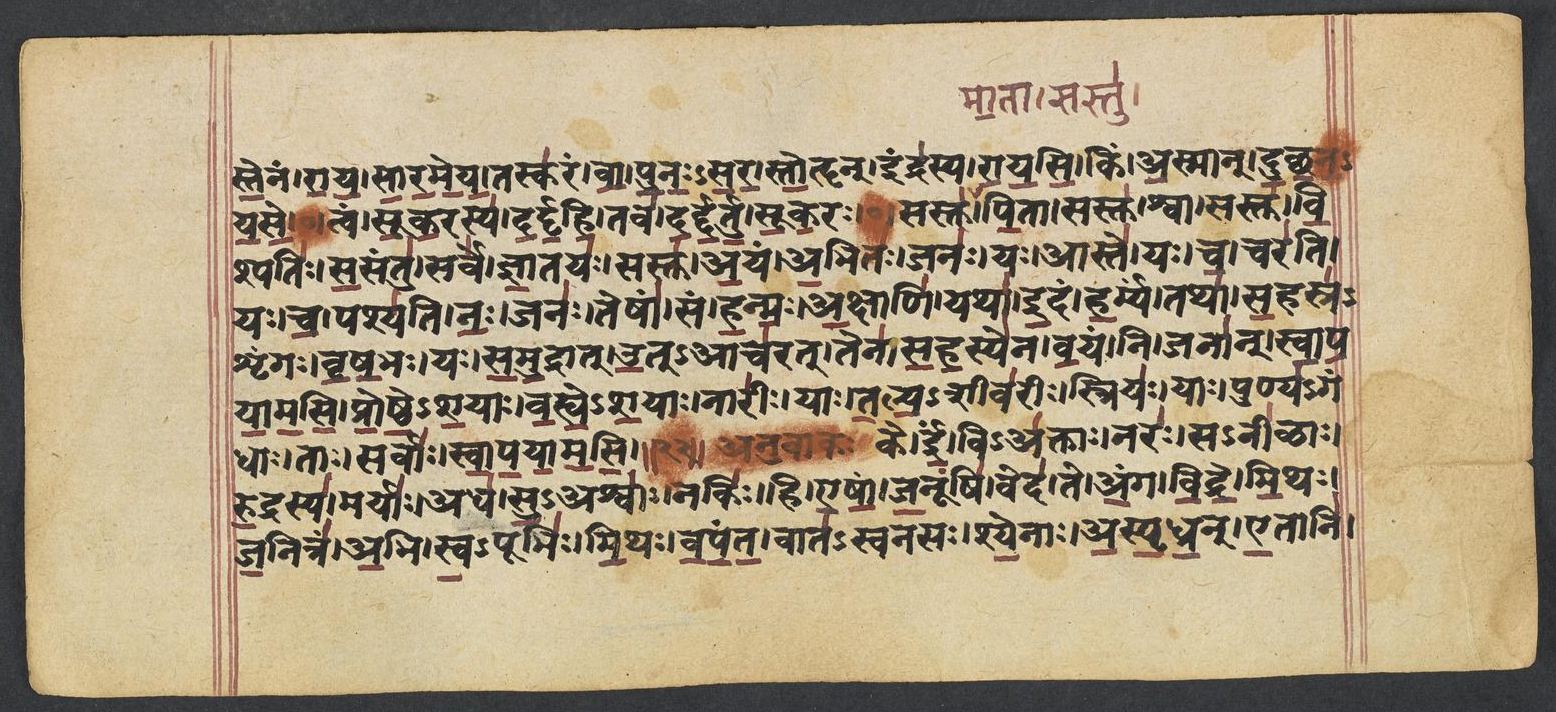
Where on the image
Penn Ms. Coll. 390 Item 41, fol. 527r (numbered 48r by the scribe) (OPenn image 527, lower leaf). Checked on the image: the Rigveda text on this page begins in RV 7.55.3 ‹stenam rāya sārameya taskaram›. The next page with Rigveda text, fol. 527v (numbered 48v by the scribe), begins in RV 7.56.4 ‹dhīraḥ niṇyā ciketa pṛśniḥ›. Verses 7.55.3-8 end on this page.
3ste̱naṁ rā̍ya sārameya̱ taska̍raṁ vā punaḥsara | sto̱tṝn indra̍sya rāyasi̱ kim a̱smān du̍cchunāyase̱ ni ṣu sva̍pa ||
4tvaṁ sū̍ka̱rasya̍ dardṛhi̱ tava̍ dardartu sūka̱raḥ | sto̱tṝn indra̍sya rāyasi̱ kim a̱smān du̍cchunāyase̱ ni ṣu sva̍pa ||
5sastu̍ mā̱tā sastu̍ pi̱tā sastu̱ śvā sastu̍ vi̱śpati̍ḥ | sa̱santu̱ sarve̍ jñā̱taya̱ḥ sastv a̱yam a̱bhito̱ jana̍ḥ ||
6ya āste̱ yaś ca̱ cara̍ti̱ yaś ca̱ paśya̍ti no̱ jana̍ḥ | teṣā̱ṁ saṁ ha̍nmo a̱kṣāṇi̱ yathe̱daṁ ha̱rmyaṁ tathā̍ ||
7sa̱hasra̍śṛṅgo vṛṣa̱bho yaḥ sa̍mu̱drād u̱dāca̍rat | tenā̍ saha̱sye̍nā va̱yaṁ ni janā̍n svāpayāmasi ||
8pro̱ṣṭhe̱śa̱yā va̍hyeśa̱yā nārī̱r yās ta̍lpa̱śīva̍rīḥ | striyo̱ yāḥ puṇya̍gandhā̱s tāḥ sarvā̍ḥ svāpayāmasi ||
Compare: Padapāṭha (word-by-word text written in the manuscript; Sansknet e-text via GRETIL)
3stenam | rāya | sārameya | taskaram | vā | punaḥ-sara | stotṝn | indrasya | rāyasi | kim | asmān | ducchuna-yase | ni | su | svapa
4tvam | sūkarasya | dadṛhi | tava | dardartu | sūkaraḥ | stotṝn | indrasya | rāyasi | kim | asmān | ducchuna-yase | ni | su | svapa
5sastu | mātā | sastu | pitā | sastu | śvā | sastu | viśpatiḥ | sasantu | sarve | jñātayaḥ | sastu | ayam | abhitaḥ | janaḥ
6yaḥ | āste | yaḥ | ca | carati | yaḥ | ca | paśyati | naḥ | janaḥ | teṣām | sam | hanmaḥ | akṣāṇi | yathā | idam | harmyam | tathā
7sahasra-śṛṅgaḥ | vṛṣabhaḥ | yaḥ | samudrāt | ut-ācarat | tena | sahasyena | vayam | ni | janān | svāpayāmasi
8proṣṭhe--śayāḥ | vahye--śayāḥ | nārīḥ | yāḥ | talpa-śīvarīḥ | sriyaḥ | yāḥ | puṇya-gandhāḥ | tāḥ | sarvāḥ | svāpayāmasi
3Saramâ's Son, retrace thy way: bark at the robber and the thief. At Indra's singers barkest thou? Why dust thou seek to terrify us? Go to sleep.
4Be on thy guard against the boar, and let the boar beware of thee. At Indra's singers barkest thou? Why dost thou seek to terrify us? Go to sleep.
5Sleep mother, let the father sleep, sleep dog and master of the house. Let all the kinsmen sleep, sleep all the people who are round about.
6The man who sits, the man who walks, and whosoever looks on us, Of these we closely shut the eyes, even as we closely shut this house.
7The Bull who hath a thousand horns, who rises up from out the sea,– By him the Strong and Mighty One we lull and make the people sleep.
8The women sleeping in the court, lying without, or stretched on beds, The matrons with their odorous sweetsthese, one and all, we lull to sleep.
Notes
- Sanskrit: Aufrecht's edition (1877) with the Vedic accents, as entered by van Nooten and Holland (GRETIL).
- English: Ralph T. H. Griffith, The Hymns of the Rigveda (1889-1892; 2nd ed. 1896-1897), from the VedaWeb digital text; OCR slips in that text were corrected against the printed 2nd edition (data/sources/rigveda/griffith_errata.json).
- Padapāṭha (edition text): Sansknet e-text via GRETIL (CC BY-NC-SA 4.0).
Cite
Sources
- Source: Penn Ms. Coll. 390 Item 41 (undated (catalogued with Penn's 18th-19th c. Vedic manuscripts)), OPenn, Public Domain Mark + Aufrecht's accented text (GRETIL) + Griffith's English (VedaWeb) (holding institution)
- Critical edition: Aufrecht (1877), accented e-text via GRETIL
← previous · → next · v cycle view · l back to library