Rigveda 7.58: To the Maruts
Introduction
Rigveda 7.58 is a hymn of 6 verses addressed to the Maruts. It stands in book (maṇḍala) 7, the family book of Vasiṣṭha. The Rigveda is the oldest collection of Sanskrit hymns, composed in the second half of the second millennium BCE and handed down orally for many centuries before it was written down.
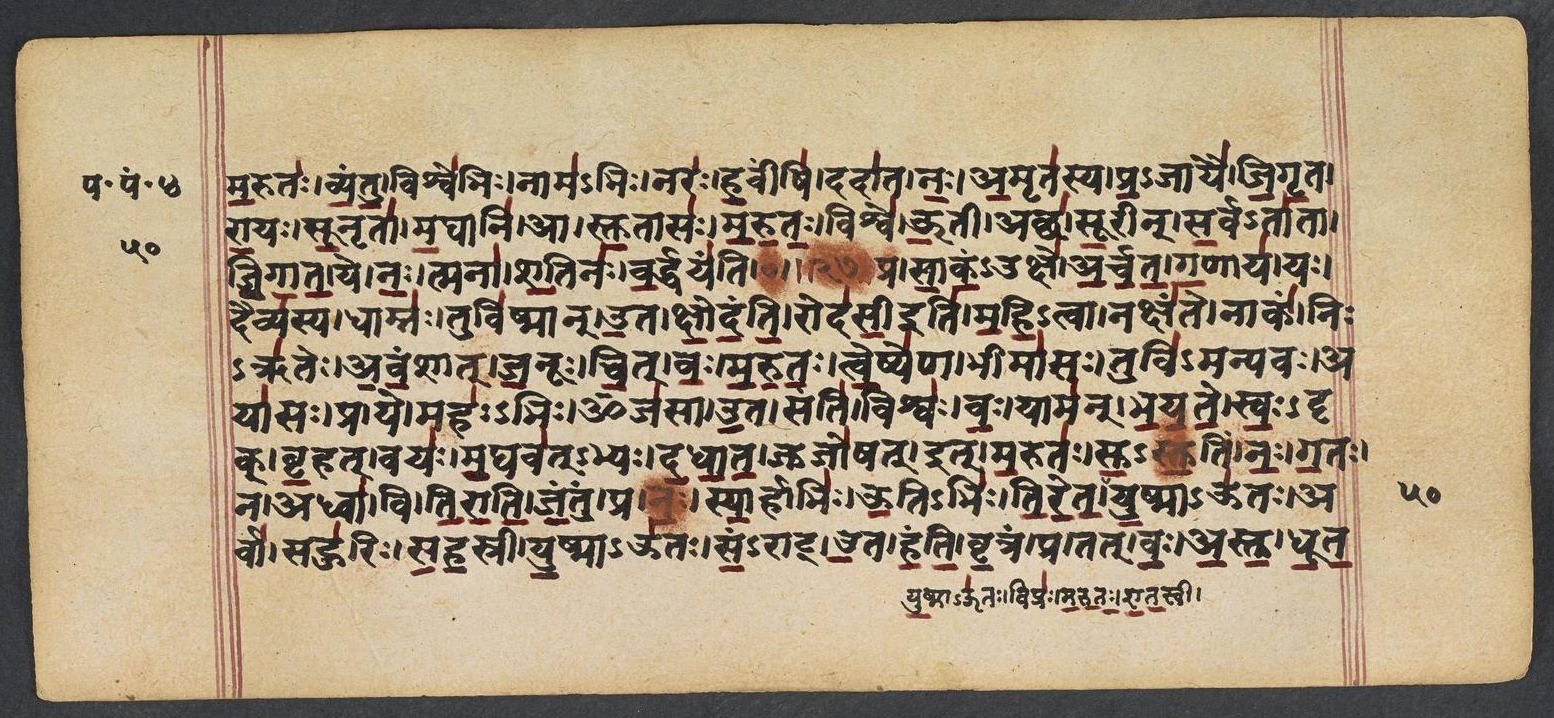
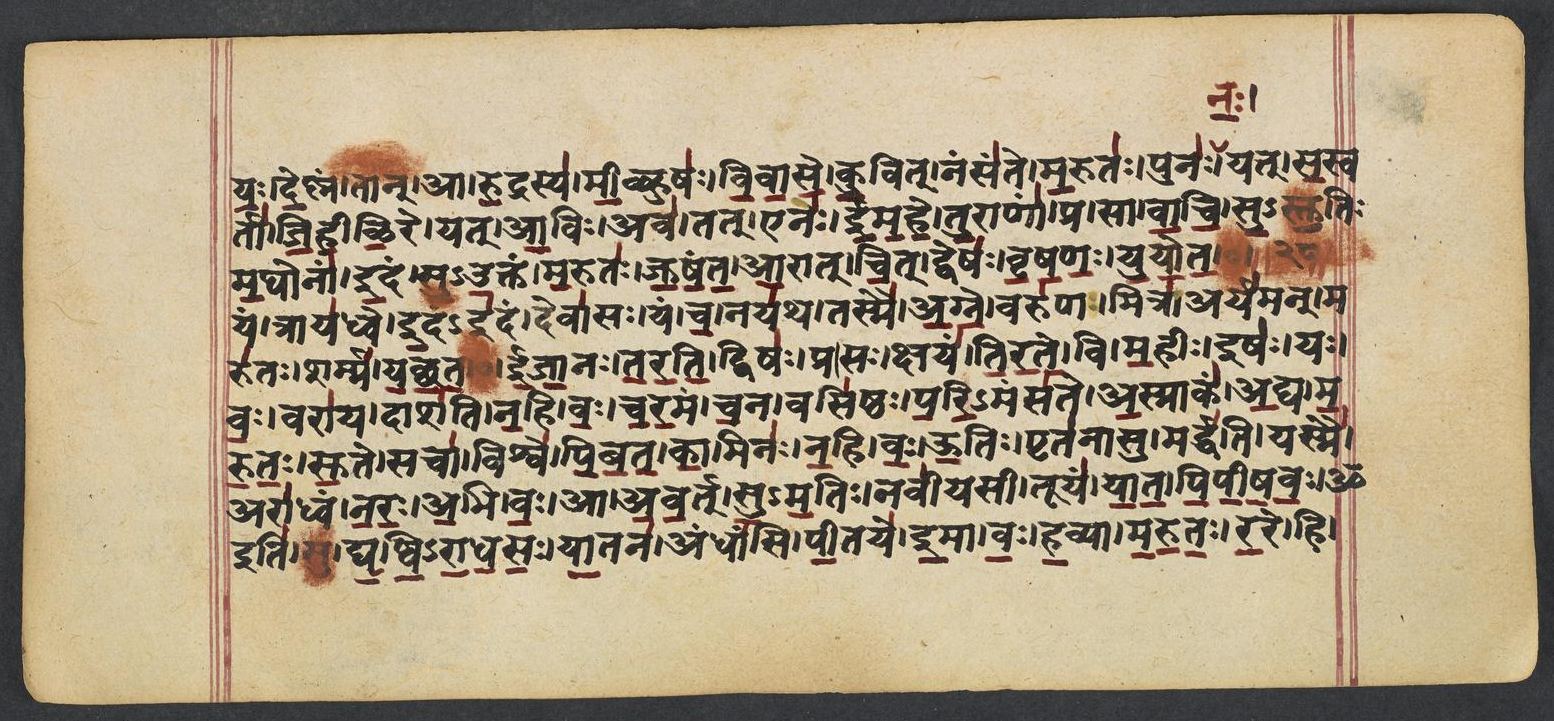
The manuscript shown is Penn Ms. Coll. 390 Item 41 (University of Pennsylvania), an undated paper manuscript of the padapāṭha (the word-by-word recitation text, in which every word is written separately and compounds are split) of the whole Ṛgveda in Devanāgarī, 884 leaves in fascicles, 7-9 lines to the page, accents in red; this hymn stands on fol. 529v-530r. Each section below gives the verses that end on one page; the page boundaries were read on the images (the opening words of every page), not counted out. Where the manuscript is a padapāṭha (the word-by-word recitation text), the section shows Aufrecht's continuous (saṃhitā) text first and, as the edition text, the padapāṭha of the same verses, which is the form written on the page.
How was this verified? (Provenance)
Where on the image
Penn Ms. Coll. 390 Item 41, fol. 529v (numbered 50v by the scribe) (OPenn image 530, upper leaf). Checked on the image: the Rigveda text on this page begins in RV 7.57.6 ‹marutaḥ vyantu viśvebhiḥ nāma-bhiḥ›. The next page with Rigveda text, fol. 530r (numbered 51r by the scribe), begins in RV 7.58.4 ‹-dhūtayaḥ deṣṇam›. Verses 7.58.1-3 end on this page.
1pra sā̍ka̱mukṣe̍ arcatā ga̱ṇāya̱ yo daivya̍sya̱ dhāmna̱s tuvi̍ṣmān | u̱ta kṣo̍danti̱ roda̍sī mahi̱tvā nakṣa̍nte̱ nāka̱ṁ nirṛ̍ter ava̱ṁśāt ||
2ja̱nūś ci̍d vo marutas tve̱ṣye̍ṇa̱ bhīmā̍sa̱s tuvi̍manya̱vo 'yā̍saḥ | pra ye maho̍bhi̱r oja̍so̱ta santi̱ viśvo̍ vo̱ yāma̍n bhayate sva̱rdṛk ||
3bṛ̱had vayo̍ ma̱ghava̍dbhyo dadhāta̱ jujo̍ṣa̱nn in ma̱ruta̍ḥ suṣṭu̱tiṁ na̍ḥ | ga̱to nādhvā̱ vi ti̍rāti ja̱ntum pra ṇa̍ḥ spā̱rhābhi̍r ū̱tibhi̍s tireta ||
Compare: Padapāṭha (word-by-word text written in the manuscript; Sansknet e-text via GRETIL)
1pra | sākam-ukṣe | arcata | gaṇāya | yaḥ | daivyasya | dhāmnaḥ | tuviṣmān | uta | kṣodanti | rodasī iti | mahi-tvā | nakṣante | nākam | niḥ-ṛteḥ | avaṃśāt
2janūḥ | cit | vaḥ | marutaḥ | tveṣyeṇa | bhīmāsaḥ | tuvi-manyavaḥ | ayāsaḥ | pra | ye | mahaḥ-bhiḥ | ojasā | uta | santi | viśvaḥ | vaḥ | yāman | bhayate | svaḥ-dṛk
3bṛhat | vayaḥ | maghavat-bhyaḥ | dadhāta | jujoṣan | it | marutaḥ | su-stutim | naḥ | gataḥ | na | adhvā | vi | tirāti | jantum | pra | naḥ | spārhābhiḥ | ūti-bhiḥ | tireta
1SING to the troop that pours down rain in common, the Mighty Company of celestial nature. They make the world-halves tremble with their greatness: from depths of earth and sky they reach to heaven.
2Yea, your birth, Maruts, was with wild commotion, ye who move swiftly, fierce in wrath, terrific. Ye all-surpassing in your might and vigour, each looker on the light fears at your coming.
3Give ample vital power unto our princes let our fair praises gratify the Maruts. As the way travelled helpeth people onward, so further us with your delightful succours.
Where on the image
Penn Ms. Coll. 390 Item 41, fol. 530r (numbered 51r by the scribe) (OPenn image 530, lower leaf). Checked on the image: the Rigveda text on this page begins in RV 7.58.4 ‹-dhūtayaḥ deṣṇam›. The next page with Rigveda text, fol. 530v (numbered 51v by the scribe), begins in RV 7.59.5 ‹kam mo iti su›. Verses 7.58.4-6 end on this page; 7.58.4 begins on fol. 529v (numbered 50v by the scribe).
4yu̱ṣmoto̱ vipro̍ marutaḥ śata̱svī yu̱ṣmoto̱ arvā̱ sahu̍riḥ saha̱srī | yu̱ṣmota̍ḥ sa̱mrāḻ u̱ta ha̍nti vṛ̱tram pra tad vo̍ astu dhūtayo de̱ṣṇam ||
5tām̐ ā ru̱drasya̍ mī̱ḻhuṣo̍ vivāse ku̱vin naṁsa̍nte ma̱ruta̱ḥ puna̍r naḥ | yat sa̱svartā̍ jihīḻi̱re yad ā̱vir ava̱ tad ena̍ īmahe tu̱rāṇā̍m ||
6pra sā vā̍ci suṣṭu̱tir ma̱ghonā̍m i̱daṁ sū̱ktam ma̱ruto̍ juṣanta | ā̱rāc ci̱d dveṣo̍ vṛṣaṇo yuyota yū̱yam pā̍ta sva̱stibhi̱ḥ sadā̍ naḥ ||
Compare: Padapāṭha (word-by-word text written in the manuscript; Sansknet e-text via GRETIL)
4yuṣmāūtaḥ | vipraḥ | marutaḥ | śatasvī | yuṣmāūtaḥ | arvā | sahuriḥ | sahasrī | yuṣmāūtaḥ | sam-rāṭ | uta | hanti | vṛtram | pra | tat | vaḥ | astu | dhūtayaḥ | deṣṇam
5tān | ā | rudrasya | mīḷhuṣaḥ | vivāse | kuvit | naṃsante | marutaḥ | punaḥ | naḥ | yat | sasvartā | jihīḷire | yat | āviḥ | ava | tat | enaḥ | īmahe | turāṇām
6pra | sā | vāci | su-stutiḥ | maghonām | idam | su-uktam | marutaḥ | juṣanta | ārāt | cit | dveṣaḥ | vṛṣaṇaḥ | yuyota | yūyam | pāta | svasti-bhiḥ | sadā | naḥ
4Your favoured singer counts his wealth by hundreds: the strong steed whom ye favour wins a thousand. The Sovran whom ye aid destroys the foeman. May this your gift, ye Shakers, be distinguished.
5I call, as such, the Sons of bounteous Rudra: will not the Maruts turn again to us-ward? What secret sin or open stirs their anger, that we implore the Swift Ones to forgive us.
6This eulogy of the Bounteous hath been spoken: accept, ye Maruts, this our hymn of praises. Ye Bulls, keep those who hate us at a distance. Preserve us evermore, ye Gods, with blessings.
Notes
- Sanskrit: Aufrecht's edition (1877) with the Vedic accents, as entered by van Nooten and Holland (GRETIL).
- English: Ralph T. H. Griffith, The Hymns of the Rigveda (1889-1892; 2nd ed. 1896-1897), from the VedaWeb digital text; OCR slips in that text were corrected against the printed 2nd edition (data/sources/rigveda/griffith_errata.json).
- Padapāṭha (edition text): Sansknet e-text via GRETIL (CC BY-NC-SA 4.0).
Cite
Sources
- Source: Penn Ms. Coll. 390 Item 41 (undated (catalogued with Penn's 18th-19th c. Vedic manuscripts)), OPenn, Public Domain Mark + Aufrecht's accented text (GRETIL) + Griffith's English (VedaWeb) (holding institution)
- Critical edition: Aufrecht (1877), accented e-text via GRETIL
← previous · → next · v cycle view · l back to library