Rigveda 7.92: To Vayu
Introduction
Rigveda 7.92 is a hymn of 5 verses addressed to Vayu. It stands in book (maṇḍala) 7, the family book of Vasiṣṭha. The Rigveda is the oldest collection of Sanskrit hymns, composed in the second half of the second millennium BCE and handed down orally for many centuries before it was written down.
The manuscript shown is Penn Ms. Coll. 390 Item 41 (University of Pennsylvania), an undated paper manuscript of the padapāṭha (the word-by-word recitation text, in which every word is written separately and compounds are split) of the whole Ṛgveda in Devanāgarī, 884 leaves in fascicles, 7-9 lines to the page, accents in red; this hymn stands on fol. 549v-550r. Each section below gives the verses that end on one page; the page boundaries were read on the images (the opening words of every page), not counted out. Where the manuscript is a padapāṭha (the word-by-word recitation text), the section shows Aufrecht's continuous (saṃhitā) text first and, as the edition text, the padapāṭha of the same verses, which is the form written on the page.
How was this verified? (Provenance)
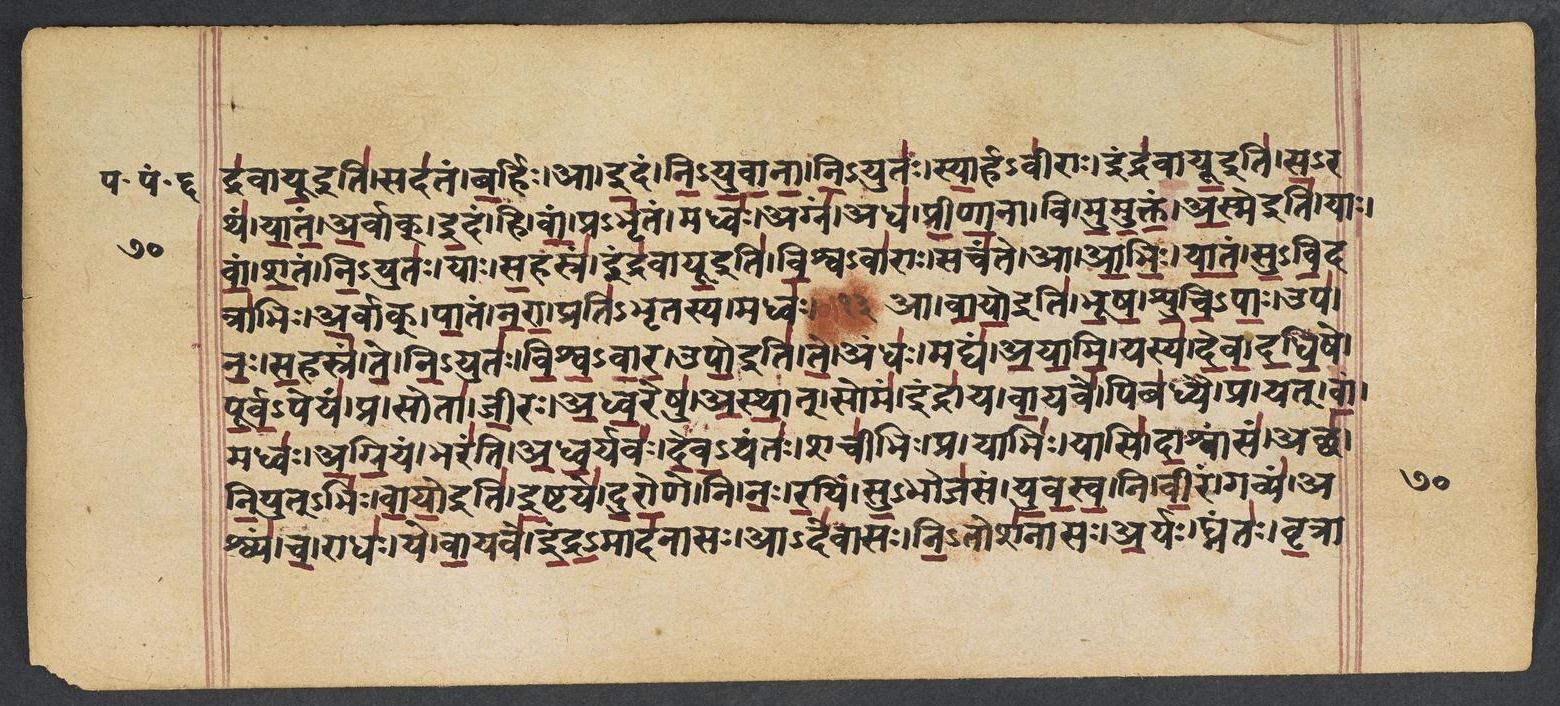
Where on the image
Penn Ms. Coll. 390 Item 41, fol. 549v (numbered 70v by the scribe) (OPenn image 550, upper leaf). Checked on the image: the Rigveda text on this page begins in RV 7.91.4 ‹-indravāyūiti sadatam barhiḥ ā›. The next page with Rigveda text, fol. 550r (numbered 71r by the scribe), begins in RV 7.92.4 ‹-vṛtrāṇi sūri-bhiḥ syāma sasahvāṃsaḥ›. Verses 7.92.1-3 end on this page.
1ā vā̍yo bhūṣa śucipā̱ upa̍ naḥ sa̱hasra̍ṁ te ni̱yuto̍ viśvavāra | upo̍ te̱ andho̱ madya̍m ayāmi̱ yasya̍ deva dadhi̱ṣe pū̍rva̱peya̍m ||
2pra sotā̍ jī̱ro a̍dhva̱reṣv a̍sthā̱t soma̱m indrā̍ya vā̱yave̱ piba̍dhyai | pra yad vā̱m madhvo̍ agri̱yam bhara̍nty adhva̱ryavo̍ deva̱yanta̱ḥ śacī̍bhiḥ ||
3pra yābhi̱r yāsi̍ dā̱śvāṁsa̱m acchā̍ ni̱yudbhi̍r vāyav i̱ṣṭaye̍ duro̱ṇe | ni no̍ ra̱yiṁ su̱bhoja̍saṁ yuvasva̱ ni vī̱raṁ gavya̱m aśvya̍ṁ ca̱ rādha̍ḥ ||
Compare: Padapāṭha (word-by-word text written in the manuscript; Sansknet e-text via GRETIL)
1ā | vāyo iti | bhūṣa | śuci-pāḥ | upa | naḥ | sahasram | te | ni-yutaḥ | viśva-vāra | upo iti | te | andhaḥ | madyam | ayāmi | yasya | deva | dadhiṣe | pūrva-peyam
2pra | sotā | jīraḥ | adhvareṣu | asthāt | somam | indrāya | vāyave | pibadhyai | pra | yat | vām | madhvaḥ | agriyam | bharanti | adhvaryavaḥ | deva-yantaḥ | śacībhiḥ
3pra | yābhiḥ | yāsi | dāśvāṃsam | accha | niyut-bhiḥ | vāyo iti | iṣṭaye | duroṇe | ni | naḥ | rayim | su-bhojasam | yuvasva | ni | vīram | gavyam | aśvyam | ca | rādhaḥ
1O Vâyu, drinker of the pure, be near us: a thousand teams are thine, Allbounteous Giver. To thee the rapture-bringing juice is offered, whose first draught, God, thou takest as thy portion.
2Prompt at the holy rites forth came the presser with Soma-draughts for Indra and for Vâyu, When ministering priests with strong devotion bring to you Twain the first taste of the Soma.
3The teams wherewith thou seekest him who offers, within his home, O Vâyu, to direct him, Therewith send wealth: to us with full enjoyment, a hero son and gifts of kine and horses.
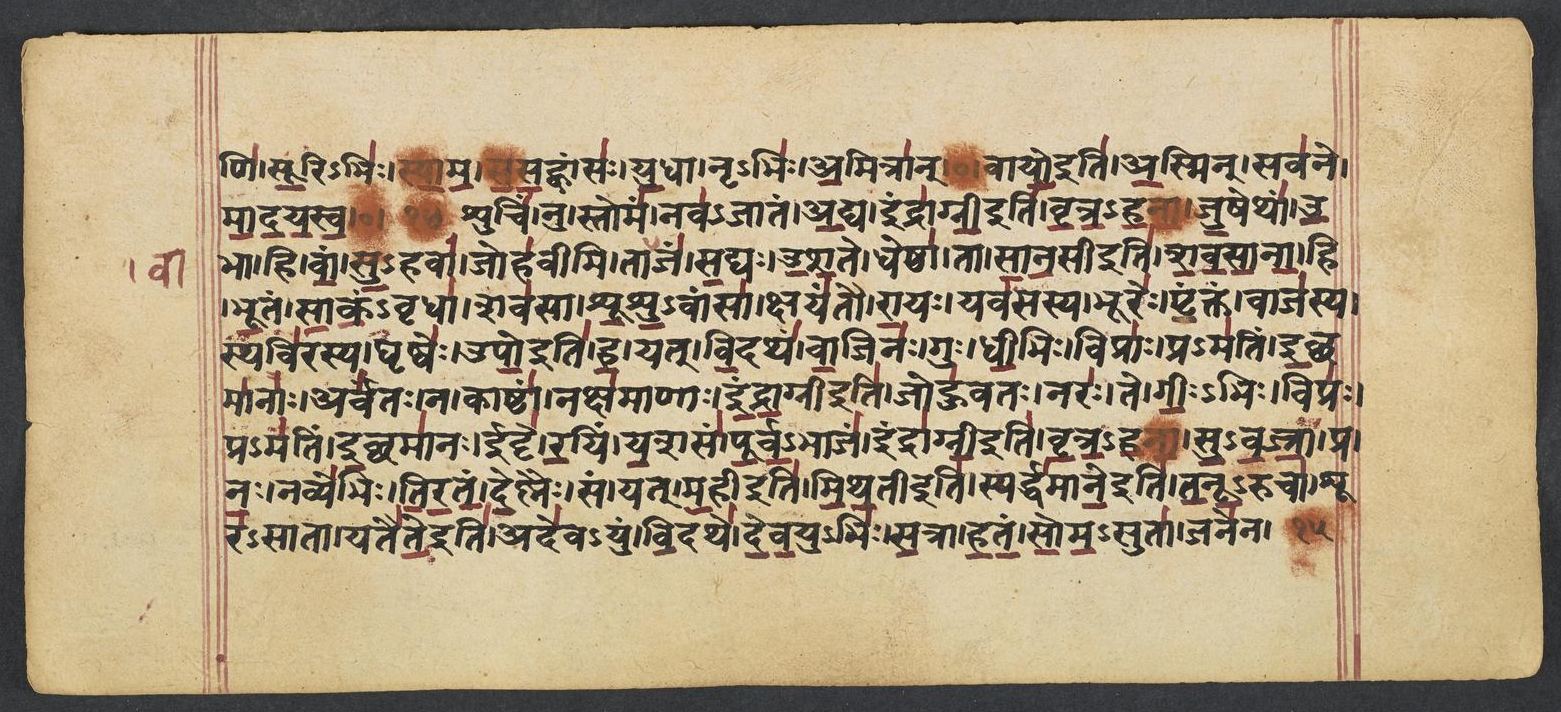
Where on the image
Penn Ms. Coll. 390 Item 41, fol. 550r (numbered 71r by the scribe) (OPenn image 550, lower leaf). Checked on the image: the Rigveda text on this page begins in RV 7.92.4 ‹-vṛtrāṇi sūri-bhiḥ syāma sasahvāṃsaḥ›. The next page with Rigveda text, fol. 550v (numbered 71v by the scribe), begins in RV 7.93.6 ‹imām oṃ iti su›. Verses 7.92.4-5 end on this page; 7.92.4 begins on fol. 549v (numbered 70v by the scribe).
4ye vā̱yava̍ indra̱māda̍nāsa̱ āde̍vāso ni̱tośa̍nāso a̱ryaḥ | ghnanto̍ vṛ̱trāṇi̍ sū̱ribhi̍ḥ ṣyāma sāsa̱hvāṁso̍ yu̱dhā nṛbhi̍r a̱mitrā̍n ||
5ā no̍ ni̱yudbhi̍ḥ śa̱tinī̍bhir adhva̱raṁ sa̍ha̱sriṇī̍bhi̱r upa̍ yāhi ya̱jñam | vāyo̍ a̱smin sava̍ne mādayasva yū̱yam pā̍ta sva̱stibhi̱ḥ sadā̍ naḥ ||
Compare: Padapāṭha (word-by-word text written in the manuscript; Sansknet e-text via GRETIL)
4ye | vāyave | indra-mādanāsaḥ | ādevāsaḥ | ni-tośanāsaḥ | aryaḥ | ghnantaḥ | vṛtrāṇi | sūri-bhiḥ | syāma | sasahvāṃsaḥ | yudhā | nṛ-bhiḥ | amitrān
5ā | naḥ | niyut-bhiḥ | śatinībhiḥ | adhvaram | sahasriṇībhiḥ | upa | yāhi | yajñam | vāyo iti | asmin | savane | mādayasva | yūyam | pāta | svasti-bhiḥ | sadā | naḥ
4Near to the Gods and making Indra joyful, devout and ofFering precious gifts to Vâyu, Allied with princes, smiting down the hostile, may we with heroes conquer foes in battle.
5With thy yoked teams in hundreds and in thousands come to our sacrifice and solemn worship. Come, Vâyu, make thee glad at this libation. Preserve us evermore, ye Gods, with blessings.
Notes
- Sanskrit: Aufrecht's edition (1877) with the Vedic accents, as entered by van Nooten and Holland (GRETIL).
- English: Ralph T. H. Griffith, The Hymns of the Rigveda (1889-1892; 2nd ed. 1896-1897), from the VedaWeb digital text; OCR slips in that text were corrected against the printed 2nd edition (data/sources/rigveda/griffith_errata.json).
- Padapāṭha (edition text): Sansknet e-text via GRETIL (CC BY-NC-SA 4.0).
Cite
Sources
- Source: Penn Ms. Coll. 390 Item 41 (undated (catalogued with Penn's 18th-19th c. Vedic manuscripts)), OPenn, Public Domain Mark + Aufrecht's accented text (GRETIL) + Griffith's English (VedaWeb) (holding institution)
- Critical edition: Aufrecht (1877), accented e-text via GRETIL
← previous · → next · v cycle view · l back to library