Rigveda 7.99: To Vishnu, Indra and Vishnu
Introduction
Rigveda 7.99 is a hymn of 7 verses addressed to Vishnu, Indra and Vishnu. It stands in book (maṇḍala) 7, the family book of Vasiṣṭha. The Rigveda is the oldest collection of Sanskrit hymns, composed in the second half of the second millennium BCE and handed down orally for many centuries before it was written down.
The manuscript shown is Penn Ms. Coll. 390 Item 41 (University of Pennsylvania), an undated paper manuscript of the padapāṭha (the word-by-word recitation text, in which every word is written separately and compounds are split) of the whole Ṛgveda in Devanāgarī, 884 leaves in fascicles, 7-9 lines to the page, accents in red; this hymn stands on fol. 553v-554r. Each section below gives the verses that end on one page; the page boundaries were read on the images (the opening words of every page), not counted out. Where the manuscript is a padapāṭha (the word-by-word recitation text), the section shows Aufrecht's continuous (saṃhitā) text first and, as the edition text, the padapāṭha of the same verses, which is the form written on the page.
How was this verified? (Provenance)
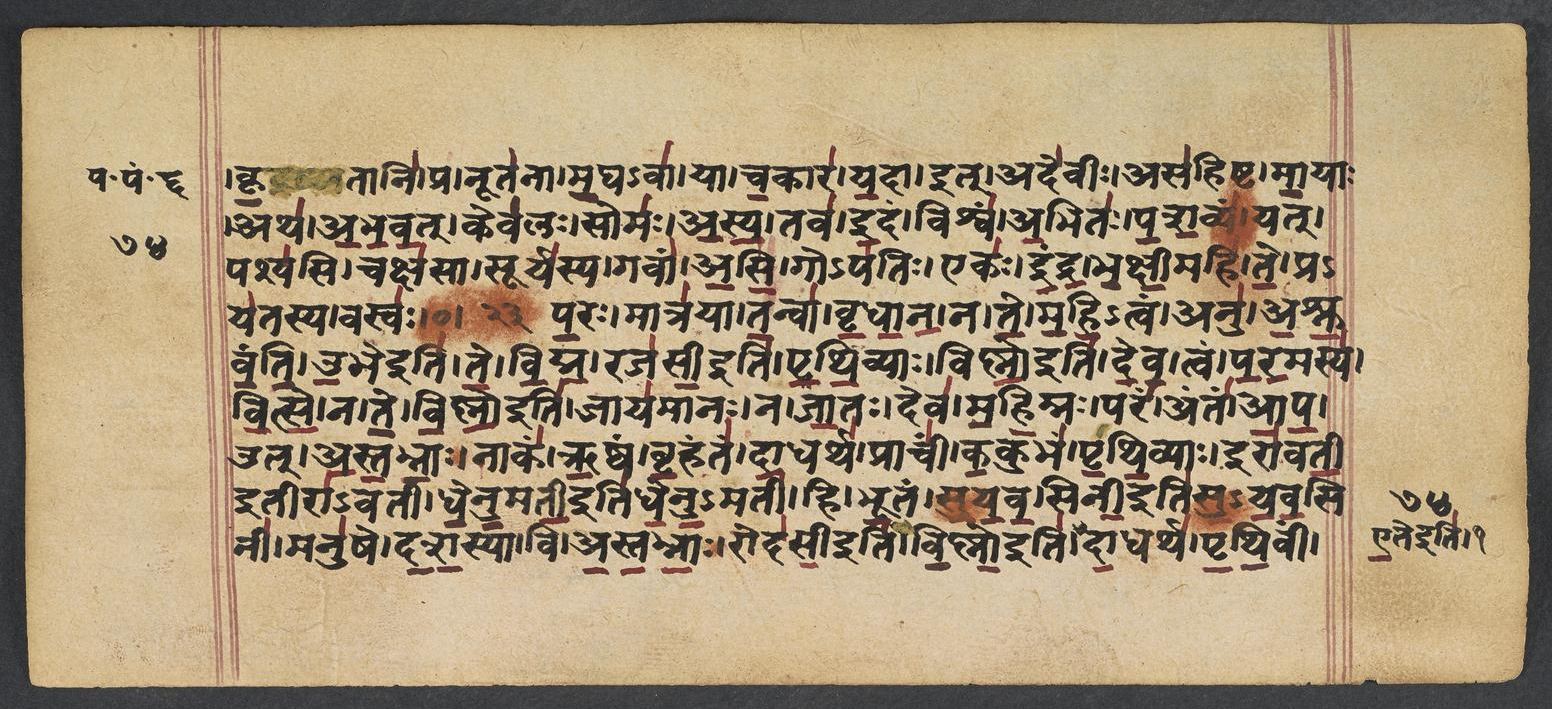
Where on the image
Penn Ms. Coll. 390 Item 41, fol. 553v (numbered 74v by the scribe) (OPenn image 554, upper leaf). Checked on the image: the Rigveda text on this page begins in RV 7.98.5 ‹kṛtāni pra nūtanā magha-vā›. The next page with Rigveda text, fol. 554r (numbered 75r by the scribe), begins in RV 7.99.3 ‹abhitaḥ mayūkhaiḥ›. Verses 7.99.1-2 end on this page.
1pa̱ro mātra̍yā ta̱nvā̍ vṛdhāna̱ na te̍ mahi̱tvam anv a̍śnuvanti | u̱bhe te̍ vidma̱ raja̍sī pṛthi̱vyā viṣṇo̍ deva̱ tvam pa̍ra̱masya̍ vitse ||
2na te̍ viṣṇo̱ jāya̍māno̱ na jā̱to deva̍ mahi̱mnaḥ para̱m anta̍m āpa | ud a̍stabhnā̱ nāka̍m ṛ̱ṣvam bṛ̱hanta̍ṁ dā̱dhartha̱ prācī̍ṁ ka̱kubha̍m pṛthi̱vyāḥ ||
Compare: Padapāṭha (word-by-word text written in the manuscript; Sansknet e-text via GRETIL)
1paraḥ | mātrayā | tanvā | vṛdhāna | na | te | mahi-tvam | anu | aśnuvanti | ubhe iti | te | vidma | rajasī iti | pṛthivyāḥ | viṣṇo iti | deva | tvam | paramasya | vitse
2na | te | viṣṇo iti | jāyamānaḥ | na | jātaḥ | deva | mahimnaḥ | param | antam | āpa | ut | astabhnāḥ | nākam | ṛṣvam | bṛhantam | dādhartha | prācīm | kakubham | pṛthivyāḥ
1MEN come not nigh thy majesty who growest beyond all bound and measure with thy body. Both thy two regions of the earth, O Vishṇu, we know: thou God, knowest the highest also.
2None who is born or being born, God Vishṇu, hath reached the utmost limit of thy grandeur. The vast high vault of heaven hast thou supported, and fixed earth's eastern pinnacle securely.
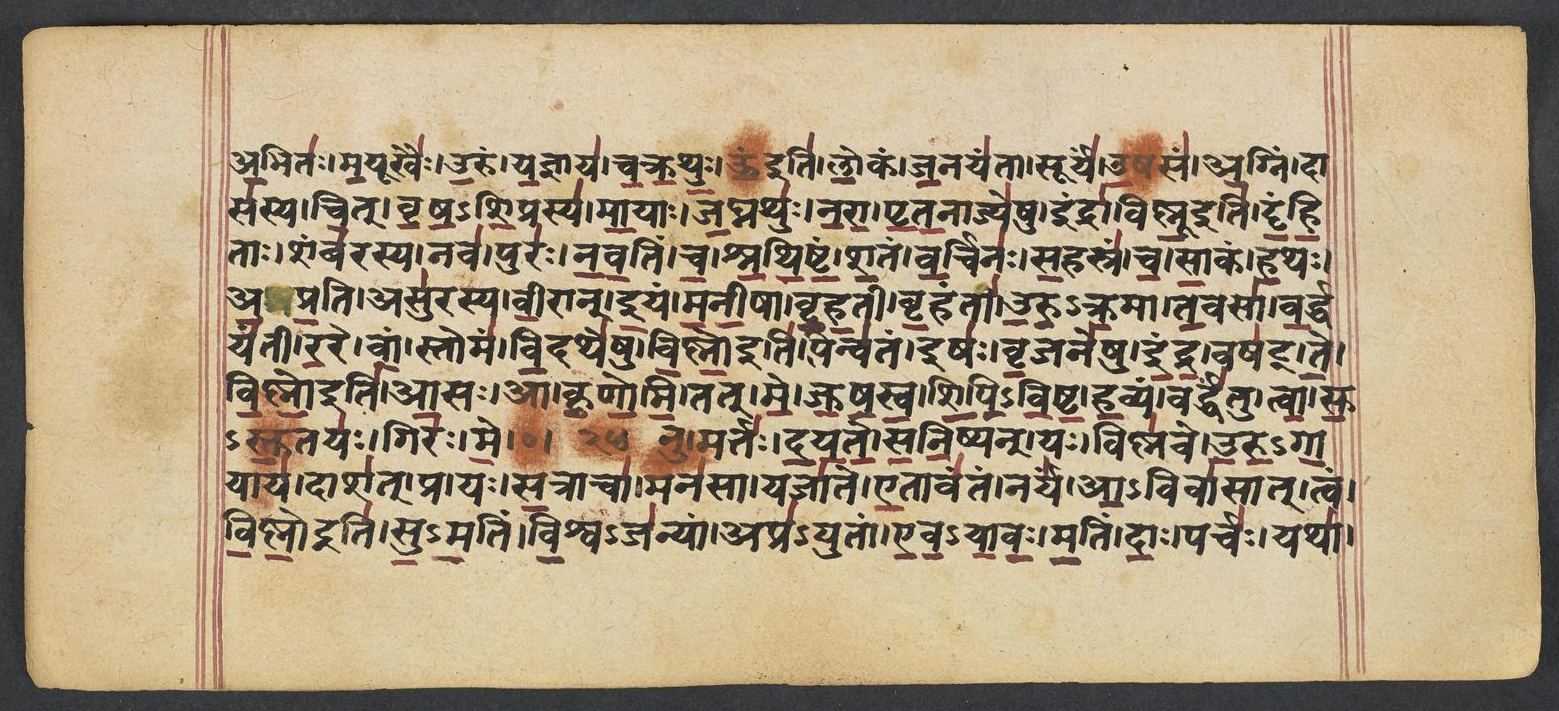
Where on the image
Penn Ms. Coll. 390 Item 41, fol. 554r (numbered 75r by the scribe) (OPenn image 554, lower leaf). Checked on the image: the Rigveda text on this page begins in RV 7.99.3 ‹abhitaḥ mayūkhaiḥ›. The next page with Rigveda text, fol. 554v (numbered 75v by the scribe), begins in RV 7.100.2 ‹naḥ suvitasya bhūreḥ aśva-vataḥ›. Verses 7.99.3-7 end on this page; 7.99.3 begins on fol. 553v (numbered 74v by the scribe).
3irā̍vatī dhenu̱matī̱ hi bhū̱taṁ sū̍yava̱sinī̱ manu̍ṣe daśa̱syā | vy a̍stabhnā̱ roda̍sī viṣṇav e̱te dā̱dhartha̍ pṛthi̱vīm a̱bhito̍ ma̱yūkhai̍ḥ ||
4u̱ruṁ ya̱jñāya̍ cakrathur u lo̱kaṁ ja̱naya̍ntā̱ sūrya̍m u̱ṣāsa̍m a̱gnim | dāsa̍sya cid vṛṣaśi̱prasya̍ mā̱yā ja̱ghnathu̍r narā pṛta̱nājye̍ṣu ||
5indrā̍viṣṇū dṛṁhi̱tāḥ śamba̍rasya̱ nava̱ puro̍ nava̱tiṁ ca̍ śnathiṣṭam | śa̱taṁ va̱rcina̍ḥ sa̱hasra̍ṁ ca sā̱kaṁ ha̱tho a̍pra̱ty asu̍rasya vī̱rān ||
6i̱yam ma̍nī̱ṣā bṛ̍ha̱tī bṛ̱hanto̍rukra̱mā ta̱vasā̍ va̱rdhaya̍ntī | ra̱re vā̱ṁ stoma̍ṁ vi̱dathe̍ṣu viṣṇo̱ pinva̍ta̱m iṣo̍ vṛ̱jane̍ṣv indra ||
7vaṣa̍ṭ te viṣṇav ā̱sa ā kṛ̍ṇomi̱ tan me̍ juṣasva śipiviṣṭa ha̱vyam | vardha̍ntu tvā suṣṭu̱tayo̱ giro̍ me yū̱yam pā̍ta sva̱stibhi̱ḥ sadā̍ naḥ ||
Compare: Padapāṭha (word-by-word text written in the manuscript; Sansknet e-text via GRETIL)
3irāvatī itīrāvatī | dhenumatī itidhenu-matī | hi | bhūtam | suyavasinī itisu-yavasinī | manuṣe | daśasyā | vi | astabhnāḥ | rodasī iti | viṣṇo iti | ete iti | dādhartha | pṛthivīm | abhitaḥ | mayūkhaiḥ
4urum | yajñāya | cakrathuḥ | oṃ iti | lokam | janayantā | sūryam | uṣasam | agnim | dāsasya | cit | vṛṣa-śiprasya | māyāḥ | jaghnathuḥ | narā | pṛtanājyeṣu
5indrāviṣṇūiti | dṛṃhitāḥ | śambarasya | nava | puraḥ | navatim | ca | śnath iṣṭam | śatam | varcinaḥ | sahasram | ca | sākam | hathaḥ | aprati | asurasya | vīrān
6iyam | manīṣā | bṛhatī | bṛhantā | uru-kramā | tavasā | vardhayantī | rare | vām | stomam | vidatheṣu | viṣṇo iti | pinvatam | iṣaḥ | vṛjaneṣu | indra
7vaṣaṭ | te | viṣṇo iti | āsaḥ | ā | kṛṇomi | tat | me | juṣasva | śipi-viṣṭa | havyam | vardhantu | tvā | su-stutayaḥ | giraḥ | me | yūyam | pāta | svasti-bhiḥ | sadā | naḥ
3Rich in sweet food be ye, and rich in milch-kine, with fertile pastures, fain to do men service. Both these worlds, Vishṇu, hast thou stayed asunder, and firmly fixed the earth with pegs around it.
4Ye have made spacious room for sacrificing by generating Sûrya, Dawn, and Agni. O Heroes, ye have conquered in your battles even the bull-jawed Dâsa's wiles and magic.
5Ye have destroyed, thou, Indra, and thou Vishṇu, Ṣambara's nine-and-ninety fenced castles. Ye Twain smote down a hundred times a thousand resistless heroes of the royal Varcin.
6This is the lofty hymn of praise, exalting the Lords of Mighty Stride, the strong and lofty. I laud you in the solemn synods, Vishṇu: pour ye food on us in our camps, O Indra.
7O Vishṇu, unto thee my lips cry Vashaṭ! Let this mine offering, Ṣipivishṭa, please thee. May these my songs of eulogy exalt thee. Preserve us evermore, ye Gods, with blessings.
Notes
- Sanskrit: Aufrecht's edition (1877) with the Vedic accents, as entered by van Nooten and Holland (GRETIL).
- English: Ralph T. H. Griffith, The Hymns of the Rigveda (1889-1892; 2nd ed. 1896-1897), from the VedaWeb digital text; OCR slips in that text were corrected against the printed 2nd edition (data/sources/rigveda/griffith_errata.json).
- Padapāṭha (edition text): Sansknet e-text via GRETIL (CC BY-NC-SA 4.0).
Cite
Sources
- Source: Penn Ms. Coll. 390 Item 41 (undated (catalogued with Penn's 18th-19th c. Vedic manuscripts)), OPenn, Public Domain Mark + Aufrecht's accented text (GRETIL) + Griffith's English (VedaWeb) (holding institution)
- Critical edition: Aufrecht (1877), accented e-text via GRETIL
← previous · → next · v cycle view · l back to library