Rigveda 8.15: To Indra
Introduction
Rigveda 8.15 is a hymn of 13 verses addressed to Indra. It stands in book (maṇḍala) 8, the book of the Kaṇva and Aṅgiras poets. The Rigveda is the oldest collection of Sanskrit hymns, composed in the second half of the second millennium BCE and handed down orally for many centuries before it was written down.
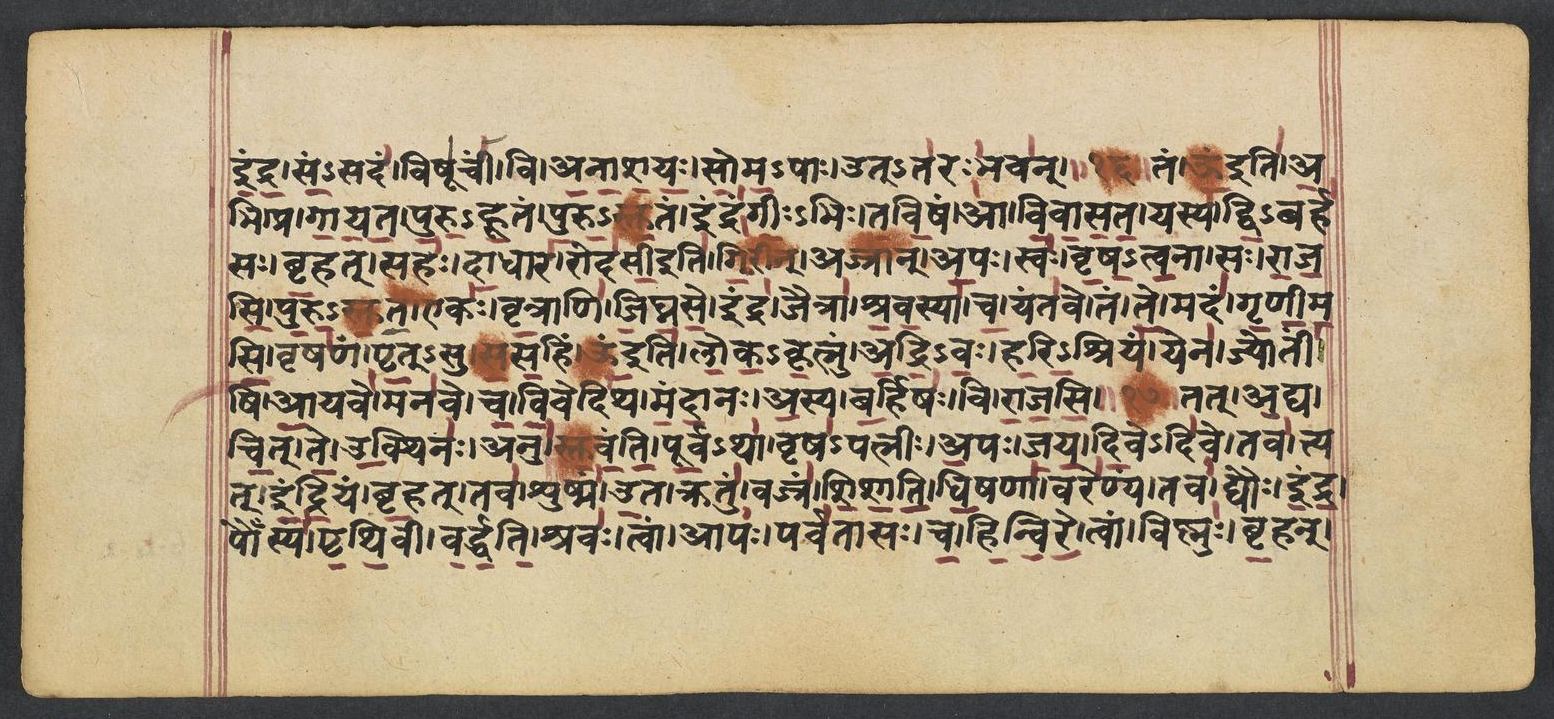
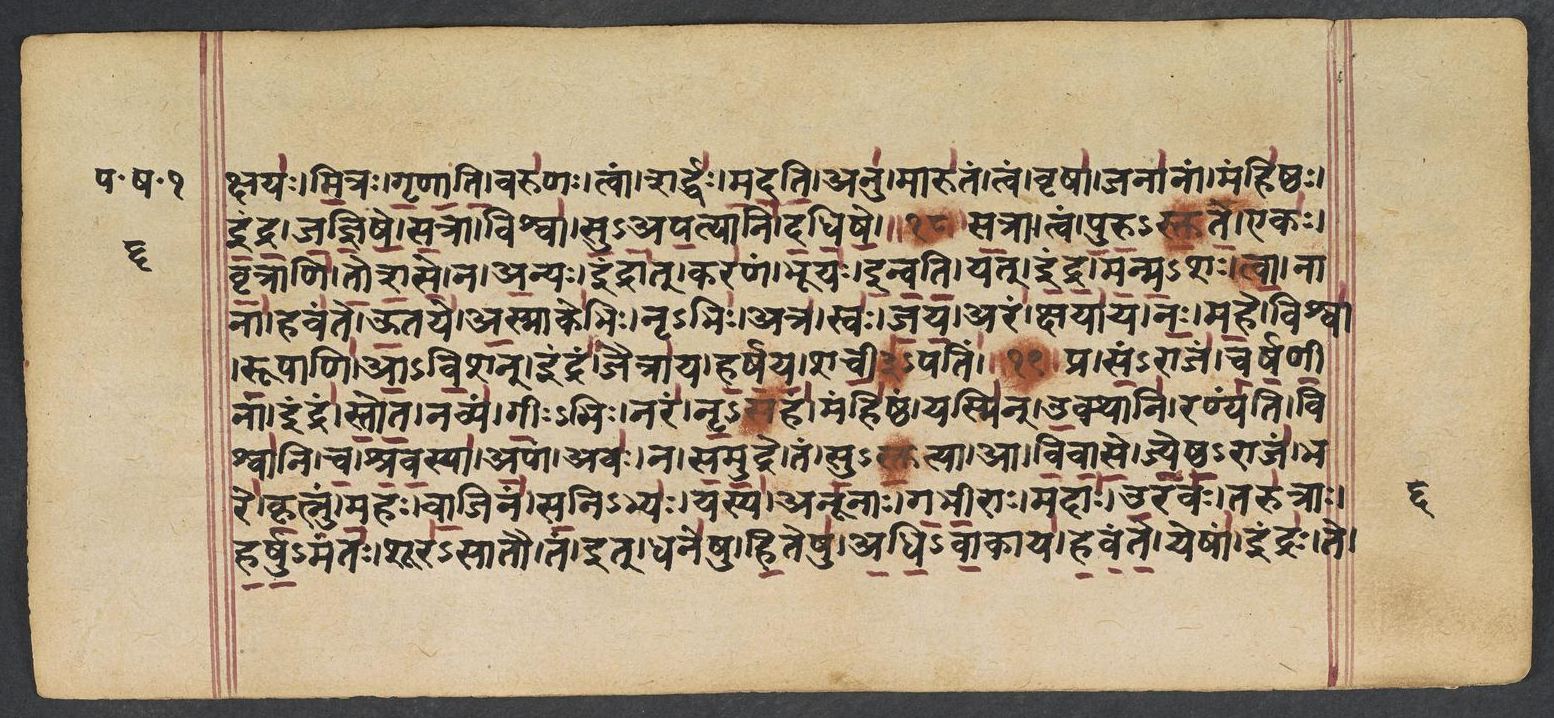
The manuscript shown is Penn Ms. Coll. 390 Item 41 (University of Pennsylvania), an undated paper manuscript of the padapāṭha (the word-by-word recitation text, in which every word is written separately and compounds are split) of the whole Ṛgveda in Devanāgarī, 884 leaves in fascicles, 7-9 lines to the page, accents in red; this hymn stands on fol. 584r-584v. Each section below gives the verses that end on one page; the page boundaries were read on the images (the opening words of every page), not counted out. Where the manuscript is a padapāṭha (the word-by-word recitation text), the section shows Aufrecht's continuous (saṃhitā) text first and, as the edition text, the padapāṭha of the same verses, which is the form written on the page.
How was this verified? (Provenance)
Where on the image
Penn Ms. Coll. 390 Item 41, fol. 584r (numbered 6r by the scribe) (OPenn image 584, lower leaf). Checked on the image: the Rigveda text on this page begins in RV 8.14.15 ‹indra sam-sadam viṣūcīm vi›. The next page with Rigveda text, fol. 584v (numbered 6v by the scribe), begins in RV 8.15.9 ‹kṣayaḥ mitraḥ gṛṇāti varuṇaḥ›. Verses 8.15.1-8 end on this page.
1tam v a̱bhi pra gā̍yata puruhū̱tam pu̍ruṣṭu̱tam | indra̍ṁ gī̱rbhis ta̍vi̱ṣam ā vi̍vāsata ||
2yasya̍ dvi̱barha̍so bṛ̱hat saho̍ dā̱dhāra̱ roda̍sī | gi̱rīm̐r ajrā̍m̐ a̱paḥ sva̍r vṛṣatva̱nā ||
3sa rā̍jasi puruṣṭuta̱m̐ eko̍ vṛ̱trāṇi̍ jighnase | indra̱ jaitrā̍ śrava̱syā̍ ca̱ yanta̍ve ||
4taṁ te̱ mada̍ṁ gṛṇīmasi̱ vṛṣa̍ṇam pṛ̱tsu sā̍sa̱him | u̱ lo̱ka̱kṛ̱tnum a̍drivo hari̱śriya̍m ||
5yena̱ jyotī̍ṁṣy ā̱yave̱ mana̍ve ca vi̱vedi̍tha | ma̱ndā̱no a̱sya ba̱rhiṣo̱ vi rā̍jasi ||
6tad a̱dyā ci̍t ta u̱kthino 'nu̍ ṣṭuvanti pū̱rvathā̍ | vṛṣa̍patnīr a̱po ja̍yā di̱ve-di̍ve ||
7tava̱ tyad i̍ndri̱yam bṛ̱hat tava̱ śuṣma̍m u̱ta kratu̍m | vajra̍ṁ śiśāti dhi̱ṣaṇā̱ vare̍ṇyam ||
8tava̱ dyaur i̍ndra̱ pauṁsya̍m pṛthi̱vī va̍rdhati̱ śrava̍ḥ | tvām āpa̱ḥ parva̍tāsaś ca hinvire ||
Compare: Padapāṭha (word-by-word text written in the manuscript; Sansknet e-text via GRETIL)
1tam | oṃ iti | abhi | pra | gāyata | puru-hūtam | puru-stutam | indram | gīḥ-bhiḥ | taviṣam | ā | vivāsata
2yasya | dvi-barhasaḥ | bṛhat | sahaḥ | dādhāra | rodasī iti | girīn | ajrān | apaḥ | svaḥ | vṛṣa-tvanā
3saḥ | rājasi | puru-stuta | ekaḥ | vṛtrāṇi | jighnase | indra | jaitrā | śravasyā | ca | yantave
4tam | te | madam | gṛṇīmasi | vṛṣaṇam | pṛt-su | sasahim | oṃ iti | loka-kṛtnum | adri-vaḥ | hari-śriyam
5yena | jyotīṃṣi | āyave | manave | ca | viveditha | mandānaḥ | asya | barhiṣaḥ | vi | rājasi
6tat | adya | cit | te | ukthinaḥ | anu | stuvanti | pūrva-thā | vṛṣa-patnīḥ | apaḥ | jaya | dive--dive
7tava | tyat | indriyam | bṛhat | tava | śuṣmam | uta | kratum | vajram | śiśāti | dhiṣaṇā | vareṇyam
8tava | dyauḥ | indra | paiṃsyam | pṛthivī | vardhati | śravaḥ | tvām | āpaḥ | pavartāsaḥ | ca | hinvire
1SING forth to him whom many men invoke, to him whom many laud. Invite the powerful Indra with your songs of praise.
2Whose lofty might-for doubly strong is he-supports the heavens and earth, And hills and plains and floods and light with manly power.
3Such, Praised by many! thou art King alone thou smitest Vr̥itras dead, To gain, O Indra, spoils of war and high renown.
4We sing this strong and wild delight of thine which conquers in the fray, Which, Caster of the Stone! gives room and shines like gold.
5Wherewith thou also foundest lights for Âyu and for Manu's sake: Now joying in this sacred grass thou beamest forth.
6This day too singers of the hymn praise, as of old, this might of thine: Win thou the waters day by day, thralls of the strong.
7That lofty Indra-power of thine, thy strength and thine intelligence, Thy thunderbolt for which we long, the wish makes keen.
8O Indra, Heaven and Earth augment thy manly power and thy renown; The waters and the mountains stir and urge thee on.
Where on the image
Penn Ms. Coll. 390 Item 41, fol. 584v (numbered 6v by the scribe) (OPenn image 585, upper leaf). Checked on the image: the Rigveda text on this page begins in RV 8.15.9 ‹kṣayaḥ mitraḥ gṛṇāti varuṇaḥ›. The next page with Rigveda text, fol. 585r (numbered 7r by the scribe), begins in RV 8.16.5 ‹jayanti›. Verses 8.15.9-13 end on this page; 8.15.9 begins on fol. 584r (numbered 6r by the scribe).
9tvāṁ viṣṇu̍r bṛ̱han kṣayo̍ mi̱tro gṛ̍ṇāti̱ varu̍ṇaḥ | tvāṁ śardho̍ mada̱ty anu̱ māru̍tam ||
10tvaṁ vṛṣā̱ janā̍nā̱m maṁhi̍ṣṭha indra jajñiṣe | sa̱trā viśvā̍ svapa̱tyāni̍ dadhiṣe ||
11sa̱trā tvam pu̍ruṣṭuta̱m̐ eko̍ vṛ̱trāṇi̍ tośase | nānya indrā̱t kara̍ṇa̱m bhūya̍ invati ||
12yad i̍ndra manma̱śas tvā̱ nānā̱ hava̍nta ū̱taye̍ | a̱smāke̍bhi̱r nṛbhi̱r atrā̱ sva̍r jaya ||
13ara̱ṁ kṣayā̍ya no ma̱he viśvā̍ rū̱pāṇy ā̍vi̱śan | indra̱ṁ jaitrā̍ya harṣayā̱ śacī̱pati̍m ||
Compare: Padapāṭha (word-by-word text written in the manuscript; Sansknet e-text via GRETIL)
9tvām | viṣṇuḥ | bṛhan | kṣayaḥ | mitraḥ | gṛṇāti | varuṇaḥ | tvām | śardhaḥ | madati | anu | mārutam
10tvam | vṛṣā | janānām | maṃhiṣṭhaḥ | indra | jajñiṣe | satrā | viśvā | su-apatyān i | dadhiṣe
11satrā | tvam | puru-stuta | ekaḥ | vṛtrāṇi | tośase | na | anyaḥ | indrāt | karaṇam | bhūyaḥ | invati
12yat | indra | manma-śaḥ | tvā | nānā | havante | ūtaye | asmākebhiḥ | nṛ-bhiḥ | atra | svaḥ | jaya
13aram | kṣayāya | naḥ | mahe | viśvā | rūpāṇi | āviśan | indram | jaitrāya | haṣarya | śacī-patim
9Vishṇu the lofty ruling Power, Varuṇa, Mitra sing thy praise: In thee the Marut3' company have great delight.
10O Indra, thou wast born the Lord of men, most liberal of thy gifts: Excellent deeds for evermore are all thine own.
11Ever, alone, O highly-praised, thou sendest Vr̥itras to their rest: None else than Indra executes the mighty deed.
12Though here and there, in varied hymns, Indra, men call on thee for aid, Still with our heroes fight and win the light of heaven.
13Already have all forms of him entered our spacious dwelling-place: For victory stir thou Indra, up, the Lord of Might.
Notes
- Sanskrit: Aufrecht's edition (1877) with the Vedic accents, as entered by van Nooten and Holland (GRETIL).
- English: Ralph T. H. Griffith, The Hymns of the Rigveda (1889-1892; 2nd ed. 1896-1897), from the VedaWeb digital text; OCR slips in that text were corrected against the printed 2nd edition (data/sources/rigveda/griffith_errata.json).
- Padapāṭha (edition text): Sansknet e-text via GRETIL (CC BY-NC-SA 4.0).
Cite
Sources
- Source: Penn Ms. Coll. 390 Item 41 (undated (catalogued with Penn's 18th-19th c. Vedic manuscripts)), OPenn, Public Domain Mark + Aufrecht's accented text (GRETIL) + Griffith's English (VedaWeb) (holding institution)
- Critical edition: Aufrecht (1877), accented e-text via GRETIL
← previous · → next · v cycle view · l back to library