Rigveda 8.16: To Indra
Introduction
Rigveda 8.16 is a hymn of 12 verses addressed to Indra. It stands in book (maṇḍala) 8, the book of the Kaṇva and Aṅgiras poets. The Rigveda is the oldest collection of Sanskrit hymns, composed in the second half of the second millennium BCE and handed down orally for many centuries before it was written down.
The manuscript shown is Penn Ms. Coll. 390 Item 41 (University of Pennsylvania), an undated paper manuscript of the padapāṭha (the word-by-word recitation text, in which every word is written separately and compounds are split) of the whole Ṛgveda in Devanāgarī, 884 leaves in fascicles, 7-9 lines to the page, accents in red; this hymn stands on fol. 584v-585r. Each section below gives the verses that end on one page; the page boundaries were read on the images (the opening words of every page), not counted out. Where the manuscript is a padapāṭha (the word-by-word recitation text), the section shows Aufrecht's continuous (saṃhitā) text first and, as the edition text, the padapāṭha of the same verses, which is the form written on the page.
How was this verified? (Provenance)
Where on the image
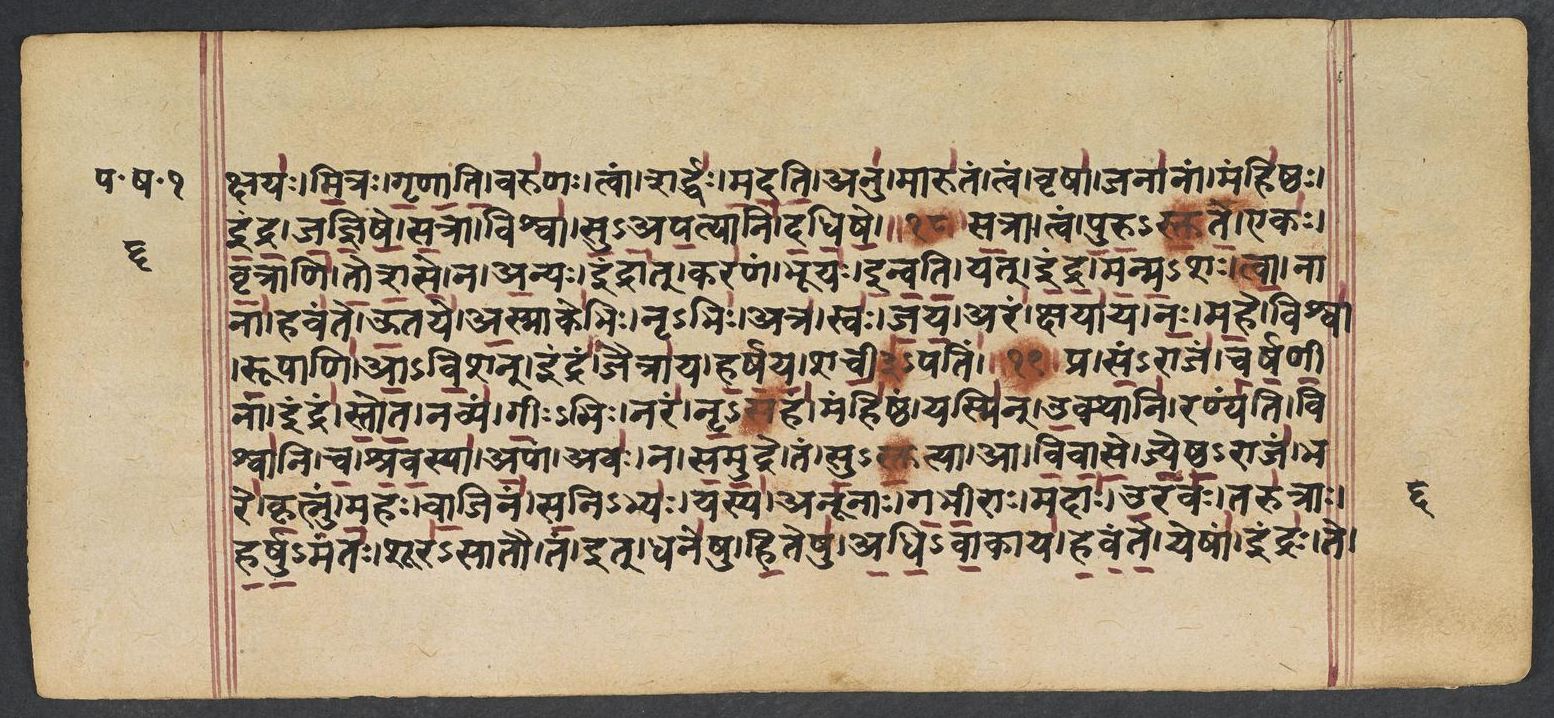
Penn Ms. Coll. 390 Item 41, fol. 584v (numbered 6v by the scribe) (OPenn image 585, upper leaf). Checked on the image: the Rigveda text on this page begins in RV 8.15.9 ‹kṣayaḥ mitraḥ gṛṇāti varuṇaḥ›. The next page with Rigveda text, fol. 585r (numbered 7r by the scribe), begins in RV 8.16.5 ‹jayanti›. Verses 8.16.1-4 end on this page.
1pra sa̱mrāja̍ṁ carṣaṇī̱nām indra̍ṁ stotā̱ navya̍ṁ gī̱rbhiḥ | nara̍ṁ nṛ̱ṣāha̱m maṁhi̍ṣṭham ||
2yasmi̍nn u̱kthāni̱ raṇya̍nti̱ viśvā̍ni ca śrava̱syā̍ | a̱pām avo̱ na sa̍mu̱dre ||
3taṁ su̍ṣṭu̱tyā vi̍vāse jyeṣṭha̱rāja̱m bhare̍ kṛ̱tnum | ma̱ho vā̱jina̍ṁ sa̱nibhya̍ḥ ||
4yasyānū̍nā gabhī̱rā madā̍ u̱rava̱s taru̍trāḥ | ha̱rṣu̱manta̱ḥ śūra̍sātau ||
Compare: Padapāṭha (word-by-word text written in the manuscript; Sansknet e-text via GRETIL)
1pra | sam-rājam | carṣaṇīnām | indram | stotā | navyam | gīḥ-bhiḥ | naram | nṛ-sāham | maṃhiṣṭham
2yasmin | ukthāni | raṇyanti | viśvāni | ca | śravasyā | apām | avaḥ | na | samudre
3tam | su-stutyā | vivāse | jyeṣṭha-rājam | bhare | kṛtnum | mahaḥ | vājinam | sani-bhyaḥ
4yasya | anūnāḥ | gabhīrāḥ | madāḥ | uravaḥ | tarutrāḥ | harṣu-mantaḥ | śūra-sātau
1PRAISE Indra whom our songs must laud, sole Sovran of mankind, the Chief Most liberal who controlleth men.
2In whom the hymns of praise delight, and all the glory-giving songs. Like the floods' longing for the sea.
3Him I invite with eulogy, best King, effective in the fight, Strong for the gain of mighty spoil.
4Whose perfect ecstasies are wide, profound, victorious, and give joy in the field where heroes win.
Where on the image
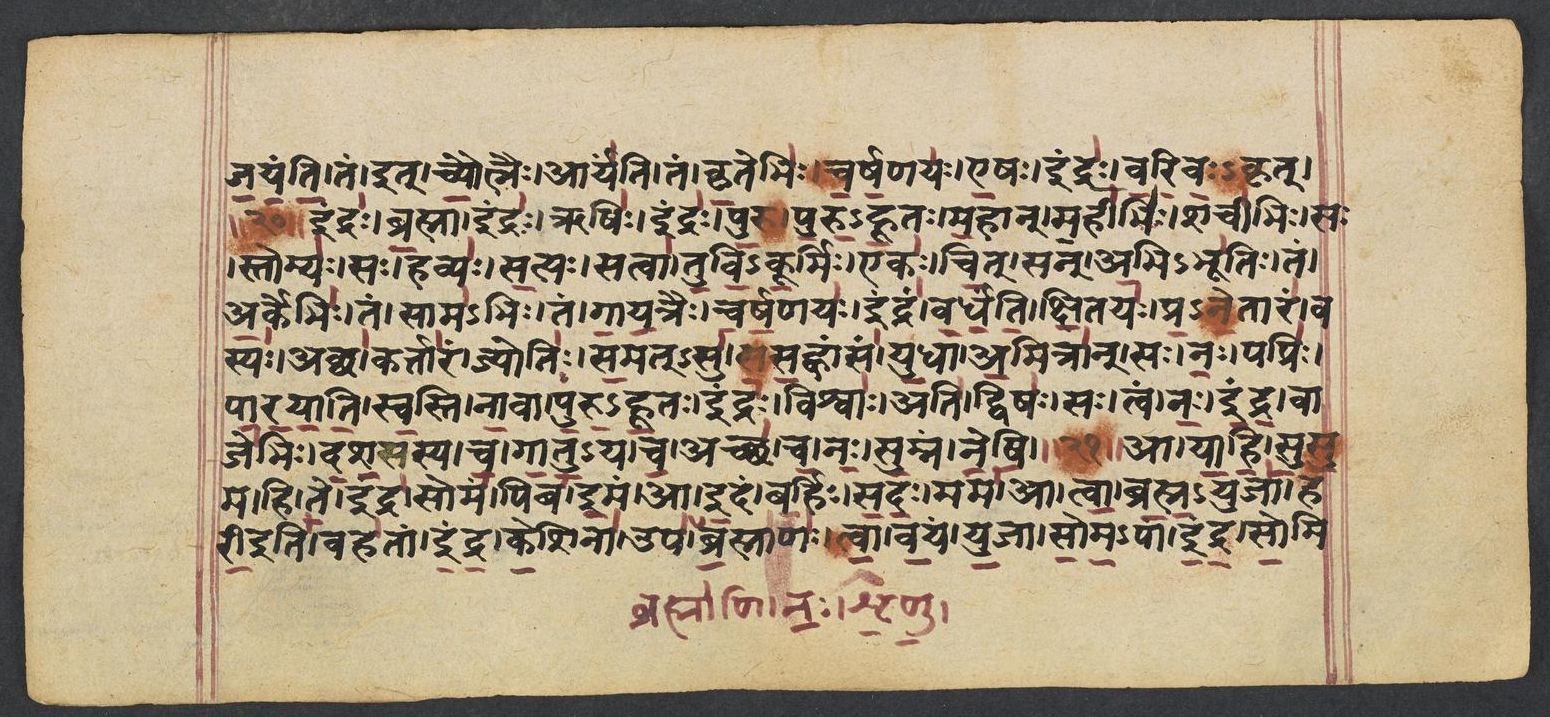
Penn Ms. Coll. 390 Item 41, fol. 585r (numbered 7r by the scribe) (OPenn image 585, lower leaf). Checked on the image: the Rigveda text on this page begins in RV 8.16.5 ‹jayanti›. The next page with Rigveda text, fol. 585v (numbered 7v by the scribe), begins in RV 8.17.3 ‹-sominaḥ suta-vantaḥ havāmahe›. Verses 8.16.5-12 end on this page; 8.16.5 begins on fol. 584v (numbered 6v by the scribe).
5tam id dhane̍ṣu hi̱teṣv a̍dhivā̱kāya̍ havante | yeṣā̱m indra̱s te ja̍yanti ||
6tam ic cyau̱tnair ārya̍nti̱ taṁ kṛ̱tebhi̍ś carṣa̱ṇaya̍ḥ | e̱ṣa indro̍ variva̱skṛt ||
7indro̍ bra̱hmendra̱ ṛṣi̱r indra̍ḥ pu̱rū pu̍ruhū̱taḥ | ma̱hān ma̱hībhi̱ḥ śacī̍bhiḥ ||
8sa stomya̱ḥ sa havya̍ḥ sa̱tyaḥ satvā̍ tuvikū̱rmiḥ | eka̍ś ci̱t sann a̱bhibhū̍tiḥ ||
9tam a̱rkebhi̱s taṁ sāma̍bhi̱s taṁ gā̍ya̱traiś ca̍rṣa̱ṇaya̍ḥ | indra̍ṁ vardhanti kṣi̱taya̍ḥ ||
10pra̱ṇe̱tāra̱ṁ vasyo̱ acchā̱ kartā̍ra̱ṁ jyoti̍ḥ sa̱matsu̍ | sā̱sa̱hvāṁsa̍ṁ yu̱dhāmitrā̍n ||
11sa na̱ḥ papri̍ḥ pārayāti sva̱sti nā̱vā pu̍ruhū̱taḥ | indro̱ viśvā̱ ati̱ dviṣa̍ḥ ||
12sa tvaṁ na̍ indra̱ vāje̍bhir daśa̱syā ca̍ gātu̱yā ca̍ | acchā̍ ca naḥ su̱mnaṁ ne̍ṣi ||
Compare: Padapāṭha (word-by-word text written in the manuscript; Sansknet e-text via GRETIL)
5tam | it | dhaneṣu | hiteṣu | adhi-vākāya | havante | yeṣām | indraḥ | te | jayanti
6tam | it | cyautnaiḥ | āryanti | tam | kṛtebhiḥ | carṣaṇayaḥ | eṣaḥ | indraḥ | varivaḥ-kṛt
7indraḥ | brahmā | indraḥ | ṛṣiḥ | indraḥ | puru | puru-hūtaḥ | mahān | mahībh iḥ | śacībhiḥ
8saḥ | stomyaḥ | saḥ | havyaḥ | satyaḥ | satvā | tuvi-kūrmiḥ | ekaḥ | cit | san | abhi-bhūtiḥ
9tam | arkebhiḥ | tam | sāma-bhiḥ | tam | gāyatraiḥ | carṣaṇayaḥ | indram | vardhanti | kṣitayaḥ
10pra-netāram | vasyaḥ | accha | kartāram | jyotiḥ | samat-su | sasahvāṃsam | yudhā | amitrān
11saḥ | naḥ | papriḥ | pārayāti | svasti | nāvā | puru-hūtaḥ | indraḥ | viśvā | ati | dviṣaḥ
12saḥ | tvam | naḥ | indra | vājebhiḥ | daśasya | ca | gātu-ya | ca | accha | ca | naḥ | sumnam | neṣi
5Him, when the spoils of war are staked, men call to be their advocate: They who have Indra win the day.
6Men honour him with stirring songs and magnify with solemn rites: Indra is he who giveth case.
7Indra is priest and R̥ishi, he is much invoked by many men, And mighty by his mighty powers.
8Meet to be lauded and invoked, true Hero with his deeds of might, Victorious even when alone.
9The men, the people magnify that Indra with their Slina. songs, With hymns and sacred eulogies
10Him who advances them to wealth, sends light to lead them in the war, And quells their foemen in the fray.
11May he, the saviour much-invoked, may Indra bear us in a ship Safely beyond all enemies.
12As such, O Indra, honour us with gifts of booty, further us, And lead us to felicity.
Notes
- Sanskrit: Aufrecht's edition (1877) with the Vedic accents, as entered by van Nooten and Holland (GRETIL).
- English: Ralph T. H. Griffith, The Hymns of the Rigveda (1889-1892; 2nd ed. 1896-1897), from the VedaWeb digital text; OCR slips in that text were corrected against the printed 2nd edition (data/sources/rigveda/griffith_errata.json).
- Padapāṭha (edition text): Sansknet e-text via GRETIL (CC BY-NC-SA 4.0).
Cite
Sources
- Source: Penn Ms. Coll. 390 Item 41 (undated (catalogued with Penn's 18th-19th c. Vedic manuscripts)), OPenn, Public Domain Mark + Aufrecht's accented text (GRETIL) + Griffith's English (VedaWeb) (holding institution)
- Critical edition: Aufrecht (1877), accented e-text via GRETIL
← previous · → next · v cycle view · l back to library