Rigveda 8.28: To all the gods
Introduction
Rigveda 8.28 is a hymn of 5 verses addressed to all the gods. It stands in book (maṇḍala) 8, the book of the Kaṇva and Aṅgiras poets. The Rigveda is the oldest collection of Sanskrit hymns, composed in the second half of the second millennium BCE and handed down orally for many centuries before it was written down.
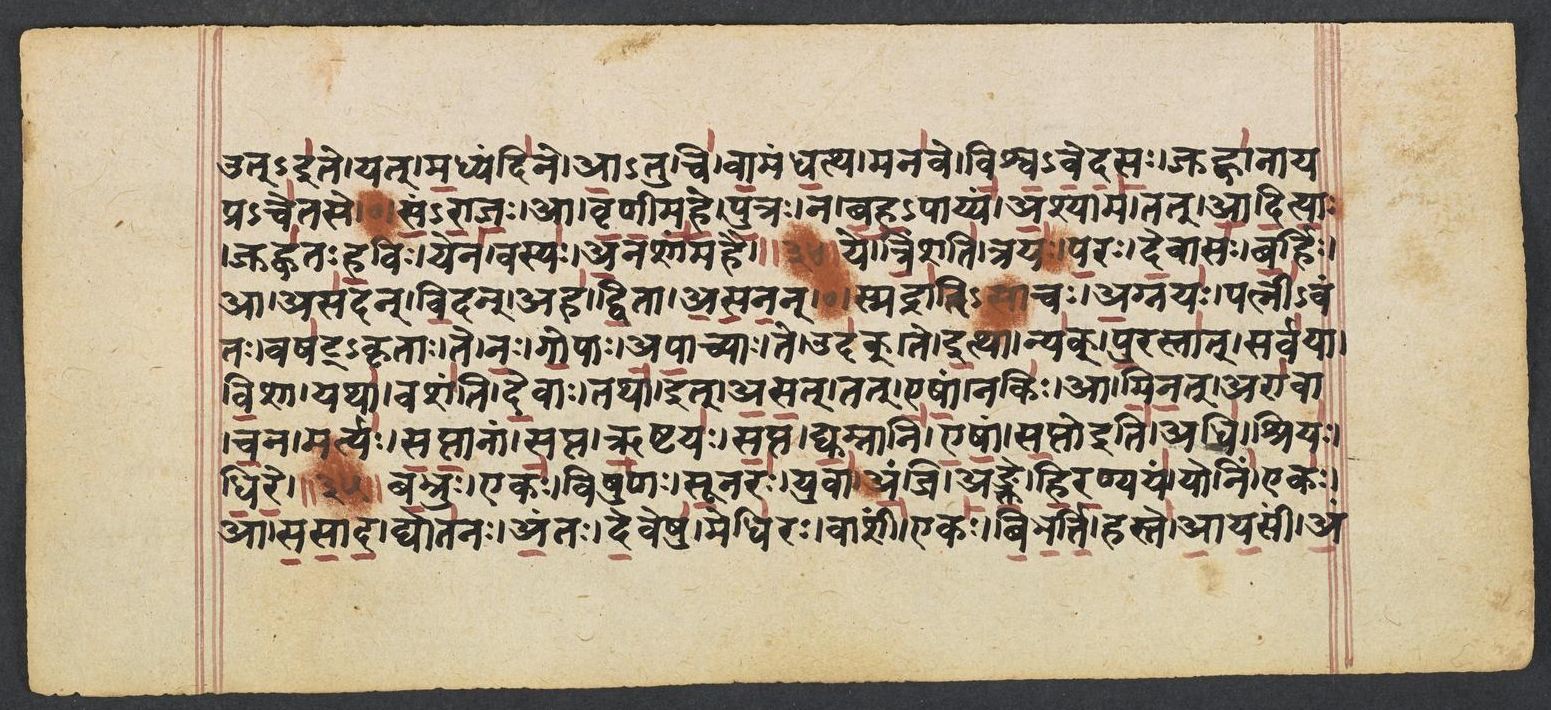
The manuscript shown is Penn Ms. Coll. 390 Item 41 (University of Pennsylvania), an undated paper manuscript of the padapāṭha (the word-by-word recitation text, in which every word is written separately and compounds are split) of the whole Ṛgveda in Devanāgarī, 884 leaves in fascicles, 7-9 lines to the page, accents in red; this hymn stands on fol. 603r. Each section below gives the verses that end on one page; the page boundaries were read on the images (the opening words of every page), not counted out. Where the manuscript is a padapāṭha (the word-by-word recitation text), the section shows Aufrecht's continuous (saṃhitā) text first and, as the edition text, the padapāṭha of the same verses, which is the form written on the page.
How was this verified? (Provenance)
Where on the image
Penn Ms. Coll. 390 Item 41, fol. 603r (numbered 25r by the scribe) (OPenn image 603, lower leaf). Checked on the image: the Rigveda text on this page begins in RV 8.27.21 ‹ut-ite yat madhyandine ātuci›. The next page with Rigveda text, fol. 603v (numbered 25v by the scribe), begins in RV 8.29.3 ‹-antaḥ deveṣu ni-dhruviḥ›. Verses 8.28.1-5 end on this page.
1ye tri̱ṁśati̱ traya̍s pa̱ro de̱vāso̍ ba̱rhir āsa̍dan | vi̱dann aha̍ dvi̱tāsa̍nan ||
2varu̍ṇo mi̱tro a̍rya̱mā smadrā̍tiṣāco a̱gnaya̍ḥ | patnī̍vanto̱ vaṣa̍ṭkṛtāḥ ||
3te no̍ go̱pā a̍pā̱cyās ta uda̱k ta i̱tthā nya̍k | pu̱rastā̱t sarva̍yā vi̱śā ||
4yathā̱ vaśa̍nti de̱vās tathed a̍sa̱t tad e̍ṣā̱ṁ naki̱r ā mi̍nat | arā̍vā ca̱na martya̍ḥ ||
5sa̱ptā̱nāṁ sa̱pta ṛ̱ṣṭaya̍ḥ sa̱pta dyu̱mnāny e̍ṣām | sa̱pto adhi̱ śriyo̍ dhire ||
Compare: Padapāṭha (word-by-word text written in the manuscript; Sansknet e-text via GRETIL)
1ye | triṃśati | trayaḥ | paraḥ | devāsaḥ | barhiḥ | ā | asadan | vidan | aha | dvitā | asanam
2varuṇaḥ | mitraḥ | aryamā | smadrāti-sācaḥ | agnayaḥ | patnī-vantaḥ | vaṣaṭ-kṛṭāḥ
3te | naḥ | gopāḥ | apācyāḥ | te | udak | te | itthā | nyak | purastāt | sarvayā | viśā
4yathā | vaśanti | devāḥ | tathā | it | asat | tat | eṣām | nakiḥ | ā | minat | arāvā | cana | martyaḥ
5saptānām | sapta | ṛṣṭayaḥ | sapta | dyumnāni | eṣām | sapto iti | adhi | śriyaḥ | dhire
1THE Thirty Gods and Three besides, whose seat hath been the sacred grass, From time of old have found and gained.
2Varuṇa, Mitra, Aryaman, Agnis, with Consorts, sending boons, To whom our Vashaṭ! is addressed:
3These are our guardians in the west, and northward here, and in the south, And on the east, with all the tribe.
4Even as the Gods desire so verily shall it be. None minisheth this power of theirs, No demon, and no mortal
5The Seven carry seven spears; seven are the splendours they possess, And seven the glories they assume.
Notes
- Sanskrit: Aufrecht's edition (1877) with the Vedic accents, as entered by van Nooten and Holland (GRETIL).
- English: Ralph T. H. Griffith, The Hymns of the Rigveda (1889-1892; 2nd ed. 1896-1897), from the VedaWeb digital text; OCR slips in that text were corrected against the printed 2nd edition (data/sources/rigveda/griffith_errata.json).
- Padapāṭha (edition text): Sansknet e-text via GRETIL (CC BY-NC-SA 4.0).
Cite
Sources
- Source: Penn Ms. Coll. 390 Item 41 (undated (catalogued with Penn's 18th-19th c. Vedic manuscripts)), OPenn, Public Domain Mark + Aufrecht's accented text (GRETIL) + Griffith's English (VedaWeb) (holding institution)
- Critical edition: Aufrecht (1877), accented e-text via GRETIL
← previous · → next · v cycle view · l back to library