Rigveda 8.34: To Indra
Introduction
Rigveda 8.34 is a hymn of 18 verses addressed to Indra. It stands in book (maṇḍala) 8, the book of the Kaṇva and Aṅgiras poets. The Rigveda is the oldest collection of Sanskrit hymns, composed in the second half of the second millennium BCE and handed down orally for many centuries before it was written down.
The manuscript shown is Penn Ms. Coll. 390 Item 41 (University of Pennsylvania), an undated paper manuscript of the padapāṭha (the word-by-word recitation text, in which every word is written separately and compounds are split) of the whole Ṛgveda in Devanāgarī, 884 leaves in fascicles, 7-9 lines to the page, accents in red; this hymn stands on fol. 608r-608v. Each section below gives the verses that end on one page; the page boundaries were read on the images (the opening words of every page), not counted out. Where the manuscript is a padapāṭha (the word-by-word recitation text), the section shows Aufrecht's continuous (saṃhitā) text first and, as the edition text, the padapāṭha of the same verses, which is the form written on the page.
How was this verified? (Provenance)
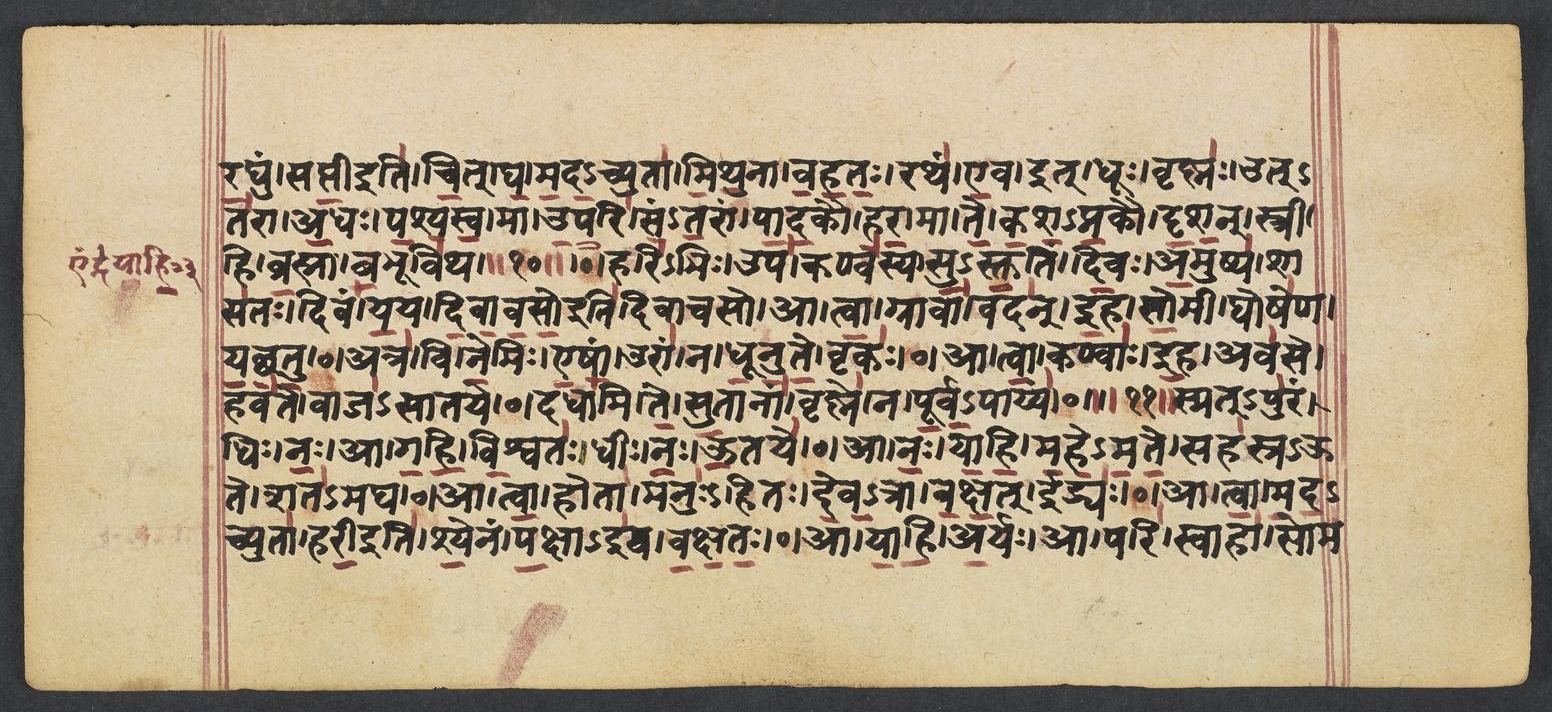
Where on the image
Penn Ms. Coll. 390 Item 41, fol. 608r (numbered 30r by the scribe) (OPenn image 608, lower leaf). Checked on the image: the Rigveda text on this page begins in RV 8.33.17 ‹raghum›. The next page with Rigveda text, fol. 608v (numbered 30v by the scribe), begins in RV 8.34.10 ‹-divāvaso itidivāvaso›. Verses 8.34.1-9 end on this page.
1endra̍ yāhi̱ hari̍bhi̱r upa̱ kaṇva̍sya suṣṭu̱tim | di̱vo a̱muṣya̱ śāsa̍to̱ diva̍ṁ ya̱ya di̍vāvaso ||
2ā tvā̱ grāvā̱ vada̍nn i̱ha so̱mī ghoṣe̍ṇa yacchatu | di̱vo a̱muṣya̱ śāsa̍to̱ diva̍ṁ ya̱ya di̍vāvaso ||
3atrā̱ vi ne̱mir e̍ṣā̱m urā̱ṁ na dhū̍nute̱ vṛka̍ḥ | di̱vo a̱muṣya̱ śāsa̍to̱ diva̍ṁ ya̱ya di̍vāvaso ||
4ā tvā̱ kaṇvā̍ i̱hāva̍se̱ hava̍nte̱ vāja̍sātaye | di̱vo a̱muṣya̱ śāsa̍to̱ diva̍ṁ ya̱ya di̍vāvaso ||
5dadhā̍mi te su̱tānā̱ṁ vṛṣṇe̱ na pū̍rva̱pāyya̍m | di̱vo a̱muṣya̱ śāsa̍to̱ diva̍ṁ ya̱ya di̍vāvaso ||
6smatpu̍raṁdhir na̱ ā ga̍hi vi̱śvato̍dhīr na ū̱taye̍ | di̱vo a̱muṣya̱ śāsa̍to̱ diva̍ṁ ya̱ya di̍vāvaso ||
7ā no̍ yāhi mahemate̱ saha̍srote̱ śatā̍magha | di̱vo a̱muṣya̱ śāsa̍to̱ diva̍ṁ ya̱ya di̍vāvaso ||
8ā tvā̱ hotā̱ manu̍rhito deva̱trā va̍kṣa̱d īḍya̍ḥ | di̱vo a̱muṣya̱ śāsa̍to̱ diva̍ṁ ya̱ya di̍vāvaso ||
9ā tvā̍ mada̱cyutā̱ harī̍ śye̱nam pa̱kṣeva̍ vakṣataḥ | di̱vo a̱muṣya̱ śāsa̍to̱ diva̍ṁ ya̱ya di̍vāvaso ||
Compare: Padapāṭha (word-by-word text written in the manuscript; Sansknet e-text via GRETIL)
1ā | indra | yāhi | hari-bhiḥ | upa | kaṇvasya | su-stutim | divaḥ | amuṣya | śāsataḥ | divam | yaya | divāvaso itidivāvaso
2ā | tvā | grāvā | vadan | iha | somī | ghoṣeṇa | yacchatu | divaḥ | amuṣya | śāsataḥ | divam | yaya | divāvaso itidivāvaso
3atra | vi | nemiḥ | eṣām | urām | na | dhūnute | vṛkaḥ | divaḥ | amuṣya | śāsataḥ | divam | yaya | divāvaso itidivāvaso
4ā | tvā | kaṇvāḥ | iha | avase | havante | vāja-sātaye | divaḥ | amuṣya | śāsataḥ | divam | yaya | divāvaso itidivāvaso
5dadhāmi | te | sutānām | vṛṣṇe | na | pūrva-pāyyam | divaḥ | amuṣya | śāsataḥ | divam | yaya | divāvaso itidivāvaso
6smat-purandhiḥ | naḥ | ā | gahi | viśvataḥ-dhīḥ | naḥ | ūtaye | divaḥ | amuṣya | śāsataḥ | divam | yaya | divāvaso itidivāvaso
7ā | naḥ | yāhi | mahe--mate | sahasra-ūte | śata-magha | divaḥ | amuṣya | śāsataḥ | divam | yaya | divāvaso itidivāvaso
8ā | tvā | hotā | manuḥ-hitaḥ | deva-trā | vakṣat | īḍyaḥ | divaḥ | amuṣya | śāsataḥ | divam | yaya | divāvaso itidivāvaso
9ā | tvā | mada-cyutā | harī iti | śyenam | pakṣāiva | vakṣataḥ | divaḥ | amuṣya | śāsataḥ | divam | yaya | divāvaso itidivāvaso
1Come hither, Indra, with thy Bays, come thou to Kaṇva's eulogy. Ye by command of yonder Dyaus, God bright by day! have gone to heaven.
2May the stone draw thee as it speaks, the Soma-stone with ringing voice. Ye by command of yonder Dyaus, God bright by day! have gone to heaven.
3The stones' rim shakes the Soma here like a wolf worrying a sheep. Ye by command of yonder Dyaus, God bright by day! have gone to heaven.
4The Kaṇvas call thee hitherward for succour and to win the spoil. Ye by command of yonder Dyaus, God bright by day! have gone to heaven.
5I set for thee, as for the Strong, the first draught of the juices shed.
6Come with abundant blessings, come with perfect care to succour us.
7Come, Lord of lofty thought, who hast infinite wealth and countless aids.
8Adorable mid Gods, the Priest good to mankind shall bring thee near.
9As wings the falcon, so thy Bays rushing in joy shall carry thee.
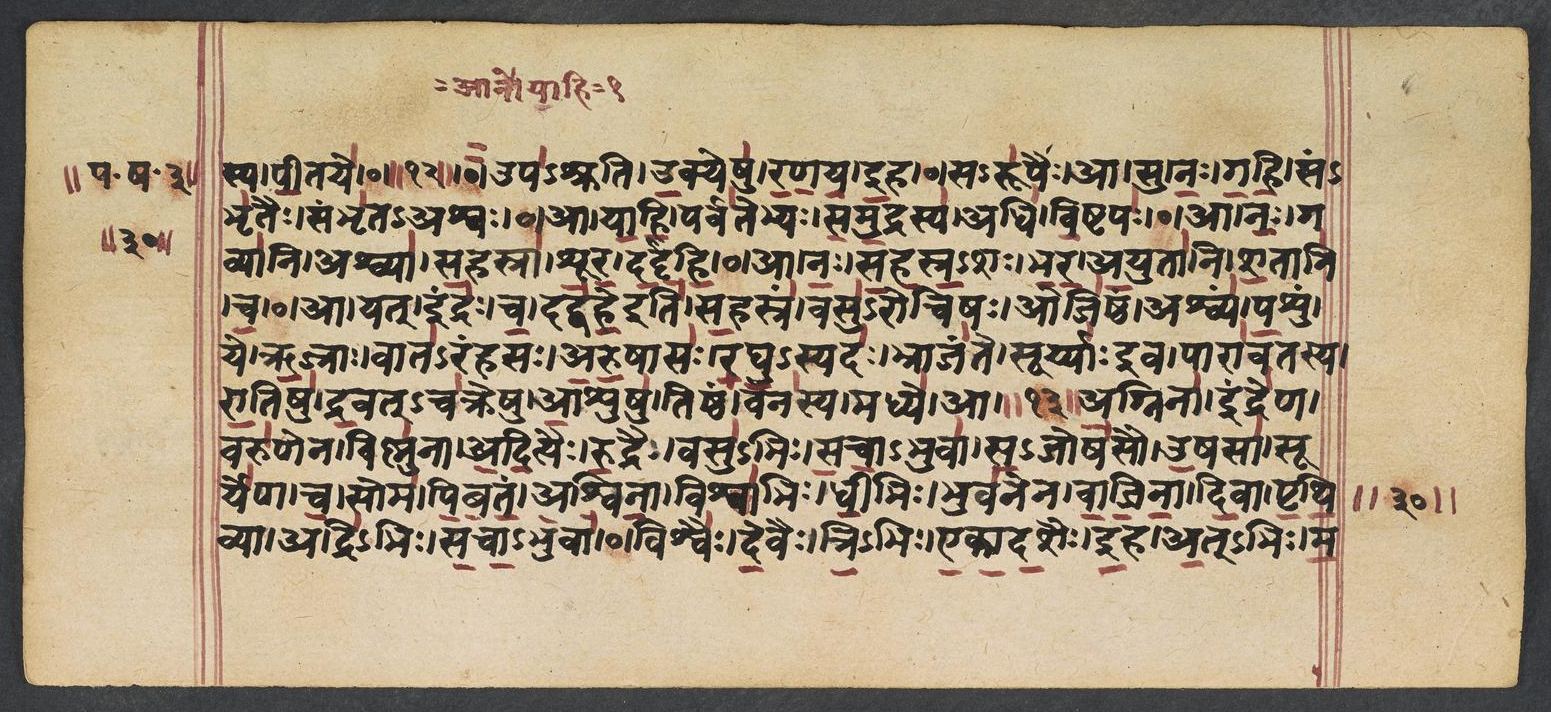
Where on the image
Penn Ms. Coll. 390 Item 41, fol. 608v (numbered 30v by the scribe) (OPenn image 609, upper leaf). Checked on the image: the Rigveda text on this page begins in RV 8.34.10 ‹-divāvaso itidivāvaso›. The next page with Rigveda text, fol. 609r (numbered 31r by the scribe), begins in RV 8.35.3 ‹-marut-bhiḥ bhṛgu-bhiḥ sacābhuvā sa-joṣasau›. Verses 8.34.10-18 end on this page; 8.34.10 begins on fol. 608r (numbered 30r by the scribe).
10ā yā̍hy a̱rya ā pari̱ svāhā̱ soma̍sya pī̱taye̍ | di̱vo a̱muṣya̱ śāsa̍to̱ diva̍ṁ ya̱ya di̍vāvaso ||
11ā no̍ yā̱hy upa̍śruty u̱ktheṣu̍ raṇayā i̱ha | di̱vo a̱muṣya̱ śāsa̍to̱ diva̍ṁ ya̱ya di̍vāvaso ||
12sarū̍pai̱r ā su no̍ gahi̱ sambhṛ̍tai̱ḥ sambhṛ̍tāśvaḥ | di̱vo a̱muṣya̱ śāsa̍to̱ diva̍ṁ ya̱ya di̍vāvaso ||
13ā yā̍hi̱ parva̍tebhyaḥ samu̱drasyādhi̍ vi̱ṣṭapa̍ḥ | di̱vo a̱muṣya̱ śāsa̍to̱ diva̍ṁ ya̱ya di̍vāvaso ||
14ā no̱ gavyā̱ny aśvyā̍ sa̱hasrā̍ śūra dardṛhi | di̱vo a̱muṣya̱ śāsa̍to̱ diva̍ṁ ya̱ya di̍vāvaso ||
15ā na̍ḥ sahasra̱śo bha̍rā̱yutā̍ni śa̱tāni̍ ca | di̱vo a̱muṣya̱ śāsa̍to̱ diva̍ṁ ya̱ya di̍vāvaso ||
16ā yad indra̍ś ca̱ dadva̍he sa̱hasra̱ṁ vasu̍rociṣaḥ | oji̍ṣṭha̱m aśvya̍m pa̱śum ||
17ya ṛ̱jrā vāta̍raṁhaso 'ru̱ṣāso̍ raghu̱ṣyada̍ḥ | bhrāja̍nte̱ sūryā̍ iva ||
18pārā̍vatasya rā̱tiṣu̍ dra̱vacca̍kreṣv ā̱śuṣu̍ | tiṣṭha̱ṁ vana̍sya̱ madhya̱ ā ||
Compare: Padapāṭha (word-by-word text written in the manuscript; Sansknet e-text via GRETIL)
10ā | yāhi | aryaḥ | ā | pari | svāhā | somasya | pītaye | divaḥ | amuṣya | śāsataḥ | divam | yaya | divāvaso itidivāvaso
11ā | naḥ | yāhi | upa-śruti | uktheṣu | raṇaya | iha | divaḥ | amuṣya | śāsataḥ | divam | yaya | divāvaso itidivāvaso
12sa-rūpaiḥ | ā | su | naḥ | gahi | sam-bhṛtaiḥ | sambhṛta-aśvaḥ | divaḥ | amuṣya | śāsataḥ | divam | yaya | divāvaso itidivāvaso
13ā | yāhi | parvatebhyaḥ | samudrasya | adhi | viṣṭapaḥ | divaḥ | amuṣya | śāsataḥ | divam | yaya | divāvaso itidivāvaso
14ā | naḥ | gavyāni | aśvyā | sahasrā | śūra | dardṛhi | divaḥ | amuṣya | śāsataḥ | divam | yaya | divāvaso itidivāvaso
15ā | naḥ | sahasra-śaḥ | bhara | ayutāni | śatāni | ca | divaḥ | amuṣya | śāsataḥ | divam | yaya | divāvaso itidivāvaso
16ā | yat | indraḥ | ca | dadvahe iti | sahasram | vasu-rociṣaḥ | ojiṣṭham | aśvyam | paśum
17ye | ṛjrāḥ | vāta-raṃhasaḥ | aruṣāsaḥ | raghu-syadaḥ | bhrājante | sūryāḥ-iva
18pārāvatasya | rātiṣu | dravat-cakreṣu | āśuṣu | tiṣṭham | vanasya | madhye | ā
10Come from the enemy to us, to Svâhâ and the Soma-draught.
11Come hither with thine ear inclined to hear, take pleasure in our lauds.
12Lord of well-nourished Horses, come with well-fed Steeds alike in hue.
13Come hither from the mountains, come from regions of the sea of air.
14Disclose to us O Hero, wealth in thousands both of kine and steeds.
15Bring riches hitherward to us in hundreds, thousands, myriads. Ye by command of yonder Dyaus, God bright by day! have gone to heaven.
16The thousand steeds, the mightiest troop, which we and Indra have received From Vasurocis as a gift,
17The brown that match the wind in speed, and bright bay coursers fleet of foot, Like Suns, resplendent are they all.
18Mid the Pârâvata's rich gifts, swift steeds whose wheels run rapidly, I seemed to stand amid a wood.
Notes
- Sanskrit: Aufrecht's edition (1877) with the Vedic accents, as entered by van Nooten and Holland (GRETIL).
- English: Ralph T. H. Griffith, The Hymns of the Rigveda (1889-1892; 2nd ed. 1896-1897), from the VedaWeb digital text; OCR slips in that text were corrected against the printed 2nd edition (data/sources/rigveda/griffith_errata.json).
- Padapāṭha (edition text): Sansknet e-text via GRETIL (CC BY-NC-SA 4.0).
Cite
Sources
- Source: Penn Ms. Coll. 390 Item 41 (undated (catalogued with Penn's 18th-19th c. Vedic manuscripts)), OPenn, Public Domain Mark + Aufrecht's accented text (GRETIL) + Griffith's English (VedaWeb) (holding institution)
- Critical edition: Aufrecht (1877), accented e-text via GRETIL
← previous · → next · v cycle view · l back to library