Rigveda 8.37: To Indra
Introduction
Rigveda 8.37 is a hymn of 7 verses addressed to Indra. It stands in book (maṇḍala) 8, the book of the Kaṇva and Aṅgiras poets. The Rigveda is the oldest collection of Sanskrit hymns, composed in the second half of the second millennium BCE and handed down orally for many centuries before it was written down.
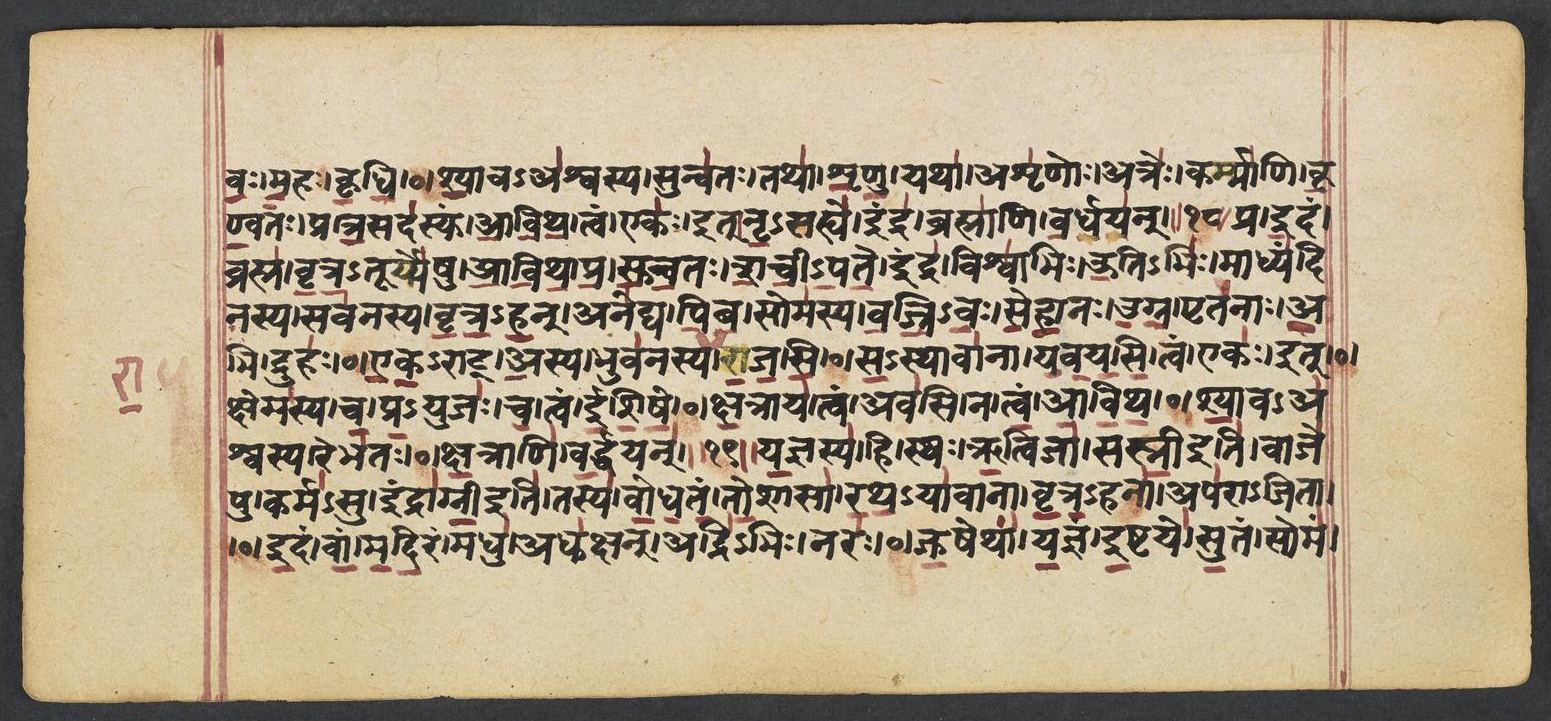
The manuscript shown is Penn Ms. Coll. 390 Item 41 (University of Pennsylvania), an undated paper manuscript of the padapāṭha (the word-by-word recitation text, in which every word is written separately and compounds are split) of the whole Ṛgveda in Devanāgarī, 884 leaves in fascicles, 7-9 lines to the page, accents in red; this hymn stands on fol. 610r. Each section below gives the verses that end on one page; the page boundaries were read on the images (the opening words of every page), not counted out. Where the manuscript is a padapāṭha (the word-by-word recitation text), the section shows Aufrecht's continuous (saṃhitā) text first and, as the edition text, the padapāṭha of the same verses, which is the form written on the page.
How was this verified? (Provenance)
Where on the image
Penn Ms. Coll. 390 Item 41, fol. 610r (numbered 32r by the scribe) (OPenn image 610, lower leaf). Checked on the image: the Rigveda text on this page begins in RV 8.36.6 ‹-indra sat-pate›. The next page with Rigveda text, fol. 610v (numbered 32v by the scribe), begins in RV 8.38.4 ‹sadhastutī itisadha-stutī indrāgnī iti›. Verses 8.37.1-7 end on this page.
1predam brahma̍ vṛtra̱tūrye̍ṣv āvitha̱ pra su̍nva̱taḥ śa̍cīpata̱ indra̱ viśvā̍bhir ū̱tibhi̍ḥ | mādhya̍ṁdinasya̱ sava̍nasya vṛtrahann anedya̱ pibā̱ soma̍sya vajrivaḥ ||
2se̱hā̱na u̍gra̱ pṛta̍nā a̱bhi druha̍ḥ śacīpata̱ indra̱ viśvā̍bhir ū̱tibhi̍ḥ | mādhya̍ṁdinasya̱ sava̍nasya vṛtrahann anedya̱ pibā̱ soma̍sya vajrivaḥ ||
3e̱ka̱rāḻ a̱sya bhuva̍nasya rājasi śacīpata̱ indra̱ viśvā̍bhir ū̱tibhi̍ḥ | mādhya̍ṁdinasya̱ sava̍nasya vṛtrahann anedya̱ pibā̱ soma̍sya vajrivaḥ ||
4sa̱sthāvā̍nā yavayasi̱ tvam eka̱ ic cha̍cīpata̱ indra̱ viśvā̍bhir ū̱tibhi̍ḥ | mādhya̍ṁdinasya̱ sava̍nasya vṛtrahann anedya̱ pibā̱ soma̍sya vajrivaḥ ||
5kṣema̍sya ca pra̱yuja̍ś ca̱ tvam ī̍śiṣe śacīpata̱ indra̱ viśvā̍bhir ū̱tibhi̍ḥ | mādhya̍ṁdinasya̱ sava̍nasya vṛtrahann anedya̱ pibā̱ soma̍sya vajrivaḥ ||
6kṣa̱trāya̍ tva̱m ava̍si̱ na tva̍m āvitha śacīpata̱ indra̱ viśvā̍bhir ū̱tibhi̍ḥ | mādhya̍ṁdinasya̱ sava̍nasya vṛtrahann anedya̱ pibā̱ soma̍sya vajrivaḥ ||
7śyā̱vāśva̍sya̱ rebha̍ta̱s tathā̍ śṛṇu̱ yathāśṛ̍ṇo̱r atre̱ḥ karmā̍ṇi kṛṇva̱taḥ | pra tra̱sada̍syum āvitha̱ tvam eka̱ in nṛ̱ṣāhya̱ indra̍ kṣa̱trāṇi̍ va̱rdhaya̍n ||
Compare: Padapāṭha (word-by-word text written in the manuscript; Sansknet e-text via GRETIL)
1pra | idam | brahma | vṛtra-tūryeṣu | āvitha | pra | sunvataḥ | śacī-pate | indra | viśvābhiḥ | ūti-bhiḥ | mādhyandinasya | savanasya | vṛtra-han | anedya | piba | somasya | vajri-vaḥ
2sehānaḥ | ugra | pṛtanāḥ | abhi | druhaḥ | śacī-pate | indra | viśvābhiḥ | ūti-bhiḥ | mādhyandinasya | savanasya | vṛtra-han | anedya | piba | somasya | vajr i-vaḥ
3eka-rāṭ | asya | bhuvanasya | rājasi | śacī-pate | indra | viśvābhiḥ | ūti-bhiḥ | mādhyandinasya | savanasya | vṛtra-han | anedya | piba | somasya | vajri--vaḥ
4sa-sthāvānā | yavayasi | tvam | ekaḥ | it | śacī-pate | indra | viśvābhiḥ | ūti-bh iḥ | mādhyandinasya | savanasya | vṛtra-han | anedya | piba | somasya | vajri-vaḥ
5kṣemasya | ca | pra-yujaḥ | ca | tvam | īśiṣe | śacī-pate | indra | viśvābhiḥ | ūti--bhiḥ | mādhyandinasya | savanasya | vṛtra-han | anedya | piba | somasya | vajri-vaḥ
6kṣatrāya | tvam | avasi | na | tvam | āvitha | śacī-pate | indra | viśvābhiḥ | ūti-bhiḥ | mādhyandinasya | savanasya | vṛtra-han | anedya | piba | somasya | vajri-vaḥ
7śyāva-aśvasya | rebhataḥ | tathā | śṛṇu | yathā | aśṛṇoḥ | atreḥ | karmāṇi | kṛṇvataḥ | pra | trasadasyum | āvitha | tvam | ekaḥ | it | nṛ-sahye | indra | brahmāṇi | vardhayan
1THIS prayer, and those who shed the juice, in wars with Vr̥itra thou holpest, Indra, Lord of Strength, with all thy succours. O Vr̥itra-slayer, from libation poured at noon, drink of the Soma juice, thou blameless Thunderer.
2Thou mighty Conqueror of hostile armaments, O Indra, Lord of Strength, with all thy saving help.
3Sole Ruler, thou art Sovran of this world of life, O Indra, Lord of Strength, with all thy saving help.
4Thou only sunderest these two consistent worlds, O Indra, Lord of Strength, with all thy saving help.
5Thou art the Lord supreme o'er rest and energy, O Indra, Lord of Strength, with all thy saving help.
6Thou helpest one to power, and one thou hast not helped, O Indra, Lord of Strength, with all thy saving aid.
7Hear thou Ṣyâvâṣva while he sings to thee, as erst thou heardest Atri when he wrought his holy rites. Indra, thou only gavest Trasadasyu aid in the fierce fight with heroes, strengthening his powers.
Notes
- Sanskrit: Aufrecht's edition (1877) with the Vedic accents, as entered by van Nooten and Holland (GRETIL).
- English: Ralph T. H. Griffith, The Hymns of the Rigveda (1889-1892; 2nd ed. 1896-1897), from the VedaWeb digital text; OCR slips in that text were corrected against the printed 2nd edition (data/sources/rigveda/griffith_errata.json).
- Padapāṭha (edition text): Sansknet e-text via GRETIL (CC BY-NC-SA 4.0).
Cite
Sources
- Source: Penn Ms. Coll. 390 Item 41 (undated (catalogued with Penn's 18th-19th c. Vedic manuscripts)), OPenn, Public Domain Mark + Aufrecht's accented text (GRETIL) + Griffith's English (VedaWeb) (holding institution)
- Critical edition: Aufrecht (1877), accented e-text via GRETIL
← previous · → next · v cycle view · l back to library