Rigveda 8.38: To Indra and Agni
Introduction
Rigveda 8.38 is a hymn of 10 verses addressed to Indra and Agni. It stands in book (maṇḍala) 8, the book of the Kaṇva and Aṅgiras poets. The Rigveda is the oldest collection of Sanskrit hymns, composed in the second half of the second millennium BCE and handed down orally for many centuries before it was written down.
The manuscript shown is Penn Ms. Coll. 390 Item 41 (University of Pennsylvania), an undated paper manuscript of the padapāṭha (the word-by-word recitation text, in which every word is written separately and compounds are split) of the whole Ṛgveda in Devanāgarī, 884 leaves in fascicles, 7-9 lines to the page, accents in red; this hymn stands on fol. 610r-610v. Each section below gives the verses that end on one page; the page boundaries were read on the images (the opening words of every page), not counted out. Where the manuscript is a padapāṭha (the word-by-word recitation text), the section shows Aufrecht's continuous (saṃhitā) text first and, as the edition text, the padapāṭha of the same verses, which is the form written on the page.
How was this verified? (Provenance)
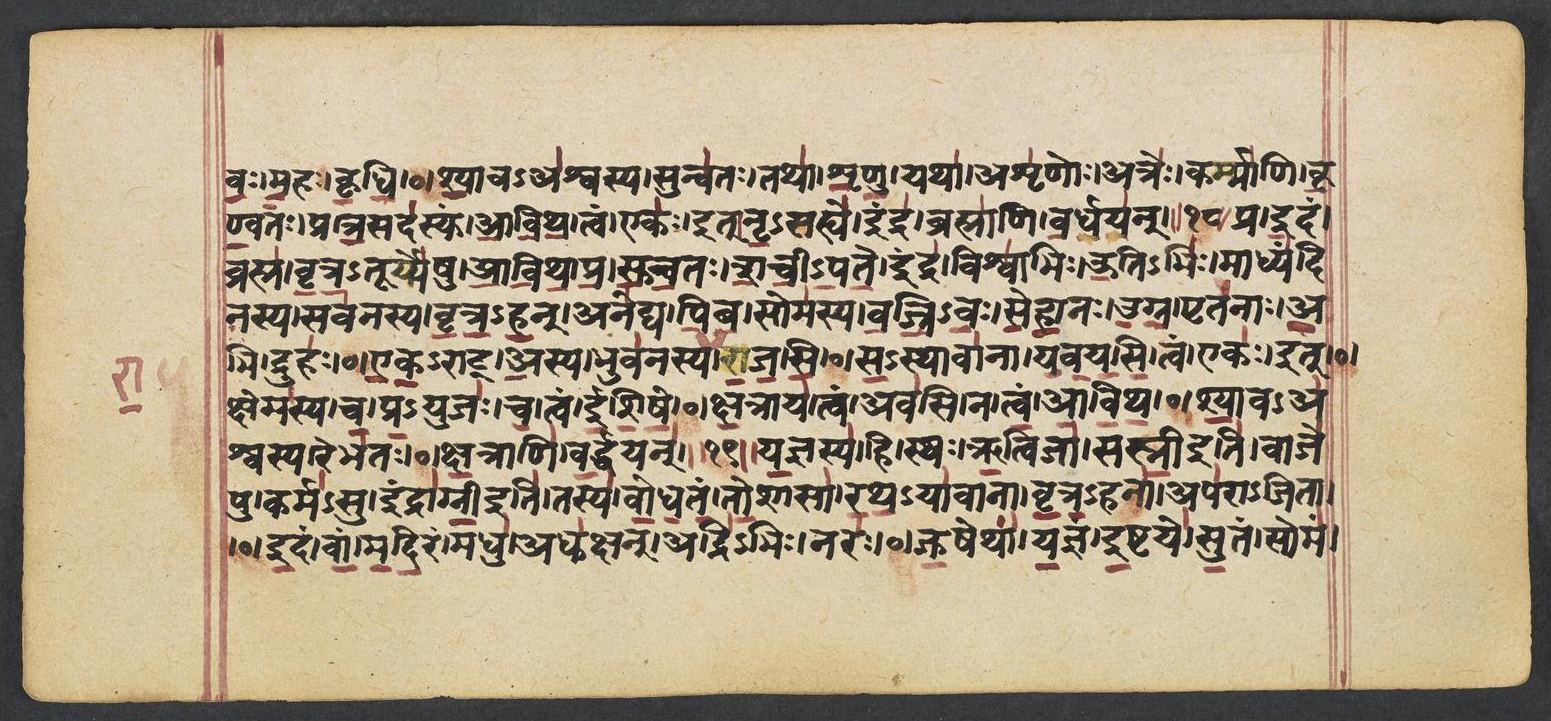
Where on the image
Penn Ms. Coll. 390 Item 41, fol. 610r (numbered 32r by the scribe) (OPenn image 610, lower leaf). Checked on the image: the Rigveda text on this page begins in RV 8.36.6 ‹-indra sat-pate›. The next page with Rigveda text, fol. 610v (numbered 32v by the scribe), begins in RV 8.38.4 ‹sadhastutī itisadha-stutī indrāgnī iti›. Verses 8.38.1-3 end on this page.
1ya̱jñasya̱ hi stha ṛ̱tvijā̱ sasnī̱ vāje̍ṣu̱ karma̍su | indrā̍gnī̱ tasya̍ bodhatam ||
2to̱śāsā̍ ratha̱yāvā̍nā vṛtra̱haṇāpa̍rājitā | indrā̍gnī̱ tasya̍ bodhatam ||
3i̱daṁ vā̍m madi̱ram madhv adhu̍kṣa̱nn adri̍bhi̱r nara̍ḥ | indrā̍gnī̱ tasya̍ bodhatam ||
Compare: Padapāṭha (word-by-word text written in the manuscript; Sansknet e-text via GRETIL)
1yajñasya | hi | sthaḥ | ṛtvijā | sasnī iti | vājeṣu | karmasu | indrāgnī iti | tasya | bodhatam
2toṣāsā | ratha-yāvānā | vṛtra-hanā | aparājitā | indrāgnī iti | tasya | bodhatam
3idam | vām | madiram | madhu | adhukṣan | adri-bhiḥ | naraḥ | indrāgnī iti | tasya | bodhatam
1YE Twain are Priests of sacrifice, winners in war and holy works: Indra and Agni, mark this well.
2Ye bounteous riders on the car, ye Vr̥itra-slayers unsubdued: Indra and Agni, mark this well.
3The men with pressing-stones have pressed this meath of yours which gives delight: Indra, and Agni, mark this well.
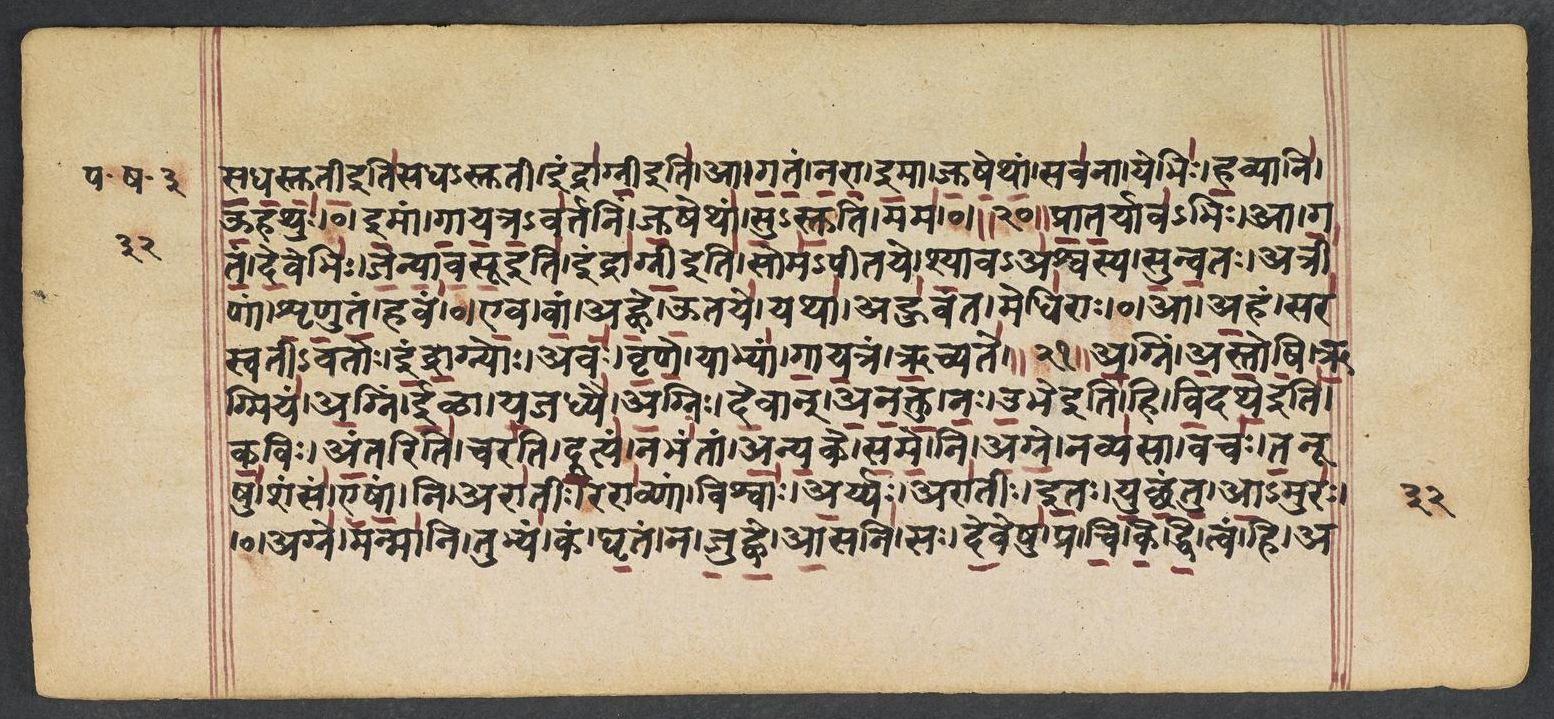
Where on the image
Penn Ms. Coll. 390 Item 41, fol. 610v (numbered 32v by the scribe) (OPenn image 611, upper leaf). Checked on the image: the Rigveda text on this page begins in RV 8.38.4 ‹sadhastutī itisadha-stutī indrāgnī iti›. The next page with Rigveda text, fol. 611r (numbered 33r by the scribe), begins in RV 8.39.3 ‹-asi pūrvyaḥ śivaḥ dūtaḥ›. Verses 8.38.4-10 end on this page; 8.38.4 begins on fol. 610r (numbered 32r by the scribe).
4ju̱ṣethā̍ṁ ya̱jñam i̱ṣṭaye̍ su̱taṁ soma̍ṁ sadhastutī | indrā̍gnī̱ ā ga̍taṁ narā ||
5i̱mā ju̍ṣethā̱ṁ sava̍nā̱ yebhi̍r ha̱vyāny ū̱hathu̍ḥ | indrā̍gnī̱ ā ga̍taṁ narā ||
6i̱māṁ gā̍ya̱trava̍rtaniṁ ju̱ṣethā̍ṁ suṣṭu̱tim mama̍ | indrā̍gnī̱ ā ga̍taṁ narā ||
7prā̱ta̱ryāva̍bhi̱r ā ga̍taṁ de̱vebhi̍r jenyāvasū | indrā̍gnī̱ soma̍pītaye ||
8śyā̱vāśva̍sya sunva̱to 'trī̍ṇāṁ śṛṇuta̱ṁ hava̍m | indrā̍gnī̱ soma̍pītaye ||
9e̱vā vā̍m ahva ū̱taye̱ yathāhu̍vanta̱ medhi̍rāḥ | indrā̍gnī̱ soma̍pītaye ||
10āhaṁ sara̍svatīvator indrā̱gnyor avo̍ vṛṇe | yābhyā̍ṁ gāya̱tram ṛ̱cyate̍ ||
Compare: Padapāṭha (word-by-word text written in the manuscript; Sansknet e-text via GRETIL)
4juṣethām | yajñam | iṣṭaye | sutam | somam | sadhastutī itisadha-stutī | indrāgnī iti | ā | gatam | narā
5imā | juṣethām | savanā | yebhiḥ | havyāni | ūhathuḥ | indrāgnī iti | ā | gatam | narā
6imām | gāyatra-vartanim | juṣethām | su-stutim | mama | indrāgnī iti | ā | gatam | narā
7prātaryāva-bhiḥ | ā | gatam | devebhiḥ | jenyāvasūiti | indrāgnī iti | soma-pītaye
8śyāva-aśvasya | sunvataḥ | atrīṇām | śṛṇutam | havam | indrāgnī iti | soma-pītaye
9eva | vām | ahve | ūtaye | yathā | ahuvanta | medhirāḥ | indrāgnī iti | soma-pītaye
10ā | aham | sarasvatī-vatoḥ | indrāgnyoḥ | avaḥ | vṛṇe | yābhyām | gāyatram | ṛcyate
4Accept our sacrifice for weal, sharers of praise! the Soma shed: Indra and Agni, Heroes, come.
5Be pleased with these libations which attract you to our sacred gifts Indra and Agni, Heroes, come.
6Accept this eulogy of mine whose model is the Gâyatrî: Indra and Agni, Heroes, Come.
7Come with the early-faring Gods, ye who are Lords of genuine wealth: Indra-Agni, to the Soma-draught
8Hear ye the call of Atris, hear Ṣyâvâṣva as he sheds the juice: Indra-Agni to the Soma-draught
9Thus have I called you to our aid as sages called on you of old: Indra-Agni to the Soma draught!
10Indra's and Agni's grace I claim, Sarasvatî's associates To whom this psalm of praise is sung.
Notes
- Sanskrit: Aufrecht's edition (1877) with the Vedic accents, as entered by van Nooten and Holland (GRETIL).
- English: Ralph T. H. Griffith, The Hymns of the Rigveda (1889-1892; 2nd ed. 1896-1897), from the VedaWeb digital text; OCR slips in that text were corrected against the printed 2nd edition (data/sources/rigveda/griffith_errata.json).
- Padapāṭha (edition text): Sansknet e-text via GRETIL (CC BY-NC-SA 4.0).
Cite
Sources
- Source: Penn Ms. Coll. 390 Item 41 (undated (catalogued with Penn's 18th-19th c. Vedic manuscripts)), OPenn, Public Domain Mark + Aufrecht's accented text (GRETIL) + Griffith's English (VedaWeb) (holding institution)
- Critical edition: Aufrecht (1877), accented e-text via GRETIL
← previous · → next · v cycle view · l back to library