Rigveda 8.54: To Indra or all the gods
Introduction
Rigveda 8.54 is a hymn of 8 verses addressed to Indra or all the gods. It stands in book (maṇḍala) 8, the book of the Kaṇva and Aṅgiras poets. The Rigveda is the oldest collection of Sanskrit hymns, composed in the second half of the second millennium BCE and handed down orally for many centuries before it was written down.
The manuscript shown is Penn Ms. Coll. 390 Item 41 (University of Pennsylvania), an undated paper manuscript of the padapāṭha (the word-by-word recitation text, in which every word is written separately and compounds are split) of the whole Ṛgveda in Devanāgarī, 884 leaves in fascicles, 7-9 lines to the page, accents in red; this hymn stands on fol. 627v-628r. Each section below gives the verses that end on one page; the page boundaries were read on the images (the opening words of every page), not counted out. Where the manuscript is a padapāṭha (the word-by-word recitation text), the section shows Aufrecht's continuous (saṃhitā) text first and, as the edition text, the padapāṭha of the same verses, which is the form written on the page.
How was this verified? (Provenance)
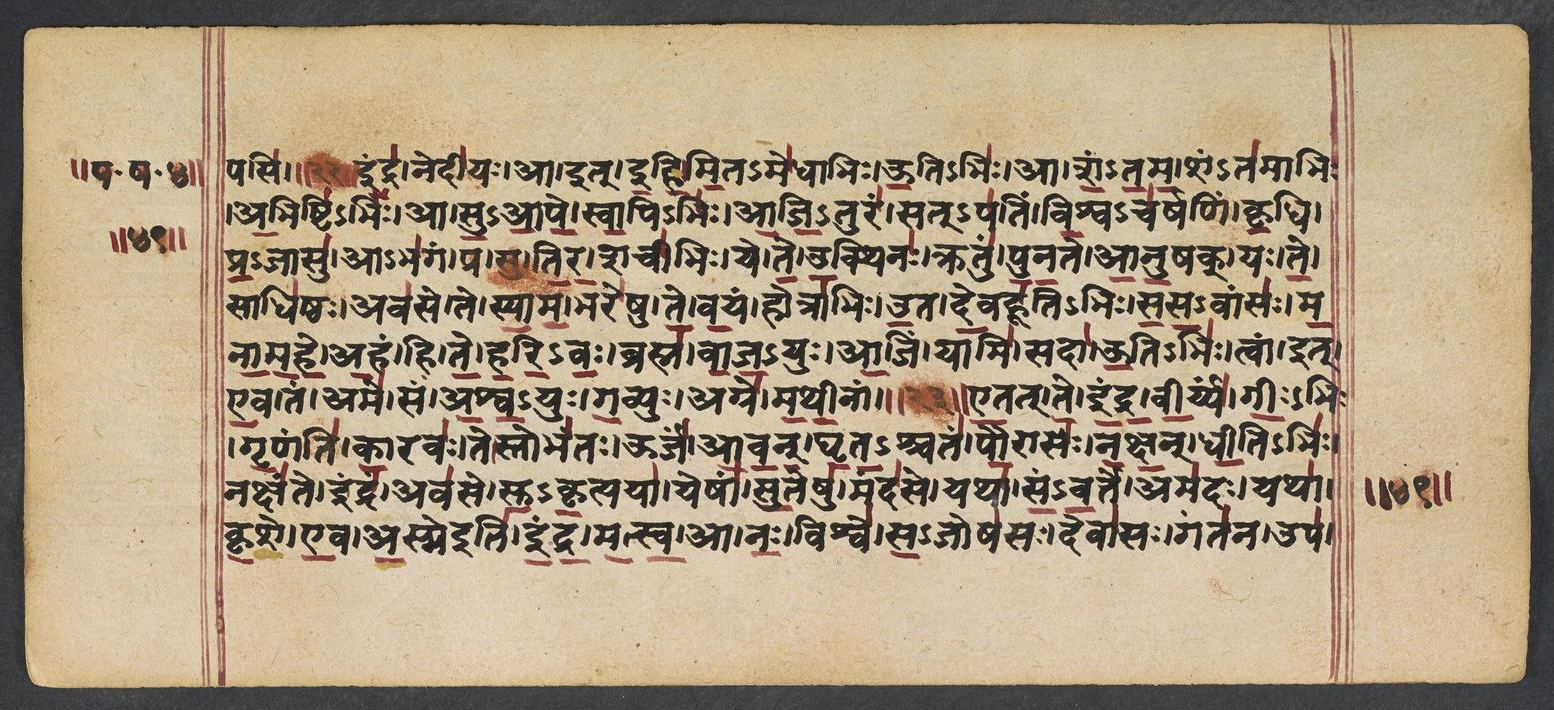
Where on the image
Penn Ms. Coll. 390 Item 41, fol. 627v (numbered 49v by the scribe) (OPenn image 628, upper leaf). Checked on the image: the Rigveda text on this page begins in RV 8.53.4 ‹-tṛmpasi›. The next page with Rigveda text, fol. 628r (numbered 50r by the scribe), begins in RV 8.54.3 ‹naḥ vasavaḥ rudrāḥ avase›. Verses 8.54.1-2 end on this page.
1e̱tat ta̍ indra vī̱rya̍ṁ gī̱rbhir gṛ̱ṇanti̍ kā̱rava̍ḥ | te stobha̍nta̱ ūrja̍m āvan ghṛta̱ścuta̍m pau̱rāso̍ nakṣan dhī̱tibhi̍ḥ ||
2nakṣa̍nta̱ indra̱m ava̍se sukṛ̱tyayā̱ yeṣā̍ṁ su̱teṣu̱ manda̍se | yathā̍ saṁva̱rte ama̍do̱ yathā̍ kṛ̱śa e̱vāsme i̍ndra matsva ||
Compare: Padapāṭha (word-by-word text written in the manuscript; Sansknet e-text via GRETIL)
1etat | te | indra | vīryam | gīḥ-bhiḥ | gṛṇanti | kāravaḥ | te | stobhantaḥ | ūrjam | āvan | ghṛta-ścutam | paurāsaḥ | nakṣan | dhīti-bhiḥ
2nakṣante | indram | avase | su-kṛtyayā | yeṣām | suteṣu | mandase | yathā | sam-varte | amadaḥ | yathā | kṛśe | eva | asme iti | indra | matsva
1INDRA, the poets with their hymns extol this hero might of thine: They strengthened, loud in song, thy power that droppeth oil. With hymns the Pauras came to thee.
2Through piety they came to Indra for his aid, they whose libations give theejoy. As thou with, Kr̥iṣa and Samvarta hast rejoiced, so, Indra, be thou glad with us.
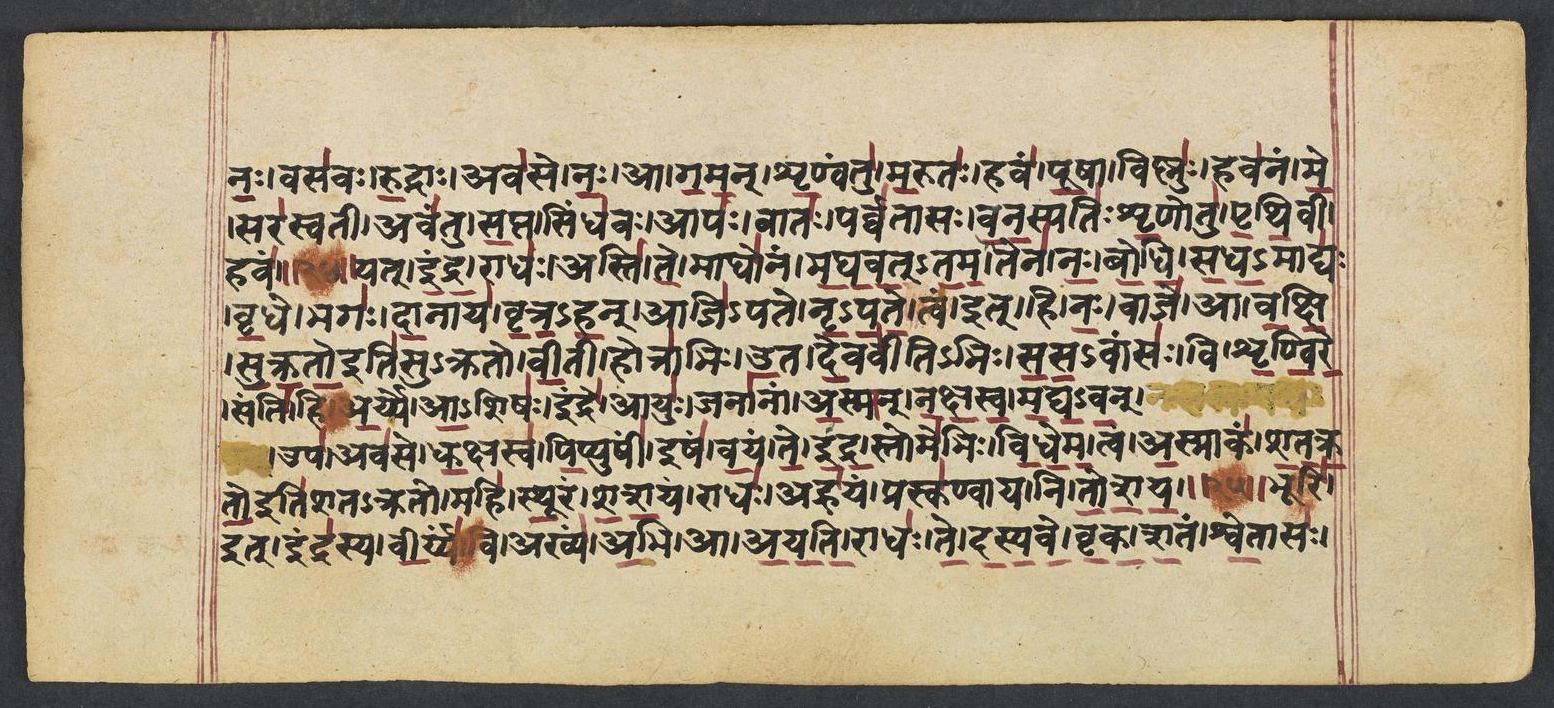
Where on the image
Penn Ms. Coll. 390 Item 41, fol. 628r (numbered 50r by the scribe) (OPenn image 628, lower leaf). Checked on the image: the Rigveda text on this page begins in RV 8.54.3 ‹naḥ vasavaḥ rudrāḥ avase›. The next page with Rigveda text, fol. 628v (numbered 50v by the scribe), begins in RV 8.55.2 ‹ukṣaṇaḥ divi tāraḥ na›. Verses 8.54.3-8 end on this page; 8.54.3 begins on fol. 627v (numbered 49v by the scribe).
3ā no̱ viśve̍ sa̱joṣa̍so̱ devā̍so̱ ganta̱nopa̍ naḥ | vasa̍vo ru̱drā ava̍se na̱ ā ga̍mañ chṛ̱ṇvantu̍ ma̱ruto̱ hava̍m ||
4pū̱ṣā viṣṇu̱r hava̍nam me̱ sara̍sva̱ty ava̍ntu sa̱pta sindha̍vaḥ | āpo̱ vāta̱ḥ parva̍tāso̱ vana̱spati̍ḥ śṛ̱ṇotu̍ pṛthi̱vī hava̍m ||
5yad i̍ndra̱ rādho̱ asti̍ te̱ māgho̍nam maghavattama | tena̍ no bodhi sadha̱mādyo̍ vṛ̱dhe bhago̍ dā̱nāya̍ vṛtrahan ||
6āji̍pate nṛpate̱ tvam id dhi no̱ vāja̱ ā va̍kṣi sukrato | vī̱tī hotrā̍bhir u̱ta de̱vavī̍tibhiḥ sasa̱vāṁso̱ vi śṛ̍ṇvire ||
7santi̱ hy a1̱̍rya ā̱śiṣa̱ indra̱ āyu̱r janā̍nām | a̱smān na̍kṣasva maghava̱nn upāva̍se dhu̱kṣasva̍ pi̱pyuṣī̱m iṣa̍m ||
8va̱yaṁ ta̍ indra̱ stome̍bhir vidhema̱ tvam a̱smāka̍ṁ śatakrato | mahi̍ sthū̱raṁ śa̍śa̱yaṁ rādho̱ ahra̍ya̱m praska̍ṇvāya̱ ni to̍śaya ||
Compare: Padapāṭha (word-by-word text written in the manuscript; Sansknet e-text via GRETIL)
3ā | naḥ | viśve | sa-joṣasaḥ | devāsaḥ | gantana | upa | naḥ | vasavaḥ | rudrāḥ | avase | naḥ | ā | gaman | śṛṇvantu | marutaḥ | havam
4pūṣā | viṣṇuḥ | havanam | me | sarasvatī | avantu | sapta | sindhavaḥ | āpaḥ | vātaḥ | parvatāsaḥ | vanaspatiḥ | śṛṇotu | pṛthivī | havam
5yat | indra | rādhaḥ | asti | te | māghonam | maghavat-tama | tena | naḥ | bodhi | sadha-mādyaḥ | vṛdhe | bhagaḥ | dānāya | vṛtra-han
6āji-pate | nṛ-pate | tvam | it | hi | naḥ | vāje | ā | vakṣi | sukrato itisu-krato | vītī | hotrābhiḥ | uta | devavīti-bhiḥ | sasa-vāṃsaḥ | vi | śṛṇvire
7santi | hi | arye | āśiṣaḥ | indre | āyuḥ | janānām | asmān | nakṣasva | magha-van | upa | avase | dhukṣasva | pipyuṣīm | iṣam
8vayam | te | indra | stomebhiḥ | vidhema | tvam | asmākam | śatakrato itiśata-krato | mahi | sthūram | śaśayam | rādhaḥ | ahrayam | praskaṇvāya | ni | tośaya
3Agreeing in your spirit, all ye Deities, come nigh to us. Vasus and Rudras shall come near to give us aid, and Maruts listen to our call.
4May Pûshan, Vishṇu, and Sarasvatî befriend, and the Seven Streams, this call of mine: May Waters, Wind, the Mountains, and the Forest-Lord, and Earth give ear unto my cry.
5Indra, with thine own bounteous gift, most liberal of the Mighty Ones, Be our boon benefactor, Vr̥itra-slayer, be our feast-companion for our weal.
6Leader of heroes, Lord of battle, lead thou us to combat, thou Most Sapient One. High fame is theirs who win by invocations, feasts and entertainment of the Gods.
7Our hopes rest on the Faithful One: in Indra is the people's life. O Maghavan, come nigh that thou mayst give us aid: make plenteous food stream forth for us.
8Thee would we worship, Indra, with our songs of praise: O Ṣatakratu, be thou ours. Pour down upon Praskaṇva bounty vast and firm, exuberant, that shall never fail.
Notes
- Sanskrit: Aufrecht's edition (1877) with the Vedic accents, as entered by van Nooten and Holland (GRETIL).
- English: Ralph T. H. Griffith, The Hymns of the Rigveda (1889-1892; 2nd ed. 1896-1897), from the VedaWeb digital text; OCR slips in that text were corrected against the printed 2nd edition (data/sources/rigveda/griffith_errata.json).
- Padapāṭha (edition text): Sansknet e-text via GRETIL (CC BY-NC-SA 4.0).
Cite
Sources
- Source: Penn Ms. Coll. 390 Item 41 (undated (catalogued with Penn's 18th-19th c. Vedic manuscripts)), OPenn, Public Domain Mark + Aufrecht's accented text (GRETIL) + Griffith's English (VedaWeb) (holding institution)
- Critical edition: Aufrecht (1877), accented e-text via GRETIL
← previous · → next · v cycle view · l back to library