Rigveda 8.53: To Indra
Introduction
Rigveda 8.53 is a hymn of 8 verses addressed to Indra. It stands in book (maṇḍala) 8, the book of the Kaṇva and Aṅgiras poets. The Rigveda is the oldest collection of Sanskrit hymns, composed in the second half of the second millennium BCE and handed down orally for many centuries before it was written down.
The manuscript shown is Penn Ms. Coll. 390 Item 41 (University of Pennsylvania), an undated paper manuscript of the padapāṭha (the word-by-word recitation text, in which every word is written separately and compounds are split) of the whole Ṛgveda in Devanāgarī, 884 leaves in fascicles, 7-9 lines to the page, accents in red; this hymn stands on fol. 627r-627v. Each section below gives the verses that end on one page; the page boundaries were read on the images (the opening words of every page), not counted out. Where the manuscript is a padapāṭha (the word-by-word recitation text), the section shows Aufrecht's continuous (saṃhitā) text first and, as the edition text, the padapāṭha of the same verses, which is the form written on the page.
How was this verified? (Provenance)
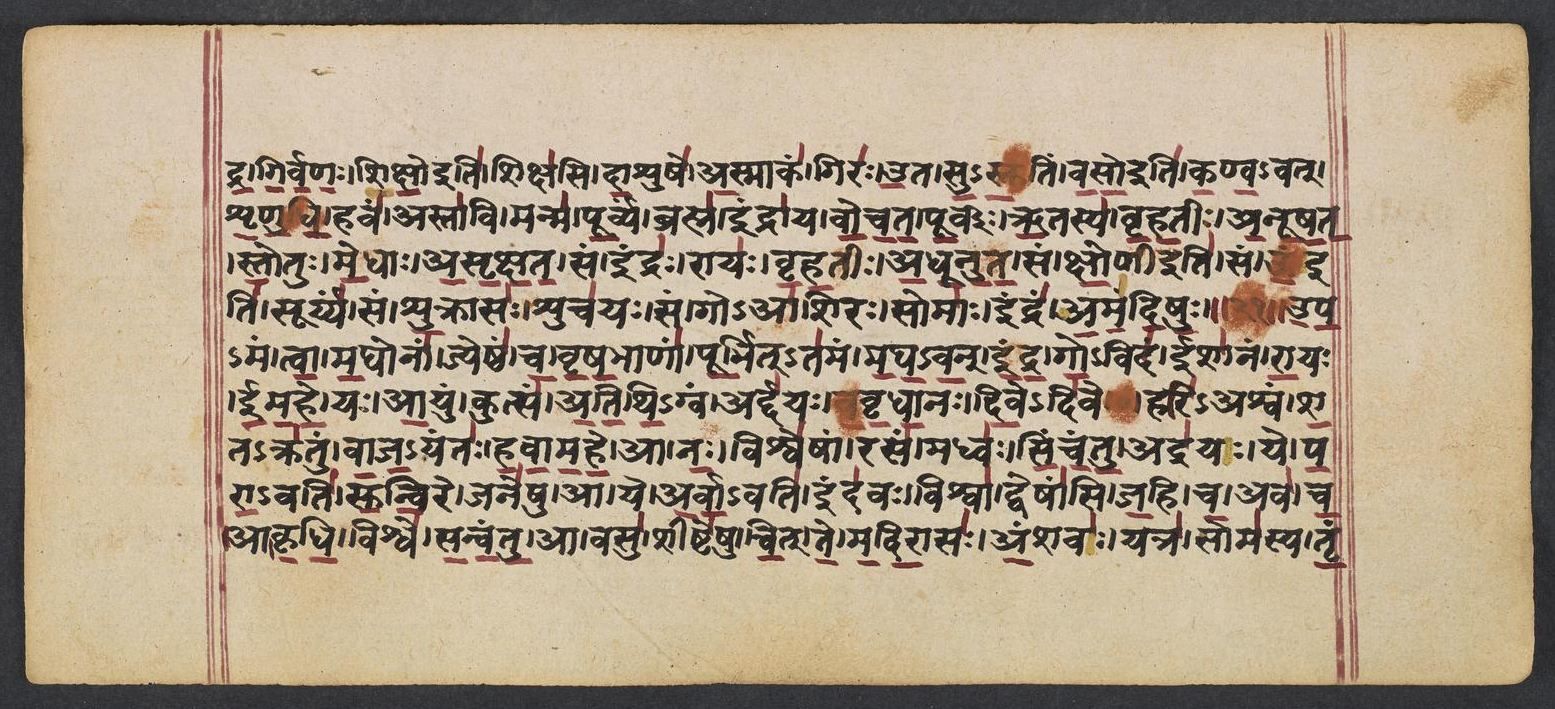
Where on the image
Penn Ms. Coll. 390 Item 41, fol. 627r (numbered 49r by the scribe) (OPenn image 627, lower leaf). Checked on the image: the Rigveda text on this page begins in RV 8.52.8 ‹-indra girvaṇaḥ śikṣo iti›. The next page with Rigveda text, fol. 627v (numbered 49v by the scribe), begins in RV 8.53.4 ‹-tṛmpasi›. Verses 8.53.1-3 end on this page.
1u̱pa̱maṁ tvā̍ ma̱ghonā̱ṁ jyeṣṭha̍ṁ ca vṛṣa̱bhāṇā̍m | pū̱rbhitta̍mam maghavann indra go̱vida̱m īśā̍naṁ rā̱ya ī̍mahe ||
2ya ā̱yuṁ kutsa̍m atithi̱gvam arda̍yo vāvṛdhā̱no di̱ve-di̍ve | taṁ tvā̍ va̱yaṁ harya̍śvaṁ śa̱takra̍tuṁ vāja̱yanto̍ havāmahe ||
3ā no̱ viśve̍ṣā̱ṁ rasa̱m madhva̍ḥ siñca̱ntv adra̍yaḥ | ye pa̍rā̱vati̍ sunvi̱re jane̱ṣv ā ye a̍rvā̱vatīnda̍vaḥ ||
Compare: Padapāṭha (word-by-word text written in the manuscript; Sansknet e-text via GRETIL)
1upa-mam | tvā | maghonām | jyeṣṭham | ca | vṛṣabhāṇām | purbhit-tamam | magha-van | indra | go--vidam | īśānam | rāyaḥ | īmahe
2yaḥ | āyum | kutsam | atithi-gvam | ardayaḥ | vavṛdhānaḥ | dive--dive | tam | tvā | vayam | hari-aśvam | śata-kratum | vāja-yantaḥ | havāmahe
3ā | naḥ | viśveṣām | rasam | madhvaḥ | siñcantu | adrayaḥ | ye | parāvati | sunv ire | janeṣu | ā | ye | arvāvati | indavaḥ
1As highest of the Maghavans, preeminent among the Bulls, Best breaker-down of forts, kine-winner, Lord of wealth, we seek thee, Indra Maghavan.
2Thou who subduedst Âyu, Kutsa, Âtithigva, waxing daily in thy might, As such, rousing thy power, we invocate thee now, thee Ṣatakratu, Lord of Bays.
3The pressing-stones shall pour for us the essence of the meath of all, Drops that have been pressed out afar among the folk, and those that have been pressed near us.
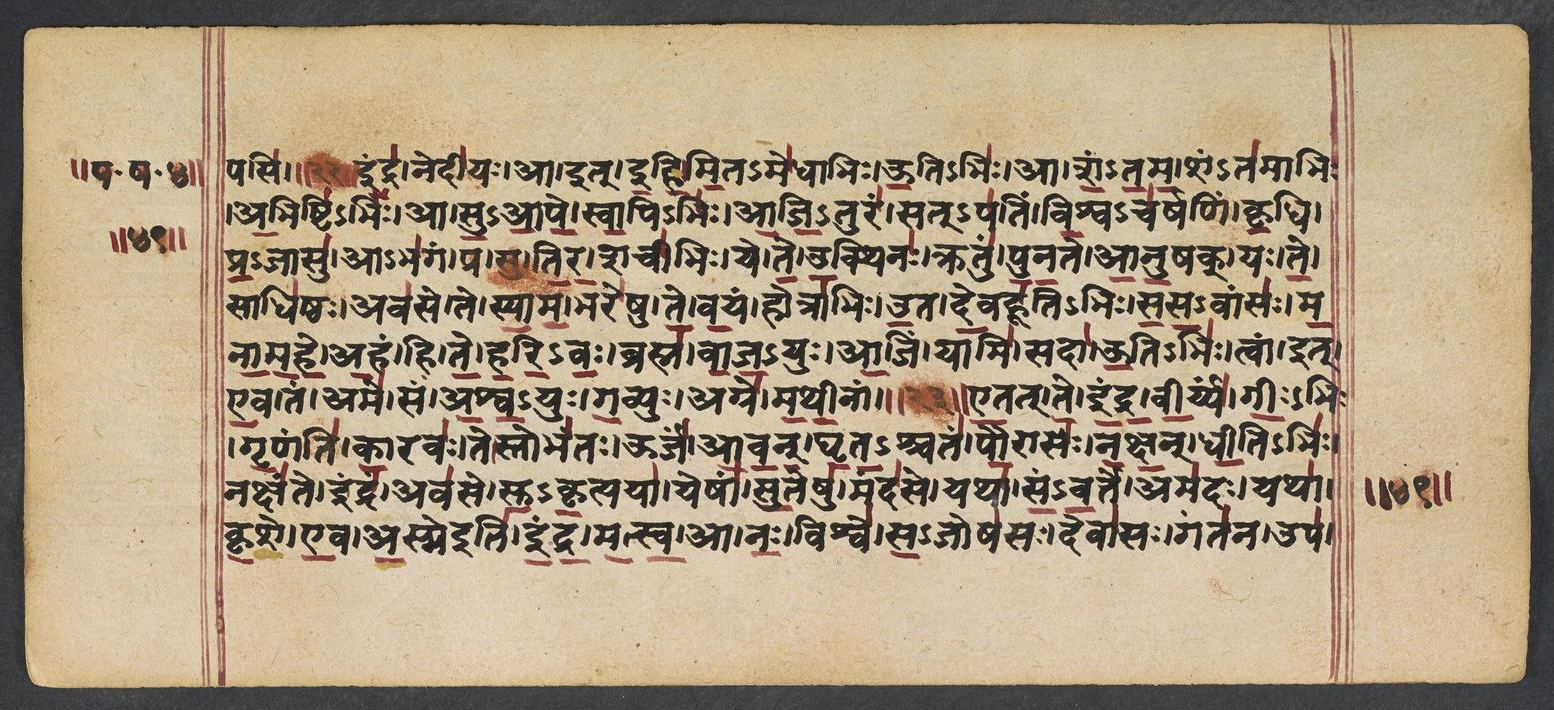
Where on the image
Penn Ms. Coll. 390 Item 41, fol. 627v (numbered 49v by the scribe) (OPenn image 628, upper leaf). Checked on the image: the Rigveda text on this page begins in RV 8.53.4 ‹-tṛmpasi›. The next page with Rigveda text, fol. 628r (numbered 50r by the scribe), begins in RV 8.54.3 ‹naḥ vasavaḥ rudrāḥ avase›. Verses 8.53.4-8 end on this page; 8.53.4 begins on fol. 627r (numbered 49r by the scribe).
4viśvā̱ dveṣā̍ṁsi ja̱hi cāva̱ cā kṛ̍dhi̱ viśve̍ sanva̱ntv ā vasu̍ | śīṣṭe̍ṣu cit te madi̱rāso̍ a̱ṁśavo̱ yatrā̱ soma̍sya tṛ̱mpasi̍ ||
5indra̱ nedī̍ya̱ ed i̍hi mi̱tame̍dhābhir ū̱tibhi̍ḥ | ā śa̍ṁtama̱ śaṁta̍mābhir a̱bhiṣṭi̍bhi̱r ā svā̍pe svā̱pibhi̍ḥ ||
6ā̱ji̱tura̱ṁ satpa̍tiṁ vi̱śvaca̍rṣaṇiṁ kṛ̱dhi pra̱jāsv ābha̍gam | pra sū ti̍rā̱ śacī̍bhi̱r ye ta̍ u̱kthina̱ḥ kratu̍m puna̱ta ā̍nu̱ṣak ||
7yas te̱ sādhi̱ṣṭho 'va̍se̱ te syā̍ma̱ bhare̍ṣu te | va̱yaṁ hotrā̍bhir u̱ta de̱vahū̍tibhiḥ sasa̱vāṁso̍ manāmahe ||
8a̱haṁ hi te̍ harivo̱ brahma̍ vāja̱yur ā̱jiṁ yāmi̱ sado̱tibhi̍ḥ | tvām id e̱va tam ame̱ sam a̍śva̱yur ga̱vyur agre̍ mathī̱nām ||
Compare: Padapāṭha (word-by-word text written in the manuscript; Sansknet e-text via GRETIL)
4viśvā | dveṣāṃsi | jahi | ca | avaca | ā | kṛdhi | viśve | sanvantu | ā | vasu | śīṣṭeṣu | cit | te | madirāsaḥ | aṃśavaḥ | yatra | somasya | tṛmpasi
5indra | nedīyaḥ | ā | it | ihi | mita-medhābhiḥ | ūti-bhiḥ | ā | śam-tama | śam-tamābhiḥ | abhiṣṭi-bhiḥ | ā | su-āpe | svāpi-bhiḥ
6āji-turam | sat-patim | viśva-carṣaṇim | kṛdhi | pra-jāsu | ābhagam | pra | su | tira | śacībhiḥ | ye | te | ukthinaḥ | kratum | punate | ānuṣak
7yaḥ | te | sādhiṣṭhaḥ | avase | te | syāma | bhareṣu | te | vayam | hotrābhiḥ | uta | devahūti-bhiḥ | sasa-vāṃsaḥ | manāmahe
8aham | hi | te | hari-vaḥ | brahma | vāja-yuḥ | ājim | yāmi | sadā | ūti-bhiḥ | tvām | it | eva | tam | ame | sam | aśva-yuḥ | gavyuḥ | agre | mathīnām
4Repel all enmities and keep them far away: let all win treasure for their own. Even among Ṣishṭas are the stalks that make thee glad, where thou with Soma satest thee.
5Come, Indra, very near to us with aids of firmly-based resolve; Come, most auspicious, with thy most auspicious help, good Kinsman, with good kinsmen, come!
6Bless thou with progeny the chief of men, the lord of heroes, victor in the fray. Aid with thy powers the men who sing thee lauds and keep their spirits ever pure and bright.
7May we be such in battle as are surest to obtain thy grace: With holy offerings and invocations of the Gods, we mean, that we may win the spoil.
8Thine, Lord of Bays, am I. Prayer longeth for the spoil. Still with thy help I seek the fight. So, at the raiders' head, I, craving steeds and kine, unite myself with thee alone.
Notes
- Sanskrit: Aufrecht's edition (1877) with the Vedic accents, as entered by van Nooten and Holland (GRETIL).
- English: Ralph T. H. Griffith, The Hymns of the Rigveda (1889-1892; 2nd ed. 1896-1897), from the VedaWeb digital text; OCR slips in that text were corrected against the printed 2nd edition (data/sources/rigveda/griffith_errata.json).
- Padapāṭha (edition text): Sansknet e-text via GRETIL (CC BY-NC-SA 4.0).
Cite
Sources
- Source: Penn Ms. Coll. 390 Item 41 (undated (catalogued with Penn's 18th-19th c. Vedic manuscripts)), OPenn, Public Domain Mark + Aufrecht's accented text (GRETIL) + Griffith's English (VedaWeb) (holding institution)
- Critical edition: Aufrecht (1877), accented e-text via GRETIL
← previous · → next · v cycle view · l back to library