Rigveda 8.86: To Asvins
Introduction
Rigveda 8.86 is a hymn of 5 verses addressed to Asvins. It stands in book (maṇḍala) 8, the book of the Kaṇva and Aṅgiras poets. The Rigveda is the oldest collection of Sanskrit hymns, composed in the second half of the second millennium BCE and handed down orally for many centuries before it was written down.
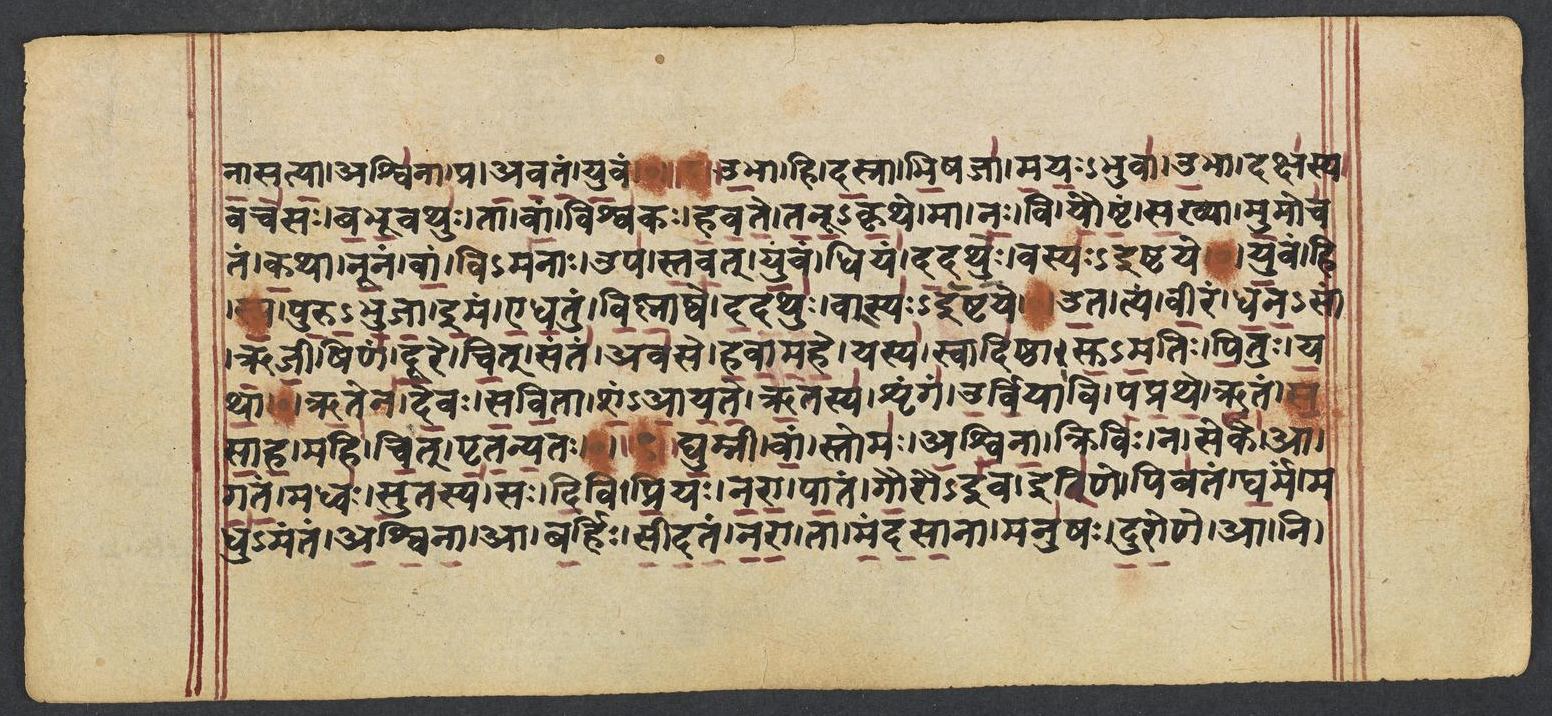
The manuscript shown is Penn Ms. Coll. 390 Item 41 (University of Pennsylvania), an undated paper manuscript of the padapāṭha (the word-by-word recitation text, in which every word is written separately and compounds are split) of the whole Ṛgveda in Devanāgarī, 884 leaves in fascicles, 7-9 lines to the page, accents in red; this hymn stands on fol. 651r. Each section below gives the verses that end on one page; the page boundaries were read on the images (the opening words of every page), not counted out. Where the manuscript is a padapāṭha (the word-by-word recitation text), the section shows Aufrecht's continuous (saṃhitā) text first and, as the edition text, the padapāṭha of the same verses, which is the form written on the page.
How was this verified? (Provenance)
Where on the image
Penn Ms. Coll. 390 Item 41, fol. 651r (numbered 73r by the scribe) (OPenn image 651, lower leaf). Checked on the image: the Rigveda text on this page begins in RV 8.85.9 ‹nāsatyā aśvinā pra avatam›. The next page with Rigveda text, fol. 651v (numbered 73v by the scribe), begins in RV 8.87.2 ‹pācam vedasā vayaḥ›. Verses 8.86.1-5 end on this page.
1u̱bhā hi da̱srā bhi̱ṣajā̍ mayo̱bhuvo̱bhā dakṣa̍sya̱ vaca̍so babhū̱vathu̍ḥ | tā vā̱ṁ viśva̍ko havate tanūkṛ̱the mā no̱ vi yau̍ṣṭaṁ sa̱khyā mu̱moca̍tam ||
2ka̱thā nū̱naṁ vā̱ṁ vima̍nā̱ upa̍ stavad yu̱vaṁ dhiya̍ṁ dadathu̱r vasya̍ïṣṭaye | tā vā̱ṁ viśva̍ko havate tanūkṛ̱the mā no̱ vi yau̍ṣṭaṁ sa̱khyā mu̱moca̍tam ||
3yu̱vaṁ hi ṣmā̍ purubhuje̱mam e̍dha̱tuṁ vi̍ṣṇā̱pve̍ da̱dathu̱r vasya̍ïṣṭaye | tā vā̱ṁ viśva̍ko havate tanūkṛ̱the mā no̱ vi yau̍ṣṭaṁ sa̱khyā mu̱moca̍tam ||
4u̱ta tyaṁ vī̱raṁ dha̍na̱sām ṛ̍jī̱ṣiṇa̍ṁ dū̱re ci̱t santa̱m ava̍se havāmahe | yasya̱ svādi̍ṣṭhā suma̱tiḥ pi̱tur ya̍thā̱ mā no̱ vi yau̍ṣṭaṁ sa̱khyā mu̱moca̍tam ||
5ṛ̱tena̍ de̱vaḥ sa̍vi̱tā śa̍māyata ṛ̱tasya̱ śṛṅga̍m urvi̱yā vi pa̍prathe | ṛ̱taṁ sā̍sāha̱ mahi̍ cit pṛtanya̱to mā no̱ vi yau̍ṣṭaṁ sa̱khyā mu̱moca̍tam ||
Compare: Padapāṭha (word-by-word text written in the manuscript; Sansknet e-text via GRETIL)
1ubhā | hi | dasrā | bhiṣajā | mayaḥ-bhuvā | ubhā | dakṣasya | vacasaḥ | babhūvathuḥ | tā | vām | viśvakaḥ | havate | tanū-kṛthe | mā | naḥ | vi | yauṣṭam | sakhyā | mumocatam
2kathā | nūnam | vām | vi-manāḥ | upa | stavat | yuvam | dhiyam | dadathuḥ | vasyaḥ-iṣṭaye | tā | vām | viśvakaḥ | havate | tanū-kṛthe | mā | naḥ | vi | yauṣṭam | sakhyā | mumocatam
3yuvam | hi | sma | puru-bhujā | imam | edhatum | viṣṇāpve | dadathuḥ | vasyaḥ-iṣṭaye | tā | vām | viśvakaḥ | havate | tanū-kṛthe | mā | naḥ | vi | yauṣṭam | sakhyā | mumocatam
4uta | tyam | vīram | dhana-sām | ṛjīṣiṇam | dūre | cit | santam | avase | havāmahe | yasya | svādiṣṭhā | su-matiḥ | pituḥ | yathā | mā | naḥ | vi | yauṣṭam | sakhyā | mumocatam
5ṛtena | devaḥ | savitā | śam-āyate | ṛtasya | śṛṅgam | urviyā | vi | paprathe | ṛtam | sasāha | mahi | cit | pṛtanyataḥ | mā | naḥ | vi | yauṣṭam | sakhyā | mumocatam
1YE Twain are wondrous strong, well-skilled in arts that heal, both bringers of delight, ye both won Daksha's praise. Viṣvaka calls on you as such to save his life. Break ye not off our friendship, come and set me free.
2How shall he praise you now who is distraught in mind? Ye Twain give wisdom for the gain of what is good. Viṣvaka calls on you as such to save his life. Break ye not off our friendship, come and set me free.
3Already have ye Twain, possessors of great wealth, prospered Vishṇâpû thus for gain of what is good. Viṣvaka calls on you as such to save his life. Break ye not off our friendship, come and set me free.
4And that Impetuous Hero, winner of the spoil, though he is far away, we call to succour us, Whose gracious favour, like a father's, is most sweet. Break ye not off our friendship, come and set me free.
5About the holy Law toils Savitar the God the horn of holy Law hath he spread far and wide. The holy Law hath quelled even mighty men of war. Break ye not off our friendship, come and set me free.
Notes
- Sanskrit: Aufrecht's edition (1877) with the Vedic accents, as entered by van Nooten and Holland (GRETIL).
- English: Ralph T. H. Griffith, The Hymns of the Rigveda (1889-1892; 2nd ed. 1896-1897), from the VedaWeb digital text; OCR slips in that text were corrected against the printed 2nd edition (data/sources/rigveda/griffith_errata.json).
- Padapāṭha (edition text): Sansknet e-text via GRETIL (CC BY-NC-SA 4.0).
Cite
Sources
- Source: Penn Ms. Coll. 390 Item 41 (undated (catalogued with Penn's 18th-19th c. Vedic manuscripts)), OPenn, Public Domain Mark + Aufrecht's accented text (GRETIL) + Griffith's English (VedaWeb) (holding institution)
- Critical edition: Aufrecht (1877), accented e-text via GRETIL
← previous · → next · v cycle view · l back to library