Rigveda 9.103: To Soma
Introduction
Rigveda 9.103 is a hymn of 6 verses addressed to Soma. It stands in book (maṇḍala) 9, the hymns to Soma Pavamāna. The Rigveda is the oldest collection of Sanskrit hymns, composed in the second half of the second millennium BCE and handed down orally for many centuries before it was written down.
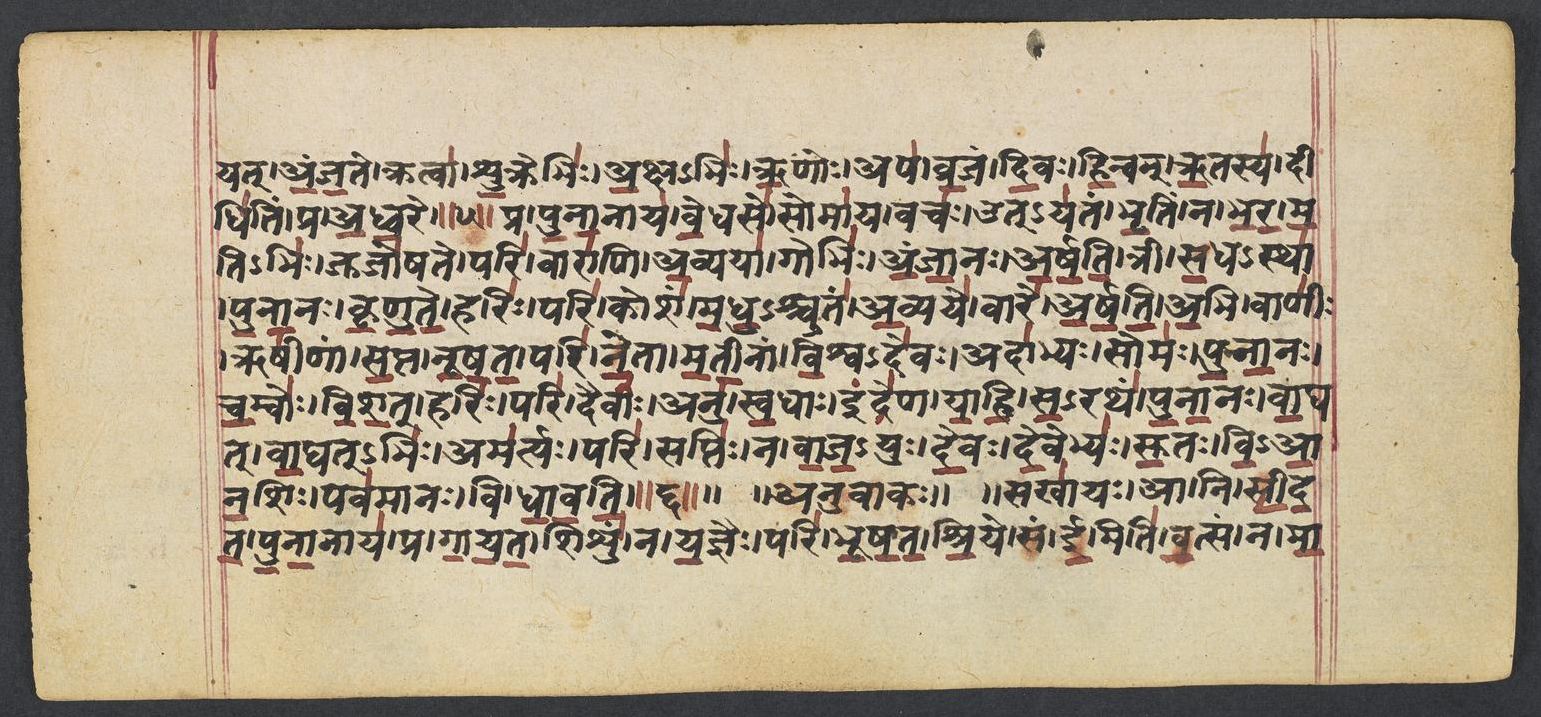
The manuscript shown is Penn Ms. Coll. 390 Item 41 (University of Pennsylvania), an undated paper manuscript of the padapāṭha (the word-by-word recitation text, in which every word is written separately and compounds are split) of the whole Ṛgveda in Devanāgarī, 884 leaves in fascicles, 7-9 lines to the page, accents in red; this hymn stands on fol. 734r. Each section below gives the verses that end on one page; the page boundaries were read on the images (the opening words of every page), not counted out. Where the manuscript is a padapāṭha (the word-by-word recitation text), the section shows Aufrecht's continuous (saṃhitā) text first and, as the edition text, the padapāṭha of the same verses, which is the form written on the page.
How was this verified? (Provenance)
Where on the image
Penn Ms. Coll. 390 Item 41, fol. 734r (numbered 51r by the scribe) (OPenn image 734, lower leaf). Checked on the image: the Rigveda text on this page begins in RV 9.102.7 ‹yat añjate›. The next page with Rigveda text, fol. 734v (numbered 51v by the scribe), begins in RV 9.104.2 ‹-mātṛ-bhiḥ sṛjata gaya-sādhanam deva-avyam›. Verses 9.103.1-6 end on this page.
1pra pu̍nā̱nāya̍ ve̱dhase̱ somā̍ya̱ vaca̱ udya̍tam | bhṛ̱tiṁ na bha̍rā ma̱tibhi̱r jujo̍ṣate ||
2pari̱ vārā̍ṇy a̱vyayā̱ gobhi̍r añjā̱no a̍rṣati | trī ṣa̱dhasthā̍ punā̱naḥ kṛ̍ṇute̱ hari̍ḥ ||
3pari̱ kośa̍m madhu̱ścuta̍m a̱vyaye̱ vāre̍ arṣati | a̱bhi vāṇī̱r ṛṣī̍ṇāṁ sa̱pta nū̍ṣata ||
4pari̍ ṇe̱tā ma̍tī̱nāṁ vi̱śvade̍vo̱ adā̍bhyaḥ | soma̍ḥ punā̱naś ca̱mvo̍r viśa̱d dhari̍ḥ ||
5pari̱ daivī̱r anu̍ sva̱dhā indre̍ṇa yāhi sa̱ratha̍m | pu̱nā̱no vā̱ghad vā̱ghadbhi̱r ama̍rtyaḥ ||
6pari̱ sapti̱r na vā̍ja̱yur de̱vo de̱vebhya̍ḥ su̱taḥ | vyā̱na̱śiḥ pava̍māno̱ vi dhā̍vati ||
Compare: Padapāṭha (word-by-word text written in the manuscript; Sansknet e-text via GRETIL)
1pra | punānāya | vedhase | somāya | vacaḥ | ut-yatam | bhṛtim | na | bhara | mati-bhiḥ | jujoṣate
2pari | vārāṇi | avyayā | gobhiḥ | añjānaḥ | arṣati | trī | sadha-sthā | punānaḥ | kṛṇute | hariḥ
3pari | kośam | madhu-ścutam | avyaye | vāre | arṣati | abhi | vāṇīḥ | ṛṣīṇām | sapta | nūṣata
4pari | netā | matīnām | viśva-devaḥ | adābhyaḥ | somaḥ | punānaḥ | camvoḥ | viśat | hariḥ
5pari | daivīḥ | anu | svadhāḥ | indreṇa | yāhi | sa-ratham | punānaḥ | vāghat | vāghat-bhiḥ | amartyaḥ
6pari | saptiḥ | na | vāja-yuḥ | devaḥ | devebhyaḥ | sutaḥ | vi-ānaśiḥ | pavamānaḥ | vi | dhāvati
1To Soma who is purified as ordering Priest the song is raised: Bring meed, as 'twere, to one who makes thee glad with hymns.
2Blended with milk and curds he flows on through the long wool of the sheep. The Gold-hued, purified, makes him three seats for rest.
3On through the long wool of the sheep to the meath-dropping vat he flows: The R̥ishis' sevenfold quire hath sung aloud to him.
4Shared by all Gods, Infallible, the Leader of our holy hymns, Golden-hued Soma, being cleansed, hath reached the bowls.
5After thy Godlike qualities, associate with Indra, go, As a Priest purified by priests, Immortal One.
6Like a car-horse who shows his strength, a God effused for Deities. The penetrating Pavamâna flows along.
Notes
- Sanskrit: Aufrecht's edition (1877) with the Vedic accents, as entered by van Nooten and Holland (GRETIL).
- English: Ralph T. H. Griffith, The Hymns of the Rigveda (1889-1892; 2nd ed. 1896-1897), from the VedaWeb digital text; OCR slips in that text were corrected against the printed 2nd edition (data/sources/rigveda/griffith_errata.json).
- Padapāṭha (edition text): Sansknet e-text via GRETIL (CC BY-NC-SA 4.0).
Cite
Sources
- Source: Penn Ms. Coll. 390 Item 41 (undated (catalogued with Penn's 18th-19th c. Vedic manuscripts)), OPenn, Public Domain Mark + Aufrecht's accented text (GRETIL) + Griffith's English (VedaWeb) (holding institution)
- Critical edition: Aufrecht (1877), accented e-text via GRETIL
← previous · → next · v cycle view · l back to library