Rigveda 9.105: To Soma
Introduction
Rigveda 9.105 is a hymn of 6 verses addressed to Soma. It stands in book (maṇḍala) 9, the hymns to Soma Pavamāna. The Rigveda is the oldest collection of Sanskrit hymns, composed in the second half of the second millennium BCE and handed down orally for many centuries before it was written down.
The manuscript shown is Penn Ms. Coll. 390 Item 41 (University of Pennsylvania), an undated paper manuscript of the padapāṭha (the word-by-word recitation text, in which every word is written separately and compounds are split) of the whole Ṛgveda in Devanāgarī, 884 leaves in fascicles, 7-9 lines to the page, accents in red; this hymn stands on fol. 734v-735r. Each section below gives the verses that end on one page; the page boundaries were read on the images (the opening words of every page), not counted out. Where the manuscript is a padapāṭha (the word-by-word recitation text), the section shows Aufrecht's continuous (saṃhitā) text first and, as the edition text, the padapāṭha of the same verses, which is the form written on the page.
How was this verified? (Provenance)
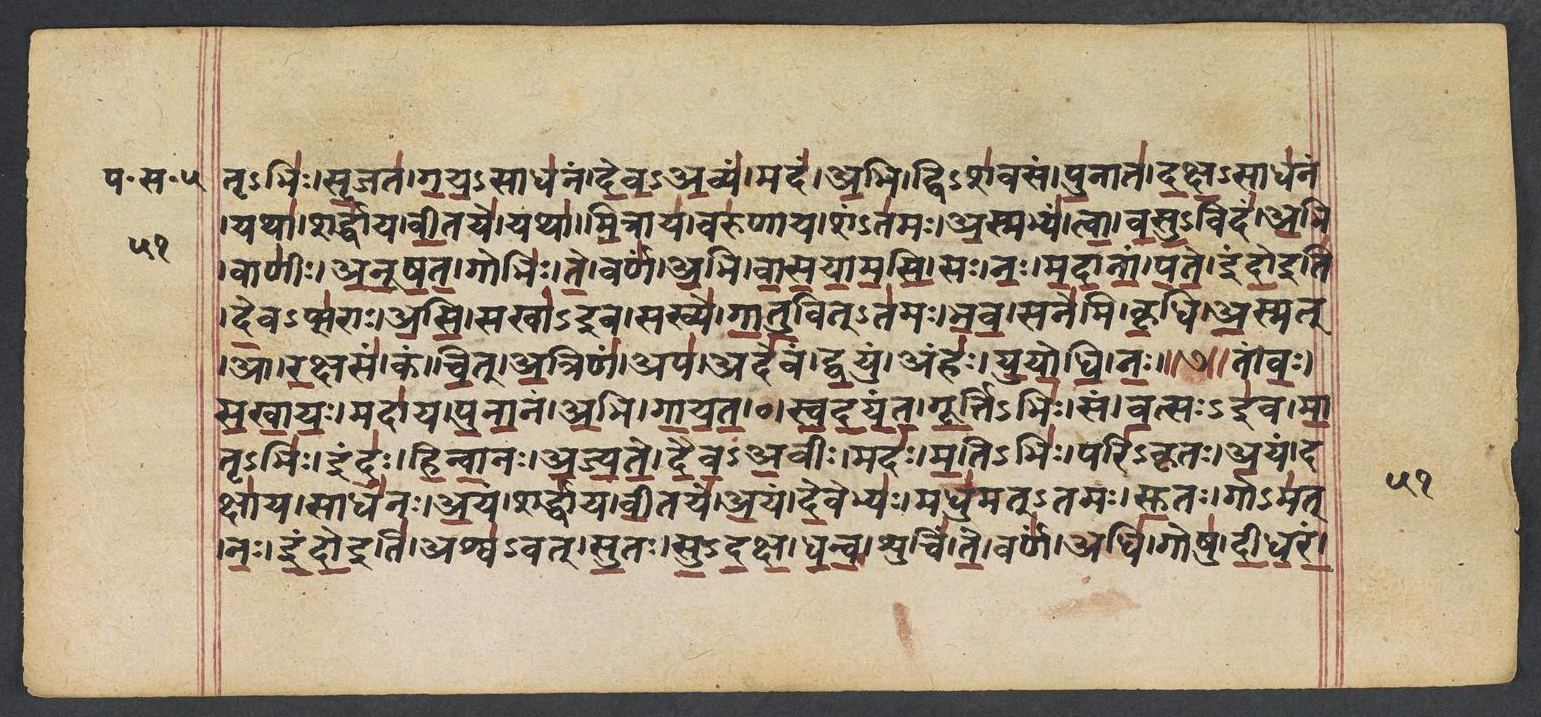
Where on the image
Penn Ms. Coll. 390 Item 41, fol. 734v (numbered 51v by the scribe) (OPenn image 735, upper leaf). Checked on the image: the Rigveda text on this page begins in RV 9.104.2 ‹-mātṛ-bhiḥ sṛjata gaya-sādhanam deva-avyam›. The next page with Rigveda text, fol. 735r (numbered 52r by the scribe), begins in RV 9.105.5 ‹saḥ naḥ harīṇām pate›. Verses 9.105.1-4 end on this page.
1taṁ va̍ḥ sakhāyo̱ madā̍ya punā̱nam a̱bhi gā̍yata | śiśu̱ṁ na ya̱jñaiḥ sva̍dayanta gū̱rtibhi̍ḥ ||
2saṁ va̱tsa i̍va mā̱tṛbhi̱r indu̍r hinvā̱no a̍jyate | de̱vā̱vīr mado̍ ma̱tibhi̱ḥ pari̍ṣkṛtaḥ ||
3a̱yaṁ dakṣā̍ya̱ sādha̍no̱ 'yaṁ śardhā̍ya vī̱taye̍ | a̱yaṁ de̱vebhyo̱ madhu̍mattamaḥ su̱taḥ ||
4goma̍n na indo̱ aśva̍vat su̱taḥ su̍dakṣa dhanva | śuci̍ṁ te̱ varṇa̱m adhi̱ goṣu̍ dīdharam ||
Compare: Padapāṭha (word-by-word text written in the manuscript; Sansknet e-text via GRETIL)
1tam | vaḥ | sakhāyaḥ | madāya | punānam | abhi | gāyata | śiśum | na | yajñaiḥ | svadayanta | gūrti-bhiḥ
2sam | vatsaḥ-iva | mātṛ-bhiḥ | induḥ | hinvānaḥ | ajyate | deva-avīḥ | madaḥ | mati-bhiḥ | pari-kṛtaḥ
3ayam | dakṣāya | sādhanaḥ | ayam | śardhāya | vītaye | ayam | devebhyaḥ | madhumat-tamaḥ | sutaḥ
4go-mat | naḥ | indo iti | aśva-vat | sutaḥ | su-dakṣa | dhanva | śucim | te | varṇam | adhi | goṣu | dīdharam
1SING; ye aloud, O friends, to him who makes him pure for gladdening drink: They shall make sweet the Child with sacrifice and laud.
2Like as a calf with mother cows, so Indu is urged forth and sent, Glorified by our hymns, the God-delighting juice.
3Effectual means of power is he, he is a banquet for the Troop, He who hath been effused, most rich in meath, for Gods.
4Flow to us, Indu, passing, strong, effused, with wealth of kine and steeds: I will spread forth above the milk thy radiant hue.
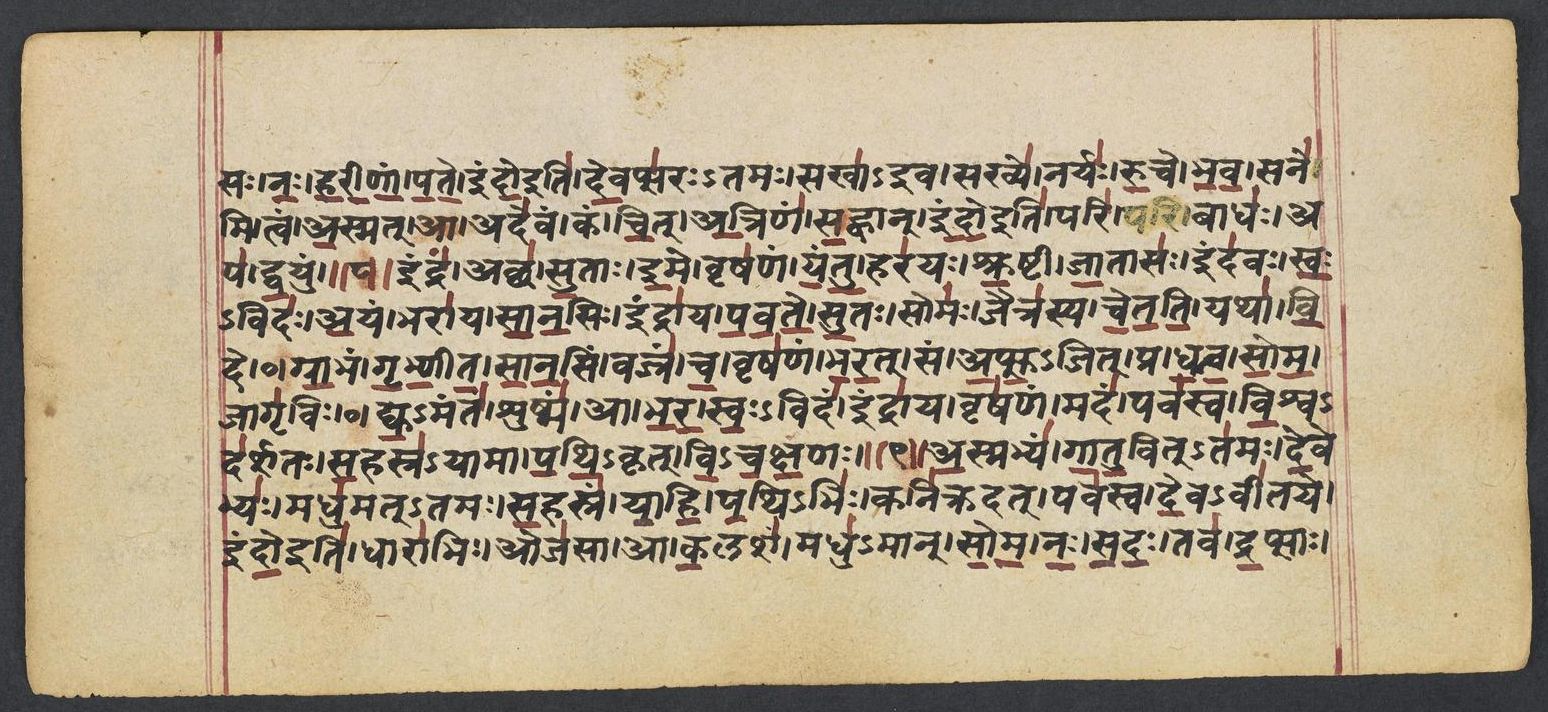
Where on the image
Penn Ms. Coll. 390 Item 41, fol. 735r (numbered 52r by the scribe) (OPenn image 735, lower leaf). Checked on the image: the Rigveda text on this page begins in RV 9.105.5 ‹saḥ naḥ harīṇām pate›. The next page with Rigveda text, fol. 735v (numbered 52v by the scribe), begins in RV 9.106.8 ‹uda-prutaḥ indram madāya vavṛdhuḥ›. Verses 9.105.5-6 end on this page.
5sa no̍ harīṇām pata̱ indo̍ de̱vapsa̍rastamaḥ | sakhe̍va̱ sakhye̱ naryo̍ ru̱ce bha̍va ||
6sane̍mi̱ tvam a̱smad ām̐ ade̍va̱ṁ kaṁ ci̍d a̱triṇa̍m | sā̱hvām̐ i̍ndo̱ pari̱ bādho̱ apa̍ dva̱yum ||
Compare: Padapāṭha (word-by-word text written in the manuscript; Sansknet e-text via GRETIL)
5saḥ | naḥ | harīṇām | pate | indo iti | devapsaraḥ-tamaḥ | sakhā-iva | sakhye | naryaḥ | ruce | bhava
6sanemi | tvam | asmat | ā | adevam | kam | cit | atriṇam | sāhvān | indo iti | pari | bādhaḥ | apa | dvayum
5Lord of the tawny, Indu thou who art the God's most special food, As Friend to friend, for splendour be thou good to men.
6Drive utterly, far away from us each godless, each voracious foe. O Indu, overcome and drive the false afar.
Notes
- Sanskrit: Aufrecht's edition (1877) with the Vedic accents, as entered by van Nooten and Holland (GRETIL).
- English: Ralph T. H. Griffith, The Hymns of the Rigveda (1889-1892; 2nd ed. 1896-1897), from the VedaWeb digital text; OCR slips in that text were corrected against the printed 2nd edition (data/sources/rigveda/griffith_errata.json).
- Padapāṭha (edition text): Sansknet e-text via GRETIL (CC BY-NC-SA 4.0).
Cite
Sources
- Source: Penn Ms. Coll. 390 Item 41 (undated (catalogued with Penn's 18th-19th c. Vedic manuscripts)), OPenn, Public Domain Mark + Aufrecht's accented text (GRETIL) + Griffith's English (VedaWeb) (holding institution)
- Critical edition: Aufrecht (1877), accented e-text via GRETIL
← previous · → next · v cycle view · l back to library