Rigveda 9.106: To Soma
Introduction
Rigveda 9.106 is a hymn of 14 verses addressed to Soma. It stands in book (maṇḍala) 9, the hymns to Soma Pavamāna. The Rigveda is the oldest collection of Sanskrit hymns, composed in the second half of the second millennium BCE and handed down orally for many centuries before it was written down.
The manuscript shown is Penn Ms. Coll. 390 Item 41 (University of Pennsylvania), an undated paper manuscript of the padapāṭha (the word-by-word recitation text, in which every word is written separately and compounds are split) of the whole Ṛgveda in Devanāgarī, 884 leaves in fascicles, 7-9 lines to the page, accents in red; this hymn stands on fol. 735r-735v. Each section below gives the verses that end on one page; the page boundaries were read on the images (the opening words of every page), not counted out. Where the manuscript is a padapāṭha (the word-by-word recitation text), the section shows Aufrecht's continuous (saṃhitā) text first and, as the edition text, the padapāṭha of the same verses, which is the form written on the page.
How was this verified? (Provenance)
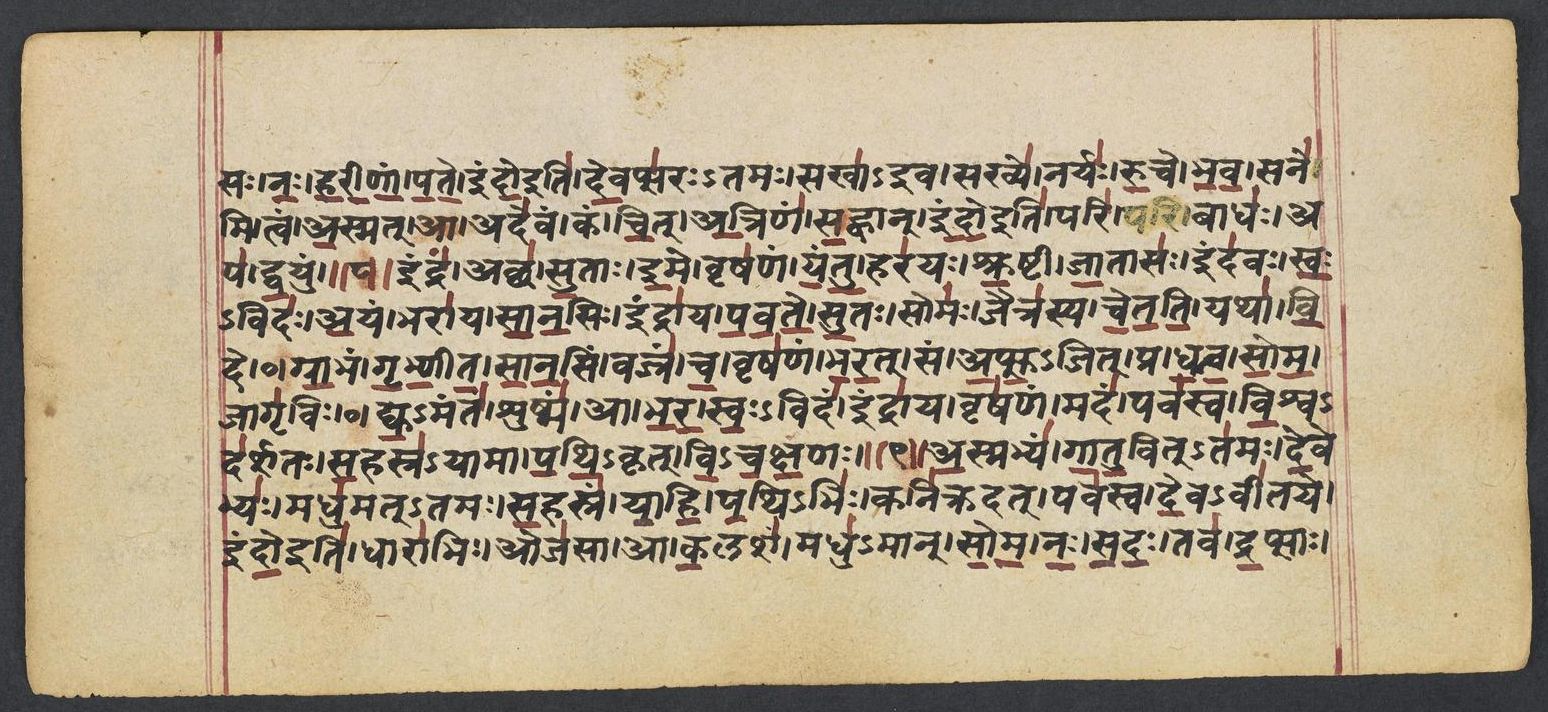
Where on the image
Penn Ms. Coll. 390 Item 41, fol. 735r (numbered 52r by the scribe) (OPenn image 735, lower leaf). Checked on the image: the Rigveda text on this page begins in RV 9.105.5 ‹saḥ naḥ harīṇām pate›. The next page with Rigveda text, fol. 735v (numbered 52v by the scribe), begins in RV 9.106.8 ‹uda-prutaḥ indram madāya vavṛdhuḥ›. Verses 9.106.1-7 end on this page.
1indra̱m accha̍ su̱tā i̱me vṛṣa̍ṇaṁ yantu̱ hara̍yaḥ | śru̱ṣṭī jā̱tāsa̱ inda̍vaḥ sva̱rvida̍ḥ ||
2a̱yam bharā̍ya sāna̱sir indrā̍ya pavate su̱taḥ | somo̱ jaitra̍sya cetati̱ yathā̍ vi̱de ||
3a̱syed indro̱ made̱ṣv ā grā̱bhaṁ gṛ̍bhṇīta sāna̱sim | vajra̍ṁ ca̱ vṛṣa̍ṇam bhara̱t sam a̍psu̱jit ||
4pra dha̍nvā soma̱ jāgṛ̍vi̱r indrā̍yendo̱ pari̍ srava | dyu̱manta̱ṁ śuṣma̱m ā bha̍rā sva̱rvida̍m ||
5indrā̍ya̱ vṛṣa̍ṇa̱m mada̱m pava̍sva vi̱śvada̍rśataḥ | sa̱hasra̍yāmā pathi̱kṛd vi̍cakṣa̱ṇaḥ ||
6a̱smabhya̍ṁ gātu̱vitta̍mo de̱vebhyo̱ madhu̍mattamaḥ | sa̱hasra̍ṁ yāhi pa̱thibhi̱ḥ kani̍kradat ||
7pava̍sva de̱vavī̍taya̱ indo̱ dhārā̍bhi̱r oja̍sā | ā ka̱laśa̱m madhu̍mān soma naḥ sadaḥ ||
Compare: Padapāṭha (word-by-word text written in the manuscript; Sansknet e-text via GRETIL)
1indram | accha | sutāḥ | ime | vṛṣaṇam | yantu | harayaḥ | śruṣṭī | jātāsaḥ | indavaḥ | svaḥ-vidaḥ
2ayam | bharāya | sānasiḥ | indrāya | pavate | sutaḥ | somaḥ | jaitrasya | cetati | yathā | vide
3asya | it | indraḥ | madeṣu | ā | grābham | gṛbhṇīta | sānasim | vajram | ca | vṛṣaṇam | bharat | sam | apsu-jit
4pra | dhanva | soma | jāgṛviḥ | indrāya | indo iti | pari | srava | dyu-mantam | śuṣmam | ā | bhara | svaḥ-vidam
5indrāya | vṛṣaṇam | madam | pavasva | viśva-darśataḥ | sahasra-yāmā | pathi-kṛt | vi-cakṣaṇaḥ
6asmabhyam | gātuvit-tamaḥ | devebhyaḥ | madhumat-tamaḥ | sahasram | yāhi | pathi-bhiḥ | kanikradat
7pavasva | deva-vītaye | indo iti | dhārābhiḥ | ojasā | ā | kalaśam | madhu-mān | soma | naḥ | sadaḥ
1To Indra, to the Mighty Steer, may these gold-coloured juices go, Drops rapidly produced, that find the light of heaven.
2Effused, this juice victorious flows for Indra, for his maintenance. Soma bethinks him of the Conqueror, as he knows.
3May Indra in his raptures gain from him the grasp that gathers spoil, And, winning waters, wield the steerstrong thunderbolt.
4Flow vigilant for Indra, thou Soma, yea, Indu, run thou on: Bring hither splendid strength that finds the light of heaven.
5Do thou, all-beautiful, purify for Indra's sake the mighty juice, Path-maker thou, far seeing, with a thousand ways.
6Best finder of prosperity for us, most rich in sweets for Gods, Proceed thou loudly roaring on a thousand paths.
7O Indu, with thy streams, in might, flow for the banquet of the Gods: Rich in meath, Soma, in our beaker take thy place.
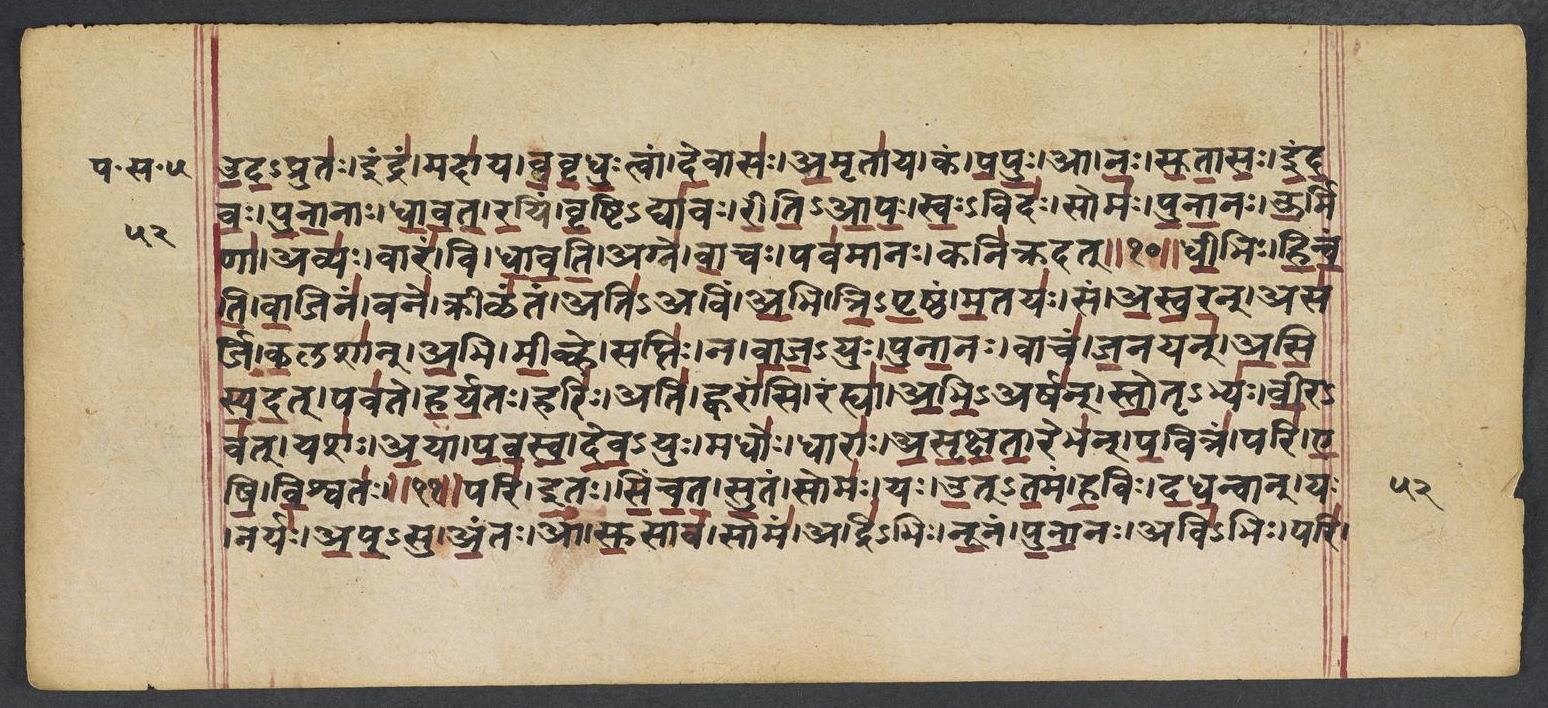
Where on the image
Penn Ms. Coll. 390 Item 41, fol. 735v (numbered 52v by the scribe) (OPenn image 736, upper leaf). Checked on the image: the Rigveda text on this page begins in RV 9.106.8 ‹uda-prutaḥ indram madāya vavṛdhuḥ›. The next page with Rigveda text, fol. 736r (numbered 53r by the scribe), begins in RV 9.107.2 ‹srava adabdhaḥ surabhim-taraḥ sute›. Verses 9.106.8-14 end on this page; 9.106.8 begins on fol. 735r (numbered 52r by the scribe).
8tava̍ dra̱psā u̍da̱pruta̱ indra̱m madā̍ya vāvṛdhuḥ | tvāṁ de̱vāso̍ a̱mṛtā̍ya̱ kam pa̍puḥ ||
9ā na̍ḥ sutāsa indavaḥ punā̱nā dhā̍vatā ra̱yim | vṛ̱ṣṭidyā̍vo rītyāpaḥ sva̱rvida̍ḥ ||
10soma̍ḥ punā̱na ū̱rmiṇāvyo̱ vāra̱ṁ vi dhā̍vati | agre̍ vā̱caḥ pava̍māna̱ḥ kani̍kradat ||
11dhī̱bhir hi̍nvanti vā̱jina̱ṁ vane̱ krīḻa̍nta̱m atya̍vim | a̱bhi tri̍pṛ̱ṣṭham ma̱taya̱ḥ sam a̍svaran ||
12asa̍rji ka̱laśā̍m̐ a̱bhi mī̱ḻhe sapti̱r na vā̍ja̱yuḥ | pu̱nā̱no vāca̍ṁ ja̱naya̍nn asiṣyadat ||
13pava̍te harya̱to hari̱r ati̱ hvarā̍ṁsi̱ raṁhyā̍ | a̱bhyarṣa̍n sto̱tṛbhyo̍ vī̱rava̱d yaśa̍ḥ ||
14a̱yā pa̍vasva deva̱yur madho̱r dhārā̍ asṛkṣata | rebha̍n pa̱vitra̱m pary e̍ṣi vi̱śvata̍ḥ ||
Compare: Padapāṭha (word-by-word text written in the manuscript; Sansknet e-text via GRETIL)
8tava | drapsāḥ | uda-prutaḥ | indram | madāya | vavṛdhuḥ | tvām | devāsaḥ | amṛtāya | kam | papuḥ
9ā | naḥ | sutāsaḥ | indavaḥ | punānāḥ | dhāvata | rayim | vṛṣṭi-dyāvaḥ | rīti-āpaḥ | svaḥ-vidaḥ
10somaḥ | punānaḥ | ūrmiṇā | avyaḥ | vāram | vi | dhāvati | agre | vācaḥ | pavamānaḥ | kanikradat
11dhībhiḥ | hinvanti | vājinam | vane | krīḷantam | ati-avim | abhi | tri-pṛṣṭham | matayaḥ | sam | asvaran
12asarji | kalaśān | abhi | mīḷhe | saptiḥ | na | vāja-yuḥ | punānaḥ | vācam | janayan | asisyadat
13pavate | haryataḥ | hariḥ | ati | hvarāṃsi | raṃhyā | abhi-arṣan | stotṛ-bhyaḥ | vīra-vat | yaśaḥ
14ayā | pavasva | deva-yuḥ | madhoḥ | dhārāḥ | asṛkṣata | rebhan | pavitram | pari | eṣi | viśvataḥ
8Thy drops that swim in water have exalted Indra to delight: The Gods have drunk thee up for immortality.
9Stream opulence to us, ye drops of Soma, pressed and purified, Pouring down rain from heaven in hoods, and finding light.
10Soma, while filtered, with his wave flows through the long wool of the sheep, Shouting while purified before the voice of song.
11With songs they send the Mighty forth, sporting in wood, above the fleece: Our psalms have glorified him of the triple height.
12Into the jars hath he been loosed, like an impetuous steed for war, And lifting up his voice, while filtered, glided on.
13Gold-hued and lovely in his course, through tangles of the wool he flows, And pours heroic fame upon the worshippers.
14Flow thus, a faithful votary: the streams of meath have been effused. Thou comest to the filter, singing, from each side.
Notes
- Sanskrit: Aufrecht's edition (1877) with the Vedic accents, as entered by van Nooten and Holland (GRETIL).
- English: Ralph T. H. Griffith, The Hymns of the Rigveda (1889-1892; 2nd ed. 1896-1897), from the VedaWeb digital text; OCR slips in that text were corrected against the printed 2nd edition (data/sources/rigveda/griffith_errata.json).
- Padapāṭha (edition text): Sansknet e-text via GRETIL (CC BY-NC-SA 4.0).
Cite
Sources
- Source: Penn Ms. Coll. 390 Item 41 (undated (catalogued with Penn's 18th-19th c. Vedic manuscripts)), OPenn, Public Domain Mark + Aufrecht's accented text (GRETIL) + Griffith's English (VedaWeb) (holding institution)
- Critical edition: Aufrecht (1877), accented e-text via GRETIL
← previous · → next · v cycle view · l back to library