Rigveda 9.11: To Soma
Introduction
Rigveda 9.11 is a hymn of 9 verses addressed to Soma. It stands in book (maṇḍala) 9, the hymns to Soma Pavamāna. The Rigveda is the oldest collection of Sanskrit hymns, composed in the second half of the second millennium BCE and handed down orally for many centuries before it was written down.
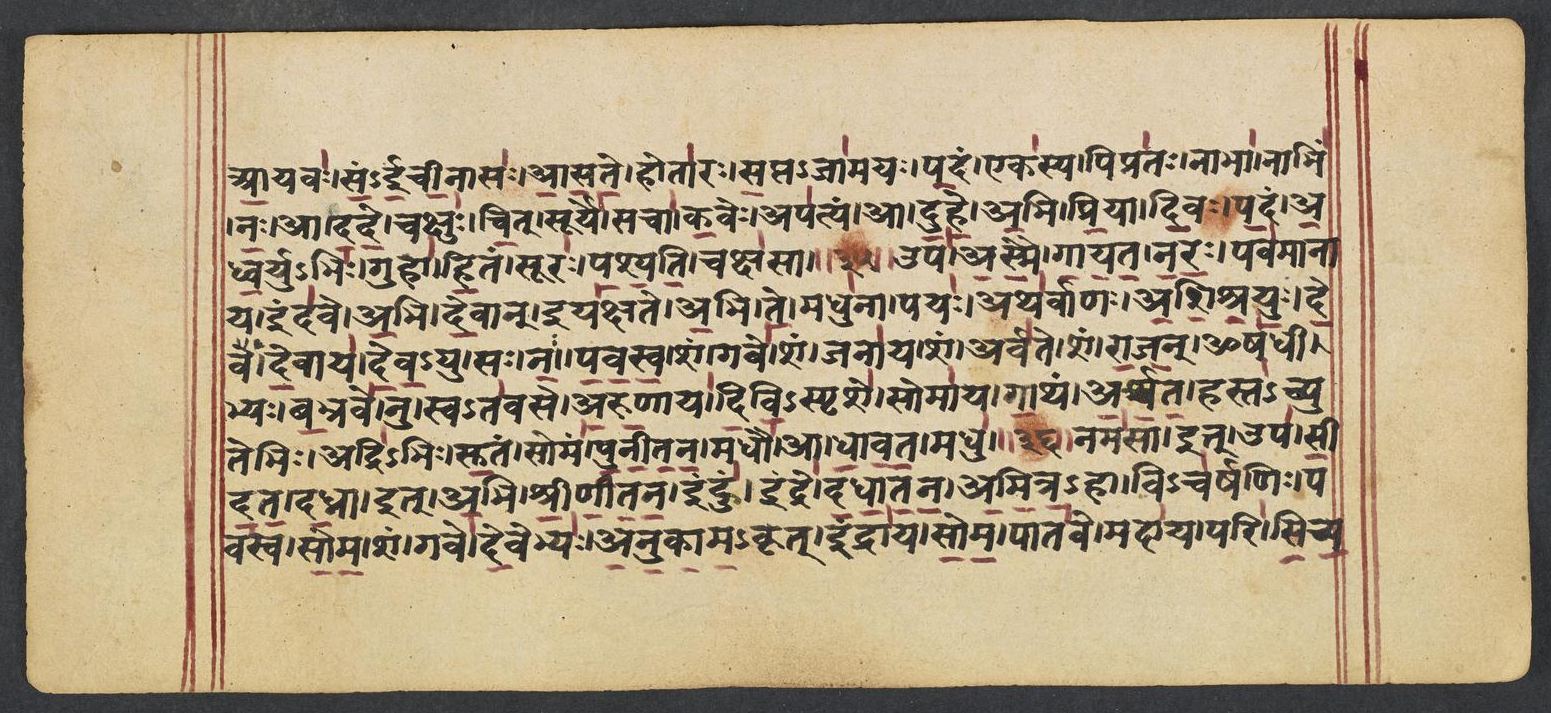
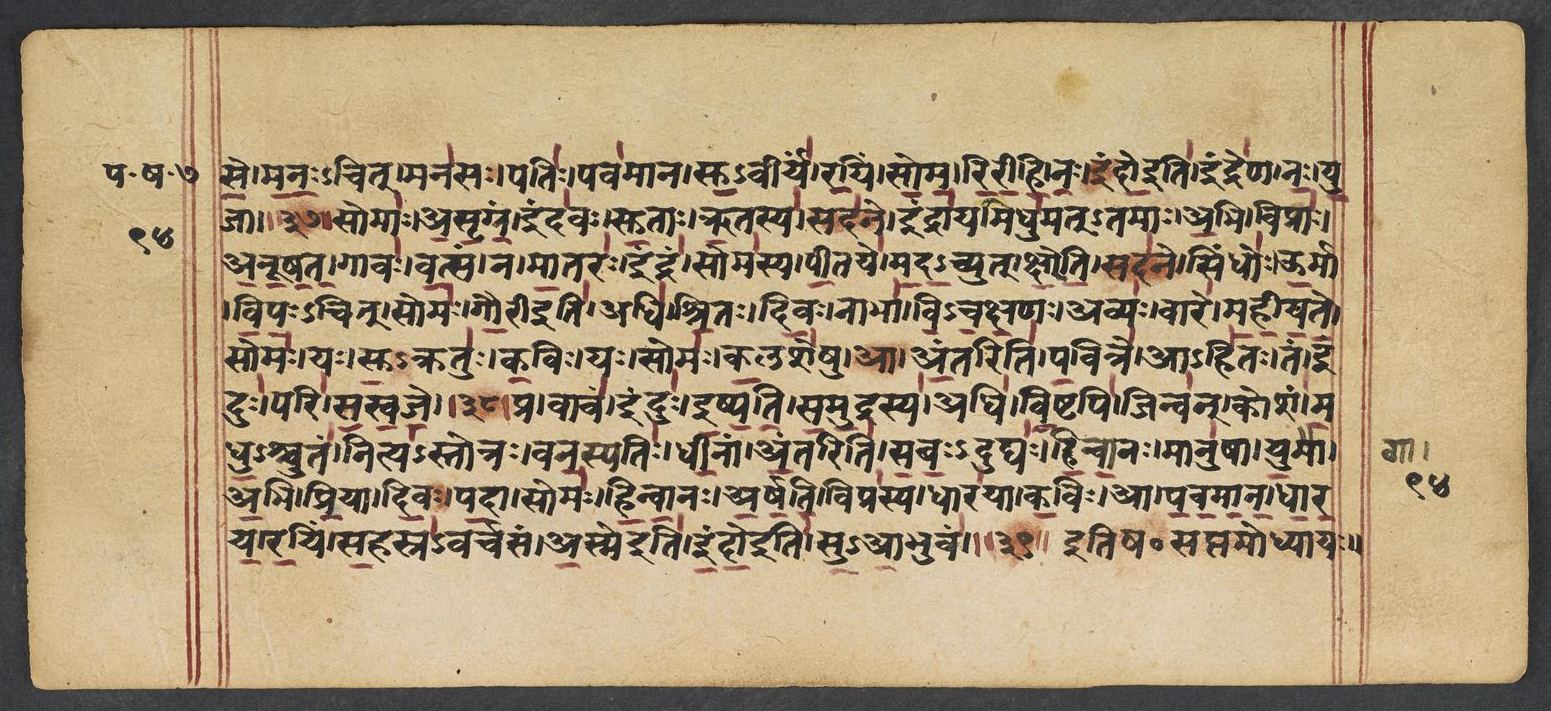
The manuscript shown is Penn Ms. Coll. 390 Item 41 (University of Pennsylvania), an undated paper manuscript of the padapāṭha (the word-by-word recitation text, in which every word is written separately and compounds are split) of the whole Ṛgveda in Devanāgarī, 884 leaves in fascicles, 7-9 lines to the page, accents in red; this hymn stands on fol. 672r-672v. Each section below gives the verses that end on one page; the page boundaries were read on the images (the opening words of every page), not counted out. Where the manuscript is a padapāṭha (the word-by-word recitation text), the section shows Aufrecht's continuous (saṃhitā) text first and, as the edition text, the padapāṭha of the same verses, which is the form written on the page.
How was this verified? (Provenance)
Where on the image
Penn Ms. Coll. 390 Item 41, fol. 672r (numbered 94r by the scribe) (OPenn image 672, lower leaf). Checked on the image: the Rigveda text on this page begins in RV 9.10.6 ‹āyavaḥ›. The next page with Rigveda text, fol. 672v (numbered 94v by the scribe), begins in RV 9.11.8 ‹-sicyase manaḥ-cit manasaḥ patiḥ›. Verses 9.11.1-7 end on this page.
1upā̍smai gāyatā nara̱ḥ pava̍mānā̱yenda̍ve | a̱bhi de̱vām̐ iya̍kṣate ||
2a̱bhi te̱ madhu̍nā̱ payo 'tha̍rvāṇo aśiśrayuḥ | de̱vaṁ de̱vāya̍ deva̱yu ||
3sa na̍ḥ pavasva̱ śaṁ gave̱ śaṁ janā̍ya̱ śam arva̍te | śaṁ rā̍ja̱nn oṣa̍dhībhyaḥ ||
4ba̱bhrave̱ nu svata̍vase 'ru̱ṇāya̍ divi̱spṛśe̍ | somā̍ya gā̱tham a̍rcata ||
5hasta̍cyutebhi̱r adri̍bhiḥ su̱taṁ soma̍m punītana | madhā̱v ā dhā̍vatā̱ madhu̍ ||
6nama̱sed upa̍ sīdata da̱dhned a̱bhi śrī̍ṇītana | indu̱m indre̍ dadhātana ||
7a̱mi̱tra̱hā vica̍rṣaṇi̱ḥ pava̍sva soma̱ śaṁ gave̍ | de̱vebhyo̍ anukāma̱kṛt ||
Compare: Padapāṭha (word-by-word text written in the manuscript; Sansknet e-text via GRETIL)
1upa | asmai | gāyata | naraḥ | pavamānāya | indave | abhi | devān | iyakṣate
2abhi | te | madhunā | payaḥ | atharvāṇaḥ | aśiśrayuḥ | devam | devāya | deva-yu
3saḥ | naḥ | pavasva | śam | gave | śam | janāya | śam | arvate | śam | rājan | oṣadhībhyaḥ
4babhrave | nu | sva-tavase | aruṇāya | divi-spṛśe | somāya | gātham | arcata
5hasta-cyutebhiḥ | adri-bhiḥ | sutam | somam | punītana | madhau | ā | dhāvata | madhu
6namasā | it | upa | sīdata | dadhnā | it | abhi | śrīṇītana | indum | indre | dadhātana
7amitra-hā | vi-carṣaṇiḥ | pavasva | soma | śam | gave | devebhyaḥ | anukāma-kṛt
1SING forth to Indu, O ye men, to him who is purified, Fain to pay worship to the Gods.
2Together with thy pleasant juice the Atharvans have commingled milk, Divine, devoted to the God.
3Bring, by thy flowing, weal to kine, weal to the people, weal to steeds. Weal, O thou King, to growing plants
4Sing a praise-song to Soma brown of hue, of independent might. The Red, who reaches up to heaven.
5Purify Soma when effused with stones which hands move rapidly, And pour the sweet milk in the meath.
6With humble homage draw ye nigh; blend the libation with the curds: To Indra offer Indu up.
7Soma, foe-que chief o'er men, doing the will of pour forth Prosperity upon our kine.
Where on the image
Penn Ms. Coll. 390 Item 41, fol. 672v (numbered 94v by the scribe) (OPenn image 673, upper leaf). Checked on the image: the Rigveda text on this page begins in RV 9.11.8 ‹-sicyase manaḥ-cit manasaḥ patiḥ›. The next page with Rigveda text, fol. 673r (numbered 95r by the scribe), begins in RV 9.13.1 ‹somaḥ punānaḥ arṣati sahasra-dhāraḥ›. Verses 9.11.8-9 end on this page; 9.11.8 begins on fol. 672r (numbered 94r by the scribe).
8indrā̍ya soma̱ pāta̍ve̱ madā̍ya̱ pari̍ ṣicyase | ma̱na̱ścin mana̍sa̱s pati̍ḥ ||
9pava̍māna su̱vīrya̍ṁ ra̱yiṁ so̍ma rirīhi naḥ | inda̱v indre̍ṇa no yu̱jā ||
Compare: Padapāṭha (word-by-word text written in the manuscript; Sansknet e-text via GRETIL)
8indrāya | soma | pātave | madāya | pari | sicyase | manaḥ-cit | manasaḥ | patiḥ
9pavamāna | su-vīryam | rayim | soma | rirīhi | naḥ | indo iti | indreṇa | naḥ | yujā
8Heart-knower, Sovran of the heart, thou art effused, O Soma, that Indra may drink thee and rejoice.
9O Soma Pavamâna, give us riches and heroic strength,– Indu! with. Indra for ally.
Notes
- Sanskrit: Aufrecht's edition (1877) with the Vedic accents, as entered by van Nooten and Holland (GRETIL).
- English: Ralph T. H. Griffith, The Hymns of the Rigveda (1889-1892; 2nd ed. 1896-1897), from the VedaWeb digital text; OCR slips in that text were corrected against the printed 2nd edition (data/sources/rigveda/griffith_errata.json).
- Padapāṭha (edition text): Sansknet e-text via GRETIL (CC BY-NC-SA 4.0).
Cite
Sources
- Source: Penn Ms. Coll. 390 Item 41 (undated (catalogued with Penn's 18th-19th c. Vedic manuscripts)), OPenn, Public Domain Mark + Aufrecht's accented text (GRETIL) + Griffith's English (VedaWeb) (holding institution)
- Critical edition: Aufrecht (1877), accented e-text via GRETIL
← previous · → next · v cycle view · l back to library