Rigveda 9.112: To Soma
Introduction
Rigveda 9.112 is a hymn of 4 verses addressed to Soma. It stands in book (maṇḍala) 9, the hymns to Soma Pavamāna. The Rigveda is the oldest collection of Sanskrit hymns, composed in the second half of the second millennium BCE and handed down orally for many centuries before it was written down.
The manuscript shown is Penn Ms. Coll. 390 Item 41 (University of Pennsylvania), an undated paper manuscript of the padapāṭha (the word-by-word recitation text, in which every word is written separately and compounds are split) of the whole Ṛgveda in Devanāgarī, 884 leaves in fascicles, 7-9 lines to the page, accents in red; this hymn stands on fol. 741r-741v. Each section below gives the verses that end on one page; the page boundaries were read on the images (the opening words of every page), not counted out. Where the manuscript is a padapāṭha (the word-by-word recitation text), the section shows Aufrecht's continuous (saṃhitā) text first and, as the edition text, the padapāṭha of the same verses, which is the form written on the page.
How was this verified? (Provenance)
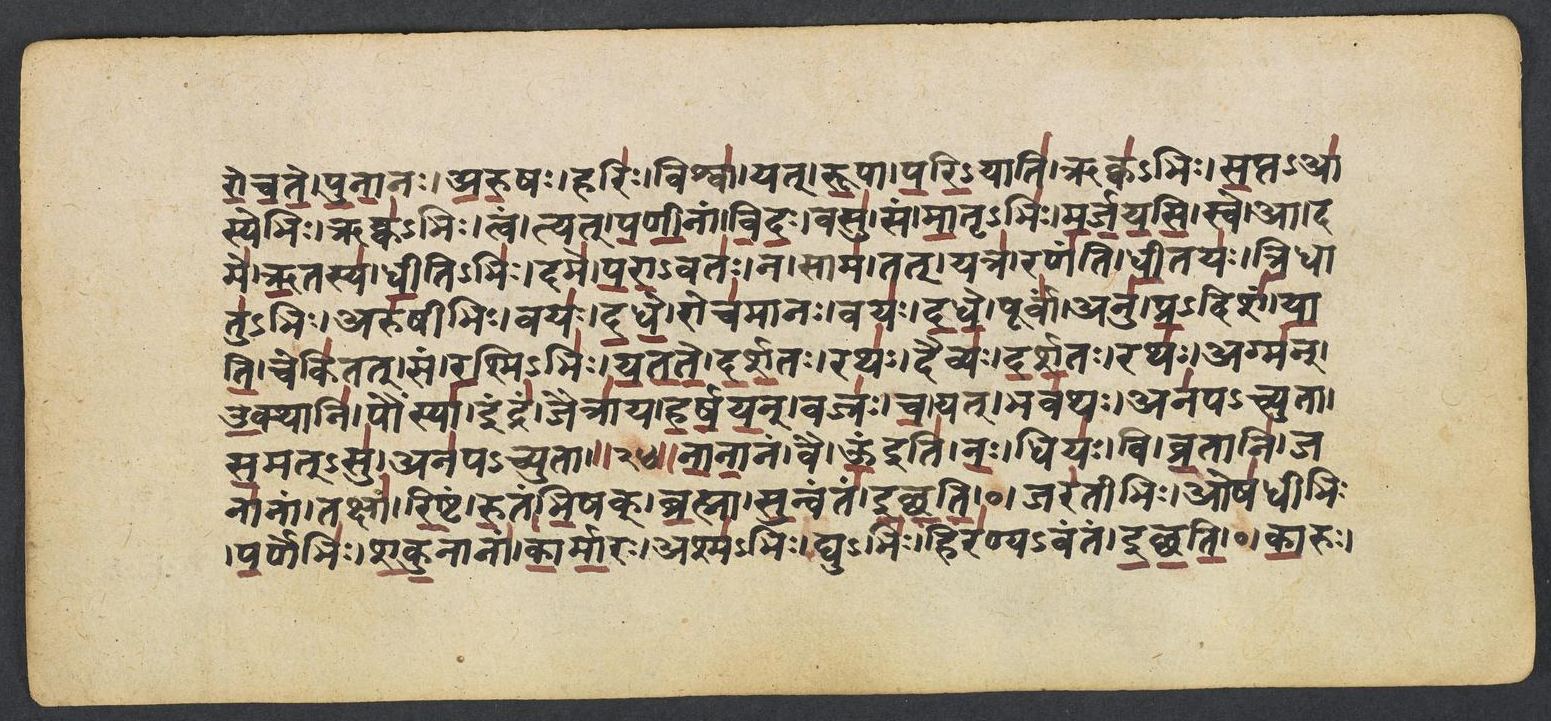
Where on the image
Penn Ms. Coll. 390 Item 41, fol. 741r (numbered 58r by the scribe) (OPenn image 741, lower leaf). Checked on the image: the Rigveda text on this page begins in RV 9.111.1 ‹rocate punānaḥ aruṣaḥ hariḥ›. The next page with Rigveda text, fol. 741v (numbered 58v by the scribe), begins in RV 9.112.3 ‹aham tataḥ bhiṣak upala-prakṣiṇī›. Verses 9.112.1-2 end on this page.
1nā̱nā̱naṁ vā u̍ no̱ dhiyo̱ vi vra̱tāni̱ janā̍nām | takṣā̍ ri̱ṣṭaṁ ru̱tam bhi̱ṣag bra̱hmā su̱nvanta̍m iccha̱tīndrā̍yendo̱ pari̍ srava ||
2jara̍tībhi̱r oṣa̍dhībhiḥ pa̱rṇebhi̍ḥ śaku̱nānā̍m | kā̱rmā̱ro aśma̍bhi̱r dyubhi̱r hira̍ṇyavantam iccha̱tīndrā̍yendo̱ pari̍ srava ||
Compare: Padapāṭha (word-by-word text written in the manuscript; Sansknet e-text via GRETIL)
1nānānam | vai | oṃ iti | naḥ | dhiyaḥ | vi | vratāni | janānām | takṣā | riṣṭam | rutam | bhiṣak | brahmā | sunvantam | icchati | indrāya | indo iti | pari | srava
2jaratībhiḥ | oṣadhībhiḥ | parṇebhiḥ | śakunānām | kārmāraḥ | aśma-bhiḥ | dyu-bhiḥ | hiraṇya-vantam | icchati | indrāya | indo iti | pari | srava
1WE all have various thoughts and plans, and diverse are the ways of men. The Brahman seeks the worshipper, wright seeks the cracked, and leech the maimed. Flow, Indu, flow for Indra's sake.
2The smith with ripe and seasoned plants, with feathers of the birds of air, With stones, and with enkindled flames, seeks him who hath a store of gold. Flow, Indu, flow for Indra's sake.
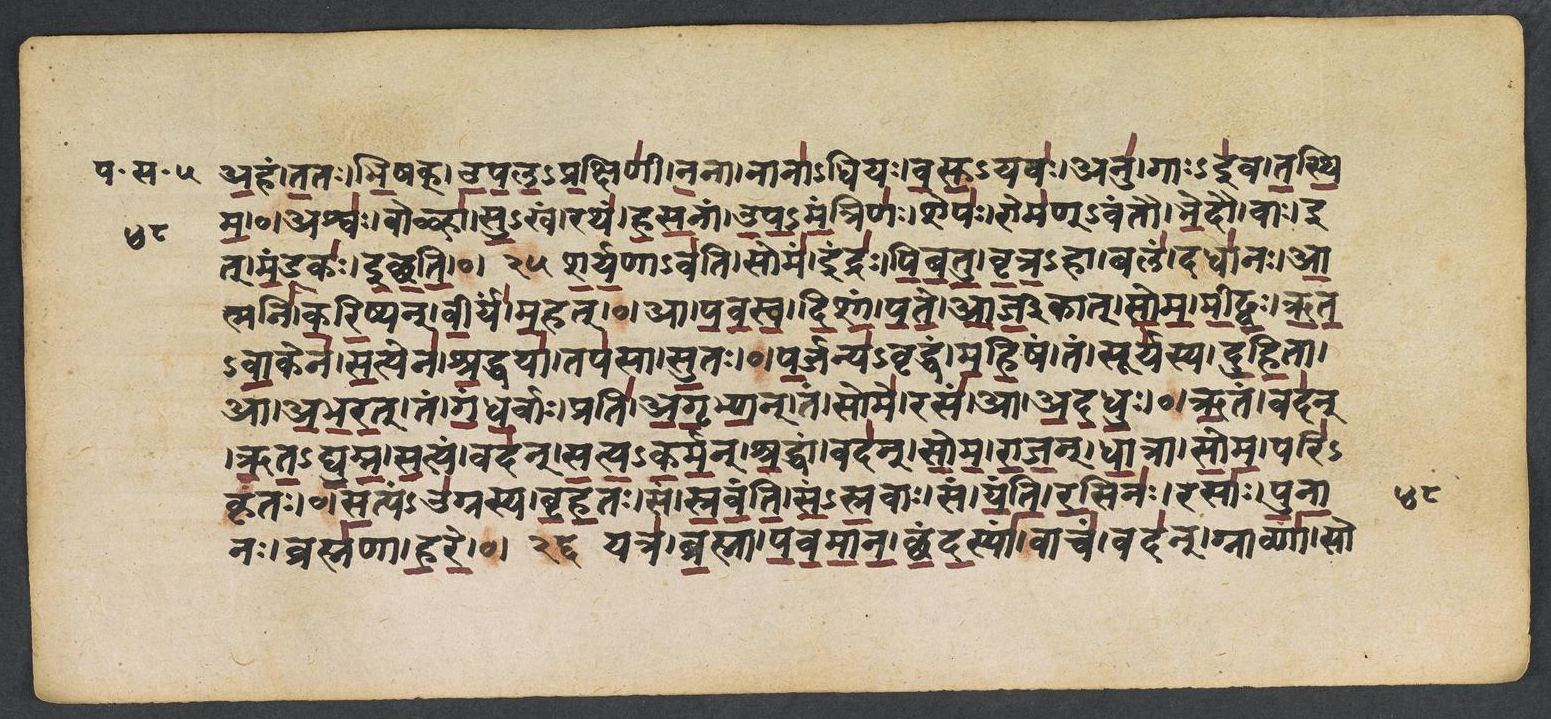
Where on the image
Penn Ms. Coll. 390 Item 41, fol. 741v (numbered 58v by the scribe) (OPenn image 742, upper leaf). Checked on the image: the Rigveda text on this page begins in RV 9.112.3 ‹aham tataḥ bhiṣak upala-prakṣiṇī›. The next page with Rigveda text, fol. 742r (numbered 59r by the scribe), begins in RV 9.113.6 ‹-some mahīyate somena ānandam›. Verses 9.112.3-4 end on this page; 9.112.3 begins on fol. 741r (numbered 58r by the scribe).
3kā̱rur a̱haṁ ta̱to bhi̱ṣag u̍palapra̱kṣiṇī̍ na̱nā | nānā̍dhiyo vasū̱yavo 'nu̱ gā i̍va tasthi̱mendrā̍yendo̱ pari̍ srava ||
4aśvo̱ voḻhā̍ su̱khaṁ ratha̍ṁ hasa̱nām u̍pama̱ntriṇa̍ḥ | śepo̱ roma̍ṇvantau bhe̱dau vār in ma̱ṇḍūka̍ iccha̱tīndrā̍yendo̱ pari̍ srava ||
Compare: Padapāṭha (word-by-word text written in the manuscript; Sansknet e-text via GRETIL)
3kāruḥ | aham | tataḥ | bhiṣak | upala-prakṣiṇī | nanā | nānādhiyaḥ | vasu-yavaḥ | anu | gāḥ-iva | tasthima | indrāya | indo iti | pari | srava
4aśvaḥ | voḷhā | sukham | ratham | hasanām | upa-mantriṇaḥ | śepaḥ | romaṇ-vantau | bhedau | vāḥ | it | maṇḍūkaḥ | icchati | indrāya | indo iti | pari | srava
3A bard am I, my dad's a leech, mammy lays corn upon the stones. Striving for wealth, with varied plans, we follow our desires like kine. Flow, Indu, flow for Indra's sake.
4The horse would draw an easy car, gay hosts attract the laugh and jest. The male desires his mate's approach, the frog is eager for the flood, Flow, Indu, flow for Indra's sake.
Notes
- Sanskrit: Aufrecht's edition (1877) with the Vedic accents, as entered by van Nooten and Holland (GRETIL).
- English: Ralph T. H. Griffith, The Hymns of the Rigveda (1889-1892; 2nd ed. 1896-1897), from the VedaWeb digital text; OCR slips in that text were corrected against the printed 2nd edition (data/sources/rigveda/griffith_errata.json).
- Padapāṭha (edition text): Sansknet e-text via GRETIL (CC BY-NC-SA 4.0).
Cite
Sources
- Source: Penn Ms. Coll. 390 Item 41 (undated (catalogued with Penn's 18th-19th c. Vedic manuscripts)), OPenn, Public Domain Mark + Aufrecht's accented text (GRETIL) + Griffith's English (VedaWeb) (holding institution)
- Critical edition: Aufrecht (1877), accented e-text via GRETIL
← previous · → next · v cycle view · l back to library