Rigveda 9.111: To Soma
Introduction
Rigveda 9.111 is a hymn of 3 verses addressed to Soma. It stands in book (maṇḍala) 9, the hymns to Soma Pavamāna. The Rigveda is the oldest collection of Sanskrit hymns, composed in the second half of the second millennium BCE and handed down orally for many centuries before it was written down.
The manuscript shown is Penn Ms. Coll. 390 Item 41 (University of Pennsylvania), an undated paper manuscript of the padapāṭha (the word-by-word recitation text, in which every word is written separately and compounds are split) of the whole Ṛgveda in Devanāgarī, 884 leaves in fascicles, 7-9 lines to the page, accents in red; this hymn stands on fol. 740v-741r. Each section below gives the verses that end on one page; the page boundaries were read on the images (the opening words of every page), not counted out. Where the manuscript is a padapāṭha (the word-by-word recitation text), the section shows Aufrecht's continuous (saṃhitā) text first and, as the edition text, the padapāṭha of the same verses, which is the form written on the page.
How was this verified? (Provenance)
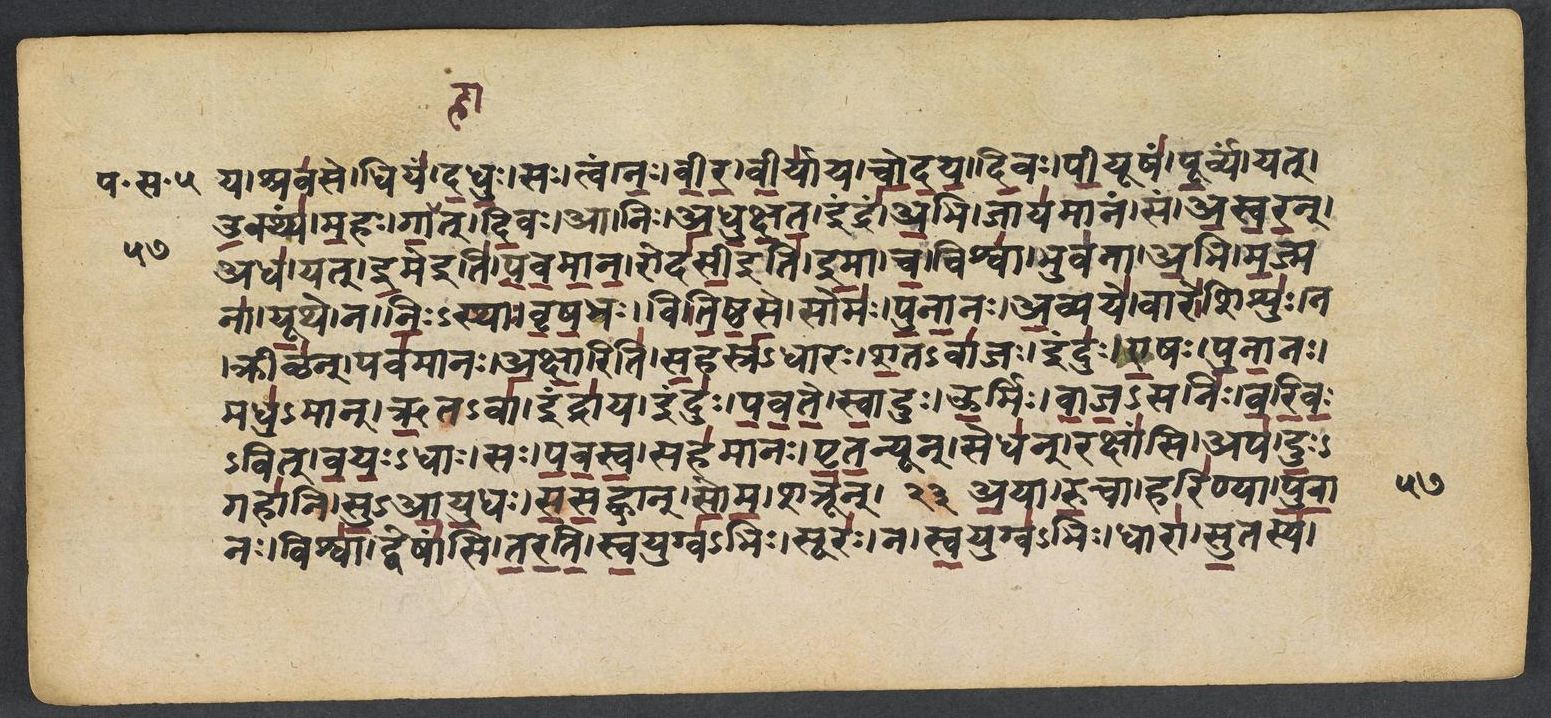
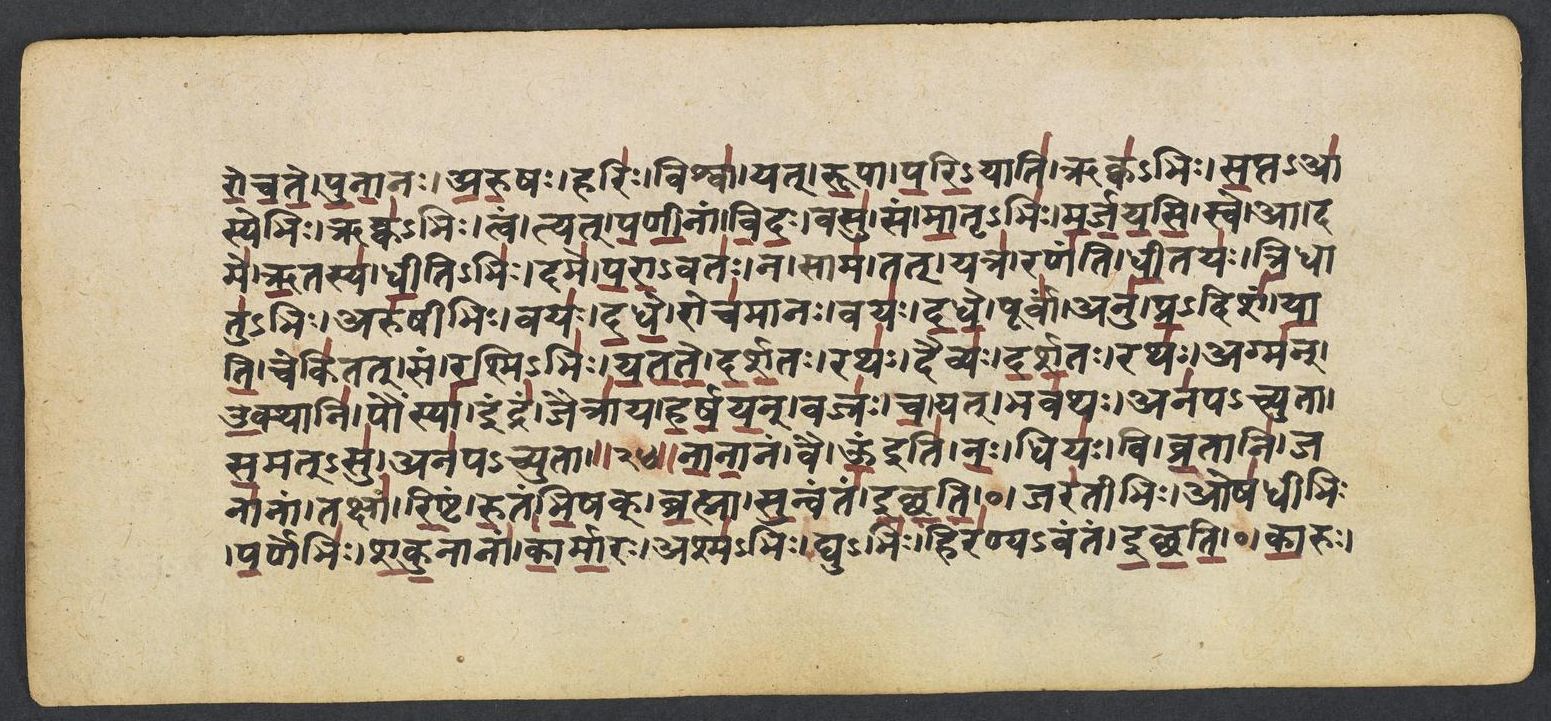
Where on the image
Penn Ms. Coll. 390 Item 41, fol. 741r (numbered 58r by the scribe) (OPenn image 741, lower leaf). Checked on the image: the Rigveda text on this page begins in RV 9.111.1 ‹rocate punānaḥ aruṣaḥ hariḥ›. The next page with Rigveda text, fol. 741v (numbered 58v by the scribe), begins in RV 9.112.3 ‹aham tataḥ bhiṣak upala-prakṣiṇī›. Verses 9.111.1-3 end on this page; 9.111.1 begins on fol. 740v (numbered 57v by the scribe).
1a̱yā ru̱cā hari̍ṇyā punā̱no viśvā̱ dveṣā̍ṁsi tarati sva̱yugva̍bhi̱ḥ sūro̱ na sva̱yugva̍bhiḥ | dhārā̍ su̱tasya̍ rocate punā̱no a̍ru̱ṣo hari̍ḥ | viśvā̱ yad rū̱pā pa̍ri̱yāty ṛkva̍bhiḥ sa̱ptāsye̍bhi̱r ṛkva̍bhiḥ ||
2tvaṁ tyat pa̍ṇī̱nāṁ vi̍do̱ vasu̱ sam mā̱tṛbhi̍r marjayasi̱ sva ā dama̍ ṛ̱tasya̍ dhī̱tibhi̱r dame̍ | pa̱rā̱vato̱ na sāma̱ tad yatrā̱ raṇa̍nti dhī̱taya̍ḥ | tri̱dhātu̍bhi̱r aru̍ṣībhi̱r vayo̍ dadhe̱ roca̍māno̱ vayo̍ dadhe ||
3pūrvā̱m anu̍ pra̱diśa̍ṁ yāti̱ ceki̍ta̱t saṁ ra̱śmibhi̍r yatate darśa̱to ratho̱ daivyo̍ darśa̱to ratha̍ḥ | agma̍nn u̱kthāni̱ pauṁsyendra̱ṁ jaitrā̍ya harṣayan | vajra̍ś ca̱ yad bhava̍tho̱ ana̍pacyutā sa̱matsv ana̍pacyutā ||
Compare: Padapāṭha (word-by-word text written in the manuscript; Sansknet e-text via GRETIL)
1ayā | rucā | hariṇyā | punānaḥ | viśvā | dveṣāṃsi | tarati | svayugva-bhiḥ | sūraḥ | na | svayugva-bhiḥ | dhārā | sutasya | rocate | punānaḥ | aruṣaḥ | hariḥ | viśvā | yat | rūpā | pari-yāti | ṛkva-bhiḥ | sapta-āsyebhiḥ | ṛkva-bhiḥ
2tvam | tyat | paṇīnām | vidaḥ | vasu | sam | mātṛ-bhiḥ | marjayasi | sve | ā | dame | ṛtasya | dhīti-bhiḥ | dame | parāvataḥ | na | sāma | tat | yatra | raṇanti | dhītayaḥ | tridhātu-bhiḥ | aruṣībhiḥ | vayaḥ | dadhe | rocamānaḥ | vayaḥ | dadhe
3pūrvām | anu | pra-diśam | yāti | cekitat | sam | raśmi-bhiḥ | yatate | darśataḥ | rathaḥ | daivyaḥ | darśataḥ | rathaḥ | agman | ukthāni | paiṃsyā | indram | jaitrāya | harṣayan | vajraḥ | ca | yat | bhavathaḥ | anapa-cyutā | samat-su | anapa-cyutā
1WITH this his golden splendour purifying him, he with his own allies subdues all enemies, as Ṣarawith his own allies. Cleansing himself with stream of juice he shines forth yellow-hued and red, when with the praisers he encompasses all forms, with praisers having seven mouths.
2That treasure of the Paṇis thou discoveredst; thou with thy mothers deckest thee in thine abode, with songs of worship in thine home. As 'twere from far, the hymn is heard, where holy songs resound in joy. He with the ruddy-hued, threefold hath won life-power, he, glittering, hath won life-power.
3He moves intelligent, directed to the East. The very beauteous car rivals the beams of light, the beautiful celestial car. Hymns, lauding manly valour, came, inciting Indra to success, that ye may be unconquered, both thy bolt and thou, both be unconquered in the war.
Notes
- Sanskrit: Aufrecht's edition (1877) with the Vedic accents, as entered by van Nooten and Holland (GRETIL).
- English: Ralph T. H. Griffith, The Hymns of the Rigveda (1889-1892; 2nd ed. 1896-1897), from the VedaWeb digital text; OCR slips in that text were corrected against the printed 2nd edition (data/sources/rigveda/griffith_errata.json).
- Padapāṭha (edition text): Sansknet e-text via GRETIL (CC BY-NC-SA 4.0).
Cite
Sources
- Source: Penn Ms. Coll. 390 Item 41 (undated (catalogued with Penn's 18th-19th c. Vedic manuscripts)), OPenn, Public Domain Mark + Aufrecht's accented text (GRETIL) + Griffith's English (VedaWeb) (holding institution)
- Critical edition: Aufrecht (1877), accented e-text via GRETIL
← previous · → next · v cycle view · l back to library