Rigveda 9.20: To Soma
Introduction
Rigveda 9.20 is a hymn of 7 verses addressed to Soma. It stands in book (maṇḍala) 9, the hymns to Soma Pavamāna. The Rigveda is the oldest collection of Sanskrit hymns, composed in the second half of the second millennium BCE and handed down orally for many centuries before it was written down.
The manuscript shown is Penn Ms. Coll. 390 Item 41 (University of Pennsylvania), an undated paper manuscript of the padapāṭha (the word-by-word recitation text, in which every word is written separately and compounds are split) of the whole Ṛgveda in Devanāgarī, 884 leaves in fascicles, 7-9 lines to the page, accents in red; this hymn stands on fol. 675v-676r. Each section below gives the verses that end on one page; the page boundaries were read on the images (the opening words of every page), not counted out. Where the manuscript is a padapāṭha (the word-by-word recitation text), the section shows Aufrecht's continuous (saṃhitā) text first and, as the edition text, the padapāṭha of the same verses, which is the form written on the page.
How was this verified? (Provenance)
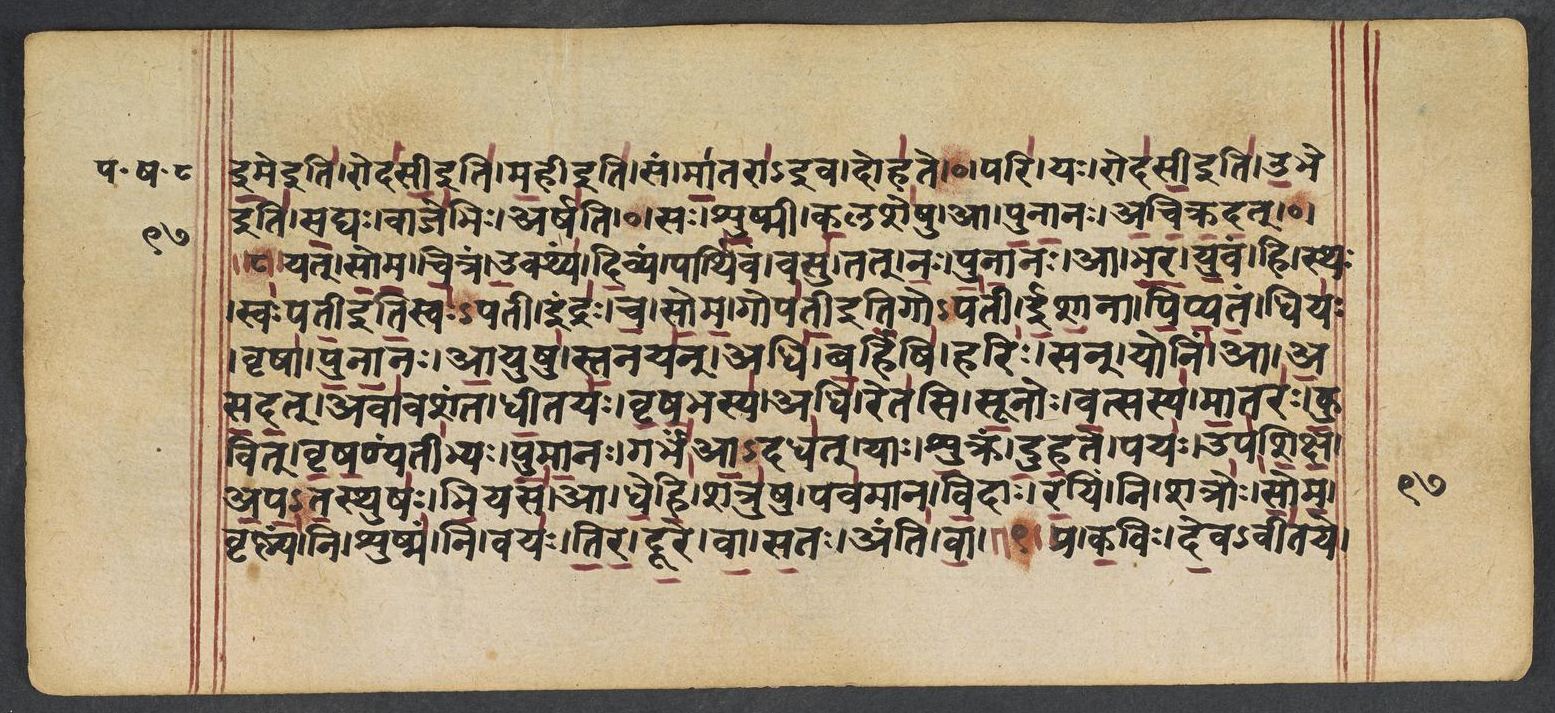
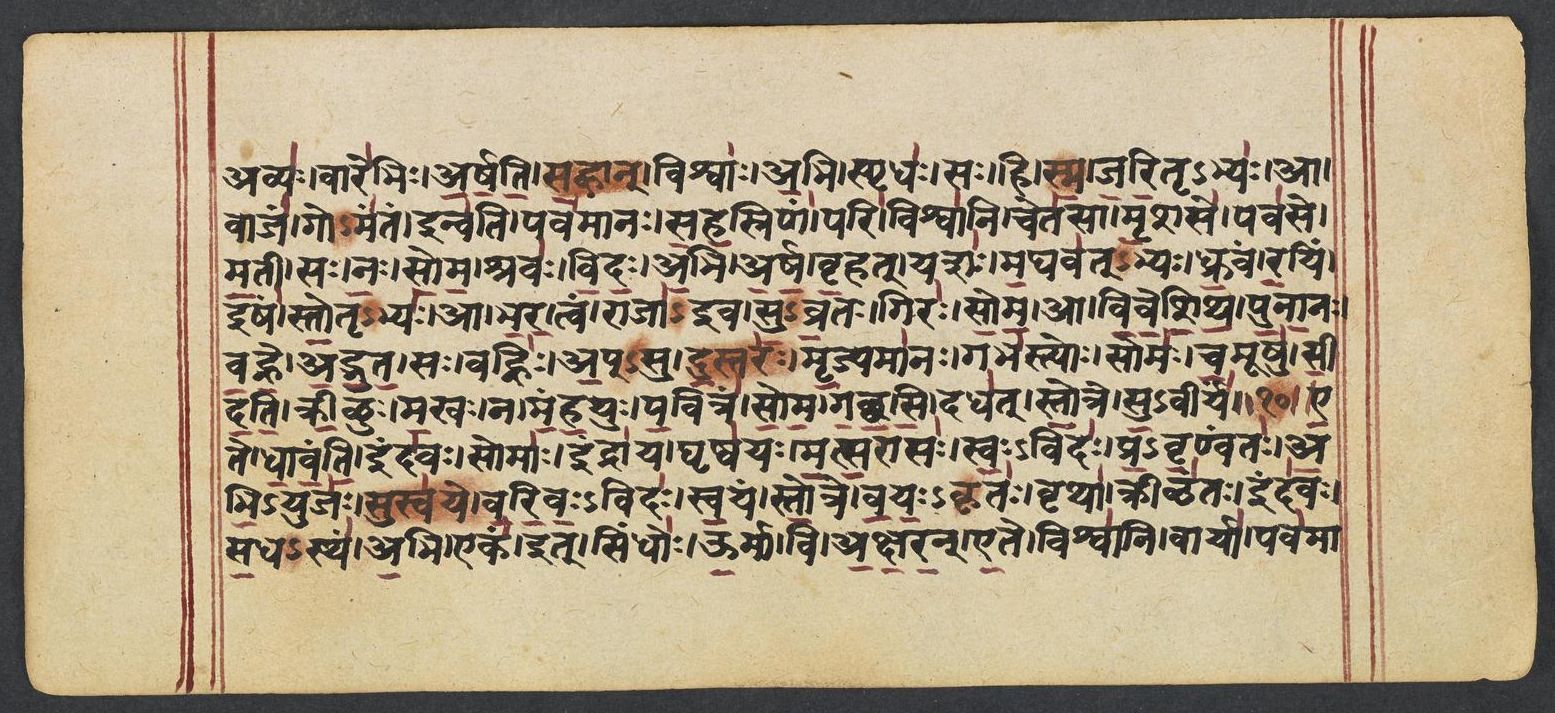
Where on the image
Penn Ms. Coll. 390 Item 41, fol. 676r (numbered 98r by the scribe) (OPenn image 676, lower leaf). Checked on the image: the Rigveda text on this page begins in RV 9.20.1 ‹avyaḥ vārebhiḥ arṣati sahvān›. The next page with Rigveda text, fol. 676v (numbered 98v by the scribe), begins in RV 9.21.4 ‹-pavamānāsaḥ āśata hitāḥ na›. Verses 9.20.1-7 end on this page; 9.20.1 begins on fol. 675v (numbered 97v by the scribe).
1pra ka̱vir de̱vavī̍ta̱ye 'vyo̱ vāre̍bhir arṣati | sā̱hvān viśvā̍ a̱bhi spṛdha̍ḥ ||
2sa hi ṣmā̍ jari̱tṛbhya̱ ā vāja̱ṁ goma̍nta̱m inva̍ti | pava̍mānaḥ saha̱sriṇa̍m ||
3pari̱ viśvā̍ni̱ ceta̍sā mṛ̱śase̱ pava̍se ma̱tī | sa na̍ḥ soma̱ śravo̍ vidaḥ ||
4a̱bhy a̍rṣa bṛ̱had yaśo̍ ma̱ghava̍dbhyo dhru̱vaṁ ra̱yim | iṣa̍ṁ sto̱tṛbhya̱ ā bha̍ra ||
5tvaṁ rāje̍va suvra̱to gira̍ḥ so̱mā vi̍veśitha | pu̱nā̱no va̍hne adbhuta ||
6sa vahni̍r a̱psu du̱ṣṭaro̍ mṛ̱jyamā̍no̱ gabha̍styoḥ | soma̍ś ca̱mūṣu̍ sīdati ||
7krī̱ḻur ma̱kho na ma̍ṁha̱yuḥ pa̱vitra̍ṁ soma gacchasi | dadha̍t sto̱tre su̱vīrya̍m ||
Compare: Padapāṭha (word-by-word text written in the manuscript; Sansknet e-text via GRETIL)
1pra | kaviḥ | deva-vītaye | avyaḥ | vārebhiḥ | arṣati | sahvān | viśvāḥ | abhi | spṛdhaḥ
2saḥ | hi | sma | jaritṛ-bhyaḥ | ā | vājam | go-mantam | invati | pavamānaḥ | sahasriṇam
3pari | viśvāni | cetasā | mṛśase | pavase | matī | saḥ | naḥ | soma | śravaḥ | vidaḥ
4abhi | arṣa | bṛhat | yaśaḥ | maghavat-bhyaḥ | dhruvam | rayim | iṣam | stotṛ-bhyaḥ | ā | bhara
5tvam | rājā-iva | su-vrataḥ | giraḥ | soma | ā | viveśitha | punānaḥ | vahne | adbhuta
6saḥ | vahniḥ | ap-su | dustaraḥ | mṛjyamānaḥ | gabhastyoḥ | somaḥ | camūṣu | sīdati
7krīḷuḥ | makhaḥ | na | maṃhayuḥ | pavitram | soma | gacchasi | dadhat | stotre | su-vīryam
1FORTH through the straining-cloth the Sage flows to the banquet of the Gods, Subduing all our enemies.
2For he, as Pavamâna, sends thousandfold treasure in the shape Of cattle to the singing-men.
3Thou graspest all things with thy mind, and purifiest thee with thoughts As such, O Soma, find us fame.
4Pour lofty glory on us, send sure riches to our liberal lords, Bring food to those who sing thy praise.
5As thou art cleansed, O Wondrous Steed, O Soma, thou hast entered, like A pious King, into the songs.
6He, Soma, like a courser in the floods invincible, made clean With hands, is resting in the jars.
7Disporting, like a liberal chief, thou goest, Soma, to the sieve, Lending the laud a Hero's strength.
Notes
- Sanskrit: Aufrecht's edition (1877) with the Vedic accents, as entered by van Nooten and Holland (GRETIL).
- English: Ralph T. H. Griffith, The Hymns of the Rigveda (1889-1892; 2nd ed. 1896-1897), from the VedaWeb digital text; OCR slips in that text were corrected against the printed 2nd edition (data/sources/rigveda/griffith_errata.json).
- Padapāṭha (edition text): Sansknet e-text via GRETIL (CC BY-NC-SA 4.0).
Cite
Sources
- Source: Penn Ms. Coll. 390 Item 41 (undated (catalogued with Penn's 18th-19th c. Vedic manuscripts)), OPenn, Public Domain Mark + Aufrecht's accented text (GRETIL) + Griffith's English (VedaWeb) (holding institution)
- Critical edition: Aufrecht (1877), accented e-text via GRETIL
← previous · → next · v cycle view · l back to library