Rigveda 9.27: To Soma
Introduction
Rigveda 9.27 is a hymn of 6 verses addressed to Soma. It stands in book (maṇḍala) 9, the hymns to Soma Pavamāna. The Rigveda is the oldest collection of Sanskrit hymns, composed in the second half of the second millennium BCE and handed down orally for many centuries before it was written down.
The manuscript shown is Penn Ms. Coll. 390 Item 41 (University of Pennsylvania), an undated paper manuscript of the padapāṭha (the word-by-word recitation text, in which every word is written separately and compounds are split) of the whole Ṛgveda in Devanāgarī, 884 leaves in fascicles, 7-9 lines to the page, accents in red; this hymn stands on fol. 678r-678v. Each section below gives the verses that end on one page; the page boundaries were read on the images (the opening words of every page), not counted out. Where the manuscript is a padapāṭha (the word-by-word recitation text), the section shows Aufrecht's continuous (saṃhitā) text first and, as the edition text, the padapāṭha of the same verses, which is the form written on the page.
How was this verified? (Provenance)
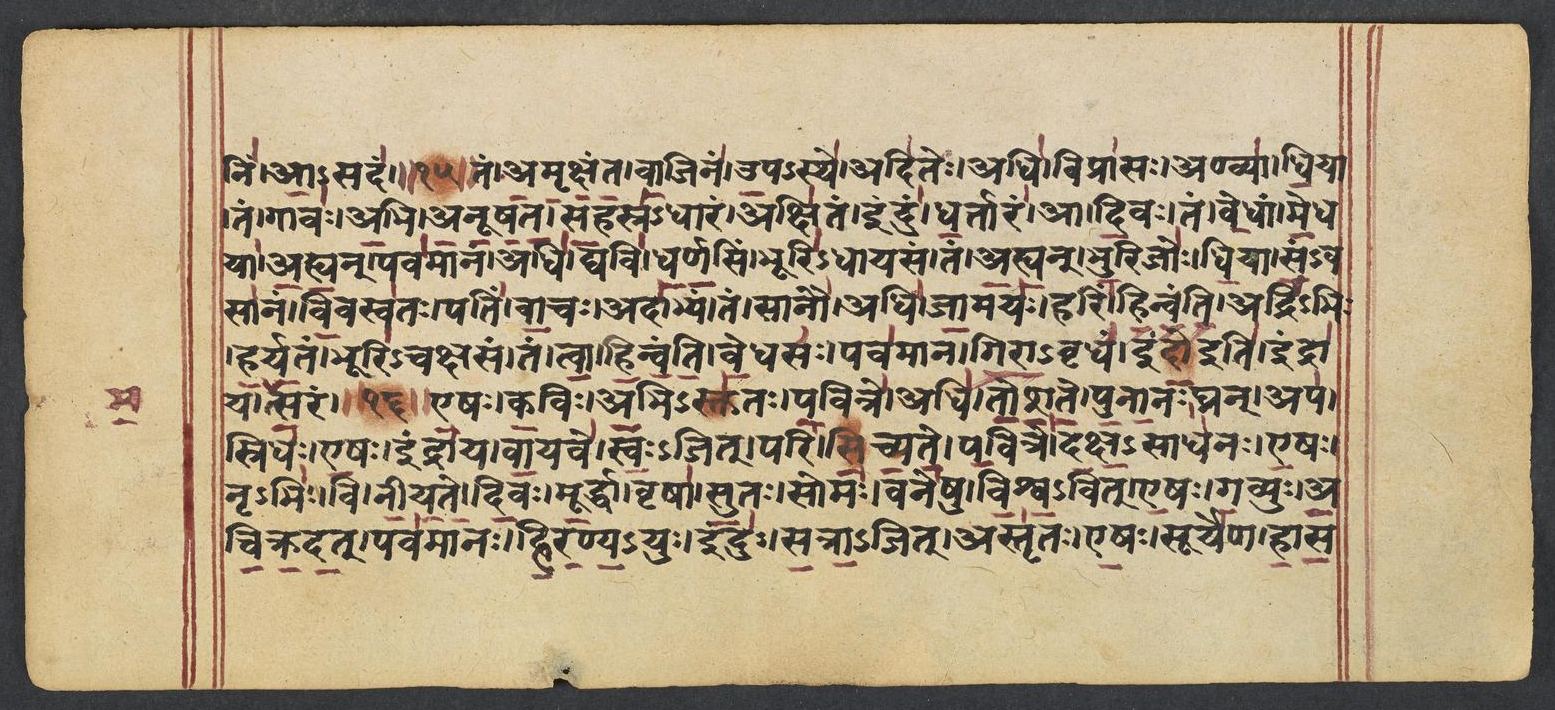
Where on the image
Penn Ms. Coll. 390 Item 41, fol. 678r (numbered 100r by the scribe) (OPenn image 678, lower leaf). Checked on the image: the Rigveda text on this page begins in RV 9.25.6 ‹-yonim āsadam›. The next page with Rigveda text, fol. 678v (numbered 100v by the scribe), begins in RV 9.27.5 ‹-hāsate pavamānaḥ adhi dyavi›. Verses 9.27.1-4 end on this page.
1e̱ṣa ka̱vir a̱bhiṣṭu̍taḥ pa̱vitre̱ adhi̍ tośate | pu̱nā̱no ghnann apa̱ sridha̍ḥ ||
2e̱ṣa indrā̍ya vā̱yave̍ sva̱rjit pari̍ ṣicyate | pa̱vitre̍ dakṣa̱sādha̍naḥ ||
3e̱ṣa nṛbhi̱r vi nī̍yate di̱vo mū̱rdhā vṛṣā̍ su̱taḥ | somo̱ vane̍ṣu viśva̱vit ||
4e̱ṣa ga̱vyur a̍cikrada̱t pava̍māno hiraṇya̱yuḥ | indu̍ḥ satrā̱jid astṛ̍taḥ ||
Compare: Padapāṭha (word-by-word text written in the manuscript; Sansknet e-text via GRETIL)
1eṣaḥ | kaviḥ | abhi-stutaḥ | pavitre | adhi | tośate | punānaḥ | ghnan | apa | sridhaḥ
2eṣaḥ | indrāya | vāyave | svaḥ-jit | pari | sicyate | pavitre | dakṣa-sādhanaḥ
3eṣaḥ | nṛ-bhiḥ | vi | nīyate | divaḥ | mūrdhā | vṛṣā | sutaḥ | somaḥ | vaneṣu | viśva-vit
4eṣaḥ | gavyuḥ | acikradat | pavamānaḥ | hiraṇya-yuḥ | induḥ | satrājit | astṛtaḥ
1THIS Sage, exalted by our lauds, flows to the purifying cloth, Scattering foes as he is cleansed.
2As giving power and winning light, for Indra and for Vâyu he Is poured upon the filtering-cloth.
3The men conduct him, Soma, Steer, Omniscient, and the Head of Heaven, Effused into the vats of wood.
4Longing for kine, longing for gold hath Indu Pavamâna lowed, Still Conqueror, never overcome.
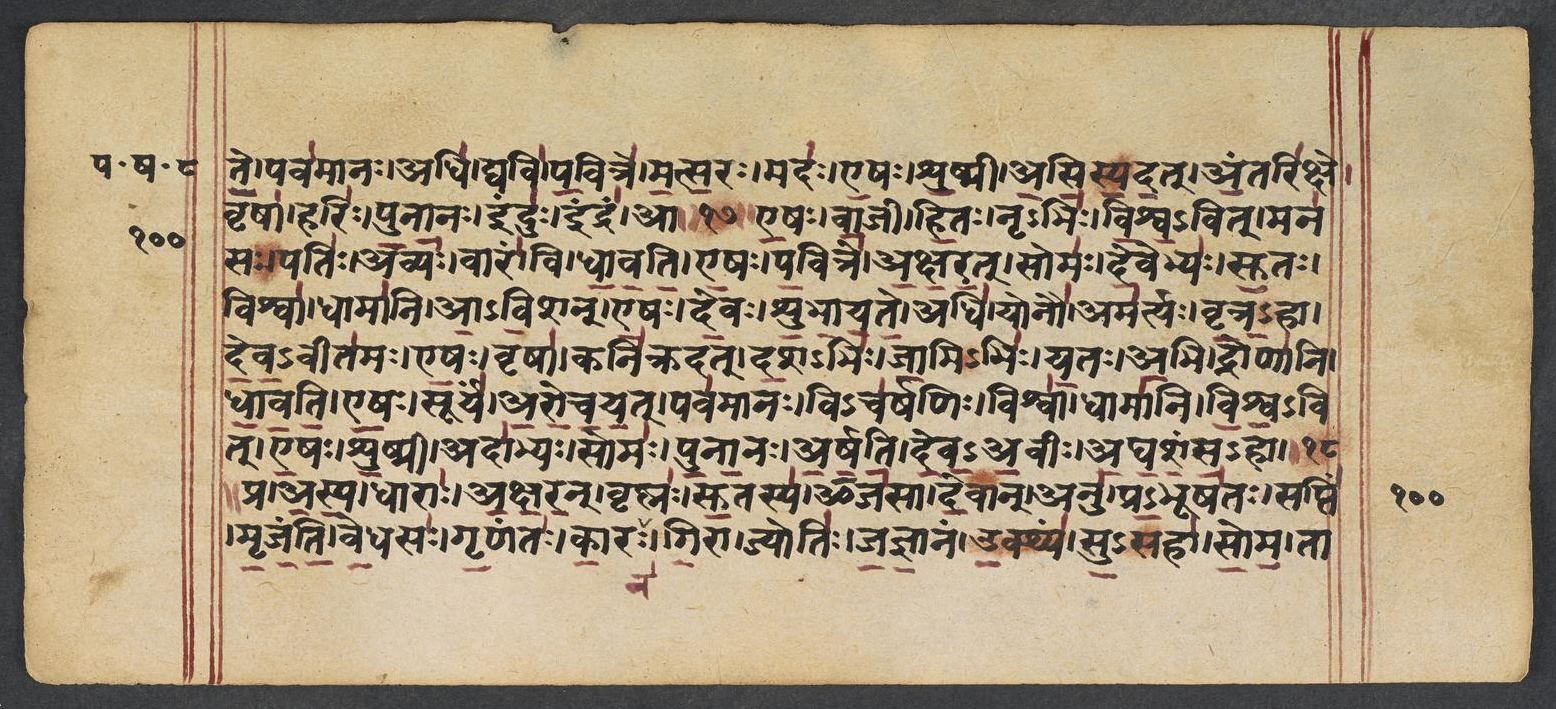
Where on the image
Penn Ms. Coll. 390 Item 41, fol. 678v (numbered 100v by the scribe) (OPenn image 679, upper leaf). Checked on the image: the Rigveda text on this page begins in RV 9.27.5 ‹-hāsate pavamānaḥ adhi dyavi›. The next page with Rigveda text, fol. 679r (numbered 101r by the scribe), begins in RV 9.29.3 ‹-tāni te punānāya prabhuvaso›. Verses 9.27.5-6 end on this page; 9.27.5 begins on fol. 678r (numbered 100r by the scribe).
5e̱ṣa sūrye̍ṇa hāsate̱ pava̍māno̱ adhi̱ dyavi̍ | pa̱vitre̍ matsa̱ro mada̍ḥ ||
6e̱ṣa śu̱ṣmy a̍siṣyadad a̱ntari̍kṣe̱ vṛṣā̱ hari̍ḥ | pu̱nā̱na indu̱r indra̱m ā ||
Compare: Padapāṭha (word-by-word text written in the manuscript; Sansknet e-text via GRETIL)
5eṣaḥ | sūryeṇa | hāsate | pavamānaḥ | adhi | dyavi | pavitre | matsaraḥ | madaḥ
6eṣaḥ | śuṣmī | asisyadat | antarikṣe | vṛṣā | hariḥ | punānaḥ | induḥ | indram | ā
5This Pavamâna, gladdening draught, drops on the filtering cloth, and then Mounts up with Sûrya to the sky.
6To Indra in the firmament this mighty tawny Steer hath flowed, This Indu, being purified.
Notes
- Sanskrit: Aufrecht's edition (1877) with the Vedic accents, as entered by van Nooten and Holland (GRETIL).
- English: Ralph T. H. Griffith, The Hymns of the Rigveda (1889-1892; 2nd ed. 1896-1897), from the VedaWeb digital text; OCR slips in that text were corrected against the printed 2nd edition (data/sources/rigveda/griffith_errata.json).
- Padapāṭha (edition text): Sansknet e-text via GRETIL (CC BY-NC-SA 4.0).
Cite
Sources
- Source: Penn Ms. Coll. 390 Item 41 (undated (catalogued with Penn's 18th-19th c. Vedic manuscripts)), OPenn, Public Domain Mark + Aufrecht's accented text (GRETIL) + Griffith's English (VedaWeb) (holding institution)
- Critical edition: Aufrecht (1877), accented e-text via GRETIL
← previous · → next · v cycle view · l back to library