Rigveda 9.28: To Soma
Introduction
Rigveda 9.28 is a hymn of 6 verses addressed to Soma. It stands in book (maṇḍala) 9, the hymns to Soma Pavamāna. The Rigveda is the oldest collection of Sanskrit hymns, composed in the second half of the second millennium BCE and handed down orally for many centuries before it was written down.
The manuscript shown is Penn Ms. Coll. 390 Item 41 (University of Pennsylvania), an undated paper manuscript of the padapāṭha (the word-by-word recitation text, in which every word is written separately and compounds are split) of the whole Ṛgveda in Devanāgarī, 884 leaves in fascicles, 7-9 lines to the page, accents in red; this hymn stands on fol. 678v. Each section below gives the verses that end on one page; the page boundaries were read on the images (the opening words of every page), not counted out. Where the manuscript is a padapāṭha (the word-by-word recitation text), the section shows Aufrecht's continuous (saṃhitā) text first and, as the edition text, the padapāṭha of the same verses, which is the form written on the page.
How was this verified? (Provenance)
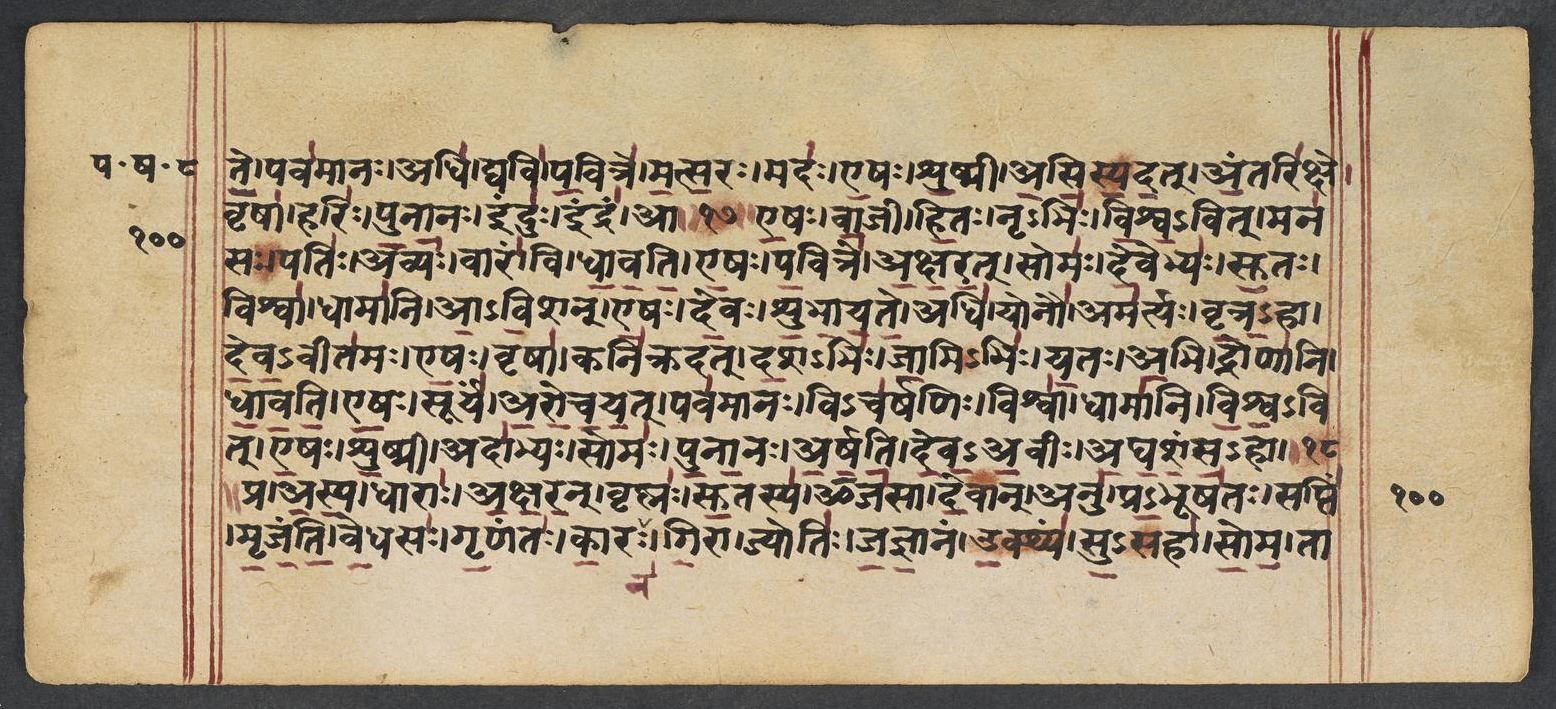
Where on the image
Penn Ms. Coll. 390 Item 41, fol. 678v (numbered 100v by the scribe) (OPenn image 679, upper leaf). Checked on the image: the Rigveda text on this page begins in RV 9.27.5 ‹-hāsate pavamānaḥ adhi dyavi›. The next page with Rigveda text, fol. 679r (numbered 101r by the scribe), begins in RV 9.29.3 ‹-tāni te punānāya prabhuvaso›. Verses 9.28.1-6 end on this page.
1e̱ṣa vā̱jī hi̱to nṛbhi̍r viśva̱vin mana̍sa̱s pati̍ḥ | avyo̱ vāra̱ṁ vi dhā̍vati ||
2e̱ṣa pa̱vitre̍ akṣara̱t somo̍ de̱vebhya̍ḥ su̱taḥ | viśvā̱ dhāmā̍ny āvi̱śan ||
3e̱ṣa de̱vaḥ śu̍bhāya̱te 'dhi̱ yonā̱v ama̍rtyaḥ | vṛ̱tra̱hā de̍va̱vīta̍maḥ ||
4e̱ṣa vṛṣā̱ kani̍kradad da̱śabhi̍r jā̱mibhi̍r ya̱taḥ | a̱bhi droṇā̍ni dhāvati ||
5e̱ṣa sūrya̍m arocaya̱t pava̍māno̱ vica̍rṣaṇiḥ | viśvā̱ dhāmā̍ni viśva̱vit ||
6e̱ṣa śu̱ṣmy adā̍bhya̱ḥ soma̍ḥ punā̱no a̍rṣati | de̱vā̱vīr a̍ghaśaṁsa̱hā ||
Compare: Padapāṭha (word-by-word text written in the manuscript; Sansknet e-text via GRETIL)
1eṣaḥ | vājī | hitaḥ | nṛ-bhiḥ | viśva-vit | manasaḥ | patiḥ | avyaḥ | vāram | vi | dhāvati
2eṣaḥ | pavitre | akṣarat | somaḥ | devebhyaḥ | sutaḥ | viśvā | dhāmāni | ā-viśan
3eṣaḥ | devaḥ | śubhāyate | adhi | yonau | amartyaḥ | vṛtra-hā | deva-vītamaḥ
4eṣaḥ | vṛṣā | kanikradat | daśa-bhiḥ | jāmi-bhiḥ | yataḥ | abhi | droṇāni | dhāvati
5eṣaḥ | sūryam | arocayat | pavamānaḥ | vi-carṣaṇiḥ | viśvā | dhāmāni | viśva-vit
6eṣaḥ | śuṣmī | adābhyaḥ | somaḥ | punānaḥ | arṣati | deva-avīḥ | aghaśaṃsa-hā
1URGED by the men, this vigorous Steed, Lord of the mind, Omniscient, Runs to the woollen straining-cloth.
2Within the filter hath he flowed, this Soma for the Gods effused, Entering all their essences.
3He shines in beauty there, this God Immortal in his dwelling-place, Foe-slayer, dearest to the Gods.
4Directed by the Sisters ten, bellowing on his way this Steer Runs onward to the wooden vats.
5This Pavamâna, swiftand strong, Omniscient, gave splendour to The Sun and all his forms of light.
6This Soma being purified, flows mighty and infallible, Slayer of sinners, dear toGods.
Notes
- Sanskrit: Aufrecht's edition (1877) with the Vedic accents, as entered by van Nooten and Holland (GRETIL).
- English: Ralph T. H. Griffith, The Hymns of the Rigveda (1889-1892; 2nd ed. 1896-1897), from the VedaWeb digital text; OCR slips in that text were corrected against the printed 2nd edition (data/sources/rigveda/griffith_errata.json).
- Padapāṭha (edition text): Sansknet e-text via GRETIL (CC BY-NC-SA 4.0).
Cite
Sources
- Source: Penn Ms. Coll. 390 Item 41 (undated (catalogued with Penn's 18th-19th c. Vedic manuscripts)), OPenn, Public Domain Mark + Aufrecht's accented text (GRETIL) + Griffith's English (VedaWeb) (holding institution)
- Critical edition: Aufrecht (1877), accented e-text via GRETIL
← previous · → next · v cycle view · l back to library