Rigveda 9.3: To Soma
Introduction
Rigveda 9.3 is a hymn of 10 verses addressed to Soma. It stands in book (maṇḍala) 9, the hymns to Soma Pavamāna. The Rigveda is the oldest collection of Sanskrit hymns, composed in the second half of the second millennium BCE and handed down orally for many centuries before it was written down.
The manuscript shown is Penn Ms. Coll. 390 Item 41 (University of Pennsylvania), an undated paper manuscript of the padapāṭha (the word-by-word recitation text, in which every word is written separately and compounds are split) of the whole Ṛgveda in Devanāgarī, 884 leaves in fascicles, 7-9 lines to the page, accents in red; this hymn stands on fol. 668r-668v. Each section below gives the verses that end on one page; the page boundaries were read on the images (the opening words of every page), not counted out. Where the manuscript is a padapāṭha (the word-by-word recitation text), the section shows Aufrecht's continuous (saṃhitā) text first and, as the edition text, the padapāṭha of the same verses, which is the form written on the page.
How was this verified? (Provenance)
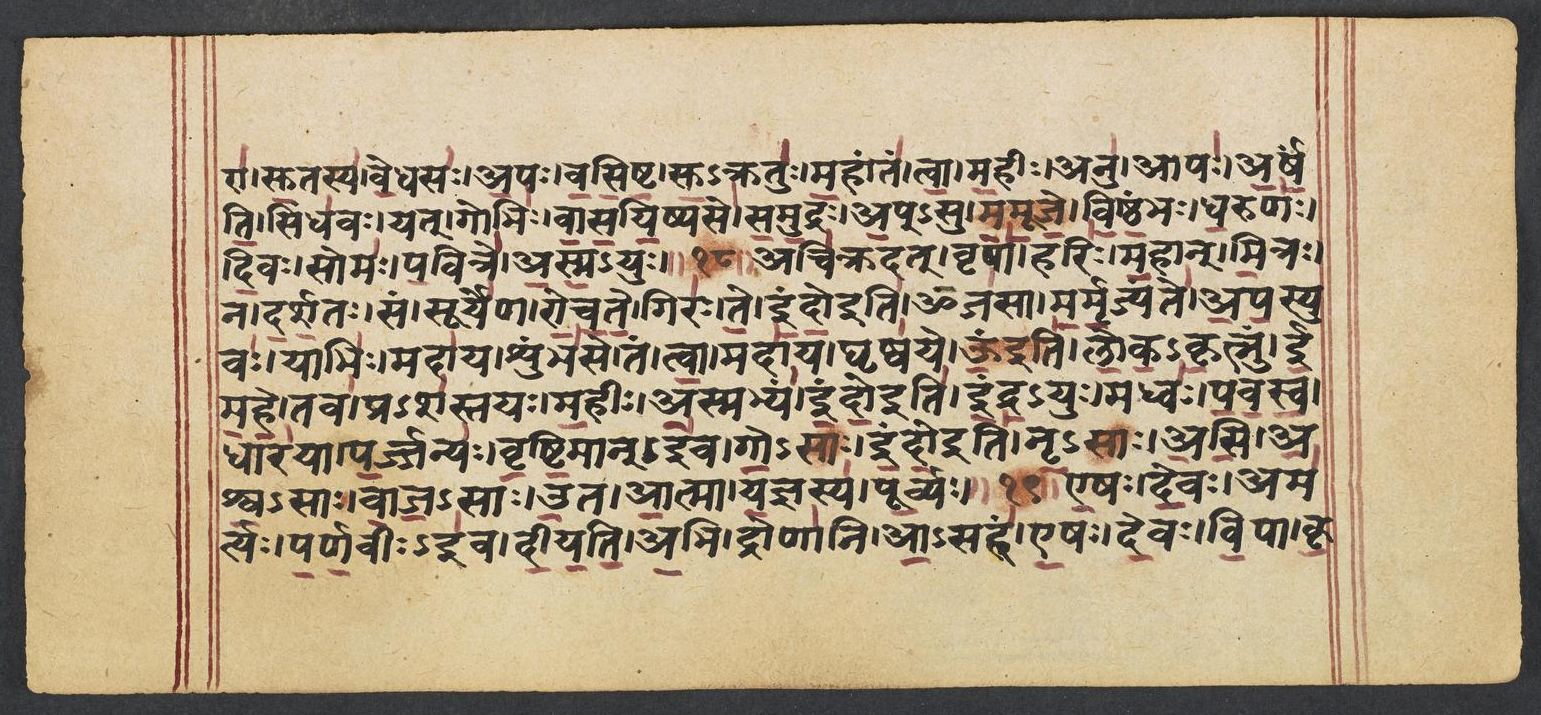
Where on the image
Penn Ms. Coll. 390 Item 41, fol. 668r (numbered 90r by the scribe) (OPenn image 668, lower leaf). Checked on the image: the Rigveda text on this page begins in RV 9.2.3 ‹-dhārā sutasya vedhasaḥ apaḥ›. The next page with Rigveda text, fol. 668v (numbered 90v by the scribe), begins in RV 9.3.2 ‹-kṛtaḥ ati hvarāṃsi dhāvati›. Verse 9.3.1 ends on this page.
1e̱ṣa de̱vo ama̍rtyaḥ parṇa̱vīr i̍va dīyati | a̱bhi droṇā̍ny ā̱sada̍m ||
Compare: Padapāṭha (word-by-word text written in the manuscript; Sansknet e-text via GRETIL)
1eṣaḥ | devaḥ | amartyaḥ | parṇavīḥ-iva | dīyati | abhi | droṇāni | āsadam
1HERE present this Immortal God flies, like a bird upon her wings, To settle in the vats of wood.
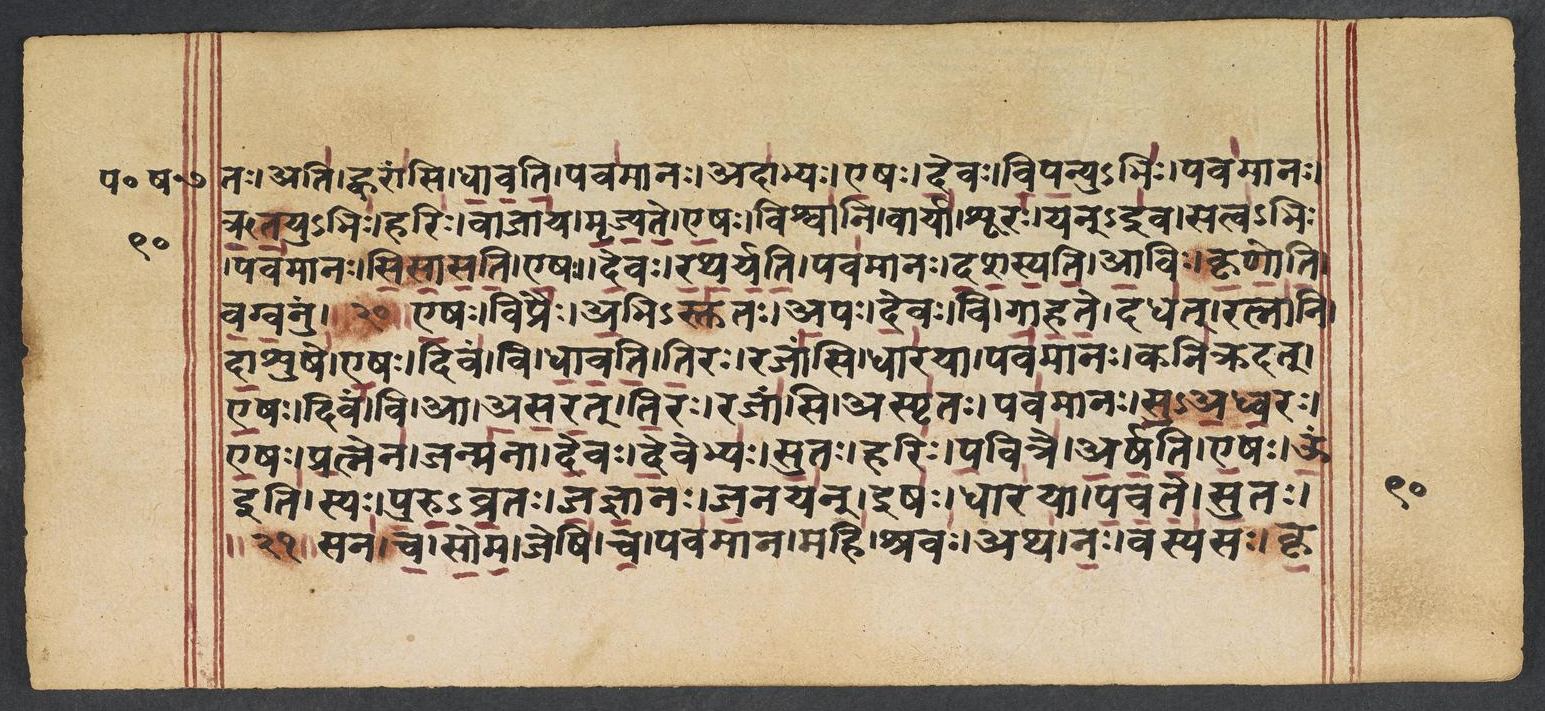
Where on the image
Penn Ms. Coll. 390 Item 41, fol. 668v (numbered 90v by the scribe) (OPenn image 669, upper leaf). Checked on the image: the Rigveda text on this page begins in RV 9.3.2 ‹-kṛtaḥ ati hvarāṃsi dhāvati›. The next page with Rigveda text, fol. 669r (numbered 91r by the scribe), begins in RV 9.4.1 ‹-kṛdhi›. Verses 9.3.2-10 end on this page; 9.3.2 begins on fol. 668r (numbered 90r by the scribe).
2e̱ṣa de̱vo vi̱pā kṛ̱to 'ti̱ hvarā̍ṁsi dhāvati | pava̍māno̱ adā̍bhyaḥ ||
3e̱ṣa de̱vo vi̍pa̱nyubhi̱ḥ pava̍māna ṛtā̱yubhi̍ḥ | hari̱r vājā̍ya mṛjyate ||
4e̱ṣa viśvā̍ni̱ vāryā̱ śūro̱ yann i̍va̱ satva̍bhiḥ | pava̍mānaḥ siṣāsati ||
5e̱ṣa de̱vo ra̍tharyati̱ pava̍māno daśasyati | ā̱viṣ kṛ̍ṇoti vagva̱num ||
6e̱ṣa viprai̍r a̱bhiṣṭu̍to̱ 'po de̱vo vi gā̍hate | dadha̱d ratnā̍ni dā̱śuṣe̍ ||
7e̱ṣa diva̱ṁ vi dhā̍vati ti̱ro rajā̍ṁsi̱ dhāra̍yā | pava̍māna̱ḥ kani̍kradat ||
8e̱ṣa diva̱ṁ vy āsa̍rat ti̱ro rajā̱ṁsy aspṛ̍taḥ | pava̍mānaḥ svadhva̱raḥ ||
9e̱ṣa pra̱tnena̱ janma̍nā de̱vo de̱vebhya̍ḥ su̱taḥ | hari̍ḥ pa̱vitre̍ arṣati ||
10e̱ṣa u̱ sya pu̍ruvra̱to ja̍jñā̱no ja̱naya̱nn iṣa̍ḥ | dhāra̍yā pavate su̱taḥ ||
Compare: Padapāṭha (word-by-word text written in the manuscript; Sansknet e-text via GRETIL)
2eṣaḥ | devaḥ | vipā | kṛtaḥ | ati | hvarāṃsi | dhāvati | pavamānaḥ | adābhyaḥ
3eṣaḥ | devaḥ | vipanyu-bhiḥ | pavamānaḥ | ṛtayu-bhiḥ | hariḥ | vājāya | mṛjyate
4eṣaḥ | viśvāni | vāryā | śūraḥ | yan-iva | satva-bhiḥ | pavamānaḥ | sisāsati
5eṣaḥ | devaḥ | ratharyati | pavamānaḥ | daśasyati | āviḥ | kṛṇoti | vagvanum
6eṣaḥ | vipraiḥ | abhi-stutaḥ | apaḥ | devaḥ | vi | gāhate | dadhat | ratnāni | dāśuṣe
7eṣaḥ | divam | vi | dhāvati | tiraḥ | rajāṃsi | dhārayā | pavamānaḥ | kanikradat
8eṣaḥ | divam | vi | ā | asarat | tiraḥ | rajāṃsi | aspṛtaḥ | pavamānaḥ | su-adhvaraḥ
9eṣaḥ | pratnena | janmanā | devaḥ | devebhyaḥ | sutaḥ | hariḥ | pavitre | aṣarti
10eṣaḥ | oṃ iti | syaḥ | puru-vrataḥ | jajñānaḥ | janayan | iṣaḥ | dhārayā | pavate | sutaḥ
2This God, made ready with the hymn, runs swiftly through the winding ways, Inviolable as he flows.
3This God while flowing is adorned, like a bay steed for war, by men Devout and skilled in holy songs.
4He, like a warrior going forth with heroes, as he flows along Is fain to win all precious boons.
5This God, as he is flowing on, speeds like a car and gives his gifts: He lets his voice be heard of all
6Praised by the sacred bards, this God dives into waters, and bestows Rich gifts upon the worshipper.
7Away he rushes with his stream, across the regions, into heaven, And roars as he is flowing on.
8While flowing, meet for sacrifice, he hath gone up to heaven across The regions, irresistible.
9After the 'way of ancient time, this God, pressed out for Deities, Flows tawny to the straining-cloth.
10This Lord of many Holy Laws, even at his birth engendering strength, Effused, flows onward in a stream.
Notes
- Sanskrit: Aufrecht's edition (1877) with the Vedic accents, as entered by van Nooten and Holland (GRETIL).
- English: Ralph T. H. Griffith, The Hymns of the Rigveda (1889-1892; 2nd ed. 1896-1897), from the VedaWeb digital text; OCR slips in that text were corrected against the printed 2nd edition (data/sources/rigveda/griffith_errata.json).
- Padapāṭha (edition text): Sansknet e-text via GRETIL (CC BY-NC-SA 4.0).
Cite
Sources
- Source: Penn Ms. Coll. 390 Item 41 (undated (catalogued with Penn's 18th-19th c. Vedic manuscripts)), OPenn, Public Domain Mark + Aufrecht's accented text (GRETIL) + Griffith's English (VedaWeb) (holding institution)
- Critical edition: Aufrecht (1877), accented e-text via GRETIL
← previous · → next · v cycle view · l back to library