Rigveda 9.40: To Soma
Introduction
Rigveda 9.40 is a hymn of 6 verses addressed to Soma. It stands in book (maṇḍala) 9, the hymns to Soma Pavamāna. The Rigveda is the oldest collection of Sanskrit hymns, composed in the second half of the second millennium BCE and handed down orally for many centuries before it was written down.
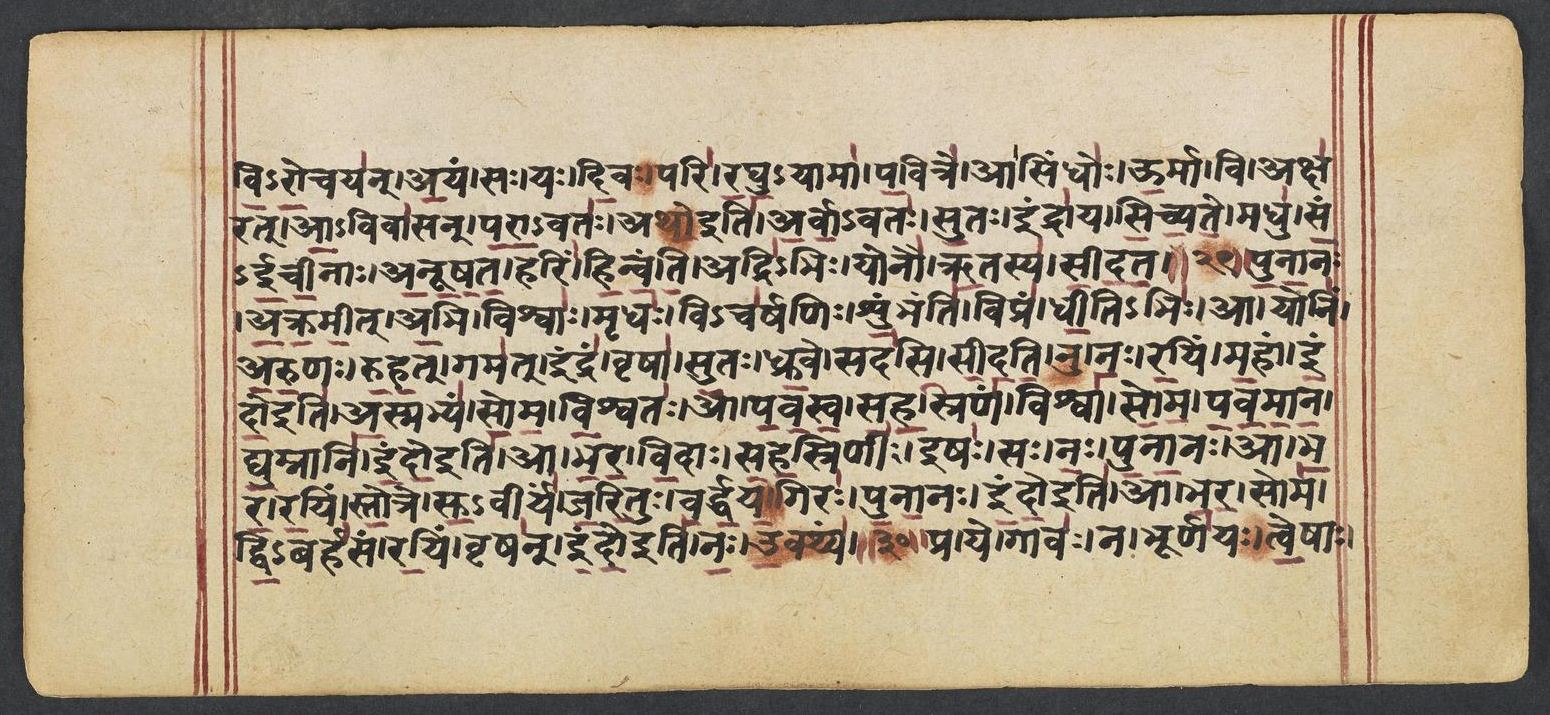
The manuscript shown is Penn Ms. Coll. 390 Item 41 (University of Pennsylvania), an undated paper manuscript of the padapāṭha (the word-by-word recitation text, in which every word is written separately and compounds are split) of the whole Ṛgveda in Devanāgarī, 884 leaves in fascicles, 7-9 lines to the page, accents in red; this hymn stands on fol. 682r. Each section below gives the verses that end on one page; the page boundaries were read on the images (the opening words of every page), not counted out. Where the manuscript is a padapāṭha (the word-by-word recitation text), the section shows Aufrecht's continuous (saṃhitā) text first and, as the edition text, the padapāṭha of the same verses, which is the form written on the page.
How was this verified? (Provenance)
Where on the image
Penn Ms. Coll. 390 Item 41, fol. 682r (numbered 104r by the scribe) (OPenn image 682, lower leaf). Checked on the image: the Rigveda text on this page begins in RV 9.39.3 ‹vi-rocayan›. The next page with Rigveda text, fol. 682v (numbered 104v by the scribe), begins in RV 9.41.1 ‹ayāsaḥ akramuḥ ghnantaḥ kṛṣṇām›. Verses 9.40.1-6 end on this page.
1pu̱nā̱no a̍kramīd a̱bhi viśvā̱ mṛdho̱ vica̍rṣaṇiḥ | śu̱mbhanti̱ vipra̍ṁ dhī̱tibhi̍ḥ ||
2ā yoni̍m aru̱ṇo ru̍ha̱d gama̱d indra̱ṁ vṛṣā̍ su̱taḥ | dhru̱ve sada̍si sīdati ||
3nū no̍ ra̱yim ma̱hām i̍ndo̱ 'smabhya̍ṁ soma vi̱śvata̍ḥ | ā pa̍vasva saha̱sriṇa̍m ||
4viśvā̍ soma pavamāna dyu̱mnānī̍nda̱v ā bha̍ra | vi̱dāḥ sa̍ha̱sriṇī̱r iṣa̍ḥ ||
5sa na̍ḥ punā̱na ā bha̍ra ra̱yiṁ sto̱tre su̱vīrya̍m | ja̱ri̱tur va̍rdhayā̱ gira̍ḥ ||
6pu̱nā̱na i̍nda̱v ā bha̍ra̱ soma̍ dvi̱barha̍saṁ ra̱yim | vṛṣa̍nn indo na u̱kthya̍m ||
Compare: Padapāṭha (word-by-word text written in the manuscript; Sansknet e-text via GRETIL)
1punānaḥ | akramīt | abhi | viśvāḥ | mṛdhaḥ | vi-carṣaṇiḥ | śumbhanti | vipram | dhīti-bhiḥ
2ā | yonim | aruṇaḥ | ruhat | gamat | indram | vṛṣā | sutaḥ | dhruve | sadasi | sīdati
3nu | naḥ | rayim | mahām | indo iti | asmabhyam | soma | viśvataḥ | ā | pavasva | sahasriṇam
4viśvā | soma | pavamāna | dyumnāni | indo iti | ā | bhara | vidāḥ | sahasriṇīḥ | iṣaḥ
5saḥ | naḥ | punānaḥ | ā | bhara | rayim | stotre | su-vīryam | jarituḥ | vardhaya | giraḥ
6punānaḥ | indo iti | ā | bhara | soma | dvi-barhasam | rayim | vṛṣan | indo iti | naḥ | ukthyam
1THE Very Active hath assailed, while purified, all enemies: They deck the Sage with holy songs.
2The Red hath mounted to his place; to Indra, goes the mighty juice: He settles in his firm abode.
3O Indu, Soma, send us now great opulence from every side, Pour on us treasures thousandfold.
4O Soma Pavamâna, bring, Indu, all splendours hitherward: Find for us food in boundless store.
5As thou art cleansed, bring hero strength and riches to thy worshipper, And prosper thou the singer's hymns.
6O Indu, Soma, being cleansed, bring hither riches doublypiled, Wealth, mighty Indu, meet for lauds.
Notes
- Sanskrit: Aufrecht's edition (1877) with the Vedic accents, as entered by van Nooten and Holland (GRETIL).
- English: Ralph T. H. Griffith, The Hymns of the Rigveda (1889-1892; 2nd ed. 1896-1897), from the VedaWeb digital text; OCR slips in that text were corrected against the printed 2nd edition (data/sources/rigveda/griffith_errata.json).
- Padapāṭha (edition text): Sansknet e-text via GRETIL (CC BY-NC-SA 4.0).
Cite
Sources
- Source: Penn Ms. Coll. 390 Item 41 (undated (catalogued with Penn's 18th-19th c. Vedic manuscripts)), OPenn, Public Domain Mark + Aufrecht's accented text (GRETIL) + Griffith's English (VedaWeb) (holding institution)
- Critical edition: Aufrecht (1877), accented e-text via GRETIL
← previous · → next · v cycle view · l back to library