Rigveda 9.41: To Soma
Introduction
Rigveda 9.41 is a hymn of 6 verses addressed to Soma. It stands in book (maṇḍala) 9, the hymns to Soma Pavamāna. The Rigveda is the oldest collection of Sanskrit hymns, composed in the second half of the second millennium BCE and handed down orally for many centuries before it was written down.
The manuscript shown is Penn Ms. Coll. 390 Item 41 (University of Pennsylvania), an undated paper manuscript of the padapāṭha (the word-by-word recitation text, in which every word is written separately and compounds are split) of the whole Ṛgveda in Devanāgarī, 884 leaves in fascicles, 7-9 lines to the page, accents in red; this hymn stands on fol. 682r-682v. Each section below gives the verses that end on one page; the page boundaries were read on the images (the opening words of every page), not counted out. Where the manuscript is a padapāṭha (the word-by-word recitation text), the section shows Aufrecht's continuous (saṃhitā) text first and, as the edition text, the padapāṭha of the same verses, which is the form written on the page.
How was this verified? (Provenance)
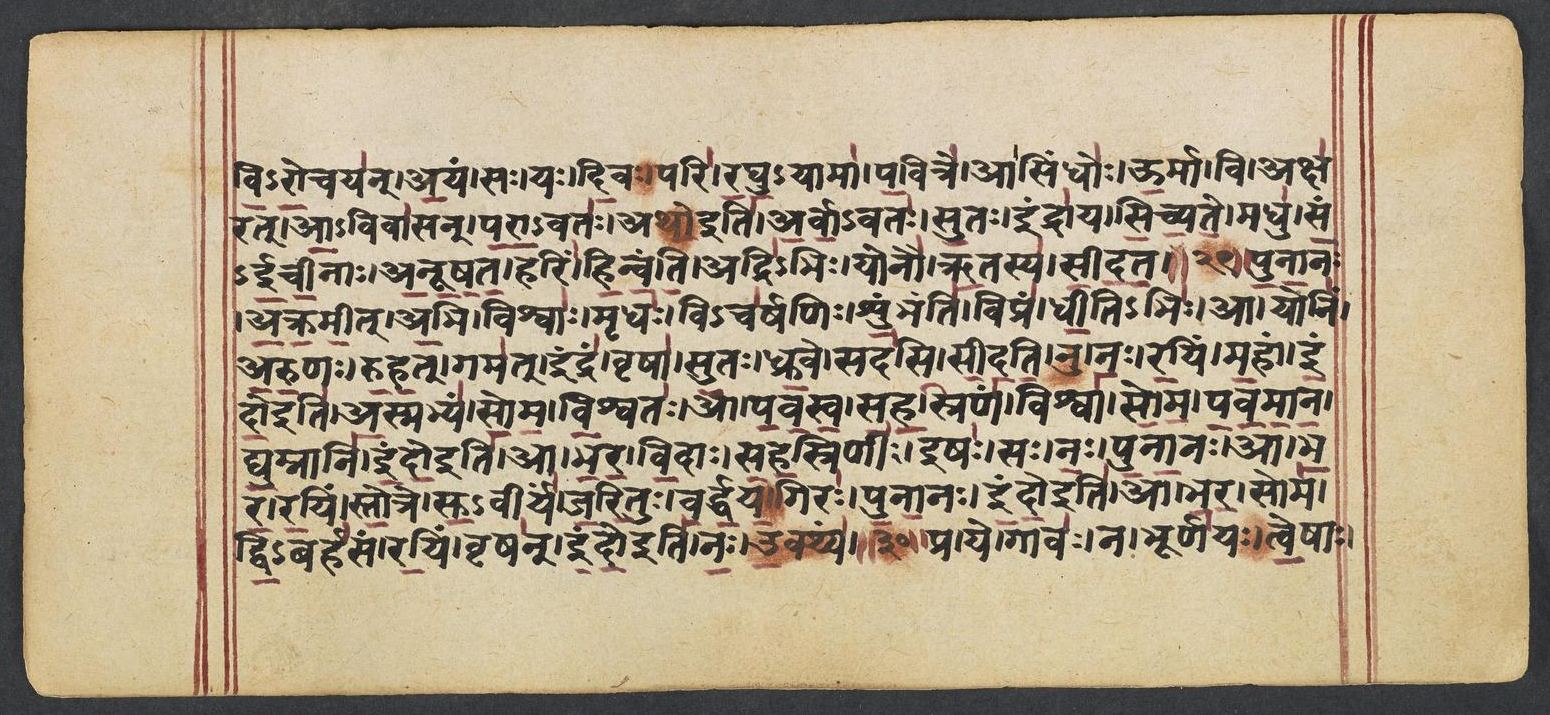
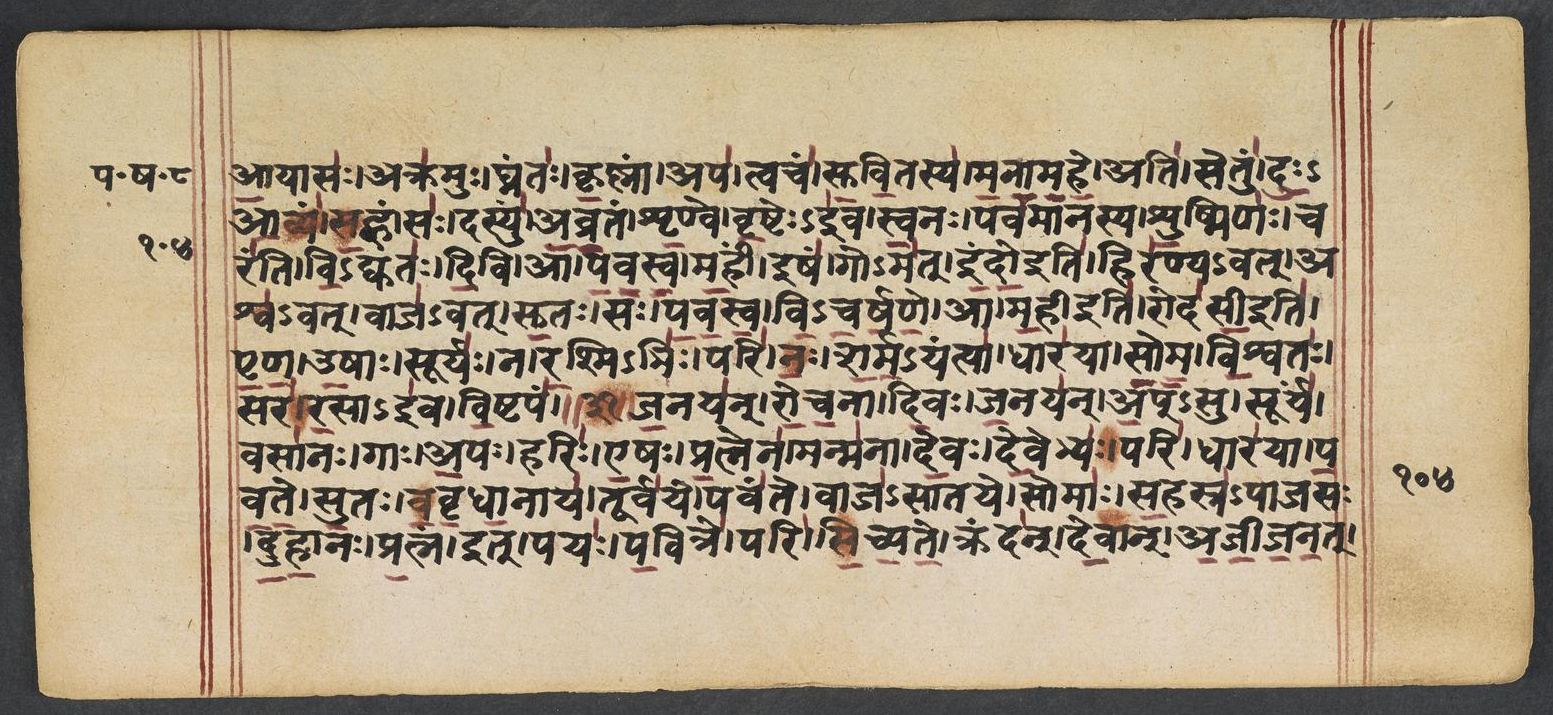
Where on the image
Penn Ms. Coll. 390 Item 41, fol. 682v (numbered 104v by the scribe) (OPenn image 683, upper leaf). Checked on the image: the Rigveda text on this page begins in RV 9.41.1 ‹ayāsaḥ akramuḥ ghnantaḥ kṛṣṇām›. The next page with Rigveda text, fol. 683r (numbered 105r by the scribe), begins in RV 9.42.5 ‹abhi viśvāni vāryā abhi›. Verses 9.41.1-6 end on this page; 9.41.1 begins on fol. 682r (numbered 104r by the scribe).
1pra ye gāvo̱ na bhūrṇa̍yas tve̱ṣā a̱yāso̱ akra̍muḥ | ghnanta̍ḥ kṛ̱ṣṇām apa̱ tvaca̍m ||
2su̱vi̱tasya̍ manāma̱he 'ti̱ setu̍ṁ durā̱vya̍m | sā̱hvāṁso̱ dasyu̍m avra̱tam ||
3śṛ̱ṇve vṛ̱ṣṭer i̍va sva̱naḥ pava̍mānasya śu̱ṣmiṇa̍ḥ | cara̍nti vi̱dyuto̍ di̱vi ||
4ā pa̍vasva ma̱hīm iṣa̱ṁ goma̍d indo̱ hira̍ṇyavat | aśvā̍va̱d vāja̍vat su̱taḥ ||
5sa pa̍vasva vicarṣaṇa̱ ā ma̱hī roda̍sī pṛṇa | u̱ṣāḥ sūryo̱ na ra̱śmibhi̍ḥ ||
6pari̍ ṇaḥ śarma̱yantyā̱ dhāra̍yā soma vi̱śvata̍ḥ | sarā̍ ra̱seva̍ vi̱ṣṭapa̍m ||
Compare: Padapāṭha (word-by-word text written in the manuscript; Sansknet e-text via GRETIL)
1pra | ye | gāvaḥ | na | bhūrṇayaḥ | tveṣāḥ | ayāsaḥ | akramuḥ | ghnantaḥ | kṛṣṇām | apa | tvacam
2suvitasya | manāmahe | ati | setum | duḥ-āvyam | sāhvāṃsaḥ | dasyum | avratam
3śṛṇve | vṛṣṭeḥ-iva | svanaḥ | pavamānasya | śuṣmiṇaḥ | caranti | vi-dyutaḥ | divi
4ā | pavasva | mahīm | iṣam | go-mat | indo iti | hiraṇya-vat | aśva-vat | vāja-vat | sutaḥ
5saḥ | pavasva | vi-carṣaṇe | ā | māhī iti | rodasī iti | pṛṇa | uṣāḥ | sūryaḥ | na | raśmi-bhiḥ
6pari | naḥ | śarma-yantyā | dhārayā | soma | viśvataḥ | sara | rasā-iva | viṣṭapam
1ACTIVE and bright have they come forth, impetuous in speed like bulls, Driving the black skin far away.
2Quelling the riteless Dasyu, may we think upon the bridge of bliss, Leaving the bridge of woe behind.
3The mighty Pavamâna's roar is heard as 'twere the rush of rain Lightnings are flashing to the sky.
4Pour out on us abundant food, when thou art pressed, O Indu wealth In kine and gold and steeds and spoil.
5Flow on thy way, Most Active, thou. fill full the mighty heavens and earth, As Dawn, as Sûrya with his beams.
6On every side, O Soma, flow round us with thy protecting stream, As Rasâ flows around the world.
Notes
- Sanskrit: Aufrecht's edition (1877) with the Vedic accents, as entered by van Nooten and Holland (GRETIL).
- English: Ralph T. H. Griffith, The Hymns of the Rigveda (1889-1892; 2nd ed. 1896-1897), from the VedaWeb digital text; OCR slips in that text were corrected against the printed 2nd edition (data/sources/rigveda/griffith_errata.json).
- Padapāṭha (edition text): Sansknet e-text via GRETIL (CC BY-NC-SA 4.0).
Cite
Sources
- Source: Penn Ms. Coll. 390 Item 41 (undated (catalogued with Penn's 18th-19th c. Vedic manuscripts)), OPenn, Public Domain Mark + Aufrecht's accented text (GRETIL) + Griffith's English (VedaWeb) (holding institution)
- Critical edition: Aufrecht (1877), accented e-text via GRETIL
← previous · → next · v cycle view · l back to library