Rigveda 9.58: To Soma
Introduction
Rigveda 9.58 is a hymn of 4 verses addressed to Soma. It stands in book (maṇḍala) 9, the hymns to Soma Pavamāna. The Rigveda is the oldest collection of Sanskrit hymns, composed in the second half of the second millennium BCE and handed down orally for many centuries before it was written down.
The manuscript shown is Penn Ms. Coll. 390 Item 41 (University of Pennsylvania), an undated paper manuscript of the padapāṭha (the word-by-word recitation text, in which every word is written separately and compounds are split) of the whole Ṛgveda in Devanāgarī, 884 leaves in fascicles, 7-9 lines to the page, accents in red; this hymn stands on fol. 688r. Each section below gives the verses that end on one page; the page boundaries were read on the images (the opening words of every page), not counted out. Where the manuscript is a padapāṭha (the word-by-word recitation text), the section shows Aufrecht's continuous (saṃhitā) text first and, as the edition text, the padapāṭha of the same verses, which is the form written on the page.
How was this verified? (Provenance)
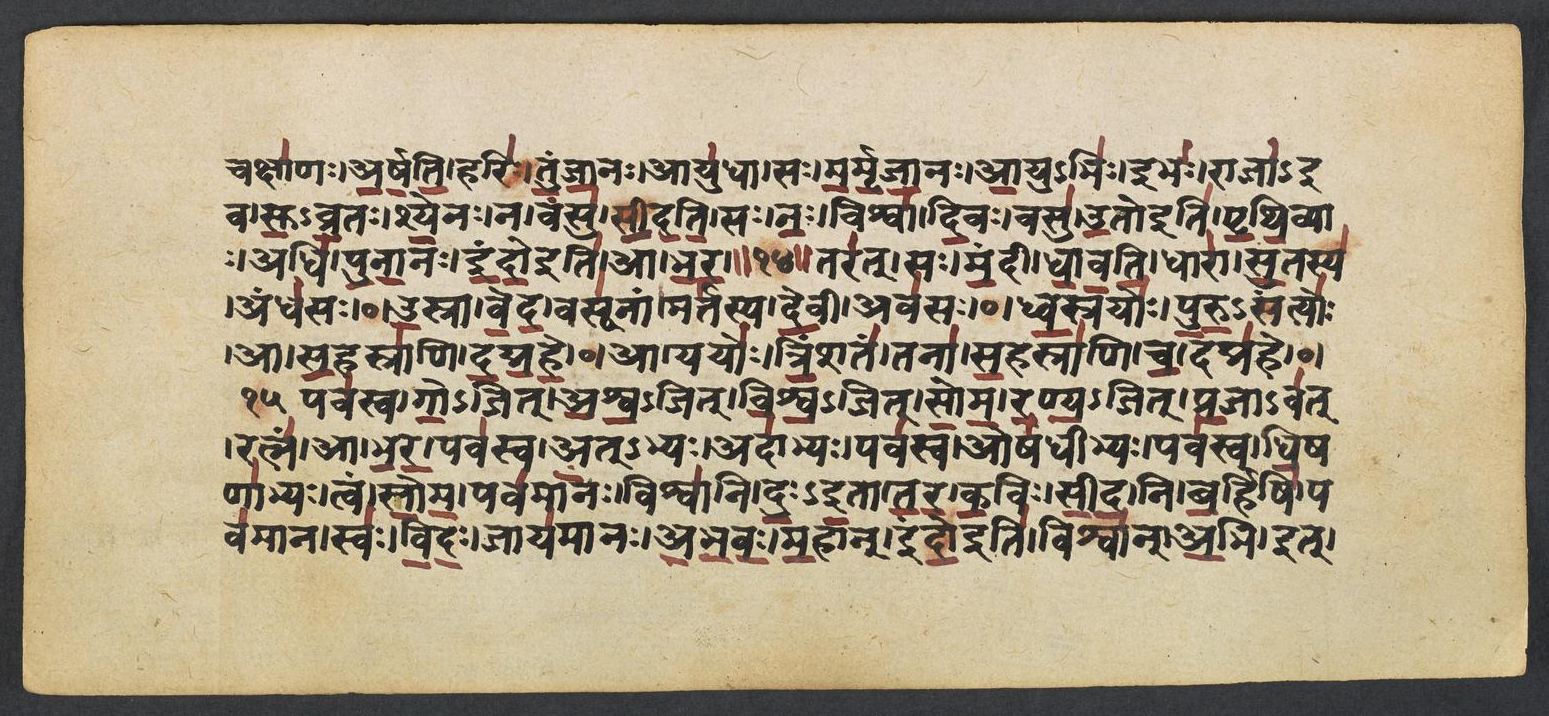
Where on the image
Penn Ms. Coll. 390 Item 41, fol. 688r (numbered 5r by the scribe) (OPenn image 688, lower leaf). Checked on the image: the Rigveda text on this page begins in RV 9.57.2 ‹cakṣāṇaḥ arṣati hariḥ tuñjānaḥ›. The next page with Rigveda text, fol. 688v (numbered 5v by the scribe), begins in RV 9.59.4 ‹asi›. Verses 9.58.1-4 end on this page.
1tara̱t sa ma̱ndī dhā̍vati̱ dhārā̍ su̱tasyāndha̍saḥ | tara̱t sa ma̱ndī dhā̍vati ||
2u̱srā ve̍da̱ vasū̍nā̱m marta̍sya de̱vy ava̍saḥ | tara̱t sa ma̱ndī dhā̍vati ||
3dhva̱srayo̍ḥ puru̱ṣantyo̱r ā sa̱hasrā̍ṇi dadmahe | tara̱t sa ma̱ndī dhā̍vati ||
4ā yayo̍s tri̱ṁśata̱ṁ tanā̍ sa̱hasrā̍ṇi ca̱ dadma̍he | tara̱t sa ma̱ndī dhā̍vati ||
Compare: Padapāṭha (word-by-word text written in the manuscript; Sansknet e-text via GRETIL)
1tarat | saḥ | mandī | dhāvati | dhārā | sutasya | andhasaḥ | tarat | saḥ | mandī | dhāvati
2usrā | veda | vasūnām | martasya | devī | avasaḥ | tarat | saḥ | mandī | dhāvati
3dhvasrayoḥ | puru-santyoḥ | ā | sahasrāṇi | dadmahe | tarat | saḥ | mandī | dhāvati
4ā | yayoḥ | triṃśatam | tanā | sahasrāṇi | ca | dadmahe | tarat | saḥ | mandī | dhāvati
1SWIFT runs this giver of delight, even the stream of flowing juice: Swift runs this giver of delight.
2The Morning knows all precious things, the Goddess knows her grace to man: Swift runs this giver of delight.
3We have accepted thousands from Dhvasra's and Purushanti's hands: Swift runs this giver of delight.
4From whom we have accepted thus thousands and three times ten beside: Swift runs this giver of delight.
Notes
- Sanskrit: Aufrecht's edition (1877) with the Vedic accents, as entered by van Nooten and Holland (GRETIL).
- English: Ralph T. H. Griffith, The Hymns of the Rigveda (1889-1892; 2nd ed. 1896-1897), from the VedaWeb digital text; OCR slips in that text were corrected against the printed 2nd edition (data/sources/rigveda/griffith_errata.json).
- Padapāṭha (edition text): Sansknet e-text via GRETIL (CC BY-NC-SA 4.0).
Cite
Sources
- Source: Penn Ms. Coll. 390 Item 41 (undated (catalogued with Penn's 18th-19th c. Vedic manuscripts)), OPenn, Public Domain Mark + Aufrecht's accented text (GRETIL) + Griffith's English (VedaWeb) (holding institution)
- Critical edition: Aufrecht (1877), accented e-text via GRETIL
← previous · → next · v cycle view · l back to library