Rigveda 9.60: To Soma
Introduction
Rigveda 9.60 is a hymn of 4 verses addressed to Soma. It stands in book (maṇḍala) 9, the hymns to Soma Pavamāna. The Rigveda is the oldest collection of Sanskrit hymns, composed in the second half of the second millennium BCE and handed down orally for many centuries before it was written down.
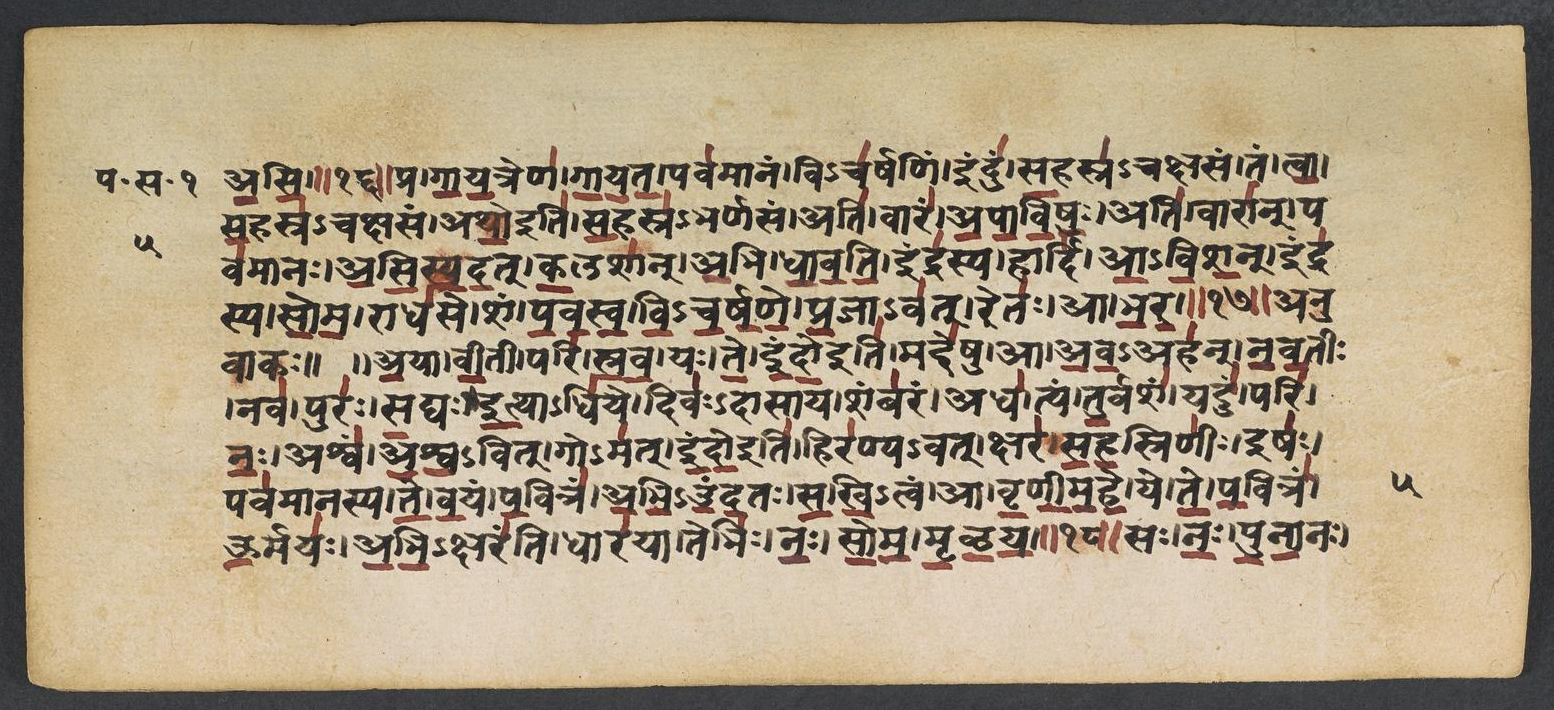
The manuscript shown is Penn Ms. Coll. 390 Item 41 (University of Pennsylvania), an undated paper manuscript of the padapāṭha (the word-by-word recitation text, in which every word is written separately and compounds are split) of the whole Ṛgveda in Devanāgarī, 884 leaves in fascicles, 7-9 lines to the page, accents in red; this hymn stands on fol. 688v. Each section below gives the verses that end on one page; the page boundaries were read on the images (the opening words of every page), not counted out. Where the manuscript is a padapāṭha (the word-by-word recitation text), the section shows Aufrecht's continuous (saṃhitā) text first and, as the edition text, the padapāṭha of the same verses, which is the form written on the page.
How was this verified? (Provenance)
Where on the image
Penn Ms. Coll. 390 Item 41, fol. 688v (numbered 5v by the scribe) (OPenn image 689, upper leaf). Checked on the image: the Rigveda text on this page begins in RV 9.59.4 ‹asi›. The next page with Rigveda text, fol. 689r (numbered 6r by the scribe), begins in RV 9.61.6 ‹ā bhara rayim vīra-vatīm›. Verses 9.60.1-4 end on this page.
1pra gā̍ya̱treṇa̍ gāyata̱ pava̍māna̱ṁ vica̍rṣaṇim | indu̍ṁ sa̱hasra̍cakṣasam ||
2taṁ tvā̍ sa̱hasra̍cakṣasa̱m atho̍ sa̱hasra̍bharṇasam | ati̱ vāra̍m apāviṣuḥ ||
3ati̱ vārā̱n pava̍māno asiṣyadat ka̱laśā̍m̐ a̱bhi dhā̍vati | indra̍sya̱ hārdy ā̍vi̱śan ||
4indra̍sya soma̱ rādha̍se̱ śam pa̍vasva vicarṣaṇe | pra̱jāva̱d reta̱ ā bha̍ra ||
Compare: Padapāṭha (word-by-word text written in the manuscript; Sansknet e-text via GRETIL)
1pra | gāyatreṇa | gāyata | pavamānam | vi-carṣaṇim | indum | sahasra-cakṣasam
2tvam | tvā | sahasra-cakṣasam | atho iti | sahasra-bharṇasam | ati | vāram | apāviṣuḥ
3ati | vārān | pavamānaḥ | asisyadat | kalaśān | abhi | dhāvati | indrasya | hārdi | ā-viśan
4indrasya | soma | rādhase | śam | pavasva | vi-carṣaṇe | prajāvat | retaḥ | ā | bhara
1SING forth and laud with sacred song most active Pavamâna, laud Indu who sees with thousand eyes.
2Thee who hast thousand eyes to see, bearer of thousand burthens, they Have filtered through the fleecy cloth.
3He, Pavamâna, hath streamed through the fleece then: he runs into the jars, Finding his way to Indra's heart.
4That Indra may be bounteous, flow, most active Soma, for our weal: Bring genial seed with progeny.
Notes
- Sanskrit: Aufrecht's edition (1877) with the Vedic accents, as entered by van Nooten and Holland (GRETIL).
- English: Ralph T. H. Griffith, The Hymns of the Rigveda (1889-1892; 2nd ed. 1896-1897), from the VedaWeb digital text; OCR slips in that text were corrected against the printed 2nd edition (data/sources/rigveda/griffith_errata.json).
- Padapāṭha (edition text): Sansknet e-text via GRETIL (CC BY-NC-SA 4.0).
Cite
Sources
- Source: Penn Ms. Coll. 390 Item 41 (undated (catalogued with Penn's 18th-19th c. Vedic manuscripts)), OPenn, Public Domain Mark + Aufrecht's accented text (GRETIL) + Griffith's English (VedaWeb) (holding institution)
- Critical edition: Aufrecht (1877), accented e-text via GRETIL
← previous · → next · v cycle view · l back to library