Rigveda 9.76: To Soma
Introduction
Rigveda 9.76 is a hymn of 5 verses addressed to Soma. It stands in book (maṇḍala) 9, the hymns to Soma Pavamāna. The Rigveda is the oldest collection of Sanskrit hymns, composed in the second half of the second millennium BCE and handed down orally for many centuries before it was written down.
The manuscript shown is Penn Ms. Coll. 390 Item 41 (University of Pennsylvania), an undated paper manuscript of the padapāṭha (the word-by-word recitation text, in which every word is written separately and compounds are split) of the whole Ṛgveda in Devanāgarī, 884 leaves in fascicles, 7-9 lines to the page, accents in red; this hymn stands on fol. 707r-707v. Each section below gives the verses that end on one page; the page boundaries were read on the images (the opening words of every page), not counted out. Where the manuscript is a padapāṭha (the word-by-word recitation text), the section shows Aufrecht's continuous (saṃhitā) text first and, as the edition text, the padapāṭha of the same verses, which is the form written on the page.
How was this verified? (Provenance)
Where on the image
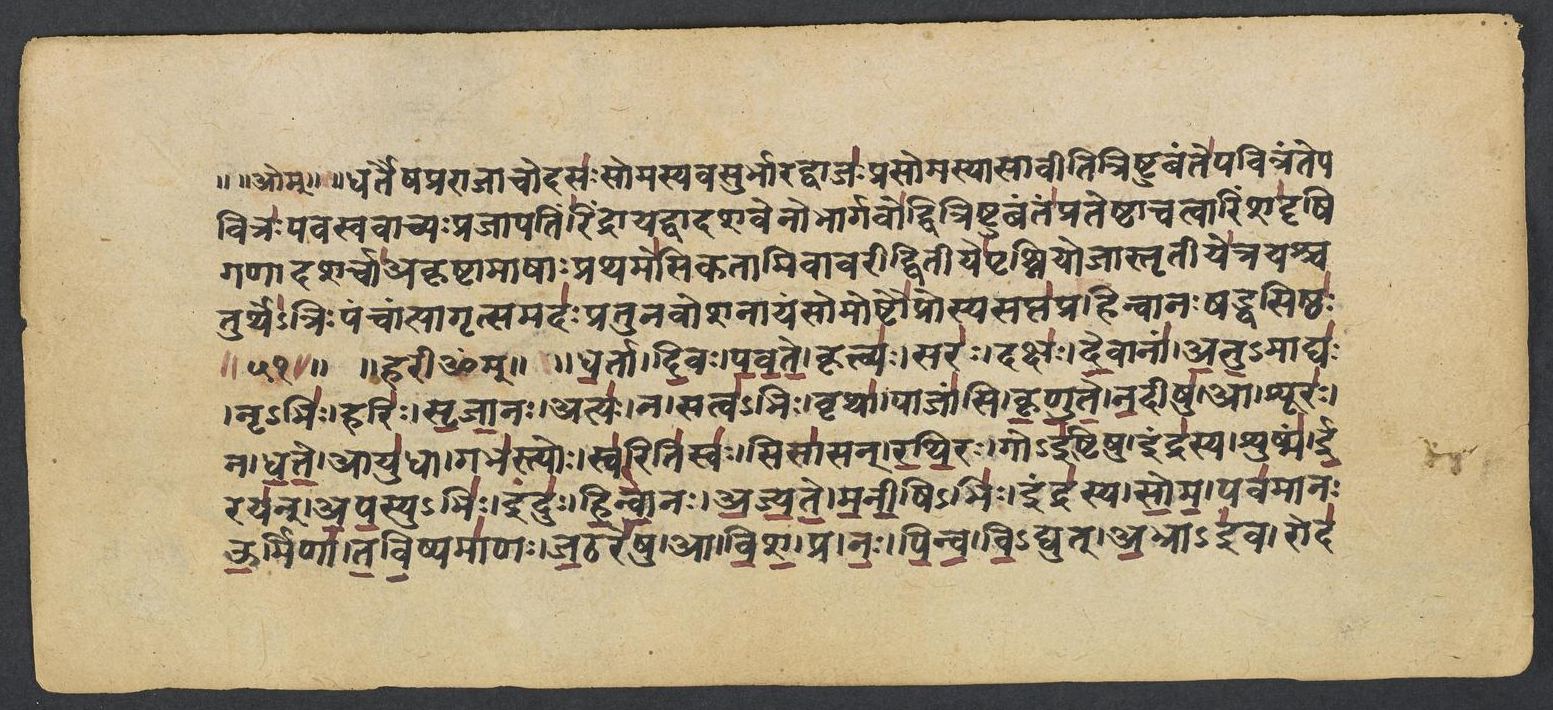
Penn Ms. Coll. 390 Item 41, fol. 707r (numbered 24r by the scribe) (OPenn image 707, lower leaf). Checked on the image: the Rigveda text on this page begins in RV 9.76.1 ‹dhartā divaḥ pavate kṛtvyaḥ›. Lines 1-5 carry oṃ and the anukramaṇī for aṣṭaka 7, adhyāya 3; 9.76.1 (dhartā divaḥ pavate) begins in line 5 after hariḥ oṃ. The next page with Rigveda text, fol. 707v (numbered 24v by the scribe), begins in RV 9.76.3 ‹-rodasī iti dhiyā na›. Verses 9.76.1-2 end on this page.
1dha̱rtā di̱vaḥ pa̍vate̱ kṛtvyo̱ raso̱ dakṣo̍ de̱vānā̍m anu̱mādyo̱ nṛbhi̍ḥ | hari̍ḥ sṛjā̱no atyo̱ na satva̍bhi̱r vṛthā̱ pājā̍ṁsi kṛṇute na̱dīṣv ā ||
2śūro̱ na dha̍tta̱ āyu̍dhā̱ gabha̍styo̱ḥ sva1̱̍ḥ siṣā̍san rathi̱ro gavi̍ṣṭiṣu | indra̍sya̱ śuṣma̍m ī̱raya̍nn apa̱syubhi̱r indu̍r hinvā̱no a̍jyate manī̱ṣibhi̍ḥ ||
Compare: Padapāṭha (word-by-word text written in the manuscript; Sansknet e-text via GRETIL)
1dhartā | divaḥ | pavate | kṛtvyaḥ | rasaḥ | dakṣaḥ | devānām | anu-mādyaḥ | nṛ-bhiḥ | hariḥ | sṛjānaḥ | atyaḥ | na | satva-bhiḥ | vṛthā | pājāṃsi | kṛṇute | nadīṣu | ā
2śūraḥ | na | dhatte | āyudhā | gabhastyoḥ | svar iti svaḥ | sisāsan | rathiraḥ | go-iṣṭiṣu | indrasya | śuṣmam | īrayan | apasyu-bhiḥ | induḥ | hinvānaḥ | ajyate | manīṣi-bhiḥ
1ON flows the potent juice, sustainer of the heavens, the strength of Gods, whom men must hail with shouts of joy. The Gold-hued, started like a courser by brave men, impetuously winneth splendour in the streams.
2He takes his weapons, like a hero, in his hands, fain to win light, car-borne, in forays for the kine. Indu, while stimulating Indra's might, is urged forward and balmed by sages skilful in their task.
Where on the image
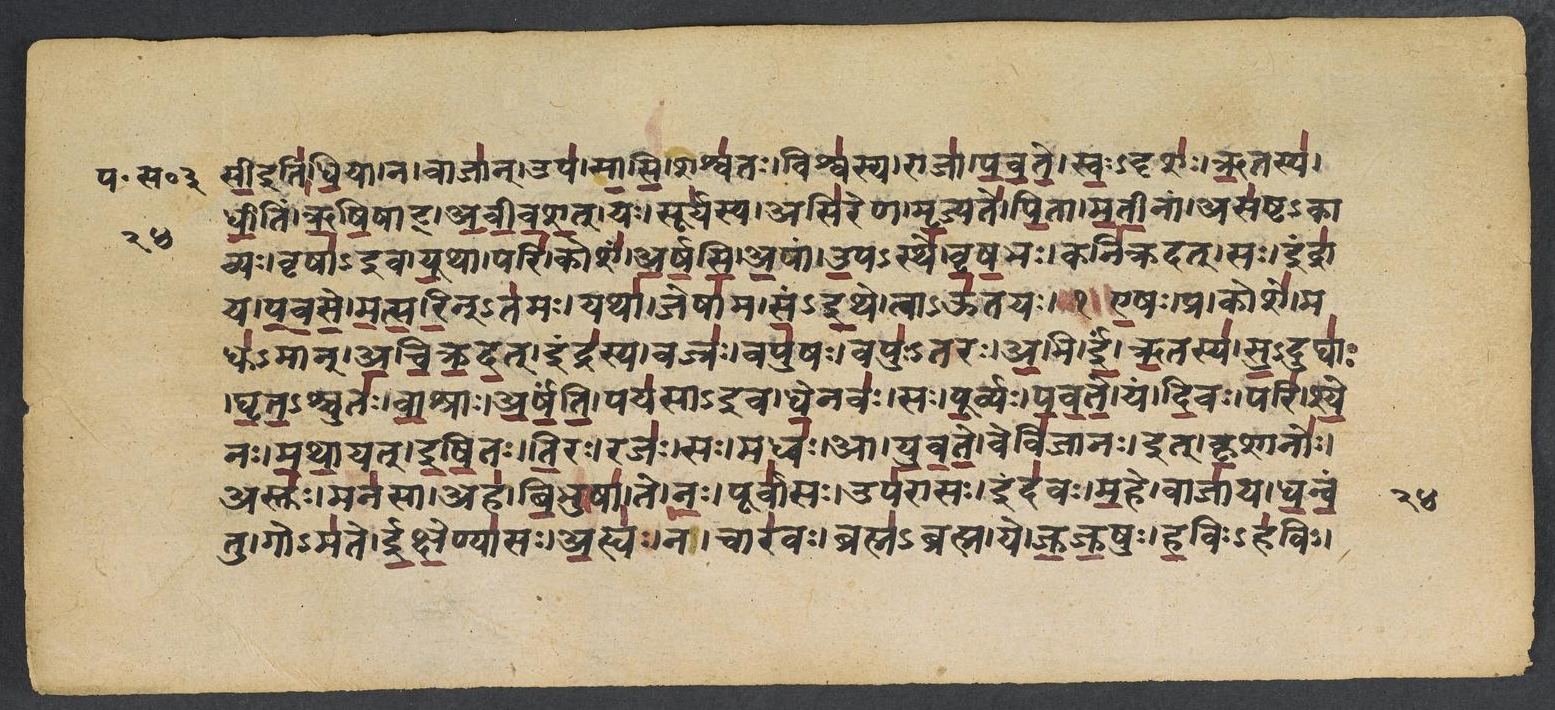
Penn Ms. Coll. 390 Item 41, fol. 707v (numbered 24v by the scribe) (OPenn image 708, upper leaf). Checked on the image: the Rigveda text on this page begins in RV 9.76.3 ‹-rodasī iti dhiyā na›. The next page with Rigveda text, fol. 708r (numbered 25r by the scribe), begins in RV 9.77.4 ‹ayam naḥ vidvān vanavat›. Verses 9.76.3-5 end on this page; 9.76.3 begins on fol. 707r (numbered 24r by the scribe).
3indra̍sya soma̱ pava̍māna ū̱rmiṇā̍ tavi̱ṣyamā̍ṇo ja̱ṭhare̱ṣv ā vi̍śa | pra ṇa̍ḥ pinva vi̱dyud a̱bhreva̱ roda̍sī dhi̱yā na vājā̱m̐ upa̍ māsi̱ śaśva̍taḥ ||
4viśva̍sya̱ rājā̍ pavate sva̱rdṛśa̍ ṛ̱tasya̍ dhī̱tim ṛ̍ṣi̱ṣāḻ a̍vīvaśat | yaḥ sūrya̱syāsi̍reṇa mṛ̱jyate̍ pi̱tā ma̍tī̱nām asa̍maṣṭakāvyaḥ ||
5vṛṣe̍va yū̱thā pari̱ kośa̍m arṣasy a̱pām u̱pasthe̍ vṛṣa̱bhaḥ kani̍kradat | sa indrā̍ya pavase matsa̱rinta̍mo̱ yathā̱ jeṣā̍ma sami̱the tvota̍yaḥ ||
Compare: Padapāṭha (word-by-word text written in the manuscript; Sansknet e-text via GRETIL)
3indrasya | soma | pavamānaḥ | ūrmiṇā | taviṣyamāṇaḥ | jaṭhareṣu | ā | viśa | pra | naḥ | pinva | vi-dyut | abhrā-iva | rodasī iti | dhiyā | na | vājān | upa | māsi | śaśvataḥ
4viśvasya | rājā | pavate | svaḥ-dṛśaḥ | ṛtasya | dhītim | ṛṣiṣāṭ | avīvaśat | yaḥ | sūryasya | asireṇa | mṛjyate | pitā | matīnām | asamaṣṭa-kāvyaḥ
5vṛṣā-iva | yūthā | pari | kośam | arṣasi | apām | upa-sthe | vṛṣabhaḥ | kanikradat | saḥ | indrāya | pavase | matsarin-tamaḥ | yathā | jeṣāma | sam-ithe | tvā-ūtayaḥ
3Soma, as thou art purified with flowing wave, exhibiting thy strength enter thou Indra's throat. Make both worlds stream for us, as lightning doth the clouds: mete out exhaustless powers for us, as 'twere through song.
4Onward he flows, the King of all that sees the light: the R̥ishis' Lord hath raised the song of sacrifice; Even he who is adorned with Sûrya's arrowy beam, Father of hymns, whose wisdom is beyond our reach.
5Like as a bull to herds, thou flowest to the pail, bellowing as a steer upon the water's lap. So, best of Cheerers, thou for Indra flowest on that we, with thy protection, may o'ercome in fight.
Notes
- Sanskrit: Aufrecht's edition (1877) with the Vedic accents, as entered by van Nooten and Holland (GRETIL).
- English: Ralph T. H. Griffith, The Hymns of the Rigveda (1889-1892; 2nd ed. 1896-1897), from the VedaWeb digital text; OCR slips in that text were corrected against the printed 2nd edition (data/sources/rigveda/griffith_errata.json).
- Padapāṭha (edition text): Sansknet e-text via GRETIL (CC BY-NC-SA 4.0).
Cite
Sources
- Source: Penn Ms. Coll. 390 Item 41 (undated (catalogued with Penn's 18th-19th c. Vedic manuscripts)), OPenn, Public Domain Mark + Aufrecht's accented text (GRETIL) + Griffith's English (VedaWeb) (holding institution)
- Critical edition: Aufrecht (1877), accented e-text via GRETIL
← previous · → next · v cycle view · l back to library