Rigveda 9.77: To Soma
Introduction
Rigveda 9.77 is a hymn of 5 verses addressed to Soma. It stands in book (maṇḍala) 9, the hymns to Soma Pavamāna. The Rigveda is the oldest collection of Sanskrit hymns, composed in the second half of the second millennium BCE and handed down orally for many centuries before it was written down.
The manuscript shown is Penn Ms. Coll. 390 Item 41 (University of Pennsylvania), an undated paper manuscript of the padapāṭha (the word-by-word recitation text, in which every word is written separately and compounds are split) of the whole Ṛgveda in Devanāgarī, 884 leaves in fascicles, 7-9 lines to the page, accents in red; this hymn stands on fol. 707v-708r. Each section below gives the verses that end on one page; the page boundaries were read on the images (the opening words of every page), not counted out. Where the manuscript is a padapāṭha (the word-by-word recitation text), the section shows Aufrecht's continuous (saṃhitā) text first and, as the edition text, the padapāṭha of the same verses, which is the form written on the page.
How was this verified? (Provenance)
Where on the image
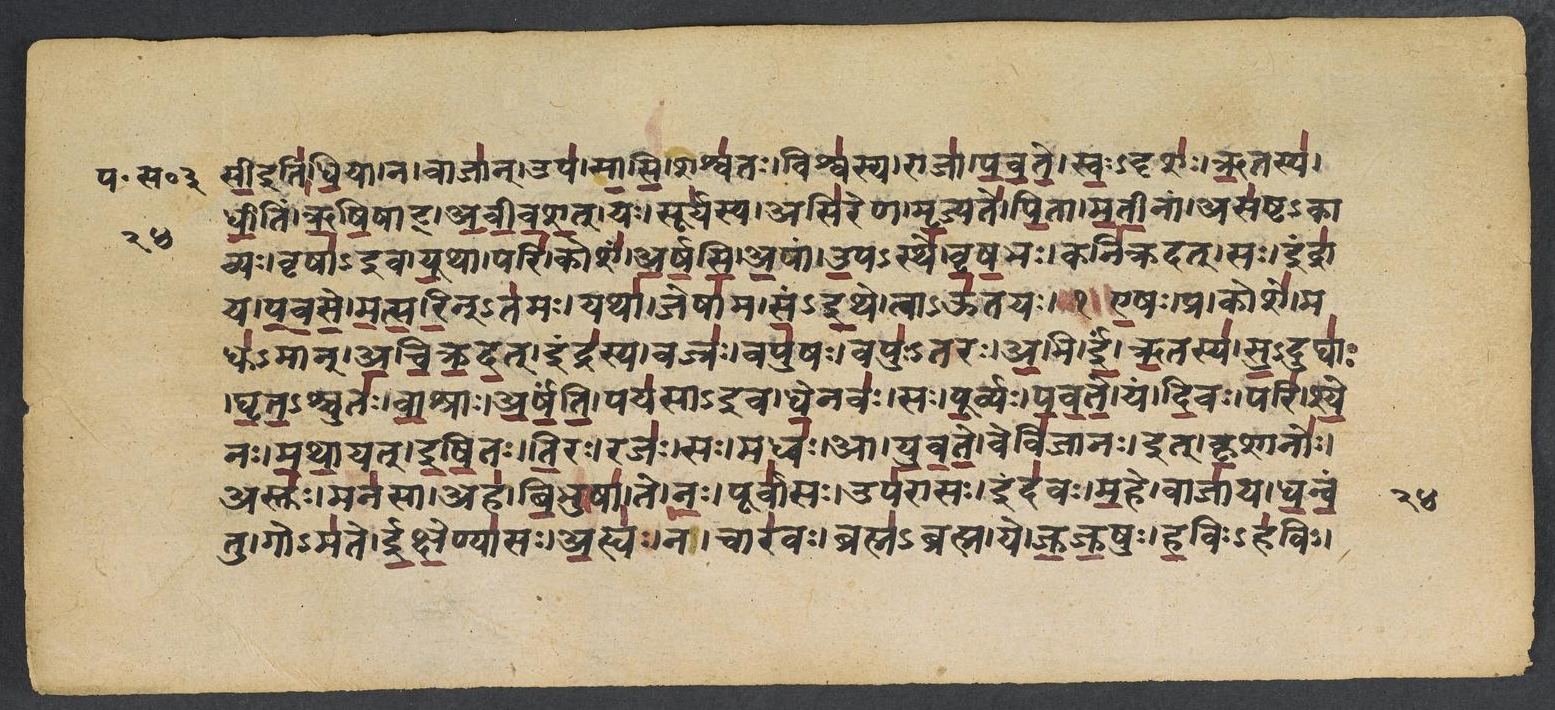
Penn Ms. Coll. 390 Item 41, fol. 707v (numbered 24v by the scribe) (OPenn image 708, upper leaf). Checked on the image: the Rigveda text on this page begins in RV 9.76.3 ‹-rodasī iti dhiyā na›. The next page with Rigveda text, fol. 708r (numbered 25r by the scribe), begins in RV 9.77.4 ‹ayam naḥ vidvān vanavat›. Verses 9.77.1-3 end on this page.
1e̱ṣa pra kośe̱ madhu̍mām̐ acikrada̱d indra̍sya̱ vajro̱ vapu̍ṣo̱ vapu̍ṣṭaraḥ | a̱bhīm ṛ̱tasya̍ su̱dughā̍ ghṛta̱ścuto̍ vā̱śrā a̍rṣanti̱ paya̍seva dhe̱nava̍ḥ ||
2sa pū̱rvyaḥ pa̍vate̱ yaṁ di̱vas pari̍ śye̱no ma̍thā̱yad i̍ṣi̱tas ti̱ro raja̍ḥ | sa madhva̱ ā yu̍vate̱ vevi̍jāna̱ it kṛ̱śāno̱r astu̱r mana̱sāha̍ bi̱bhyuṣā̍ ||
3te na̱ḥ pūrvā̍sa̱ upa̍rāsa̱ inda̍vo ma̱he vājā̍ya dhanvantu̱ goma̍te | ī̱kṣe̱ṇyā̍so a̱hyo̱3̱̍ na cāra̍vo̱ brahma̍-brahma̱ ye ju̍ju̱ṣur ha̱vir-ha̍viḥ ||
Compare: Padapāṭha (word-by-word text written in the manuscript; Sansknet e-text via GRETIL)
1eṣaḥ | pra | kośe | madhu-mān | acikradat | indrasya | vajraḥ | vapuṣaḥ | vapuḥ-taraḥ | abhi | īm | ṛtasya | su-dughāḥ | ghṛta-ścutaḥ | vāśrāḥ | arṣanti | payasā-iva | dhenavaḥ
2saḥ | pūrvyaḥ | pavate | yam | divaḥ | pari | śyenaḥ | mathāyat | iṣitaḥ | tiraḥ | rajaḥ | saḥ | madhvaḥ | ā | yuvate | vevijānaḥ | it | kṛśānoḥ | astuḥ | manasā | aha | bibhyuṣā
3te | naḥ | pūrvāsaḥ | uparāsaḥ | indavaḥ | mahe | vājāya | dhanvantu | go-mate | īkṣeṇyāsaḥ | ahyaḥ | na | cāravaḥ | brahma-brahma | ye | jujuṣuḥ | haviḥ-haviḥ
1MORE beauteous than the beautiful, as Indra's bolt, this Soma, rich in sweets, hath clamoured in the vat. Dropping with oil, abundant, streams of sacrifice flow unto him like milch-kine, lowing, with their milk.
2On flows that Ancient One whom, hitherward, from heaven, sped through the region of the air, the Falcon snatched. He, quivering with alarm and terrified in heart before bow-armed Kr̥iṣânu, holdeth fast the sweet.
3May those first freshest drops of Soma juice effused flow on, their way to bring us mighty strength in kine. Beauteous as serpents, worthy to be looked upon, they whom each sacred gift and all our prayers have pleased.
Where on the image
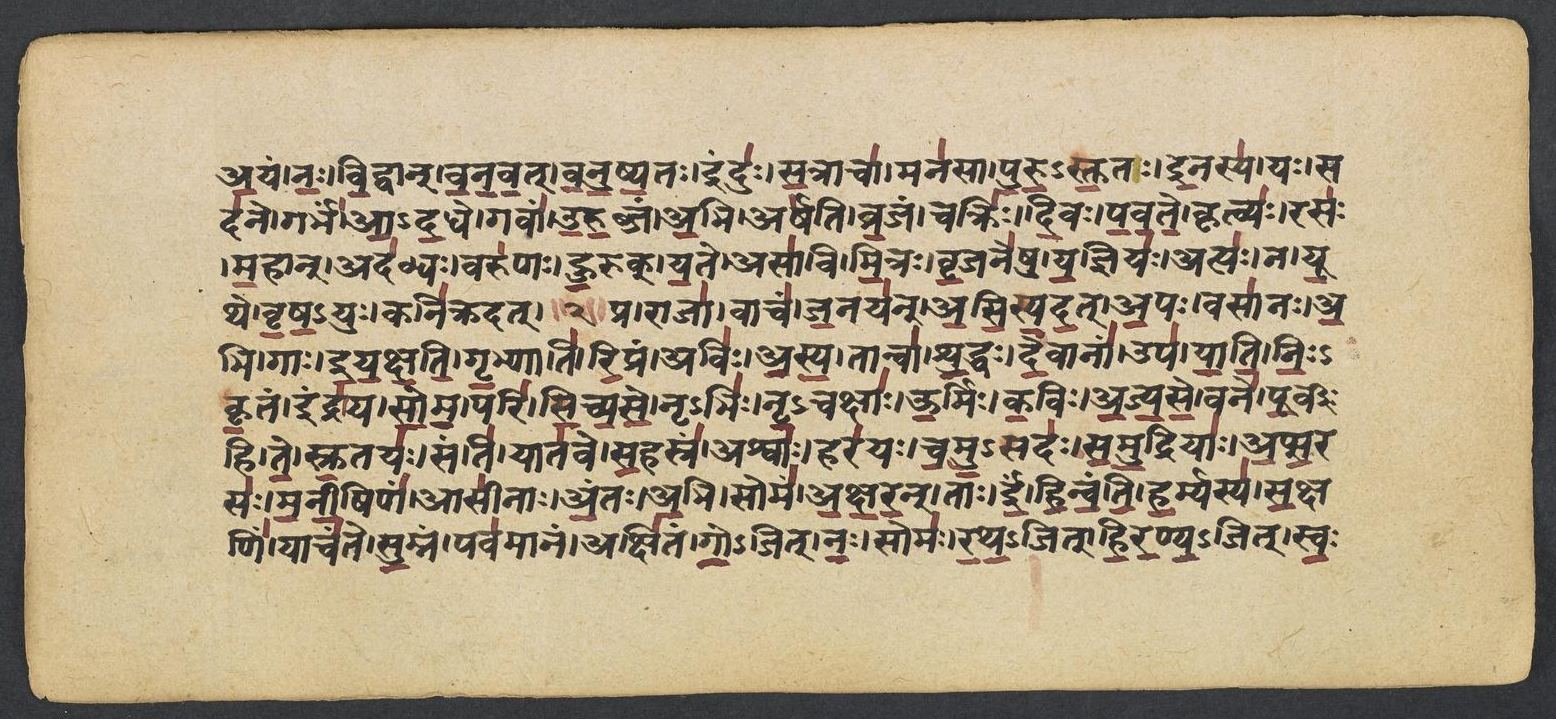
Penn Ms. Coll. 390 Item 41, fol. 708r (numbered 25r by the scribe) (OPenn image 708, lower leaf). Checked on the image: the Rigveda text on this page begins in RV 9.77.4 ‹ayam naḥ vidvān vanavat›. The next page with Rigveda text, fol. 708v (numbered 25v by the scribe), begins in RV 9.78.4 ‹-svaḥ-jit ap-jit pavate sahasra-jit›. Verses 9.77.4-5 end on this page.
4a̱yaṁ no̍ vi̱dvān va̍navad vanuṣya̱ta indu̍ḥ sa̱trācā̱ mana̍sā puruṣṭu̱taḥ | i̱nasya̱ yaḥ sada̍ne̱ garbha̍m āda̱dhe gavā̍m uru̱bjam a̱bhy arṣa̍ti vra̱jam ||
5cakri̍r di̱vaḥ pa̍vate̱ kṛtvyo̱ raso̍ ma̱hām̐ ada̍bdho̱ varu̍ṇo hu̱rug ya̱te | asā̍vi mi̱tro vṛ̱jane̍ṣu ya̱jñiyo 'tyo̱ na yū̱the vṛ̍ṣa̱yuḥ kani̍kradat ||
Compare: Padapāṭha (word-by-word text written in the manuscript; Sansknet e-text via GRETIL)
4ayam | naḥ | vidvān | vanavat | vanuṣyataḥ | induḥ | satrācā | manasā | puru-stutaḥ | inasya | yaḥ | sadane | garbham | ādadhe | gavām | urubjam | abhi | aṣarti | vrajam
5cakriḥ | divaḥ | pavate | kṛtvyaḥ | rasaḥ | mahān | adabdhaḥ | varuṇaḥ | huruk | yate | asāvi | mitraḥ | vṛjaneṣu | yajñiyaḥ | atyaḥ | na | yūthe | vṛṣa-yuḥ | kanikradat
4May that much-lauded Indu, with a heart inclined to us, well-knowing, fight against our enemies. He who hath brought the germ beside the Strong One's seat moves onward to the widely-opcned stall of kine.
5The active potent juice of heaven is flowing on, great Varuṇa whom the forward man can ne'er deceive. Mitra, the Holy, hath been pressed for troubled times, neighing like an impatient horse amid the herd,
Notes
- Sanskrit: Aufrecht's edition (1877) with the Vedic accents, as entered by van Nooten and Holland (GRETIL).
- English: Ralph T. H. Griffith, The Hymns of the Rigveda (1889-1892; 2nd ed. 1896-1897), from the VedaWeb digital text; OCR slips in that text were corrected against the printed 2nd edition (data/sources/rigveda/griffith_errata.json).
- Padapāṭha (edition text): Sansknet e-text via GRETIL (CC BY-NC-SA 4.0).
Cite
Sources
- Source: Penn Ms. Coll. 390 Item 41 (undated (catalogued with Penn's 18th-19th c. Vedic manuscripts)), OPenn, Public Domain Mark + Aufrecht's accented text (GRETIL) + Griffith's English (VedaWeb) (holding institution)
- Critical edition: Aufrecht (1877), accented e-text via GRETIL
← previous · → next · v cycle view · l back to library