Rigveda 9.84: To Soma
Introduction
Rigveda 9.84 is a hymn of 5 verses addressed to Soma. It stands in book (maṇḍala) 9, the hymns to Soma Pavamāna. The Rigveda is the oldest collection of Sanskrit hymns, composed in the second half of the second millennium BCE and handed down orally for many centuries before it was written down.
The manuscript shown is Penn Ms. Coll. 390 Item 41 (University of Pennsylvania), an undated paper manuscript of the padapāṭha (the word-by-word recitation text, in which every word is written separately and compounds are split) of the whole Ṛgveda in Devanāgarī, 884 leaves in fascicles, 7-9 lines to the page, accents in red; this hymn stands on fol. 710v-711r. Each section below gives the verses that end on one page; the page boundaries were read on the images (the opening words of every page), not counted out. Where the manuscript is a padapāṭha (the word-by-word recitation text), the section shows Aufrecht's continuous (saṃhitā) text first and, as the edition text, the padapāṭha of the same verses, which is the form written on the page.
How was this verified? (Provenance)
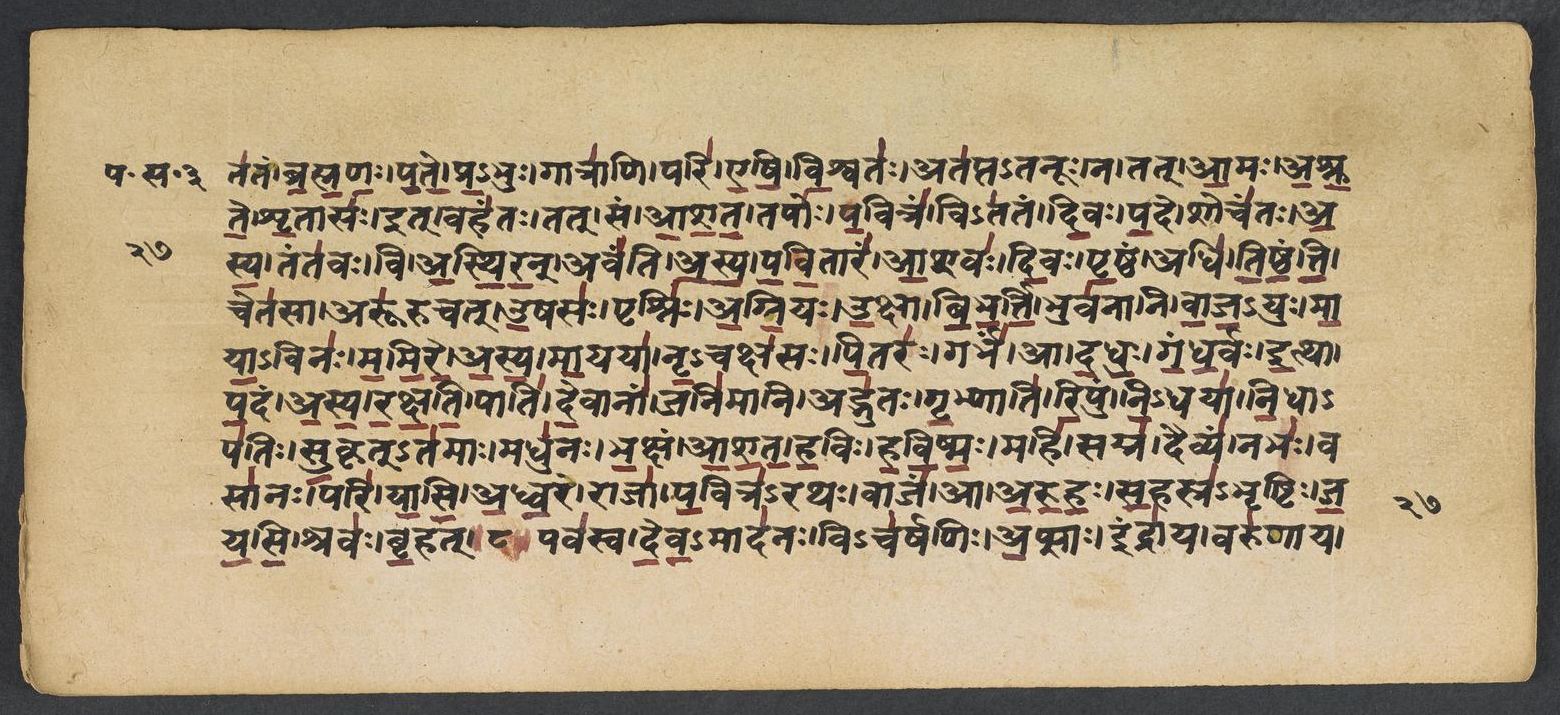
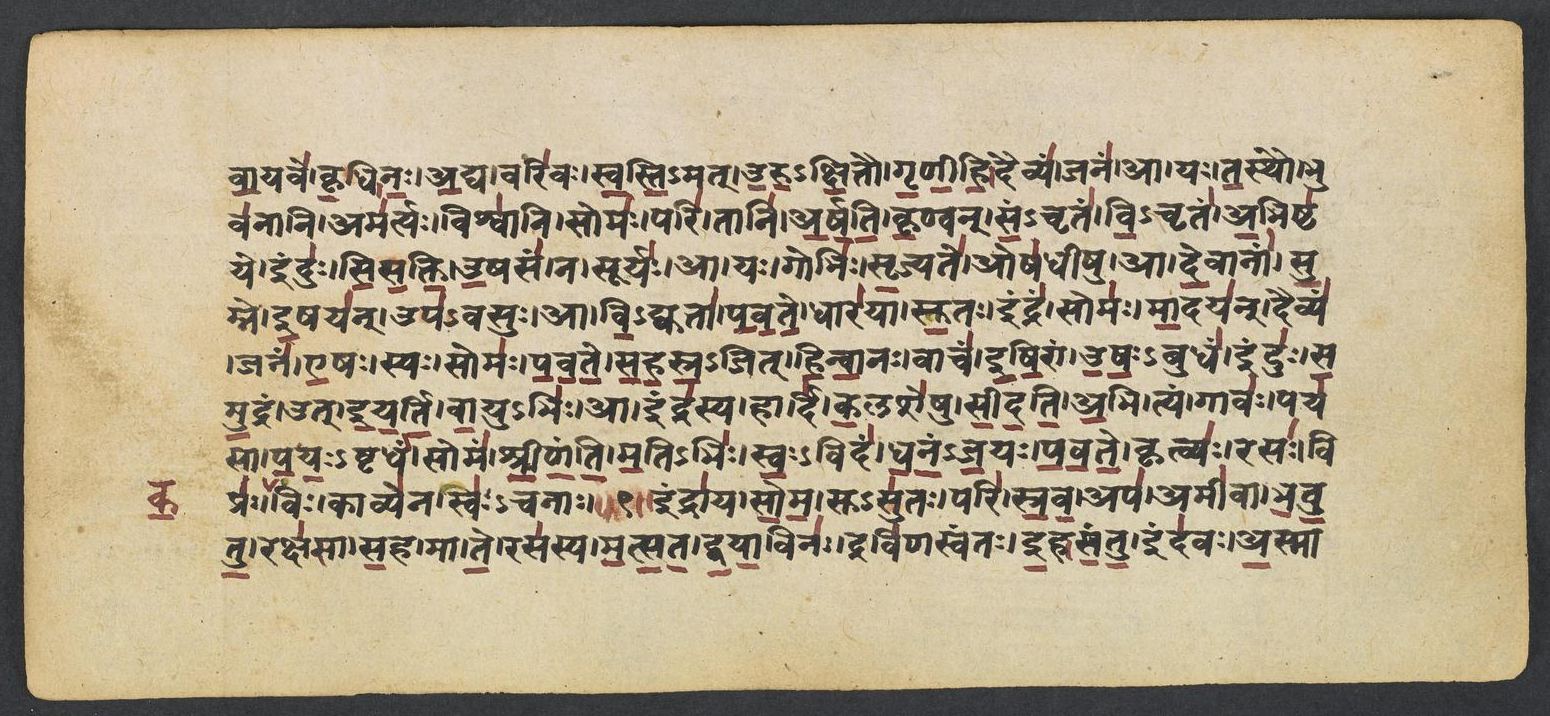
Where on the image
Penn Ms. Coll. 390 Item 41, fol. 711r (numbered 28r by the scribe) (OPenn image 711, lower leaf). Checked on the image: the Rigveda text on this page begins in RV 9.84.1 ‹vāyave kṛdhi naḥ adya›. The next page with Rigveda text, fol. 711v (numbered 28v by the scribe), begins in RV 9.85.2 ‹-asmān sa-marye pavamāna codaya›. Verses 9.84.1-5 end on this page; 9.84.1 begins on fol. 710v (numbered 27v by the scribe).
1pava̍sva deva̱māda̍no̱ vica̍rṣaṇir a̱psā indrā̍ya̱ varu̍ṇāya vā̱yave̍ | kṛ̱dhī no̍ a̱dya vari̍vaḥ svasti̱mad u̍rukṣi̱tau gṛ̍ṇīhi̱ daivya̱ṁ jana̍m ||
2ā yas ta̱sthau bhuva̍nā̱ny ama̍rtyo̱ viśvā̍ni̱ soma̱ḥ pari̱ tāny a̍rṣati | kṛ̱ṇvan sa̱ṁcṛta̍ṁ vi̱cṛta̍m a̱bhiṣṭa̍ya̱ indu̍ḥ siṣakty u̱ṣasa̱ṁ na sūrya̍ḥ ||
3ā yo gobhi̍ḥ sṛ̱jyata̱ oṣa̍dhī̱ṣv ā de̱vānā̍ṁ su̱mna i̱ṣaya̱nn upā̍vasuḥ | ā vi̱dyutā̍ pavate̱ dhāra̍yā su̱ta indra̱ṁ somo̍ mā̱daya̱n daivya̱ṁ jana̍m ||
4e̱ṣa sya soma̍ḥ pavate sahasra̱jid dhi̍nvā̱no vāca̍m iṣi̱rām u̍ṣa̱rbudha̍m | indu̍ḥ samu̱dram ud i̍yarti vā̱yubhi̱r endra̍sya̱ hārdi̍ ka̱laśe̍ṣu sīdati ||
5a̱bhi tyaṁ gāva̱ḥ paya̍sā payo̱vṛdha̱ṁ soma̍ṁ śrīṇanti ma̱tibhi̍ḥ sva̱rvida̍m | dha̱na̱ṁja̱yaḥ pa̍vate̱ kṛtvyo̱ raso̱ vipra̍ḥ ka̱viḥ kāvye̍nā̱ sva̍rcanāḥ ||
Compare: Padapāṭha (word-by-word text written in the manuscript; Sansknet e-text via GRETIL)
1pavasva | deva-mādanaḥ | vi-carṣaṇiḥ | apsāḥ | indrāya | varuṇāya | vāyave | kṛdhi | naḥ | adya | varivaḥ | svasti-mat | uru-kṣitau | gṛṇīhi | daivyam | janam
2ā | yaḥ | tasthau | bhuvanāni | amartyaḥ | viśvāni | somaḥ | pari | tāni | arṣati | kṛṇvan | sam-cṛtam | vi-cṛtam | abhiṣṭaye | induḥ | sisakti | uṣasam | na | sūryaḥ
3ā | yaḥ | gobhiḥ | sṛjyate | oṣadhīṣu | ā | devānām | sumne | iṣayan | upa-vasuḥ | ā | vi-dyutā | pavate | dhārayā | sutaḥ | indram | somaḥ | mādayan | daivyam | janam
4eṣaḥ | syaḥ | somaḥ | pavate | sahasra-jit | hinvānaḥ | vācam | iṣirām | uṣaḥ-budham | induḥ | samudram | ut | iyarti | vāyu-bhiḥ | ā | indrasya | hārdi | kalaśeṣu | sīdati
5abhi | tyam | gāvaḥ | payasā | payaḥ-vṛdham | somam | śrīṇanti | mati-bhiḥ | svaḥ-vidam | dhanam-jayaḥ | pavate | kṛtvyaḥ | rasaḥ | vipraḥ | kaviḥ | kāvyena | svaḥ-canāḥ
1FLOW, cheering Gods, most active, winner of the flood, for Indra, and for Vâyu, and for Varuṇa. Bestow on us to-day wide room with happiness, and in thine ample dwelling laud the Host of Heaven.
2He who hath come anear to creatures that have life, Immortal Soma flows onward to all of them. Effecting, for our aid, both union and release, Indu, like Sûrya, follows closely after Dawn.
3He who is poured with milk, he who within the plants hastes bringing treasure for the happiness of Gods, He, poured forth in a stream flows with the lightning's flash, Soma who gladdens Indra and the Host of Heaven.
4Winner of thousands, he, this Soma, flows along, raising a vigorous voice that wakens with the dawn. Indu with winds drives on the ocean of the air, he sinks within the jars, he rests in Indra's heart.
5The kine with milk dress him who makes the milk increase, Soma, amid the songs, who finds the light of heaven. Winner of wealth, the effectual juice is flowing on, Singer and Sage by wisdom, dear as heaven itself.
Notes
- Sanskrit: Aufrecht's edition (1877) with the Vedic accents, as entered by van Nooten and Holland (GRETIL).
- English: Ralph T. H. Griffith, The Hymns of the Rigveda (1889-1892; 2nd ed. 1896-1897), from the VedaWeb digital text; OCR slips in that text were corrected against the printed 2nd edition (data/sources/rigveda/griffith_errata.json).
- Padapāṭha (edition text): Sansknet e-text via GRETIL (CC BY-NC-SA 4.0).
Cite
Sources
- Source: Penn Ms. Coll. 390 Item 41 (undated (catalogued with Penn's 18th-19th c. Vedic manuscripts)), OPenn, Public Domain Mark + Aufrecht's accented text (GRETIL) + Griffith's English (VedaWeb) (holding institution)
- Critical edition: Aufrecht (1877), accented e-text via GRETIL
← previous · → next · v cycle view · l back to library