Suetonius, Nero 16.2: 'punishment was inflicted on the Christians'
Introduction
In the life of Nero (emperor 54-68 AD), Suetonius lists the emperor's measures of public order: limits on spending, rules for taverns, the banishment of the pantomime actors, and "afflicti suppliciis Christiani, genus hominum superstitionis novae ac maleficae", punishment inflicted on the Christians, a class of men given to a new and mischievous superstition. Unlike Tacitus (Annals 15.44), Suetonius does not connect the punishment with the fire of Rome. With Tacitus, it is one of the two earliest Roman references to Nero's action against the Christians.
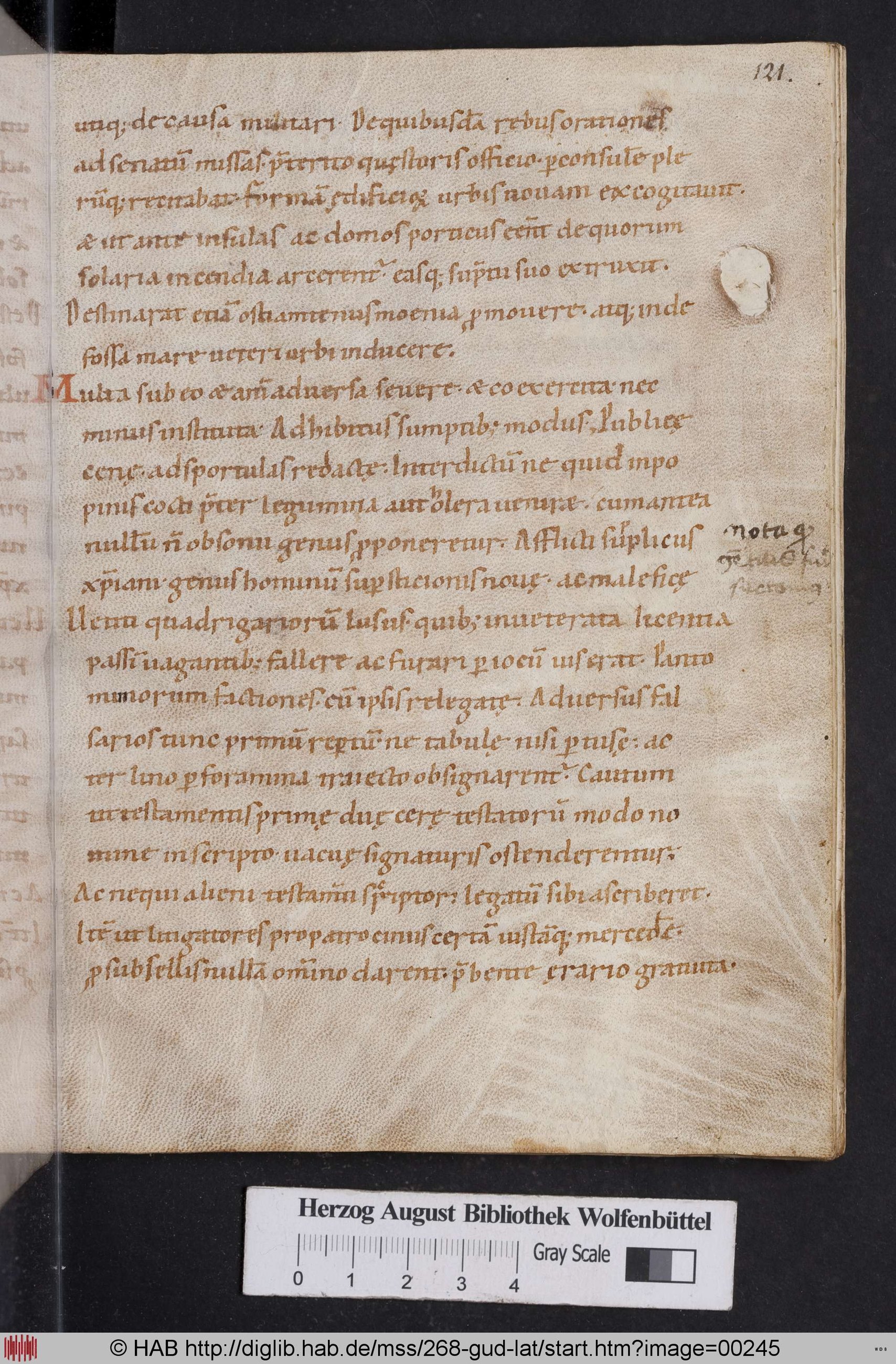
Section 16.2 fills lines 8-16 of folio 121r; the copyist wrote the name with the abbreviation "xpiani" (line 13).
The photograph is of a Suetonius manuscript of the 11th century now in Wolfenbuettel (Herzog August Bibliothek, Cod. Guelf. 268 Gud. lat.), written in Caroline minuscule, 26 lines to the page. The oldest manuscript of Suetonius, Paris, BnF lat. 6115 (the Memmianus, 9th century), is digitized on Gallica but could not be retrieved for this library; it may be added later.
How was this verified? (Provenance)
Where on the image
Checked on the image: fol. 121r line 7 ends 16.1 'fossa mare ueteri urbi inducere'; line 8 begins 16.2 with a red initial, 'Multa sub eo & animaduersa seuere · & coercita nec'; line 12 ends 'Afflicti suppliciis', line 13 'xpiani genus hominu(m) sup(er)stitionis noue · ac malefice' (xpiani is the usual abbreviation of Christiani); line 16 'mimorum factiones cu(m) ipsis relegate', followed by Nero 17 'Aduersus fal-'. A later hand wrote a note beginning 'nota q(uod)' in the right margin beside lines 12-14. Latin shown is Ihm's critical text, not a transcription of this page.
Multa sub eo et animaduersa seuere et coercita nec minus instituta: adhibitus sumptibus modus; publicae cenae ad sportulas redactae; interdictum ne quid in popinis cocti praeter legumina aut holera ueniret, cum antea nullum non obsonii genus proponeretur; afflicti suppliciis Christiani, genus hominum superstitionis nouae ac maleficae; uetiti quadrigariorum lusus, quibus inueterata licentia passim uagantibus fallere ac furari per iocum ius erat; pantomimorum factiones cum ipsis simul relegatae;
During his reign many abuses were severely punished and put down, and no fewer new laws were made: a limit was set to expenditures; the public banquets were confined to a distribution of food; the sale of any kind of cooked viands in the taverns was forbidden, with the exception of pulse and vegetables, whereas before every sort of dainty was exposed for sale. Punishment was inflicted on the Christians, a class of men given to a new and mischievous superstition. He put an end to the diversions of the chariot drivers, who from immunity of long standing claimed the right of ranging at large and amusing themselves by cheating and robbing the people. The pantomimic actors and their partisans were banished from the city.
Notes
- Latin is Maximilian Ihm's critical text (Teubner, 1908), not a transcription of the manuscript page.
- English is J. C. Rolfe's Loeb translation (1914).
Cite
Sources
- Source: Wolfenbuettel, HAB, Cod. Guelf. 268 Gud. lat., fol. 121r (Wolfenbuetteler Digitale Bibliothek) + Ihm's Latin (Perseus) + Rolfe's English (LacusCurtius) (holding institution)
- Critical edition: Fisher 1906 (Tacitus) and Ihm 1908 (Suetonius), via Perseus
← previous · → next · v cycle view · l back to library