Suetonius, Claudius 25.4: the Jews expelled from Rome 'at the instigation of Chrestus'
Introduction
Gaius Suetonius Tranquillus published his Lives of the Caesars about 121 AD. In the life of Claudius (emperor 41-54 AD), among a list of the emperor's measures concerning foreigners, he writes that Claudius expelled the Jews from Rome because they were constantly rioting "impulsore Chresto", at the instigation of Chrestus. Many historians connect this with the expulsion mentioned in Acts 18:2, where Paul meets Aquila and Priscilla in Corinth, "lately come from Italy ... because that Claudius had commanded all Jews to depart from Rome", and take "Chrestus" as a form of the name Christus. Others read it as the name of an otherwise unknown agitator. The sentence is shown here with the rest of section 25.4.
The section begins on the last three lines of folio 109v and ends on the first three lines of folio 110r; both pages are shown.
The photograph is of a Suetonius manuscript of the 11th century now in Wolfenbuettel (Herzog August Bibliothek, Cod. Guelf. 268 Gud. lat.), written in Caroline minuscule, 26 lines to the page. The oldest manuscript of Suetonius, Paris, BnF lat. 6115 (the Memmianus, 9th century), is digitized on Gallica but could not be retrieved for this library; it may be added later.
How was this verified? (Provenance)
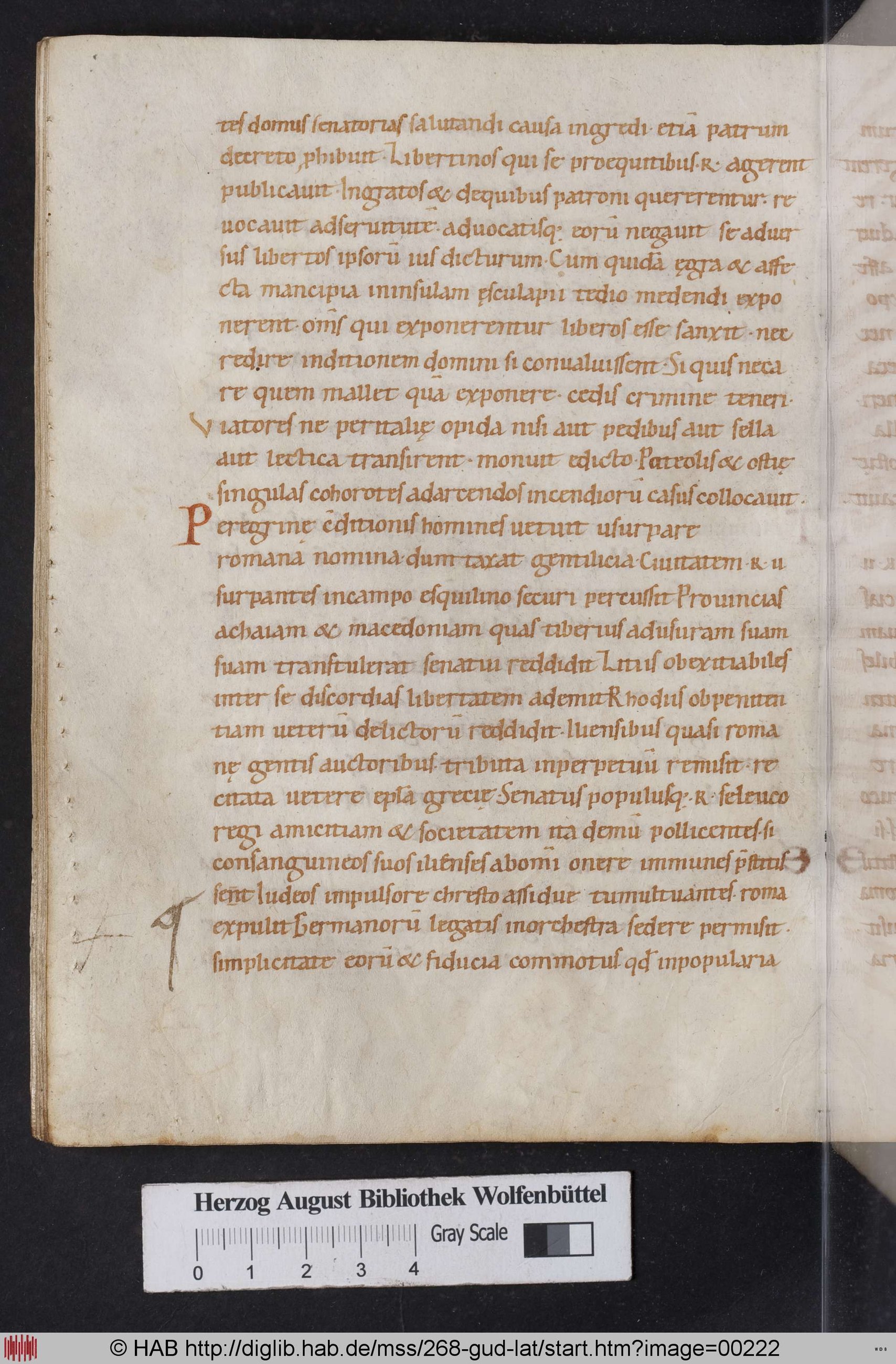
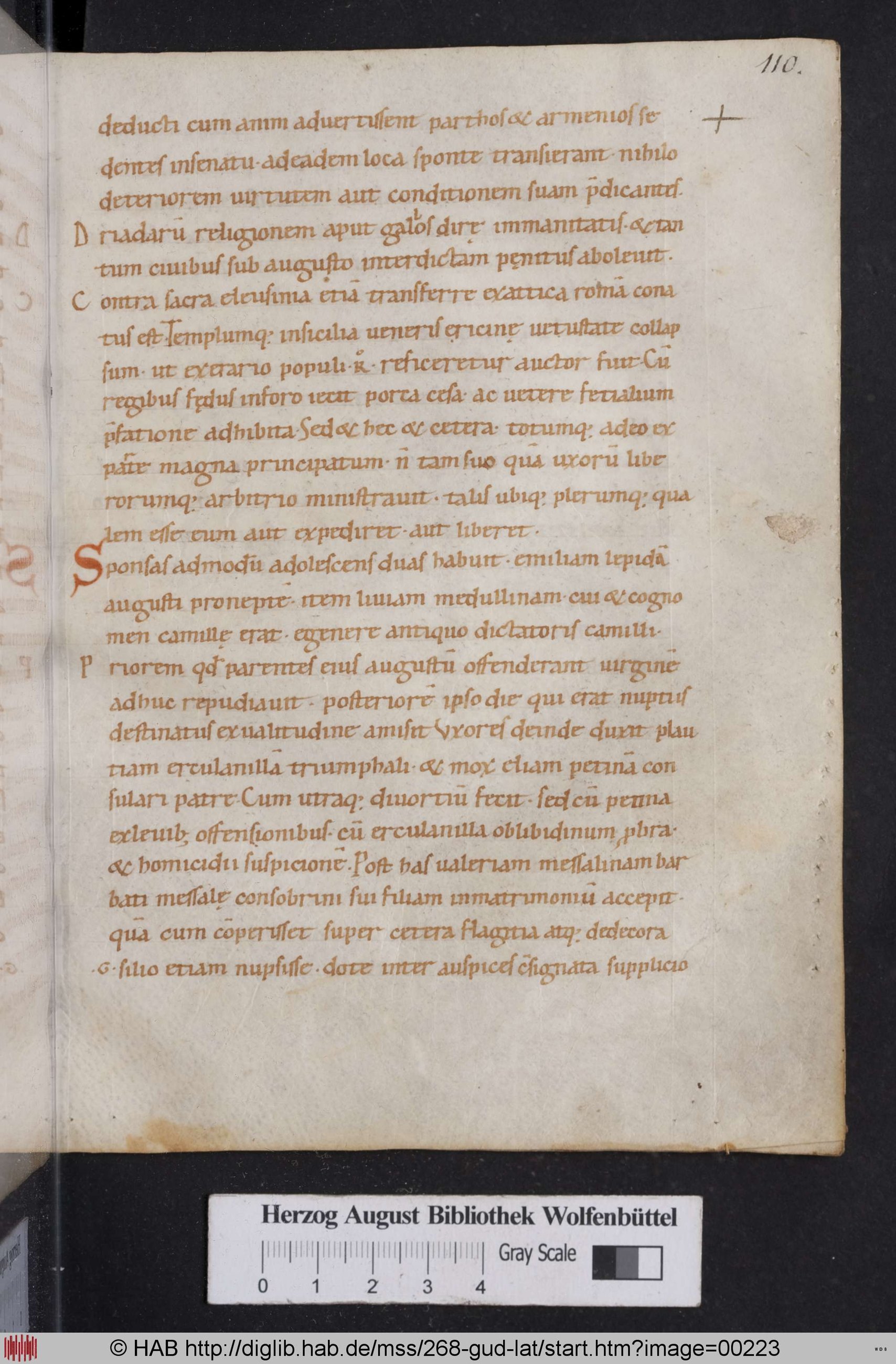
Where on the image
Checked on the images: fol. 109v line 23 ends 'immunes p(rae)stitis-' (end of 25.3), line 24 'sent · Iudeos impulsore chresto assidue tumultuantes roma', line 25 'expulit · Germanoru(m) legatis in orchestra sedere permisit', line 26 'simplicitate eoru(m) & fiducia commotus q(uo)d in popularia'; the sentence continues at the top of fol. 110r, line 1 'deducti cum animaduertissent parthos & armenios se-', and 25.4 ends on line 3 'p(rae)dicantes', before 25.5 'Druidarum religionem'. The page spells 'chresto', as Ihm prints. A later reader drew a mark and a cross in the left margin beside lines 24-26. Latin shown is Ihm's critical text, not a transcription of this page.
Iudaeos impulsore Chresto assidue tumultuantis Roma expulit. Germanorum legatis in orchestra sedere permisit, simplicitate eorum et fiducia commotus, quod in popularia deducti, cum animaduertissent Parthos et Armenios sedentis in senatu, ad eadem loca sponte transierant, nihilo deteriorem uirtutem aut condicionem suam praedicantes.
Since the Jews constantly made disturbances at the instigation of Chrestus, he expelled them from Rome. He allowed the envoys of the Germans to sit in the orchestra, led by their naïve self-confidence; for when they had been taken to the seats occupied by the common people and saw the Parthian and Armenian envoys sitting with the senate, they moved of their own accord to the same part of the theatre, protesting that their merits and rank were no whit inferior.
Notes
- Latin is Maximilian Ihm's critical text (Teubner, 1908), not a transcription of the manuscript page; the manuscript also reads 'chresto'.
- English is J. C. Rolfe's Loeb translation (1914), made from his own Latin text, which agrees with Ihm here.
Cite
Sources
- Source: Wolfenbuettel, HAB, Cod. Guelf. 268 Gud. lat., fol. 109v-110r (Wolfenbuetteler Digitale Bibliothek) + Ihm's Latin (Perseus) + Rolfe's English (LacusCurtius) (holding institution)
- Critical edition: Fisher 1906 (Tacitus) and Ihm 1908 (Suetonius), via Perseus
← previous · → next · v cycle view · l back to library