Tacitus, Annals 15.44: Nero, the fire of Rome and the Christians
Introduction
Cornelius Tacitus wrote the Annals, a history of Rome from the death of Augustus to the death of Nero, about 115-120 AD. In book 15, chapter 44, after describing the great fire of Rome in July 64 AD, he reports that Nero, unable to stop the rumor that he had ordered the fire, fixed the blame on the Christians and had many of them put to death. In the same passage Tacitus explains the name: "Christus" had been executed under Tiberius by the procurator Pontius Pilate. It is the earliest surviving statement by a Roman writer about the death of Jesus.
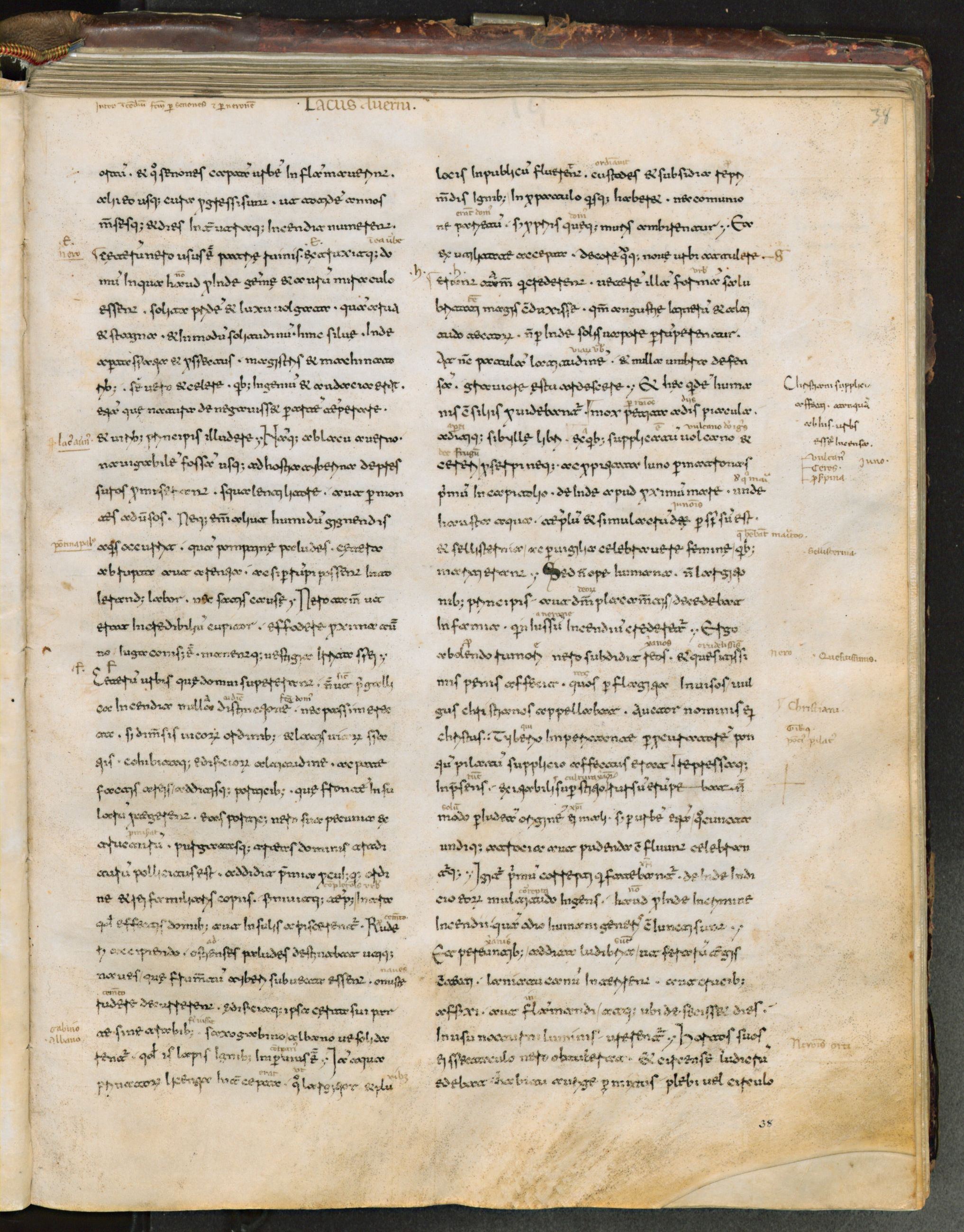
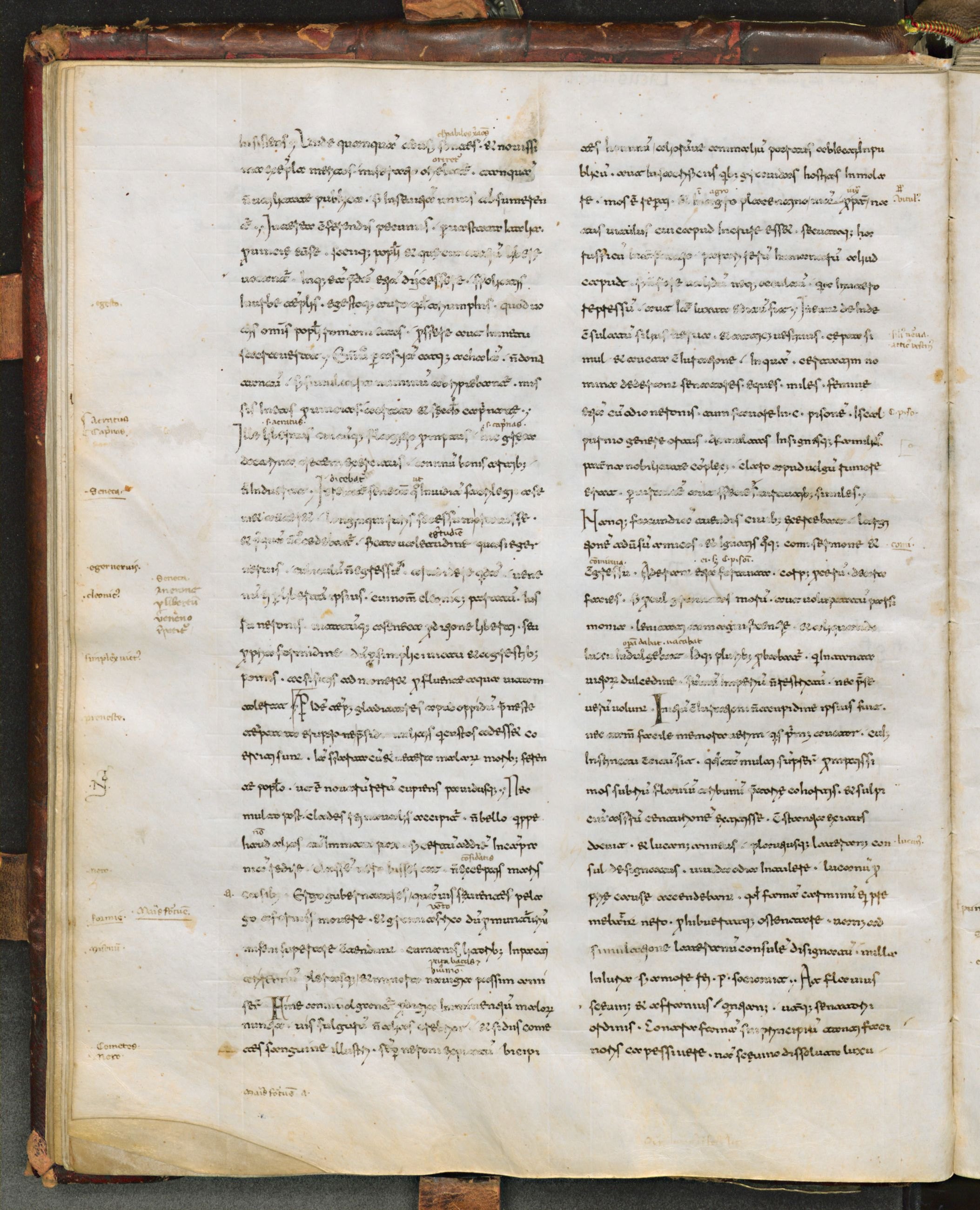
Books 11-16 of the Annals survive in a single independent manuscript, the "second Medicean" (Florence, Biblioteca Medicea Laurenziana, Plut. 68.2), written in Beneventan script in the 11th century, probably at Monte Cassino; the later manuscripts of these books are generally held to descend from it. The passage fills the right-hand column of folio 38r from line 9 to the end (line 35) and the first four lines of the left-hand column of folio 38v.
The chapter is shown in five parts, cut at sentence breaks; each part names the column and lines that carry it, checked on the photographs. On folio 38r, line 21, the word for the Christians is written "chri stianos", with a gap after "chri"; scholars who have examined the manuscript report that the i is a correction of an original e, so that the copyist first wrote "Chrestianos".
How was this verified? (Provenance)
Where on the image
Checked on the image: fol. 38r, right-hand column (col. b), line 9 ends 'Et hec q(ui)de(m) huma-' and line 10 begins 'nis consiliis p(ro)uidebant(ur)'; this part ends on line 16 with 'mariti erant'. Marginal glosses beside it name Vulcan, Ceres, Proserpina and Juno. Latin shown is Fisher's 1906 critical text, not a transcription of this page; the copyist's spelling and a few words differ.
Et haec quidem humanis consiliis providebantur. mox petita dis piacula aditique Sibyllae libri, ex quibus supplicatum Vulcano et Cereri Proserpinaeque ac propitiata Iuno per matronas, primum in Capitolio, deinde apud proximum mare, unde hausta aqua templum et simulacrum deae perspersum est; et sellisternia ac pervigilia celebravere feminae quibus mariti erant.
Such indeed were the precautions of human wisdom. The next thing was to seek means of propitiating the gods, and recourse was had to the Sibylline books, by the direction of which prayers were offered to Vulcanus, Ceres, and Proserpina. Juno, too, was entreated by the matrons, first, in the Capitol, then on the nearest part of the coast, whence water was procured to sprinkle the fane and image of the goddess. And there were sacred banquets and nightly vigils celebrated by married women.
Where on the image
Checked on the image: fol. 38r col. b line 16 'Sed n(on) ope humana', line 18 ends 'Ergo', line 19 'abolendo rumori nero subdidit reos', line 21 'gus chri stianos appellabat', written with a gap after 'chri'. Scholars who have examined the manuscript since G. Andresen (1902) report that the i here is a correction of an original e ('Chrestianos'). A later hand wrote 'Christiani' in the right margin. Latin shown is Fisher's 1906 critical text, not a transcription of this page; the copyist's spelling and a few words differ.
sed non ope humana, non largitionibus principis aut deum placamentis decedebat infamia quin iussum incendium crederetur. ergo abolendo rumori Nero subdidit reos et quaesitissimis poenis adfecit quos per flagitia invisos vulgus Christianos appellabat.
But all human efforts, all the lavish gifts of the emperor, and the propitiations of the gods, did not banish the sinister belief that the conflagration was the result of an order. Consequently, to get rid of the report, Nero fastened the guilt and inflicted the most exquisite tortures on a class hated for their abominations, called Christians by the populace.
Where on the image
Checked on the image: fol. 38r col. b line 21 ends 'auctor nominis ei(us)', line 22 'christus · Tyberio imperitante p(er) procuratore(m) pon-', line 23 'tiu(m) pilatu(m) supplicio adfectus erat', line 27 begins 'turq;' (end of 'celebranturque'). Marginal notes beside lines 21-23 name Tiberius and Pilate. Latin shown is Fisher's 1906 critical text, not a transcription of this page; the copyist's spelling and a few words differ.
auctor nominis eius Christus Tiberio imperitante per procuratorem Pontium Pilatum supplicio adfectus erat; repressaque in praesens exitiabilis superstitio rursum erumpebat, non modo per Iudaeam, originem eius mali, sed per urbem etiam quo cuncta undique atrocia aut pudenda confluunt celebranturque.
Christus, from whom the name had its origin, suffered the extreme penalty during the reign of Tiberius at the hands of one of our procurators, Pontius Pilatus, and a most mischievous superstition, thus checked for the moment, again broke out not only in Judæa, the first source of the evil, but even in Rome, where all things hideous and shameful from every part of the world find their centre and become popular.
Where on the image
Checked on the image: fol. 38r col. b line 27 'Igit(ur) p(ri)mu(m) correpti q(ui) fatebant(ur)', line 29 ends 'coniuncti sunt' (the manuscript's reading where Fisher prints 'convicti'), line 33 begins 'in usu nocturni luminis urerentur'. Latin shown is Fisher's 1906 critical text, not a transcription of this page; the copyist's spelling and a few words differ.
igitur primum correpti qui fatebantur, deinde indicio eorum multitudo ingens haud proinde in crimine incendii quam odio humani generis convicti sunt. et pereuntibus addita ludibria, ut ferarum tergis contecti laniatu canum interirent, aut crucibus adfixi aut flammandi, atque ubi defecisset dies in usum nocturni luminis urerentur.
Accordingly, an arrest was first made of all who pleaded guilty; then, upon their information, an immense multitude was convicted, not so much of the crime of firing the city, as of hatred against mankind. Mockery of every sort was added to their deaths. Covered with the skins of beasts, they were torn by dogs and perished, or were nailed to crosses, or were doomed to the flames and burnt, to serve as a nightly illumination, when daylight had expired.
Where on the image
Checked on the images: this part straddles two pages. Fol. 38r col. b line 33 'Hortos suos', line 35 (last line) 'edebat habitu aurige p(er)mixtus plebi uel circulo'; it continues at the top of fol. 38v, left-hand column (col. a), line 1 'insistens · Unde quamquam aduersus sontes', and ends on line 4 'tur' (of 'absumerentur'), followed by 15.45 'Interea conferendis pecuniis'. Latin shown is Fisher's 1906 critical text, not a transcription of this page; the copyist's spelling and a few words differ.
hortos suos ei spectaculo Nero obtulerat et circense ludicrum edebat, habitu aurigae permixtus plebi vel curriculo insistens. unde quamquam adversus sontis et novissima exempla meritos miseratio oriebatur, tamquam non utilitate publica sed in saevitiam unius absumerentur.
Nero offered his gardens for the spectacle, and was exhibiting a show in the circus, while he mingled with the people in the dress of a charioteer or stood aloft on a car. Hence, even for criminals who deserved extreme and exemplary punishment, there arose a feeling of compassion; for it was not, as it seemed, for the public good, but to glut one man’s cruelty, that they were being destroyed.
Notes
- Latin is C. D. Fisher's critical text (Oxford, 1906), which prints 'Christianos'; it is an edition, not a transcription of the manuscript page. Where the manuscript differs (for example 'coniuncti' for 'convicti', 'circulo' for 'curriculo'), the scan notes say so.
- English is the translation of A. J. Church and W. J. Brodribb (first published 1876), as digitized by the Perseus Project.
- The five parts are cut at the same sentences in the Latin and the English; nothing has been added or reworded.
Cite
Sources
- Source: Florence, Biblioteca Medicea Laurenziana, Plut. 68.2, fol. 38r-38v (Teca Digitale IIIF) + Fisher's Latin and Church and Brodribb's English (Perseus) (holding institution)
- Critical edition: Fisher 1906 (Tacitus) and Ihm 1908 (Suetonius), via Perseus
← previous · → next · v cycle view · l back to library