Philo of Byblos on Taautus, royal sacrifice and the serpent, with Eusebius' conclusion (Eusebius, Praeparatio evangelica 1.10.42-55)
Introduction
Philo of Byblos, a Phoenician grammarian writing in Greek around 100 AD, claimed to have translated the Phoenician History of Sanchuniathon of Berytus, a priestly writer said to have lived before the Trojan War, who drew on the city records and the temple inscriptions of Phoenicia and on the writings of Taautus (Thoth). Philo's work survives only in the long quotations that Eusebius of Caesarea copied into book 1 of his Preparation for the Gospel (c. 313 AD), taken partly through the philosopher Porphyry. It is the fullest account of Phoenician myth in Greek, and since the discovery of the Ugaritic tablets (14th-13th c. BCE) several of its gods and stories, such as El, Dagon, the succession of divine kings and the castration of the sky god, are known to go back to Bronze Age Canaan.
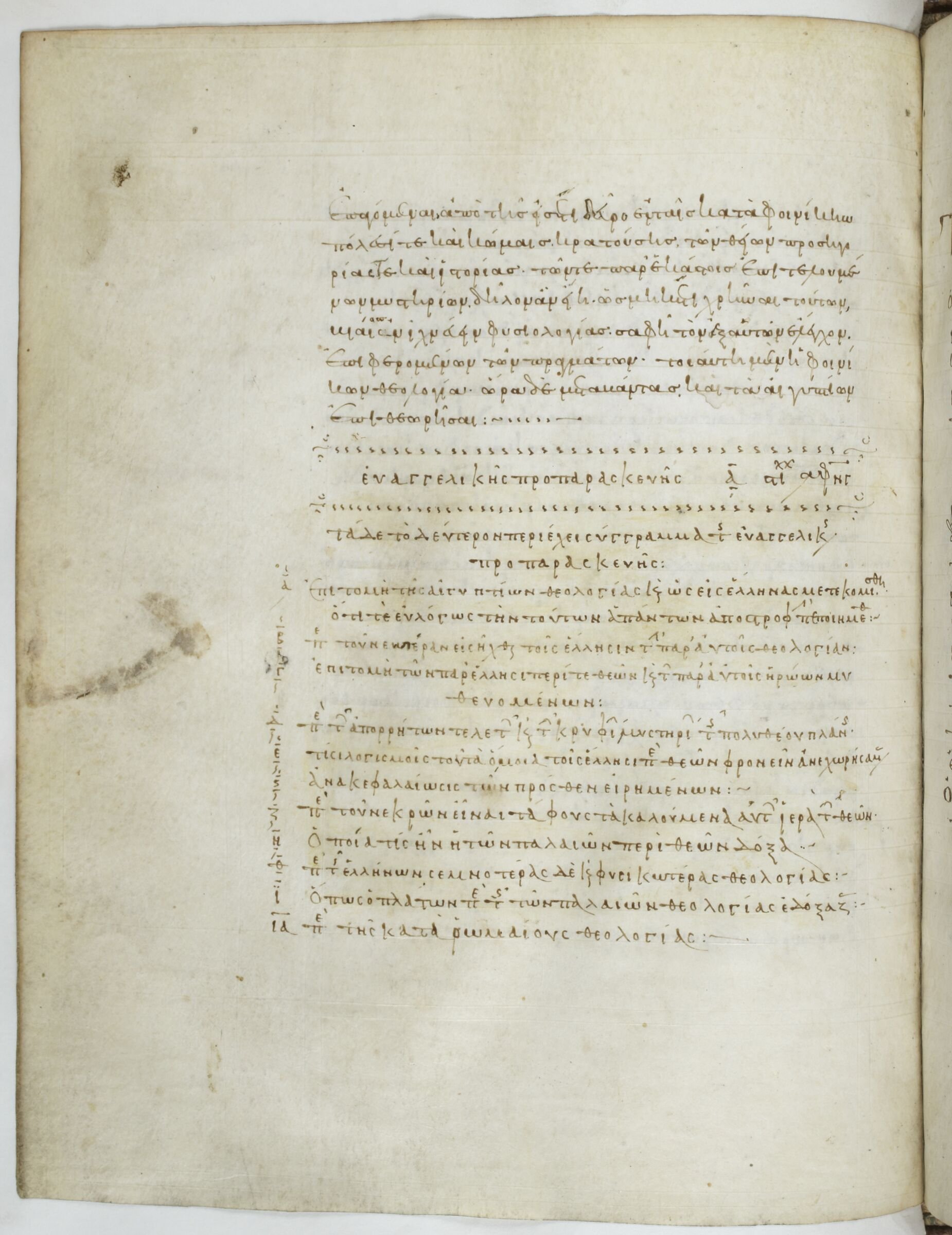
The manuscript shown is Paris, Bibliothèque nationale de France, grec 451, written in 914 AD by the scribe Baanes for Arethas, archbishop of Caesarea in Cappadocia; it is the oldest manuscript of books 1-5 of the Preparation. The passage runs from fol. 204v to fol. 213v. Each section is one of Dindorf's numbered sections and points at the page(s) that carry it; the page breaks were read on the images and are recorded in each note.
This entry covers sections 1.10.42 to 1.10.55, on fols. 211v to 213v.
How was this verified? (Provenance)
Where on the image
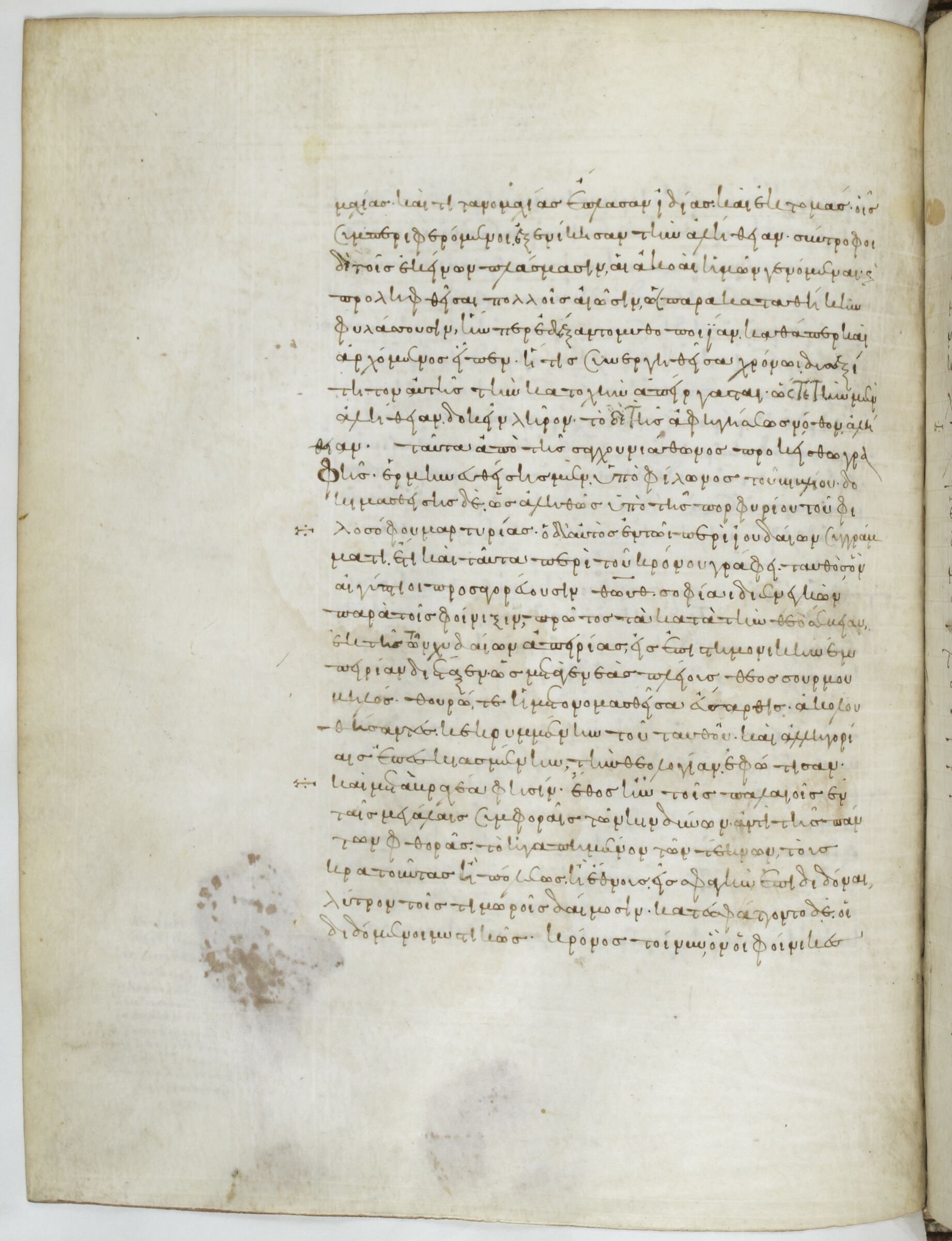
1.10.42 is on fol. 211v. Fol. 211v: begins '-μαχίας καὶ Τιτανομαχίας ἔπλασαν ἰδίας καὶ ἐκτομάς' (1.10.40) and ends in 1.10.44 '...κατεσφάττοντο δὲ οἱ διδόμενοι μυστικῶς. Κρόνος τοίνυν, ὃν οἱ Φοίνικες'. Checked on the image. Viewer: https://gallica.bnf.fr/ark:/12148/btv1b84701396/f428.item
10.42Ταῦτα ἀπὸ τῆς Σαγχουνιάθωνος προκείσθω γραφῆς, ἑρμηνευθείσης μὲν ὑπὸ Φίλωνος τοῦ Βυβλίου, δοκιμασθείσης δὲ ὡς ἀληθοῦς ὑπὸ τῆς Πορφυρίου τοῦ φιλοσόφου μαρτυρίας. ὁ δ’ αὐτὸς ἐν τῷ περὶ Ἰουδαίων συγγράμματι ἔτι καὶ ταῦτα περὶ τοῦ Κρόνου γράφει
10.42Let these suffice as quotations from the writings of Sanchuniathon, translated by Philo of Byblos, and approved as true by the testimony of Porphyry the philosopher. The same author, in his History of the Jews, further writes thus concerning Kronos:
Where on the image
1.10.43 is on fol. 211v. Fol. 211v: begins '-μαχίας καὶ Τιτανομαχίας ἔπλασαν ἰδίας καὶ ἐκτομάς' (1.10.40) and ends in 1.10.44 '...κατεσφάττοντο δὲ οἱ διδόμενοι μυστικῶς. Κρόνος τοίνυν, ὃν οἱ Φοίνικες'. Checked on the image. Viewer: https://gallica.bnf.fr/ark:/12148/btv1b84701396/f428.item
10.43“Ταυθὸς, ὃν Αἰγύπτιοι Θωὺθ προσαγορεύουσι, σοφίᾳ διενεγκὼν παρὰ τοῖς Φοίνιξι, πρῶτος τὰ κατὰ τὴν θεοσέβειαν ἐκ τῆς τῶν χυδαίων ἀπειρίας εἰς ἐπιστημονικὴν ἐμπειρίαν διέταξεν. ᾧ μετὰ γενεὰς πλείους θεὸς Σουρμουβηλὸς Θουρώ τε ἡ μετονομασθεῖσα Εὔσαρθις ἀκολουθήσαντες κεκρυμμένην τοῦ Ταυθοῦ καὶ ἀλληγορίαις ἐπεσκιασμένην τὴν θεολογίαν ἐφώτισαν.”
10.43'Tauthus, whom the Egyptians call Thöyth, excelled in wisdom among the Phoenicians, and was the first to rescue the worship of the gods from the ignorance of the vulgar, and arrange it in the order of intelligent experience. Many generations after him a god Sourmoubelos and Thuro, whose name was changed to Eusarthis, brought to light the theology of Tauthus which had been hidden and overshadowed, by allegories.'
Where on the image
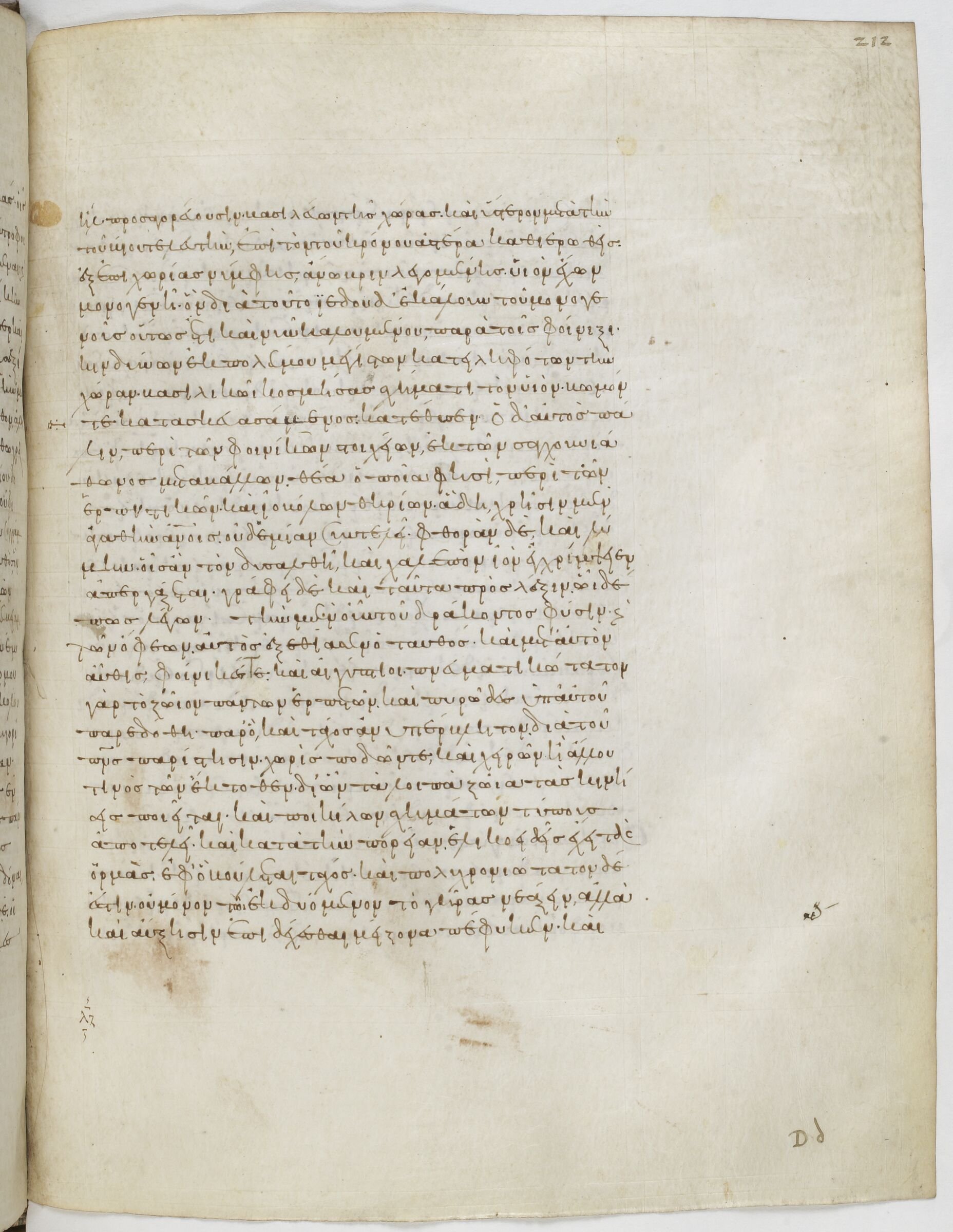
1.10.44 runs from fol. 211v to fol. 212r. Fol. 211v: begins '-μαχίας καὶ Τιτανομαχίας ἔπλασαν ἰδίας καὶ ἐκτομάς' (1.10.40) and ends in 1.10.44 '...κατεσφάττοντο δὲ οἱ διδόμενοι μυστικῶς. Κρόνος τοίνυν, ὃν οἱ Φοίνικες'. Fol. 212r: begins 'Ἦλον προσαγορεύουσι, βασιλεύων τῆς χώρας' (1.10.44) and ends in 1.10.47 '...ἀλλὰ καὶ αὔξησιν ἐπιδέχεσθαι μείζονα πέφυκε· καὶ'. Checked on the image. Viewer: https://gallica.bnf.fr/ark:/12148/btv1b84701396/f428.item
10.44Καὶ μετὰ βραχέα φησίν “Ἔθος ἦν τοῖς παλαιοῖς ἐν ταῖς μεγάλαις συμφοραῖς τῶν κινδύνων ἀντὶ τῆς πάντων φθορᾶς τὸ ἠγαπημένον τῶν τέκνων τοὺς κρατοῦντας ἢ πόλεως ἢ ἔθνους εἰς σφαγὴν ἐπιδιδόναι, λύτρον τοῖς τιμωροῖς δαίμοσι· κατεσφάττοντο δὲ οἱ διδόμενοι μυστικῶς. Κρόνος τοίνυν, ὃν οἱ Φοίνικες Ἦλον προσαγορεύουσι, βασιλεύων τῆς χώρας, καὶ ὕστερον μετὰ τὴν τοῦ βίου τελευτὴν εἰς τὸν τοῦ Κρόνου ἀστέρα καθιερωθεὶς, ἐξ ἐπιχωρίας νύμφης Ἀνωβρὲτ λεγομένης υἱὸν ἔχων μονογενῆ, (ὃν διὰ τοῦτο Ἰεδοὺδ ἐκάλουν, τοῦ μονογενοῦς οὕτως ἔτι καὶ νῦν καλουμένου παρὰ τοῖς Φοίνιξι) κινδύνων ἐκ πολέμου μεγίστων κατειληφότων τὴν χώραν, βασιλικῷ κοσμήσας σχήματι τὸν υἱὸν βωμόν τε κατασκευάσας ἄσμενος κατέθυσεν.”
10.44And soon after he says: 'It was a custom of the ancients in great crises of danger for the rulers of a city or nation, in order to avert the common ruin, to give up the most beloved of their children for sacrifice as a ransom to the avenging daemons; and those who were thus given up were sacrificed with mystic rites. Kronos then, whom the Phoenicians call Elus, who was king of the country and subsequently, after his decease, was deified as the star Saturn, had by a nymph of the country named Anobret an only begotten son, whom they on this account called Iedud, the only begotten being still so called among the Phoenicians; and when very great dangers from war had beset the country, he arrayed his son in royal apparel, and prepared an altar, and sacrificed him.'
Where on the image
1.10.45 is on fol. 212r. Fol. 212r: begins 'Ἦλον προσαγορεύουσι, βασιλεύων τῆς χώρας' (1.10.44) and ends in 1.10.47 '...ἀλλὰ καὶ αὔξησιν ἐπιδέχεσθαι μείζονα πέφυκε· καὶ'. Checked on the image. Viewer: https://gallica.bnf.fr/ark:/12148/btv1b84701396/f429.item
10.45Ὁ δ’ αὐτὸς πάλιν περὶ τῶν Φοινίκων στοιχείων ἐκ τῶν Σαγχουνιάθωνος μεταβαλὼν θέα ὁποῖά φησι περὶ τῶν ἑρπυστικῶν καὶ ἰοβόλων θηρίων, ἃ δὴ χρῆσιν μὲν ἀγαθὴν ἀνθρώποις οὐδεμίαν συντελεῖ, φθορὰν δὲ καὶ λύμην οἷς ἂν τὸν δυσαλθῆ καὶ χαλεπὸν ἰὸν ἐγχρίμψειεν ἀπεργάζεται. γράφει δὲ καὶ ταῦτα πρὸς λέξιν ὧδέ πως λέγων
10.45Again see what the same author, in his translation from Sanchuniathon about the Phoenician alphabet, says concerning the reptiles and venomous beasts, which contribute no good service to mankind, but work death and destruction to any in whom they inject their incurable and fatal poison. This also he describes, saying word for word as follows:
Where on the image
1.10.46 is on fol. 212r. Fol. 212r: begins 'Ἦλον προσαγορεύουσι, βασιλεύων τῆς χώρας' (1.10.44) and ends in 1.10.47 '...ἀλλὰ καὶ αὔξησιν ἐπιδέχεσθαι μείζονα πέφυκε· καὶ'. Checked on the image. Viewer: https://gallica.bnf.fr/ark:/12148/btv1b84701396/f429.item
10.46“Τὴν μὲν οὖν τοῦ δράκοντος φύσιν καὶ τῶν ὄφεων αὐτὸς ἐξεθείασεν ὁ Ταυθὸς, καὶ μετ’ αὐτὸν αὖθις Φοίνικές τε καὶ Αἰγύπτιοι· πνευματικώτατον γὰρ τὸ ζῷον πάντων τῶν ἑρπετῶν καὶ πυρῶδες ὑπ’ αὐτοῦ παρεδόθη· παρ’ ὃ καὶ τάχος ἀνυπέρβλητον διὰ τοῦ πνεύματος παρίστησι, χωρὶς ποδῶν τε καὶ χειρῶν ἢ ἄλλου τινὸς τῶν ἔκτοσθεν, δι’ ὧν τὰ λοιπὰ ζῷα τὰς κινήσεις ποιεῖται· καὶ ποικίλων σχημάτων τύπους ἀποτελεῖ, καὶ κατὰ τὴν πορείαν ἑλικοειδεῖς ἔχει τὰς ὁρμὰς ἐφ’ ὃ βούλεται τάχος.
10.46'The nature then of the dragon and of serpents Tauthus himself regarded as divine, and so again after him did the Phoenicians and Egyptians: for this animal was declared by him to be of all reptiles most full of breath, and fiery. In consequence of which it also exerts an unsurpassable swiftness by means of its breath, without feet and hands or any other of the external members by which the other animals make their movements. It also exhibits forms of various shapes, and in its progress makes spiral leaps as swift as it chooses.
Where on the image
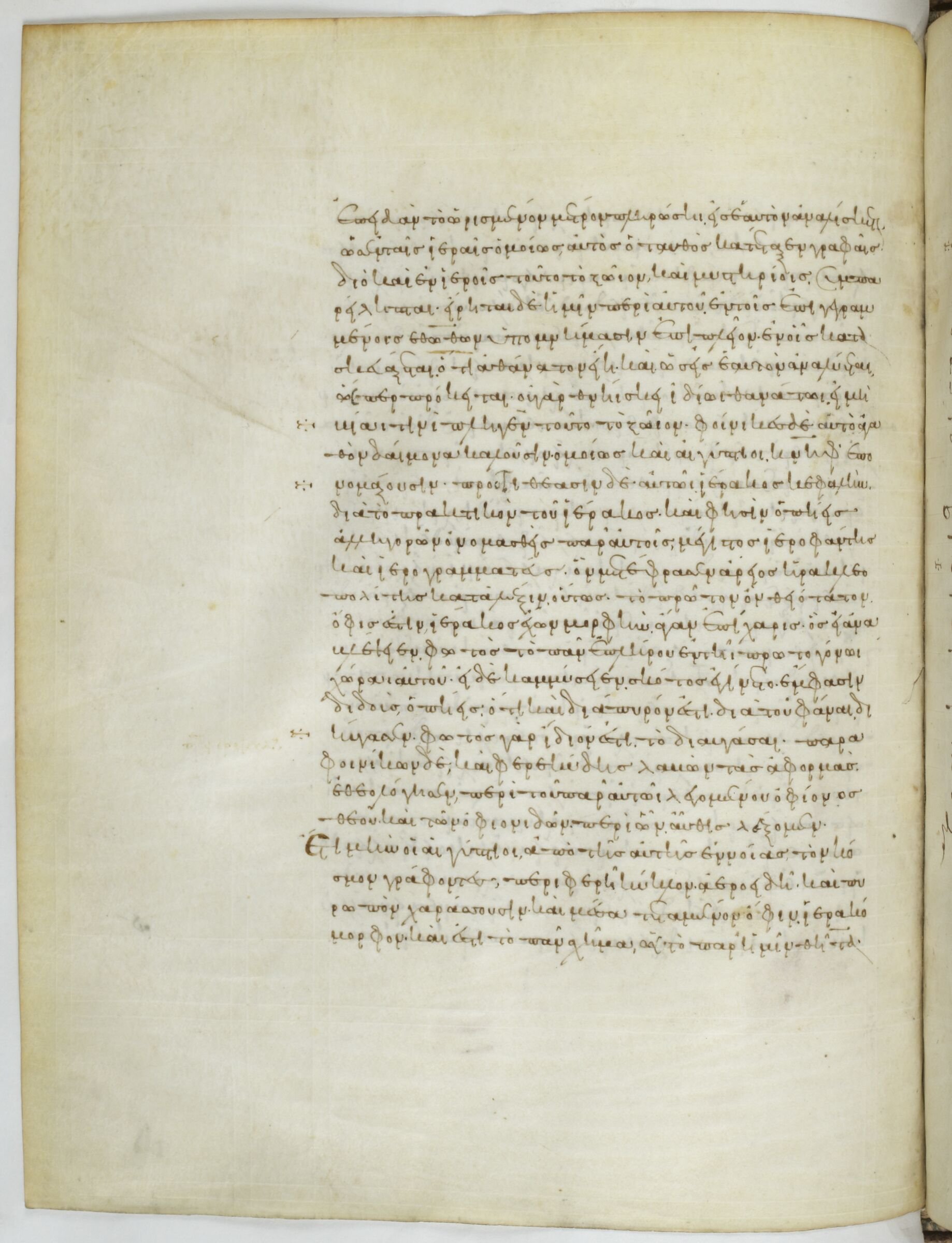
1.10.47 runs from fol. 212r to fol. 212v. Fol. 212r: begins 'Ἦλον προσαγορεύουσι, βασιλεύων τῆς χώρας' (1.10.44) and ends in 1.10.47 '...ἀλλὰ καὶ αὔξησιν ἐπιδέχεσθαι μείζονα πέφυκε· καὶ'. Fol. 212v: begins 'ἐπειδὰν τὸ ὡρισμένον μέτρον πληρώσῃ, εἰς ἑαυτὸν ἀναλίσκεται' (1.10.47) and ends in 1.10.51 '...καὶ ἔστι τὸ πᾶν σχῆμα ὡς τὸ παρ’ ἡμῖν θῆτα'. Checked on the image. Viewer: https://gallica.bnf.fr/ark:/12148/btv1b84701396/f429.item
10.47καὶ πολυχρονιώτατον δέ ἐστιν, οὐ μόνον τε ἐκδυόμενον τὸ γῆρας νεάζειν, ἀλλὰ καὶ αὔξησιν ἐπιδέχεσθαι μείζονα πέφυκε· καὶ ἐπειδὰν τὸ ὡρισμένον μέτρον πληρώσῃ, εἰς ἑαυτὸν ἀναλίσκεται, ὡς ἐν ταῖς ἱεραῖς ὁμοίως αὐτὸς ὁ Ταυθὸς κατέταξε γραφαῖς. διὸ καὶ ἐν ἱεροῖς τοῦτο τὸ ζῷον καὶ ἐν μυστηρίοις συμπαρείληπται.
10.47It is also most long-lived, and its nature is to put off its old skin, and so not only to grow young again, but also to assume a larger growth; and after it has fulfilled its appointed measure of age, it is self-consumed, in like manner as Tauthus himself has set down in his sacred books: for which reason this animal has also been adopted in temples and in mystic rites.
Where on the image
1.10.48 is on fol. 212v. Fol. 212v: begins 'ἐπειδὰν τὸ ὡρισμένον μέτρον πληρώσῃ, εἰς ἑαυτὸν ἀναλίσκεται' (1.10.47) and ends in 1.10.51 '...καὶ ἔστι τὸ πᾶν σχῆμα ὡς τὸ παρ’ ἡμῖν θῆτα'. Checked on the image. Viewer: https://gallica.bnf.fr/ark:/12148/btv1b84701396/f430.item
10.48εἴρηται δὲ ἡμῖν περὶ αὐτοῦ ἐν τοῖς ἐπιγραφομένοις Ἐθωθιῶν ὑπομνήμασιν ἐπὶ πλέον· ἐν οἷς κατασκευάζεται ὅτι ἀθάνατον εἴη, καὶ ὡς εἰς ἑαυτὸν ἀναλύεται, ὥσπερ πρόκειται· οὐ γὰρ θνήσκει ἰδίῳ θανάτῳ, εἰ μὴ βίᾳ τινὶ πληγὲν, τοῦτο τὸ ζῷον. Φοίνικες δὲ αὐτὸ ἀγαθὸν δαίμονα καλοῦσιν· ὁμοίως καὶ Αἰγύπτιοι κνὴφ ἐπονομάζουσι· προστιθέασι δὲ αὐτῷ ἱέρακος κεφαλὴν, διὰ τὸ πρακτικὸν τοῦ ἱέρακος.
10.48'We have spoken more fully about it in the memoirs entitled Ethothiae, in which we prove that it is immortal, and is self-consumed, as is stated before: for this animal does not die by a natural death, but only if struck by a violent blow. The Phoenicians call it "Good Daemon": in like manner the Egyptians also surname it Cneph; and they add to it the head of a hawk because of the hawk's activity.
Where on the image
1.10.49 is on fol. 212v. Fol. 212v: begins 'ἐπειδὰν τὸ ὡρισμένον μέτρον πληρώσῃ, εἰς ἑαυτὸν ἀναλίσκεται' (1.10.47) and ends in 1.10.51 '...καὶ ἔστι τὸ πᾶν σχῆμα ὡς τὸ παρ’ ἡμῖν θῆτα'. Checked on the image. Viewer: https://gallica.bnf.fr/ark:/12148/btv1b84701396/f430.item
10.49καί φησιν ὁ Ἐπήεις ἀλληγορῶν, (ὁ ὀνομασθεὶς παρ’ αὐτοῖς μέγιστος ἱεροφάντης καὶ ἱερογραμματεὺς, ὃν μετέφρασεν Ἄρειος Ἡρακλεοπολίτης) κατὰ λέξιν οὕτως· ‘τὸ πρῶτον ὂν θειότατον ὄφις ἐστὶν ἱέρακος ἔχων μορφὴν, ἄγαν ἐπίχαρις· ὃς εἰ ἀναβλέψειε, φωτὸς τὸ πᾶν ἐπλήρου ἐν τῇ πρωτογόνῳ χώρᾳ αὐτοῦ· εἰ δὲ καμμύσειε, σκότος ἐγίνετο,’
10.49'Epeïs also (who is called among them a chief hierophant and sacred scribe, and whose work was translated [into Greek] by Areius of Heracleopolis), speaks in an allegory word for word as follows: 'The first and most divine being is a serpent with the form of a hawk, extremely graceful, which whenever he opened his eyes filled all with light in his original birthplace, but if he shut his eyes, darkness came on.'
Where on the image
1.10.50 is on fol. 212v. Fol. 212v: begins 'ἐπειδὰν τὸ ὡρισμένον μέτρον πληρώσῃ, εἰς ἑαυτὸν ἀναλίσκεται' (1.10.47) and ends in 1.10.51 '...καὶ ἔστι τὸ πᾶν σχῆμα ὡς τὸ παρ’ ἡμῖν θῆτα'. Checked on the image. Viewer: https://gallica.bnf.fr/ark:/12148/btv1b84701396/f430.item
10.50ἔμφασιν διδοὺς ὁ Ἐπήεις ὅτι καὶ διάπυρόν ἐστι διὰ τοῦ φάναι ‘διηύγασε’· φωτὸς γὰρ ἴδιόν ἐστι τὸ διαυγάσαι. παρὰ Φοινίκων δὲ καὶ Φερεκύδης λαβὼν τὰς ἀφορμὰς ἐθεολόγησε περὶ τοῦ παρ’ αὐτῷ λεγομένου Ὀφίονος θεοῦ καὶ τῶν Ὀφιονιδῶν, περὶ ὧν αὖθις λέξομεν.
10.50'Epeïs here intimates that he is also of a fiery substance, by saying "he shone through," for to shine through is peculiar to light. From the Phoenicians Pherecydes also took the first ideas of his theology concerning the god called by him Ophion and concerning the Ophionidae, of whom we shall speak again.
Where on the image
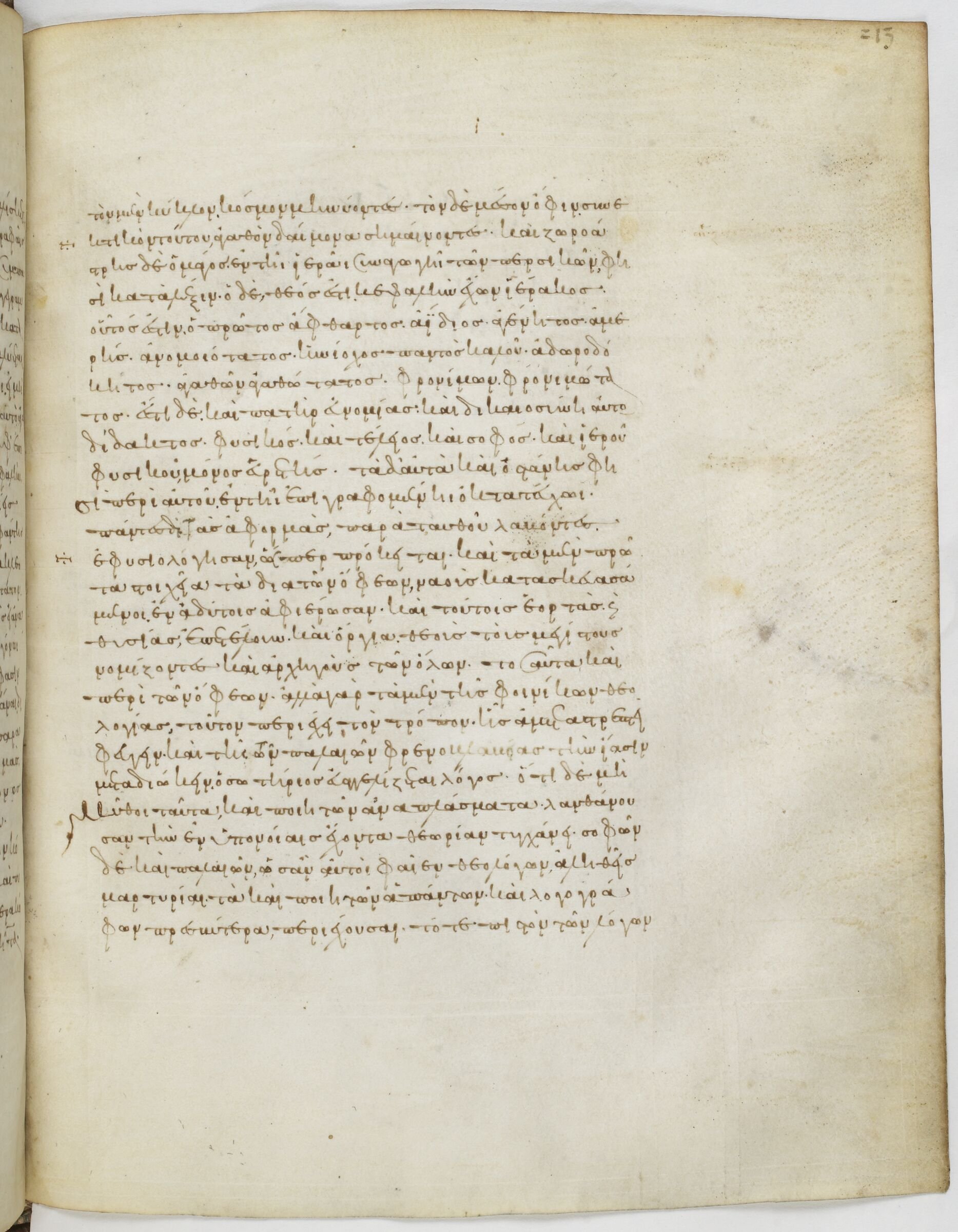
1.10.51 runs from fol. 212v to fol. 213r. Fol. 212v: begins 'ἐπειδὰν τὸ ὡρισμένον μέτρον πληρώσῃ, εἰς ἑαυτὸν ἀναλίσκεται' (1.10.47) and ends in 1.10.51 '...καὶ ἔστι τὸ πᾶν σχῆμα ὡς τὸ παρ’ ἡμῖν θῆτα'. Fol. 213r: begins 'τὸν μὲν κύκλον κόσμον μηνύοντες' (1.10.51); 1.10.52 'καὶ Ζωροάστρης δὲ ὁ μάγος' (line 2, marked ÷); 1.10.53 'πάντες δὲ τὰς ἀφορμὰς παρὰ Ταυθοῦ λαβόντες' (line 12, marked ÷ at line 13); 1.10.54 'ἀλλὰ γὰρ τὰ μὲν τῆς Φοινίκων θεολογίας' (line 18); 1.10.55 'ὅτι δὲ μὴ' at the end of line 21, with a large marginal sign at 'μῦθοι ταῦτα'; the page ends '...τό τε πιστὸν τῶν λόγων'. Checked on the image. Viewer: https://gallica.bnf.fr/ark:/12148/btv1b84701396/f430.item
10.51ἔτι μὴν οἱ Αἰγύπτιοι ἀπὸ τῆς αὐτῆς ἐννοίας τὸν κόσμον γράφοντες περιφερῆ κύκλον ἀεροειδῆ καὶ πυρωπὸν χαράσσουσι, καὶ μέσα τεταμένον ὄφιν ἱερακόμορφον· καὶ ἔστι τὸ πᾶν σχῆμα ὡς τὸ παρ’ ἡμῖν θῆτα· τὸν μὲν κύκλον κόσμον μηνύοντες, τὸν δὲ μέσον ὄφιν συνεκτικὸν τούτου ἀγαθὸν δαίμονα σημαίνοντες.
10.51'Moreover the Egyptians, describing the world from the same idea, engrave the circumference of a circle, of the colour of the sky and of fire, and a hawk-shaped serpent stretched across the middle of it, and the whole shape is like our Theta (θ), representing the circle as the world, and signifying by the serpent which connects it in the middle the good daemon.
Where on the image
1.10.52 is on fol. 213r. Fol. 213r: begins 'τὸν μὲν κύκλον κόσμον μηνύοντες' (1.10.51); 1.10.52 'καὶ Ζωροάστρης δὲ ὁ μάγος' (line 2, marked ÷); 1.10.53 'πάντες δὲ τὰς ἀφορμὰς παρὰ Ταυθοῦ λαβόντες' (line 12, marked ÷ at line 13); 1.10.54 'ἀλλὰ γὰρ τὰ μὲν τῆς Φοινίκων θεολογίας' (line 18); 1.10.55 'ὅτι δὲ μὴ' at the end of line 21, with a large marginal sign at 'μῦθοι ταῦτα'; the page ends '...τό τε πιστὸν τῶν λόγων'. Checked on the image. Viewer: https://gallica.bnf.fr/ark:/12148/btv1b84701396/f431.item
10.52καὶ Ζωροάστρης δὲ ὁ μάγος ἐν τῇ ἱερᾷ συναγωγῇ τῶν Περσικῶν φησι κατὰ λέξιν ‘ὁ δὲ θεός ἐστι κεφαλὴν ἔχων ἱέρακος. οὗτός ἐστιν ὁ πρῶτος ἄφθαρτος, ἀΐδιος, ἀγένητος, ἀμερὴς, ἀνομοιότατος, ἡνίοχος παντὸς καλοῦ, ἀδωροδόκητος, ἀγαθῶν ἀγαθώτατος, φρονίμων φρονιμώτατος· ἔστι δὲ καὶ πατὴρ εὐνομίας καὶ δικαιοσύνης, αὐτοδίδακτος, φυσικὸς, καὶ τέλειος, καὶ σοφὸς, καὶ ἱεροῦ φυσικοῦ μόνος εὑρετής.’ τὰ δ’ αὐτὰ καὶ Ὀστάνης φησὶ περὶ αὐτοῦ ἐν τῇ ἐπιγραφομένῃ Ὀκτατεύχῳ.”
10.52'Zoroaster also the Magian, in the Sacred Collection of Persian Records, says in express words: "And god has the head of a hawk. He is the first, incorruptible, eternal, uncreate, without parts, most unlike (all else), the controller of all good, who cannot be bribed, the best of all the good, the wisest of all wise; and he is also a father of good laws and justice, self-taught, natural, and perfect, and wise, and the sole author of the sacred power of nature. 'The same also is said of him by Ostanes in the book entitled Octateuch.'
Where on the image
1.10.53 is on fol. 213r. Fol. 213r: begins 'τὸν μὲν κύκλον κόσμον μηνύοντες' (1.10.51); 1.10.52 'καὶ Ζωροάστρης δὲ ὁ μάγος' (line 2, marked ÷); 1.10.53 'πάντες δὲ τὰς ἀφορμὰς παρὰ Ταυθοῦ λαβόντες' (line 12, marked ÷ at line 13); 1.10.54 'ἀλλὰ γὰρ τὰ μὲν τῆς Φοινίκων θεολογίας' (line 18); 1.10.55 'ὅτι δὲ μὴ' at the end of line 21, with a large marginal sign at 'μῦθοι ταῦτα'; the page ends '...τό τε πιστὸν τῶν λόγων'. Checked on the image. Viewer: https://gallica.bnf.fr/ark:/12148/btv1b84701396/f431.item
10.53Πάντες δὲ τὰς ἀφορμὰς παρὰ Ταυθοῦ λαβόντες ἐφυσιολόγησαν, ὥσπερ πρόκειται. καὶ τὰ μὲν πρῶτα στοιχεῖα τὰ διὰ τῶν ὄφεων ναοὺς κατασκευασάμενοι ἐν ἀδύτοις ἀφιέρωσαν, καὶ τούτοις ἑορτὰς καὶ θυσίας ἐπετέλουν καὶ ὄργια, θεοὺς τοὺς μεγίστους νομίζοντες καὶ ἀρχηγοὺς τῶν ὅλων. τοσαῦτα καὶ περὶ τῶν ὄφεων.
10.53From Tauthus, as is said above, all received their impulse towards physiological systems: and having built temples they consecrated in the shrines the primary elements represented by serpents, and in their honour celebrated festivals, and sacrifices, and mystic rites, regarding them as the greatest gods, and rulers of the universe. So much concerning serpents.
Where on the image
1.10.54 is on fol. 213r. Fol. 213r: begins 'τὸν μὲν κύκλον κόσμον μηνύοντες' (1.10.51); 1.10.52 'καὶ Ζωροάστρης δὲ ὁ μάγος' (line 2, marked ÷); 1.10.53 'πάντες δὲ τὰς ἀφορμὰς παρὰ Ταυθοῦ λαβόντες' (line 12, marked ÷ at line 13); 1.10.54 'ἀλλὰ γὰρ τὰ μὲν τῆς Φοινίκων θεολογίας' (line 18); 1.10.55 'ὅτι δὲ μὴ' at the end of line 21, with a large marginal sign at 'μῦθοι ταῦτα'; the page ends '...τό τε πιστὸν τῶν λόγων'. Checked on the image. Viewer: https://gallica.bnf.fr/ark:/12148/btv1b84701396/f431.item
10.54Ἀλλὰ γὰρ τὰ μὲν τῆς Φοινίκων θεολογίας τοῦτον περιέχει τὸν τρόπον· ἣν ἀμεταστρεπτὶ φεύγειν καὶ τῆς τῶν παλαιῶν φρενοβλαβείας τὴν ἴασιν μεταδιώκειν ὁ σωτήριος εὐαγγελίζεται λόγος.
10.54Such then is the character of the theology of the Phoenicians, from which the word of salvation in the gospel teaches us to flee with averted eyes, and earnestly to seek the remedy for this madness of the ancients.
Where on the image
1.10.55 runs from fol. 213r to fol. 213v. Fol. 213r: begins 'τὸν μὲν κύκλον κόσμον μηνύοντες' (1.10.51); 1.10.52 'καὶ Ζωροάστρης δὲ ὁ μάγος' (line 2, marked ÷); 1.10.53 'πάντες δὲ τὰς ἀφορμὰς παρὰ Ταυθοῦ λαβόντες' (line 12, marked ÷ at line 13); 1.10.54 'ἀλλὰ γὰρ τὰ μὲν τῆς Φοινίκων θεολογίας' (line 18); 1.10.55 'ὅτι δὲ μὴ' at the end of line 21, with a large marginal sign at 'μῦθοι ταῦτα'; the page ends '...τό τε πιστὸν τῶν λόγων'. Fol. 213v: begins 'ἐπαγόμεναι ἀπὸ τῆς εἰσέτι δεῦρο ἐν ταῖς κατὰ Φοινίκην πόλεσι' (1.10.55); book 1 ends on line 8 'ἐπιθεωρῆσαι' and is followed by the subscription and the list of chapters of book 2. Checked on the image. Viewer: https://gallica.bnf.fr/ark:/12148/btv1b84701396/f431.item
10.55ὅτι δὲ μὴ μῦθοι ταῦτα καὶ ποιητῶν ἀναπλάσματα λανθάνουσάν τινα ἐν ὑπονοίαις ἔχοντα θεωρίαν τυγχάνει, σοφῶν δὲ καὶ παλαιῶν, ὡς ἂν αὐτοὶ φαῖεν, θεολόγων ἀληθεῖς μαρτυρίαι, τὰ καὶ ποιητῶν ἁπάντων καὶ λογογράφων πρεσβύτερα περιέχουσαι, τό τε πιστὸν τῶν λόγων ἐπαγόμεναι ἀπὸ τῆς εἰσέτι δεῦρο ἐν ταῖς κατὰ Φοινίκην πόλεσί τε καὶ κώμαις κρατούσης τῶν θεῶν προσηγορίας τε καὶ ἱστορίας, τῶν τε παρ’ ἑκάστοις ἐπιτελουμένων μυστηρίων, δῆλον ἂν εἴη, ὡς μηκέτι χρῆναι τούτων βιαίους ἀνιχνεύειν φυσιολογίας, σαφῆ τὸν ἐξ αὐτῶν ἔλεγχον ἐπιφερομένων τῶν πραγμάτων. τοιαύτη μὲν οὖν ἡ Φοινίκων θεολογία· ὥρα δὲ μεταβάντας καὶ τὰ Αἰγυπτίων ἐπιθεωρῆσαι.
10.55It must be manifest that these are not fables and poets' fictions containing some theory concealed in hidden meanings, but true testimonies, as they would themselves say, of wise and ancient theologians, containing things of earlier date than all poets and historians, and deriving the credibility of their statements from the names and history of the gods still prevailing in the cities and villages of Phoenicia, and from the mysteries celebrated among each people: so that it is no longer necessary to search out violent physical explanations of these things, since the evidence which the facts bring with them of themselves is quite clear. Such then is the theology of the Phoenicians: but it is now time to pass on and examine carefully the case of the Egyptians.
Notes
- Greek: W. Dindorf's Teubner edition (1867), from the First1KGreek digital text, proofread against the printed pages. The manuscript's wording differs from the edition in small details; the Greek shown is the edition, not a transcription of the page.
- English: E. H. Gifford's translation (Oxford, 1903). Where a Greek section begins in the middle of an English sentence, the English is divided at the corresponding clause.
- Asterisks mark a gap that Dindorf indicates in the Greek of 1.10.36; Gifford marks it with dots.
Cite
Sources
- Source: Paris gr. 451 (Arethas codex, 914 AD) via Gallica + Dindorf Greek (First1KGreek, proofread) + Gifford English (1903) (holding institution)
- Critical edition: W. Dindorf, Eusebii Caesariensis opera I (Teubner 1867), First1KGreek, proofread
← previous · → next · v cycle view · l back to library